
13 Fun and Effective Ways to Teach Coin Counting in 2nd Grade
Do your students have difficulty counting money? Coin counting is an important part of solidifying early math skills, but it can be tricky for children to master.
Teaching your second-grade students the basics of coin counting is an effective way to ensure they understand and retain the concept. With a bit of patience and practice, your students can become skilled at coin counting.

Why Teaching Coin Counting Is Harder Than Ever
Remember when you’d dig through the couch cushions for coins to buy candy at the corner store? Today’s kids don’t get that same experience. With credit cards, digital wallets, and tap-to-pay everywhere, many second-grade students have never handled actual coins—let alone counted them.
That makes teaching money skills more challenging than ever.
In fact, the Common Core math standard for money (2.MD.C.8) expects students to solve word problems with dollars, quarters, dimes, nickels, and pennies—with no prior formal instruction. For students with limited exposure to physical currency, this can be especially tough.
In this post, I’ll share 13 engaging strategies I’ve used with my own second-grade students, from hands-on coin games to running a class store that doubles as behavior management. Whether you’re just introducing coins or looking to deepen understanding, these tips will help your students master coin counting with confidence.
13 Engaging Strategies for Teaching Coin Counting in 2nd Grade
Learning to count coins is an essential math skill for second-grade students—but let’s be real: it can be tough for little learners who rarely see actual coins these days. Whether you’re introducing money for the first time or reinforcing skills before state testing, these 13 coin counting tips will make the process more fun, hands-on, and effective. Keep reading for practical strategies, photos, and examples straight from my classroom.
1. Share Personal Stories to Build Connection
Remember when your parents gave you a handful of coins and sent you off to the candy machine or corner store? Sharing personal stories like this helps students connect emotionally to a skill that can feel abstract. I like to start our money unit by telling a story about how I saved up change for something I really wanted—it opens up a conversation and helps students understand why money matters in everyday life.
2. Use Visual Aids to Identify Coins
Start by displaying large, clear images of coins on a bulletin board or anchor chart. Make sure to include both the heads and tails, as well as value labels and distinguishing features like size, color, and edge texture. These visuals give students consistent reference points throughout the unit and help them begin to mentally categorize each coin.
3. Get Hands-On with Real or Play Coins
You can talk about coins all day, but nothing replaces the learning that happens when students touch, sort, and count them. I use plastic coins for daily activities and reserve real coins for small group instruction. Encourage students to sort coins by value, size, or even by the smooth vs. ridged edges—this tactile experience cements their understanding in a way that worksheets alone can’t.
4. Play Coin Counting Games Like Bingo or Race to 100
Who doesn’t love a good game? Make learning fun by introducing games and puzzles that involve counting coins. This will not only boost their understanding but also create a positive association with learning. Play games that involve identifying and naming coins, such as “Coin Bingo” or “Coin Memory.” Race to 100 is another great game for this!
5. Practice Counting Coin Combinations
Start simple—counting by ones with pennies—and build up to combinations like two nickels and a dime. I scaffold this by giving each student a coin mat with visuals, and we count aloud as we build different totals. Repetition is key, so make it part of your morning work or small group routine.
6. Solve Word Problems with Real-Life Context
Integrate coin counting into your regular math word problems. Give students relatable scenarios like, “Maria found 2 quarters and a nickel in her backpack. How much money does she have?” This not only reinforces coin values but also strengthens their problem-solving skills.
7. Set Up a Pretend Store for Role-Play Practice
Nothing motivates like shopping! Set up a pretend store in your classroom where students can use coins to “buy” pencils, stickers, or coupons for extra privileges. It’s an easy way to practice counting money and making change in a way that feels fun and meaningful. I like to rotate the store items monthly to keep the excitement alive.
8. Host a Mini Market Day to Explore Goods and Services
Take your store to the next level with a classroom marketplace. Students create their own products or services to “sell” and use coins to buy from each other. Not only does this practice coin counting, but it also ties beautifully into social studies standards on goods, services, and economics. It’s one of my favorite projects of the year!
9. Reinforce Skills with Targeted Worksheets
Worksheets can get a bad rap, but when they’re used intentionally, they reinforce key skills. I use worksheets that gradually increase in difficulty—from simple identification to counting mixed coin sets and solving word problems. They’re great for morning work, homework, or quick formative assessments.
10. Use Coin Counting Songs to Build Fluency
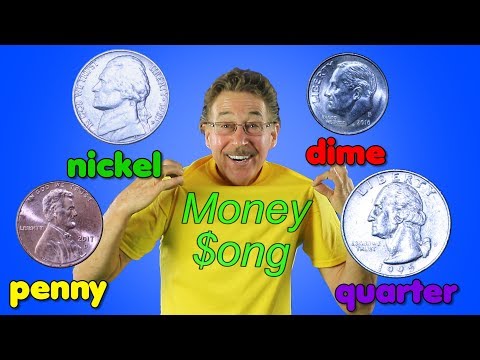
Music makes everything stick! I use songs and chants to help students memorize coin values and practice skip counting. YouTube is full of catchy tunes that teach counting by 5s and 10s using nickels, dimes, and quarters. I’ll even catch my students singing the songs during transitions—which tells me it’s working!
Here’s a fun one for second graders:
11. Integrate Online Games and Activities
There are so many free and low-cost digital tools for teaching coin counting. Websites like ABCya and Toy Theater offer games where students drag coins into piggy banks or solve coin puzzles. I like to use these in computer centers or as independent practice for early finishers.
12. Lead Group Discussions and Number Talks
Use number talks to discuss different ways to make the same amount using coins. Ask, “Who can make 25¢ in a different way?” and let students explain their thinking. These conversations not only build number sense but also deepen their understanding of equivalency and flexible thinking.
💬 15 Number Talks for Coin Counting
🪙 Coin Value Combinations
- “What are different ways to make 25¢?”
(Answers might include: 2 dimes and 1 nickel, 1 quarter, 5 nickels, etc.) - “How can you make 50¢ using only nickels and dimes?”
- “Which is worth more: 3 nickels or 1 dime and 1 penny?”
(Use this to explore reasoning and comparative thinking.) - “You have 2 quarters. What are all the different ways to make 50¢ using smaller coins?”
💵 Same Value, Different Coins
- “Can you make 36¢ in more than one way?”
(Encourages flexible thinking with combinations like 1 quarter + 1 dime + 1 penny or 3 dimes + 1 nickel + 1 penny.) - “Is there a way to make 45¢ without using any quarters?”
- “Show me a way to make $1.00 using exactly 6 coins.”
💡 Reasoning & Estimation
- “You have these coins: [show 1 dime, 2 nickels, 4 pennies]. Do you have enough to buy something that costs 21¢?”
(Let students reason without immediately calculating.) - “You have 3 coins. Could they add up to more than 50¢? Why or why not?”
- “I have 4 coins that add up to 40¢. What could they be?”
🔁 Skip Counting & Patterns
- “Let’s count by 5s until we reach 35¢. What coins could we use to get there?”
- “What’s the fastest way to count this set of coins?”
(Show a mix: e.g., 2 dimes, 1 nickel, 4 pennies. Look for counting strategy, not just answer.)
🤔 What’s Missing?
- “You want to buy something that costs 28¢. You have a quarter. What coin(s) do you need to make exact change?”
- “I have 17¢. I give you 2 dimes. How much change should you give back?”
- “I gave you 75¢, and your item cost 67¢. How could you give me change using as few coins as possible?”
13. Encourage Parent Involvement at Home
Learning doesn’t stop at the classroom door. Ask parents to help reinforce coin counting by giving their children change to count after a purchase or by playing simple games with spare coins. You can also send home a list of online games or songs students have enjoyed in class, so families can continue the fun and learning at home.

How to use a classroom money system for behavior management
Need more ideas for the end of the day? Check out these routines to make that day just a bit calmer.
How to Use a Classroom Store to Reinforce Money Skills
For a couple of years, I’ve had a class store. Here is how I have used it to teach money and coin counting.
Students Earning Coins Through Behavior Incentives
Students earn money for being on task, for instance, when they are at their desks working independently. Sometimes I will use it for participation, or whenever I want to reward individual students. I don’t use it for whole-class rewards.
I deliberately Price Items to Practice Coin Combinations
I open the store each Friday for students to buy things. I have both tangible things from Oriental Trading Co. and reward coupons that I purchased from TpT. I keep all the prices below $1, and I tend to raise prices throughout the year.
Inflation, y’all.
But seriously, raising prices helps me teach different coin combinations. We even go about $1 later in the year.
Here is how I taught second grade students to count coins throughout the year. The gist of it is:
- Using scaffolds, we sort coins and count them together as a whole class.
- We make change using a number line.
- I adjust the cost of goods to make the math more or less challenging
The key thing that made a difference is that we did this on a weekly basis for about 20-30 minutes each week.
Whole-Class Practice with iPad + Whiteboard
When we open the store, each student decides on what they want to buy and brings the money up to me. Our iPad has allowed us to sort and count our coins.
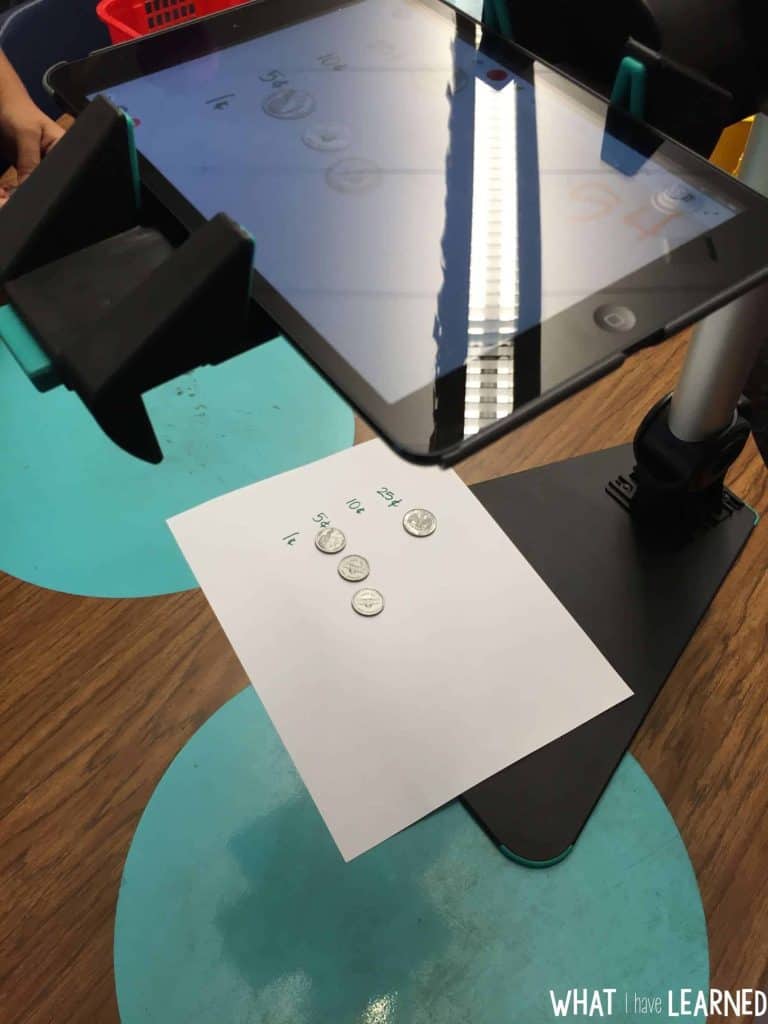
I have written the coin values on a piece of paper from greatest to least. Students sort their coins by value. We then count the coins starting at the highest value. We do this as a whole class so that everyone can practice counting coins.
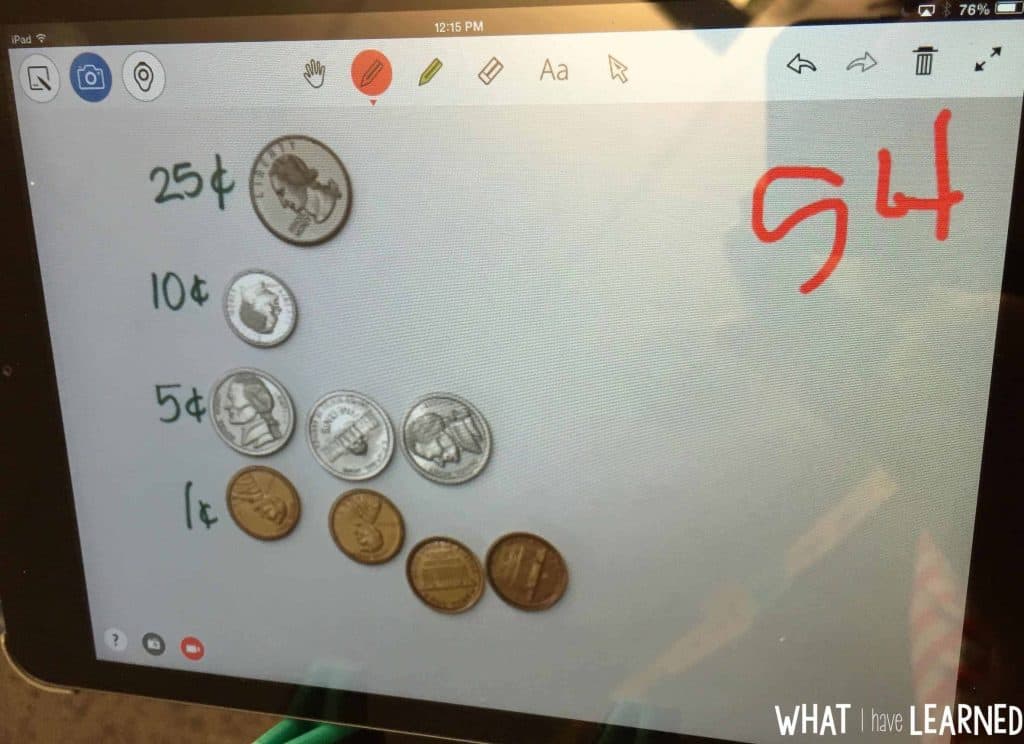
Using the iPad and iPEVO Whiteboard, I write the cost of the item the student wants. You probably have a similar setup in your classroom. As a class, we chorally count the coins to see if the student has enough money.
Making Change Using a Number Line
After a couple of weeks of coin counting, students have become pretty proficient at counting money. We move on to learning how to make change. I ask students the value of coins they will receive if the amount they give me is over the amount needed.
We use a number line to figure out the change, or the difference between what the students gave me and the cost of the item.


Above are a couple of examples of how we count money using number lines. For the second picture, the cost of the item was 19¢ and the student handed me 25¢.
Adjusting the Challenge as the Year Progresses
I tend to make the cost of the goods tricky, so most students will receive change. Price your items with a digit that ends in an 8 or a 9.
Removing Scaffolds for Independent Practice
Later in the year, I no longer counted the money with students and only used this sheet with individual students who needed a little extra practice.
Students get really excited about our Marketplace time, as we call it. The technology is perfect for having whole-class counting sequences with different amounts. The store and money also provide motivations for on-task behavior.
We only open the store on Fridays for about 30 minutes at the end of the day. The motivation, incentive, and small amount of weekly practice are enough for most students to have a working knowledge of coins, counting money, and finding the differences between amounts of coins.
Extend Learning with Seasonal & Hands-On Activities
In the Spring, we do formal instruction and practice with money. By the springtime, the class store has allowed most of my students to learn money concepts, in terms of counting money and giving change. Teaching our money unit goes much smoother, given the weekly practice throughout the year.
Money Task Cards
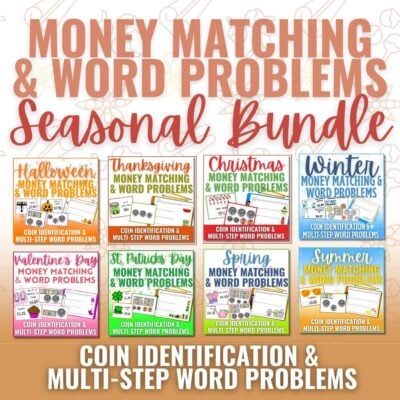
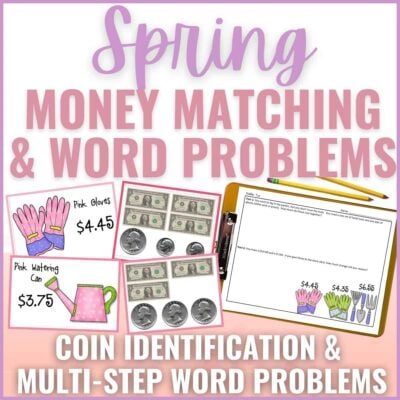
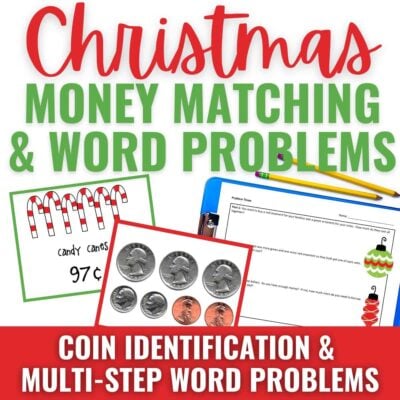
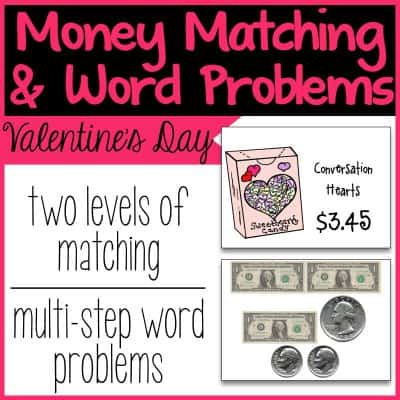
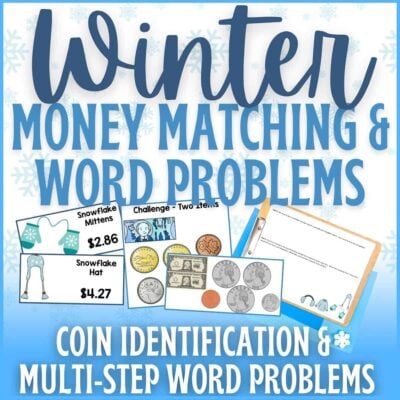
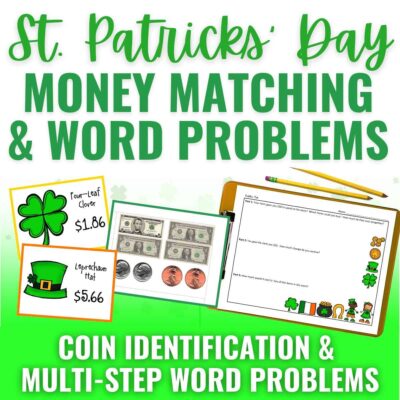
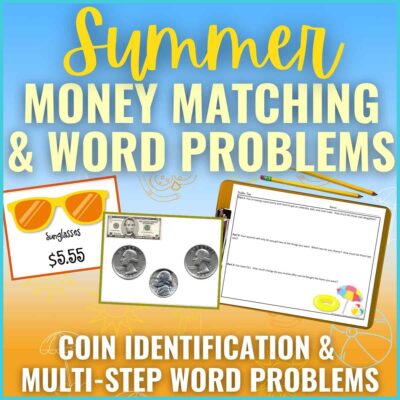
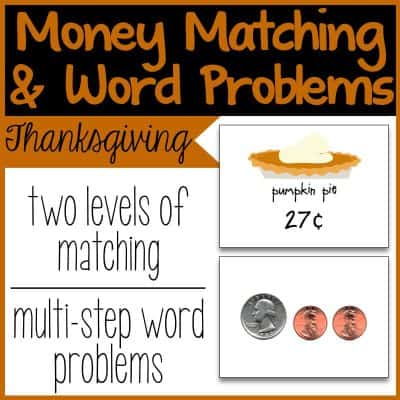
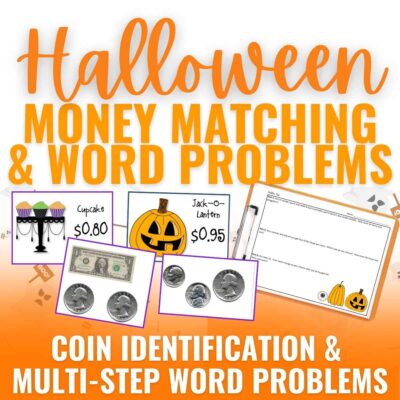
I do a few more activities as a whole class, including some Money Matching Task Cards and Problem Solving Sheets. The money-matching activities have a picture of an item with a price and another card with coins. Students match the item with the coins.
There are also a couple of challenge cards where students have two objects that they have to add together and a greater amount of coins and dollars.
Also included are multi-step word problems that focus on the monthly themed objects.
-
 Product on saleMoney Matching and Word Problems BUNDLEOriginal price was: $30.00.$22.39Current price is: $22.39.
 -
-
-
-
-
-
-
-
Seasonal Math Stations
I also have some money stations infused in my seasonal math stations that make the rounds during the spring. Seasonal math stations are available for Valentine’s Day, St. Patrick’s Day, Spring, and Summer.
Money Number Puzzles
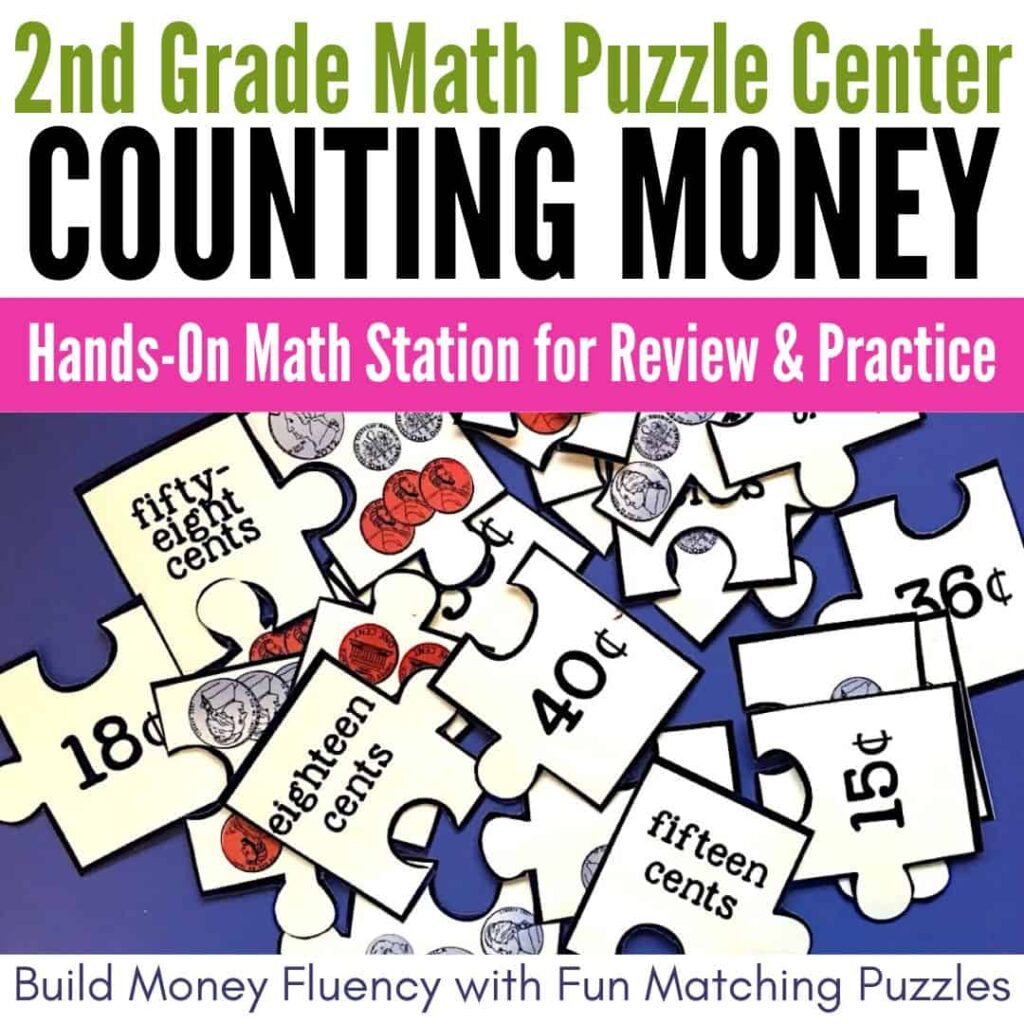
A more recent addition to these games includes some Money Number Puzzles. My students LOVE doing these number puzzles and they require almost no instruction.
These coin counting puzzles allow students to see that an amount, like 58¢, can be created with multiple sets of coins.


Money Number Puzzles
Money Puzzles offers students an opportunity to match two sets of coins to a money value. In addition students match the word form. There are four cards for each complete puzzle.
Teaching coin counting doesn’t have to feel like one more overwhelming math standard to cram in. With the right structure, a little creativity, and consistent practice, your students can master this essential life skill—even in a world where coins are becoming less common.
Small Weekly Practice = Big Student Growth
By dedicating just 20–30 minutes each week to meaningful coin-counting activities, you’ll give your students the repetition they need without overwhelming your schedule. Whether you’re sorting coins, using number lines, or working through real-world math problems, that small dose of weekly practice adds up to lasting understanding and confidence.
Turn Behavior Management into a Math Opportunity
The classroom store is more than just a fun Friday treat—it’s a built-in math lesson. By linking your behavior incentive system to coin counting, you’re reinforcing academic skills in an authentic and motivating way. Over time, your students won’t just behave better—they’ll think better about money, math, and problem-solving.
Jessica BOschen
Jessica is a teacher, homeschool parent, and entrepreneur. She shares her passion for teaching and education on What I Have Learned. Jessica has 16 years of experience teaching elementary school and currently homeschools her two middle and high school boys. She enjoys scaffolding learning for students, focusing on helping our most challenging learners achieve success in all academic areas.