
Student Strengths: 100+ Examples to Share With Parents
Teachers spend a lot of time describing where students need support, but it can be tricky to put a student’s strengths into clear words. Having ready-to-use examples of student strengths saves time when writing report card comments, preparing for parent-teacher conferences, or documenting strengths for an IEP. Putting a student’s strengths into clear, specific words is harder than it sounds, and most teachers find themselves describing areas for growth far more often than what students do well.
The examples in this post are organized by academic areas, work habits, social skills, and executive functioning, so you can quickly find language that fits each student you’re writing about.
This list of student strengths examples is organized by academic areas, work habits, social skills, and executive functioning so you can quickly find wording that fits each student.
If you’re looking for full sentence starters and complete comment examples, check out:
- Report Card Comments for Teachers
- Report Card Remarks for Struggling Students
- Comments for Progress Reports
When to Use Student Strengths Examples: Report Cards, IEPs, and Conferences
Highlighting student strengths examples does more than fill space on a report card. It helps build student confidence, shows families how their child contributes to the classroom, and provides a concrete starting point for academic and behavioral goals. For IEP teams, specific strength language is especially important because it grounds the present levels section in what the student can do, not just where they need support.
Teachers most often need this kind of language during:
- Report card comments
- Parent-teacher conferences
- Progress reports
- IEP present levels and goal-setting sections

Balance Student Achievement with Celebrating Student Strengths
As a teacher, I focus significantly on student improvement and meeting benchmarks. I was trained to identify areas for improvement and provide intervention. However, this focus may overlook or underemphasize student strengths.
Celebrating these strengths is essential for building confidence, fostering a positive classroom environment, and helping students recognize their value beyond test scores.
The challenge, then, is to find a balance. It’s about creating an educational experience that values and cultivates a wide range of student strengths, encouraging them to become well-rounded, self-aware individuals ready to navigate the world’s complexities.
Academic Student Strengths Examples
These strengths will be valuable for celebrating student achievements and supporting ongoing development.
Literacy Strengths
These strengths describe reading, writing, and language development.
- Demonstrates strong reading comprehension skills.
- Excels in identifying main ideas and details in texts.
- Writing shows a clear beginning, middle, and end.
- Shows creativity and coherence in writing assignments.
- Has a rich vocabulary and uses it effectively in writing and speaking.
- Reads fluently with expression and understanding.
- Uses context clues to understand new vocabulary.
- Enjoys and understands a variety of reading genres.
- Writes convincing opinion texts supported by clear evidence.
Math Strengths
- Solves word problems using clear strategies.
- Understands and applies math concepts effectively.
- Demonstrates accuracy with mathematical operations.
- Shows the ability to think logically and sequentially.
- Excels in explaining mathematical reasoning and methods.
- Applies geometric concepts confidently in different situations.
- Proficient in using technology and tools for mathematical tasks.
- Creates mathematical models to represent real-life scenarios.
- Analyzes and interprets data accurately.
Science Strengths
- Shows a keen interest in scientific experiments and inquiry.
- Designs and carries out scientific experiments effectively.
- Understands and applies scientific concepts accurately.
- Demonstrates curiosity and a willingness to explore new scientific ideas.
- Displays the ability to observe, question, and hypothesize effectively.
- Excels in interpreting scientific data.
- Evaluates scientific information critically and thoughtfully.
- Connects science concepts across topics.
Social Studies Strengths
- Shows a deep understanding of historical events and contexts.
- Demonstrates insight into geographical concepts and relationships.
- Analyzes historical events with critical insight.
- Explains how inventions and technology change communities.
- Engages actively in discussions about civic responsibility and community.
- Exhibits an understanding of cultural diversity and values.
- Can draw connections between past and present events effectively.
Using Academic Student Strengths Examples in an IEP
When writing the Present Levels of Academic Achievement and Functional Performance (PLAAFP) section of an IEP, strength-based language is required by IDEA and helps ground the document in what the student can do. Any of the academic examples above can be adapted directly for IEP writing.
For example, “Demonstrates strong reading comprehension skills, particularly when identifying main ideas in nonfiction text,” gives the IEP team a specific, observable starting point rather than a vague positive. Pair each academic strength with a data source — a benchmark score, a teacher observation, or a work sample — to make it more useful in the document.
Behavioral Area Strengths Examples
Work Habits
- Consistently completes assignments on time.
- Adapts to new learning challenges with flexibility.
- Demonstrates strong organizational skills.
- Works independently and manages time effectively.
- Shows persistence and dedication to learning.
- Seeks out additional challenges and learning opportunities.
- Seeks feedback actively to improve performance.
- Aims for excellence in all tasks, demonstrating a commitment to quality.
- Pays close attention to detail in all assignments.
- Organizes and prioritizes tasks effectively to meet objectives.
Social Skills
- Demonstrates respect and empathy towards others.
- Works well in group settings and contributes positively to team goals.
- Communicates effectively with peers and adults.
- Shows leadership qualities and can take initiative.
- Handles conflicts constructively and seeks out solutions.
- Resolves conflicts thoughtfully, seeking win-win solutions.
Emotional Skills
- Exhibits a positive attitude toward learning and school.
- Demonstrates resilience and the ability to overcome challenges.
- Shows self-awareness and the ability to self-regulate emotions.
- Maintains focus and perseverance even in difficult situations.
- Expresses feelings and needs healthily and appropriately.
Participation and Engagement
- Actively participates in class discussions and activities.
- Shows enthusiasm and curiosity for learning new things.
- Asks insightful questions and seeks a deeper understanding.
- Engages with classroom materials and resources effectively.
- Demonstrates creativity and original thinking in classroom tasks.
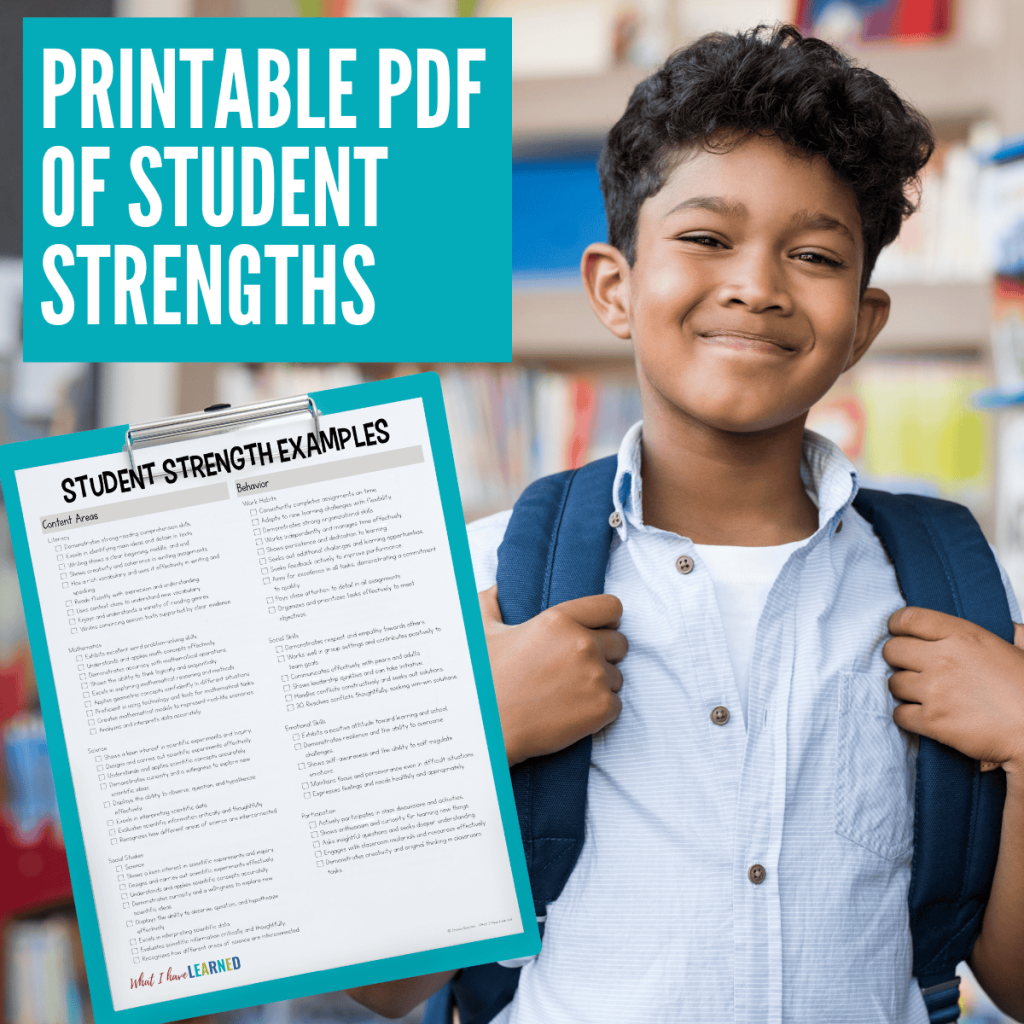
These strengths can be useful for teachers when describing student behaviors in report cards, during parent-teacher meetings, or at IEP (Individualized Education Program) meetings.

Behavioral Strengths Glossary (Quick Definitions)
Behavioral strengths can be helpful for teachers when describing student behaviors in report cards, during parent-teacher meetings, or at IEP (Individualized Education Program) meetings. Here’s a list of behavioral strengths often observed in students, along with definitions to clarify their meanings.
- Empathy: The ability to understand and share the feelings of another. Empathetic students are sensitive to the emotions of their peers and teachers, showing compassion and understanding in their interactions.
- Resilience: The capacity to recover quickly from difficulties; toughness. Resilient students bounce back from challenges and setbacks, maintaining a positive attitude and a willingness to try again.
- Self-regulation: The ability to manage one’s emotions, thoughts, and behaviors in different situations. Students who excel in self-regulation can control their impulses, handle emotional distress, and stay focused on tasks.
- Collaboration: Working with someone to produce or create something. Collaborative students work well in group settings, contribute ideas, and listen to others, aiming for a common goal.
- Leadership: The act of leading a group of people or an organization. Students with leadership strengths can guide peers toward goals, inspire teamwork, and take responsibility for group outcomes.
- Responsibility: Responsible students are reliable and accountable, completing assignments on time and taking personal responsibility for their actions.
- Adaptability: The ability to adjust to new conditions. Adaptable students can cope with changes in the classroom environment, curriculum, or teaching methods without losing focus or productivity.
- Persistence: Firm or obstinate continuance in a course of action despite difficulty or opposition. Persistent students continue working hard, even when faced with complex tasks or concepts, demonstrating determination to succeed.
- Curiosity: A strong desire to know or learn something. Curious students ask questions, seek new information, and are enthusiastic about exploring in-depth topics.
- Respect: A deep admiration for someone or something elicited by their abilities, qualities, or achievements. Respectful students value others, listen to different viewpoints, and treat people courteously and kindly.
- Self-motivation: The ability to do what needs to be done without influence from other people or situations. Self-motivated students find internal reasons to complete work and engage in learning, even without external rewards.
- Creativity: The use of imagination or original ideas to create something; inventiveness. Creative students think outside the box, offer unique solutions to problems, and express themselves innovatively.
- Mindfulness: The quality or state of being conscious or aware of something. Mindful students are present, can focus on the task, and are aware of their thoughts and feelings without getting overwhelmed. They exhibit a growth mindset.
- Communication: The imparting or exchanging information by speaking, writing, or using another medium. Students with strong communication skills can express their ideas clearly and understand the messages conveyed by others.
This list provides a framework for recognizing and describing the positive behaviors contributing to a student’s success in and out of the classroom.

Executive Functioning Strengths
Executive functioning and processing strengths are crucial in a student’s ability to effectively learn and navigate classroom tasks. Here’s a list of these strengths with brief descriptions:
- Organization: Keeping track of information and materials, planning, and maintaining a structured and orderly task approach. Students who are strong in organization can manage their assignments and materials efficiently.
- Time Management: Planning and exercising conscious control over the time spent on specific activities to increase effectiveness, efficiency, and productivity. Students with good time management complete tasks within deadlines and allocate their time wisely between activities.
- Task Initiation: The ability to begin projects efficiently or on time without undue procrastination. Students who initiate tasks well do not wait until the last minute to start their work and often begin without reminders.
- Working Memory: The capacity to hold, manipulate, and use information over short periods. Students with strong working memory can remember instructions while engaging in complex tasks and juggling multiple pieces of information simultaneously.
- Planning and Prioritization: The ability to create a roadmap to reach a goal or complete a task, including the ability to decide what’s important to focus on and what’s not. Students who excel at planning and prioritization can identify the steps needed to complete a project and determine the order in which to tackle tasks.
- Self-monitoring: The ability to monitor and evaluate one’s behavior and performance. Students who are good at self-monitoring can assess how well they are doing in their work and make adjustments as needed.
- Flexible Thinking: The capacity to adapt to new situations, adjust to unexpected changes, and think about problems in novel ways. Students with flexible thinking can easily switch between tasks and find alternative ways to solve problems.
- Impulse Control: The ability to think before acting and to delay gratification. Students with solid impulse control can resist distractions, stay focused on tasks, and make thoughtful decisions.
- Goal-Directed Persistence: The capacity to have a goal, follow through to the completion of the goal, and be aware of other demands and competing priorities. Students who demonstrate goal-directed persistence are not easily discouraged by setbacks and stay focused on their objectives.
Processing Strengths of Students in the Classroom
These processing strengths are vital for academic success and can manifest in various ways in the classroom. Recognizing and fostering these strengths can help students develop effective learning strategies and achieve their educational goals. If parents are aware of some of these strengths, they too can help at home.
- Auditory Processing: The ability to analyze, blend, and segment sounds and the capacity to understand and process auditory information. Students strong in auditory processing can follow verbal instructions well and may excel in language-based tasks.
- Visual Processing: The ability to effectively interpret and use visual information from the environment. Students with strong visual processing skills can efficiently understand graphs, charts, maps, and written material.
- Processing Speed: The pace at which an individual can perceive information, make sense of it, and begin to respond. Students with high processing speed can complete tasks quickly and understand information rapidly. Works quickly once directions are clear; finishes routine tasks efficiently.
- Language Processing: The capacity to understand and make sense of spoken and written language. Students who excel in language processing can easily comprehend reading materials, follow discussions, and articulate their thoughts clearly.
- Sequential Processing: The ability to understand and recall the sequence of information, events, or steps. Students with sequential solid processing can follow multi-step instructions and organize their thoughts logically.
Recognizing student strengths is an important part of supporting growth in the classroom. When teachers communicate what students are doing well, it builds confidence and encourages continued effort.
Whether you’re preparing report cards, meeting with families, or documenting student progress, having clear language for student strengths can make those conversations more meaningful and productive.
These examples can be adapted to fit individual students and grade levels, helping teachers describe the many ways students contribute to the classroom.

Do you have this available as a PDF as well? Great information!
Yep! I just added it to the post. You can sign up for it above.