
Short Report Card Remarks for Struggling Students
Below are 50 quick, copy-paste report card comments for struggling students, grouped by subject and concern. Each comment includes a blank line so you can add the student’s name and adjust the phrasing as needed.
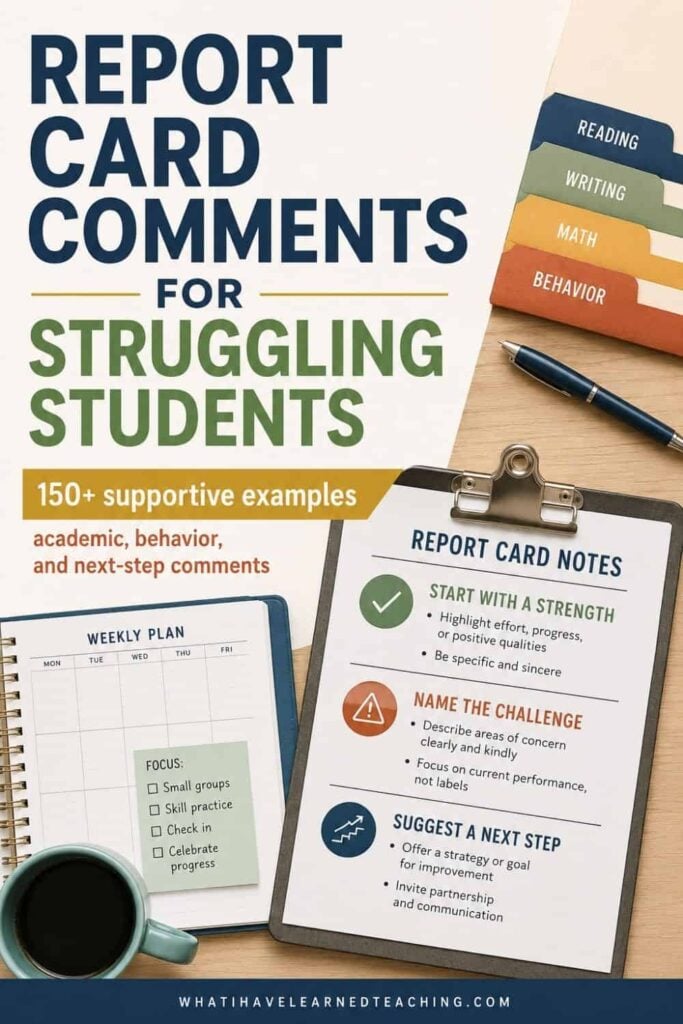
Scroll past the quick-reference list for the full collection of 150+ comments organized by category, plus a simple framework for writing comments that feel honest without being discouraging. For comments that cover all your students, not just those who are struggling, see my full list of report card comments for elementary teachers.
50 Quick Report Card Comments for Struggling Students
These short comments are designed for fast use. Each one is one or two sentences — enough to communicate clearly without taking up the entire comment box. They are organized by subject area and then by the type of concern.
Reading Comments for Struggling Students
- _____ is making progress in reading but needs continued support with decoding unfamiliar words.
- Fluency is developing; reading aloud at home each night would help _____ build confidence and speed.
- _____ works hard during reading time and is beginning to apply strategies more independently.
- Comprehension after reading is an area of focus; discussing stories at home would support continued growth.
- _____ benefits from one-on-one support to build reading accuracy and stamina.
- Sight word recognition is still developing; daily practice at home would make a noticeable difference.
- _____ reads with effort but needs more practice connecting ideas across a text.
- Decoding multi-syllable words is challenging for _____; targeted practice would strengthen this skill.
- Rereading for understanding is a strategy _____ is working on and showing improvement with.
- _____ is approaching grade-level texts with more confidence and persistence than at the start of the year.
Writing Comments for Struggling Students
- _____ is working on writing complete sentences with a clear beginning, middle, and end.
- Written responses are brief; sentence frames would help _____ expand ideas on paper.
- _____ is making progress with writing but needs more time to organize thoughts before drafting.
- Spelling accuracy is an area of focus; writing practice at home would support improvement.
- _____ is beginning to add more detail to written work, which is a step in the right direction.
- Punctuation and capitalization need more attention; reviewing these rules consistently would help.
- Staying on topic in writing is a skill _____ is actively developing.
- Written explanations are improving; _____ is learning to give reasons that connect back to the prompt.
- _____ is building stamina for longer writing tasks, which takes consistent practice and patience.
- Handwriting legibility is an area to strengthen; slowing down during writing tasks would help _____ form letters more carefully.
Math Comments for Struggling Students
- _____ is developing math fluency and benefits from regular practice with basic facts.
- Problem-solving accuracy improves when _____ slows down and checks work before finishing.
- Math concepts are taking longer to solidify for _____; repeated practice is making a difference.
- _____ is learning to use manipulatives and visual tools, which support understanding of new concepts.
- Word problems are challenging for _____; highlighting key information helps focus attention.
- Number sense is growing; _____ is gaining more confidence with hands-on math tasks.
- _____ applies math skills more accurately during guided practice than during independent work.
- Multi-step problems are a current challenge; breaking tasks into parts is a helpful strategy for _____.
- _____ is working toward fluency with addition and subtraction, which takes consistent daily practice.
- Math vocabulary is an area to develop; understanding key terms helps _____ follow directions more easily.
Effort and Motivation Comments
- _____ puts in effort but benefits from encouragement when tasks become challenging.
- Persistence is growing; _____ is staying with difficult tasks longer than earlier in the year.
- _____ benefits from setting small, concrete goals to build confidence and momentum.
- Motivation is strongest during hands-on activities; building that same persistence in other areas is the next step.
- _____ tries hard and deserves recognition for the effort shown even when results are still developing.
- Following through on assignments is an area of focus; consistent routines help _____ stay on track.
- _____ is learning that improvement takes time and is showing more willingness to stick with challenges.
- Effort varies day to day; building more consistent work habits will support _____ in reaching goals.
- _____ is capable of more than their current output reflects; working on follow-through is the priority.
- When _____ leans into a task, the results improve noticeably; building that consistency is the goal.
Behavior and Participation Comments
- _____ is working on staying focused during instruction and benefits from gentle, consistent reminders.
- Participation is growing; _____ is raising their hand more often during class discussions.
- Staying organized is a challenge; a consistent system for materials would help _____ stay on track.
- _____ transitions between activities more smoothly when given advance notice of what is coming next.
- Listening carefully during directions is a skill _____ is actively working on.
- _____ is learning to wait for turns during discussions, which supports a more productive classroom environment.
- Work completion is improving; following through to the end of assignments is the current focus for _____.
- _____ shows stronger on-task behavior during small-group work than during independent tasks.
- Respectful communication with peers is a focus area; _____ is making progress with consistent support and practice.
- _____ is learning to manage frustration during challenging tasks; breathing strategies and short breaks have helped.
If you are writing mid-year updates rather than final comments, these progress report comment examples are organized the same way and work well alongside the comments above.
The lists below offer additional options with more variation — useful when you need a comment that fits a specific student situation the quick list doesn’t quite cover.
A Simple Plan for Writing Comments About Struggling Students
Writing comments for students who are having a tough year can feel tricky. This three-step approach helps keep comments constructive and grounded.
Step 1: Begin with Strengths
Every learner brings something extraordinary to the classroom—even if you have to squint a little to see it some days. Starting with strengths helps families breathe, relax, and hear the rest of what you need to say.
Step 2: Name the Challenge
Once the strength is acknowledged, identify what is getting in the student’s way academically or behaviorally. Make it concrete. Vague comments leave parents wondering what to fix.
Step 3: Suggest a Next Step
End with a practical tip, tool, or strategy. This gives families something actionable and keeps the message as a whole supportive rather than discouraging.
Words to Avoid in Report Card Comments
Some phrases feel precise but land harder than intended. These swaps keep the comment clear and honest without sounding punitive.
| Instead of… | Try… |
|---|---|
| struggling, failing, can’t | is working toward, is developing, needs more time with |
| lazy, unmotivated | benefits from encouragement, is building persistence |
| behind, below grade level | is working to reach grade-level expectations |
| never tries, doesn’t try | puts in effort with support; benefits from consistent routines |
| poor behavior | is learning to manage [specific behavior] with guidance |
| weak student | is developing, needs additional support in |
| bad at math/reading | is working to strengthen [specific skill] |
When parents read the comment, they should leave with a clear picture of where their child is and one or two things they can do at home to help. For more on how to share this kind of news in a way that keeps families on your side, see my post on positive encouragement from teachers.
What This Looks Like in Practice
Here is the same student described in two ways. The first version leads with the problem. The second uses the three-step approach.
Before (leads with the problem)
Maya is a struggling reader who is significantly below grade level in all areas of reading.
After (sandwich method)
Maya works hard during reading time and has made consistent progress with sight word recognition this term. Decoding longer words remains challenging, and additional practice with sound-by-letter strategies will help. Reading aloud together at home for 10 minutes each night would be a helpful next step.
Both comments describe the same student. One closes a door; the other opens one.
Report Card Remarks for Weak or Struggling Students
Below are new, ready-to-use comments you can copy, paste, and adjust to match individual students.
Academic Remarks for Struggling Students
Improvement Shown
- _____ is putting in effort and showing small but steady gains in reading understanding.
- Progress is starting to show in ____’s writing. Their sentences are growing in clarity and detail.
- _____ has been trying new strategies in math, and those attempts are beginning to pay off.
- Growth in _____’s decoding skills is becoming more consistent.
- _____ is showing better stamina during independent work time.
- I’ve noticed more confidence from _____ when tackling multi-step tasks.
- _____ is beginning to apply feedback more independently.
- There has been a noticeable shift in _____’s willingness to attempt challenging tasks.
- _____ is showing stronger number sense, especially with hands-on tools.
- Improvements in _____’s homework accuracy show better effort and understanding.
Improvement Needed
- _____ needs repeated exposure to new material before concepts begin to stick.
- Basic skills in ___ remain difficult and require continued practice.
- Retaining previously taught skills is challenging for _____. Spiraled review may help.
- Independent reading is tough for _____. Extra guided support would help build confidence.
- Problem-solving steps are often skipped or rushed. Slowing down would improve accuracy.
- _____ continues to rely heavily on adult support. More practice with small, manageable tasks can help foster independence.
- Building math fact fluency remains an important area of focus.
- Writing remains brief or incomplete. Additional modeling and sentence frames will help.
- _____ often forgets key directions and needs reminders to follow through.
- Accuracy declines quickly when tasks become multi-step. More guided practice is needed.
General Academic Next Steps
- Encouraging _____ to review notes nightly will help strengthen understanding of new concepts.
- Practicing foundational skills for a few minutes each day will boost _____’s confidence and accuracy.
- Completing assignments more slowly and carefully could help _____ improve overall work quality.
- Using graphic organizers may assist _____ in organizing ideas before writing.
- Focusing on reading for 10–15 minutes at home each night would support _____’s comprehension skills.
- Working on math fact fluency will help _____ tackle multi-step problems with more ease.
- Revisiting directions before beginning tasks could prevent errors and missed steps for _____.
- Encouraging _____ to check their work before turning it in will help reduce avoidable mistakes.
- Meeting with the teacher during intervention time will support _____ in strengthening key skills.
- Breaking large tasks into smaller steps can help _____ manage work more independently.
- Practicing decoding strategies at home would greatly support _____’s reading development.
- Using sentence frames may help _____ express ideas more clearly in writing.
- Encouraging _____ to reread writing before turning it in will improve clarity and structure.
- Spending a bit more time with assigned practice pages would help _____ strengthen understanding.
- Reviewing class vocabulary terms each week will support _____ in mastering content.
Reading – Next Steps
- Practicing sight words at home would greatly support _____’s fluency.
- Listening to books while following along may help _____ with pacing and expression.
- Encouraging _____ to stop and summarize will support comprehension growth.
- Previewing vocabulary before reading can help _____ tackle new texts more confidently.
- Practicing decoding strategies will support _____ as reading becomes more complex.
- Encouraging _____ to track print with a finger or bookmark may improve accuracy.
- Rereading familiar books will help _____ strengthen fluency.
- Completing reading logs consistently will support daily practice.
- Discussing characters, setting, and events at home may build comprehension.
- Using sticky notes to mark confusing parts can help _____ ask for support more easily.
If a student is significantly behind in reading and you want to know more about the research behind early intervention, my post on when your child struggles with reading covers the signs to look for and the steps that help most.
Math – Next Steps
- Practicing number sense activities at home can support _____’s confidence with math.
- Using manipulatives will help _____ understand concepts more concretely before moving to abstract work.
- Encouraging _____ to write out steps during problem solving will improve accuracy.
- Reviewing basic addition and subtraction facts will help _____ solve problems more efficiently.
- Practicing math vocabulary will help _____ understand directions more clearly.
- Encouraging _____ to check answers with inverse operations could improve understanding.
- Working through word problems slowly and highlighting keywords will support focus.
- Using math games at home may help _____ strengthen essential skills in a fun way.
- Practicing skip counting will support _____ in multiplication work.
- Reviewing completed math work together can help _____ see common errors and improve accuracy.
Short Remarks for Science
Science remarks for struggling students often center on vocabulary retention, following procedures, and connecting observations to written conclusions. These one-liners work for both general science and unit-specific use.
- Following multi-step lab procedures is challenging for _____; reviewing steps before activities helps.
- _____ participates during science discussions but struggles to transfer ideas to written responses.
- Understanding cause-and-effect relationships in science is an area _____ is actively developing.
- Science vocabulary retention is a focus; using new terms in sentences helps _____ remember them.
- _____ needs additional support connecting observations to conclusions during science activities.
- _____ is working to retain science vocabulary; brief review of key terms before assessments would help.
- Making predictions before observations is a strategy _____ is learning to apply more consistently.
- _____ engages actively during experiments but needs support organizing findings in written form afterward.
Short Remarks for Social Studies
Social studies comments for struggling students often address content vocabulary, map skills, and the ability to connect events across time. These remarks work for progress reports and report cards at any point in the year.
- _____ is developing understanding of social studies concepts but needs support with content vocabulary.
- Map skills and geographic concepts are areas where _____ benefits from additional practice and review.
- Retaining information from social studies texts is a challenge; discussing content at home helps _____.
- _____ participates in discussions but struggles to connect social studies concepts to prior knowledge.
- Understanding timelines and historical sequence is still developing for _____.
- Writing about social studies topics is an area of focus; sentence frames would help _____ get started.
- _____ needs support connecting cause and effect in social studies; graphic organizers have been helpful.
- Social studies vocabulary retention would improve with brief weekly review of unit terms at home.
General Remarks for Struggling Students (All Subjects)
These subject-agnostic remarks work when you need one clear line that captures a student’s overall profile without naming a specific subject. They are also useful as opening or closing lines that frame a longer comment.
- _____ shows growth but needs continued support to complete work independently.
- Additional practice at home would help _____ consolidate skills learned during the school day.
- Progress is showing; building consistency will help _____ move toward grade-level expectations.
- _____ tries hard and responds well to encouragement; persistence is the next area of growth.
- Following through on tasks from start to finish is a priority goal for _____ this term.
- Regular review of previously taught skills would help _____ retain and apply what has been learned.
- _____ benefits from clear, step-by-step instructions and additional processing time.
- Asking for help when stuck is a skill _____ is developing; independence is gradually growing.
- _____ shows stronger performance in small-group settings; building that same confidence independently is the goal.
- Growth is steady, and _____ is making progress with consistent support and practice across subject areas.
- _____ is capable and improving; maintaining effort across all subjects is the next step.
- _____ benefits from reduced distractions and one-on-one support when working on challenging tasks.
Kindergarten Report Card Comments for Struggling Students
Kindergarten comments need a slightly different approach. At this age, many of the skills teachers report on—letter recognition, counting, listening, taking turns—are foundational rather than remedial. These comments reflect that developmental lens.
Academic Skills
- _____ is still working on consistently recognizing and writing all letters of the alphabet; daily practice at home with letter cards would help.
- Letter-sound connections are developing; practicing letter sounds together at home for a few minutes each day would make a noticeable difference.
- Number recognition to 20 is still developing; counting objects together at home would support continued growth.
- _____ is beginning to recognize their name in print and is showing growth in overall letter awareness.
- Rhyming and identifying beginning sounds are areas where _____ would benefit from additional practice.
- _____ is developing the ability to retell a simple story; listening to books at home and asking “what happened first?” supports this skill.
- Number writing is an area of focus; _____ is working on forming numerals correctly and in the right direction.
Fine Motor and Work Habits
- _____ is learning to hold a pencil correctly; building fine motor strength through drawing and play activities at home would help.
- Cutting and coloring tasks are still challenging for _____; these are skills that develop with regular practice.
- _____ is learning to sit and listen during whole-group instruction, which takes practice and develops over time in kindergarten.
- Following two-step directions is a skill _____ is actively working on; practicing this at home through simple games or routines would help.
- _____ is learning to work and play cooperatively with peers, which is a central skill in kindergarten and one where steady growth is showing.
If _____ is also receiving support services, coordinating language between home, school, and specialists helps create a more consistent experience. For tips on making that communication smoother, see my post on collaborating with IEP service providers.
Behavior & Work Habits
Improvement Shown
- _____ is working hard to stay on task during lessons and deserves recognition for progress.
- Transitions are becoming smoother for _____.
- _____ is making an effort to listen more carefully during instruction.
- I appreciate how _____ has been trying to use class time more responsibly.
- Work completion is improving, and _____ is starting to show pride in their effort.
- Peer interactions have grown more positive this term.
- _____ is showing better self-control during group activities.
- I’m noticing more moments when _____ pauses to think before responding.
- _____ is beginning to show more organization with materials.
- Class participation is slowly increasing and helps build their confidence.
Improvement Needed
- Staying focused during lessons is still difficult for _____. Short breaks may help.
- _____ needs reminders to stay seated and use work time productively.
- Directions are often missed or forgotten. Listening closely is an area to strengthen.
- Materials are frequently misplaced, making it harder for _____ to stay on track.
- Interrupting others happens often; learning to wait for a turn is a priority.
- Peer conflicts arise due to impulsive reactions. Practicing calm responses would help.
- Work completion is inconsistent and needs more follow-through.
- _____ struggles with transitions and may benefit from visual or verbal cues.
- Independent work remains challenging without adult guidance.
- _____ tends to avoid challenging tasks. Building perseverance is a key goal.
Next Steps
- Practicing active listening strategies—such as maintaining eye contact and keeping hands still—will support ____ during lessons.
- Encouraging _____ to pause and think before speaking will help improve participation.
- Working on raising their hand consistently will make discussions smoother for _____.
- Redirecting attention back to the speaker will help _____ stay engaged.
- Using a quiet reminder system may help _____ manage impulsive behaviors.
- Encouraging _____ to take brief movement breaks can improve overall focus.
- Practicing positive conflict-solving strategies will help _____ navigate peer interactions successfully.
- Modeling calm responses will support _____ in regulating emotions during frustration.
- Encouraging _____ to keep materials organized will help reduce lost assignments.
- Setting one small weekly goal can help _____ build stronger work habits over time.
Effort & Motivation Report Card Comments for Weaker Students
Improvement Shown
- When ____ leans into a task, the growth is noticeable.
- Effort has improved this term, and it shows in _____’s daily work.
- _____ is beginning to understand that practice leads to better results.
- Their confidence is building slowly, step by step.
- Attempts at more challenging work are becoming more frequent.
- _____ is showing more pride in completed assignments.
- Small wins are helping _____ stay more encouraged.
- I’ve seen _____ take more responsibility for their learning recently.
- _____ has shown more willingness to ask for clarification.
- Positive momentum is starting to build for _____.
Improvement Needed
- _____ often stops quickly when faced with difficulty. Encouraging persistence will help.
- Motivation varies day to day. Finding consistent routines would make a difference.
- _____ needs to try tasks independently before asking for help.
- Extra effort during classwork would help improve overall progress.
- _____ would benefit from setting small, reachable goals.
- Avoiding challenging tasks limits growth. Encouraging risk-taking in learning is important.
- Work habits slip when assignments are long or unfamiliar. Building endurance is a key next step.
- _____ needs more practice sticking with a task long enough to complete it accurately.
- A stronger work ethic would help _____ reach grade-level expectations.
- Independent practice is a struggle; developing self-reliance is essential.
Motivation, Confidence & Perseverance – Next Steps
- Encouraging _____ to celebrate small wins will help build confidence.
- Practicing positive self-talk strategies may help _____ approach challenges with more courage.
- Giving _____ opportunities to choose tasks may increase motivation.
- Encouraging _____ to try challenging items first will help build perseverance.
- Focusing on improvement rather than perfection may help _____ stay engaged.
- Practicing how to ask for help will support _____ in becoming more proactive.
- Offering short, achievable goals can help _____ feel more successful during work time.
- Encouraging _____ to reflect on progress weekly will support goal setting.
- Allowing extra time to process new information can help _____ feel less overwhelmed.
- Helping _____ recognize their strengths will boost confidence in learning.
Focus & Attention Remarks for Report Cards
Improvement Shown
- Focus has improved during shorter tasks, a helpful first step for _____.
- _____ is learning to ignore distractions more often.
- Sitting for longer stretches is becoming easier for _____.
- _____ follows multi-step directions with fewer reminders than before.
- On-task behavior is improving during teacher-led lessons.
- _____ is showing more consistent effort during independent reading time.
- Transitions back to work are becoming quicker.
- _____ shows stronger attention during hands-on activities.
- Listening during mini-lessons has improved.
- Maintaining attention during small-group work is getting better.
Improvement Needed
- Sustaining focus for an entire lesson is still an ongoing challenge for _____.
- Attention drifts often; shorter check-ins may support better engagement.
- _____ needs to work on keeping eyes on the speaker during instruction.
- Distractibility impacts learning. A quieter workspace may help.
- Staying on task during partner work is challenging for _____.
- _____ loses track of materials quickly, slowing down progress.
- Impulsivity interferes with participation and accurate work.
- Forgetting key steps leads to incomplete assignments.
- _____ has trouble returning to work after breaks.
- Strengthening overall attention to detail is a priority.
Work Habits & Executive Functioning – Next Steps
- Encouraging _____ to use a daily checklist will help them stay on track with assignments.
- Teaching _____ to preview tasks before beginning may support better work completion.
- Practicing transitions with verbal cues or timers can help _____ move smoothly between activities.
- Keeping materials in a consistent location would support _____’s organization.
- Encouraging _____ to start tasks right away will reduce rushing at the end of work time.
- Using a planner or agenda may help _____ remember homework and due dates.
- Practicing how to prioritize tasks—easy to hard—could help _____ stay focused.
- Encouraging _____ to ask clarifying questions will prevent confusion during assignments.
- Teaching _____ to highlight key words in directions would support clearer understanding.
- Chunking assignments into smaller parts could help _____ complete work more independently.
- Using a folder system for finished/not finished work may support organization.
- Practicing routines consistently will help _____ feel more secure during the school day.
- Encouraging _____ to focus on one task at a time will reduce overwhelm.
- Setting short timers for work periods may help _____ improve attention.
- Using visual cues for reminders may support _____ throughout the day.
A Helpful Tool to Give Struggling Students a Voice
Supporting struggling students becomes more effective when they have a voice in the process. A structured student self-reflection before conferences or report card season helps uncover how they view their effort, behavior, and academic progress.
Bringing students into the conversation gives them ownership, helps families understand their child’s perspective, and encourages honest reflection long before report cards go home. That’s why I like to use Behavior & Academic Self-Reflection Sheets during conferences and end-of-term check-ins.

Student Self-Reflection Sheets for Parent Conferences
Want to see how these Behavior & Academic Self-Reflection Sheets can support struggling learners in your classroom? I’ve put together a full walkthrough showing how the rubrics, prompts, and editable pages help students share their progress and goals in their own words. You’ll get a clear picture of how this tool builds student ownership and strengthens parent conversations.
These pages guide students to think carefully about how they work, how they behave, and how they’ve grown. They’re clear, structured, and easy for even your most reluctant learners to use. The rubrics and short-answer prompts help them evaluate themselves in areas such as following directions, staying on task, handling frustration, asking for help, and giving their best academic effort. The sheets come in editable Google Slides, so you can tailor questions as needed.
What I love most is that these reflections open the door to conversations students often can’t begin on their own. When you’re sitting with a family and a student can say, “I sometimes rush through my work,” or “I want to get better at staying focused during math,” it shifts the tone from teacher vs. parent to we’re all working together for this child.
You can find the full set of templates—behavior rubrics, academic checklists, math and reading self-evaluations, and deeper written reflections—in the resource below. They work beautifully with struggling learners because they break self-assessment into small, clear steps that don’t feel overwhelming.
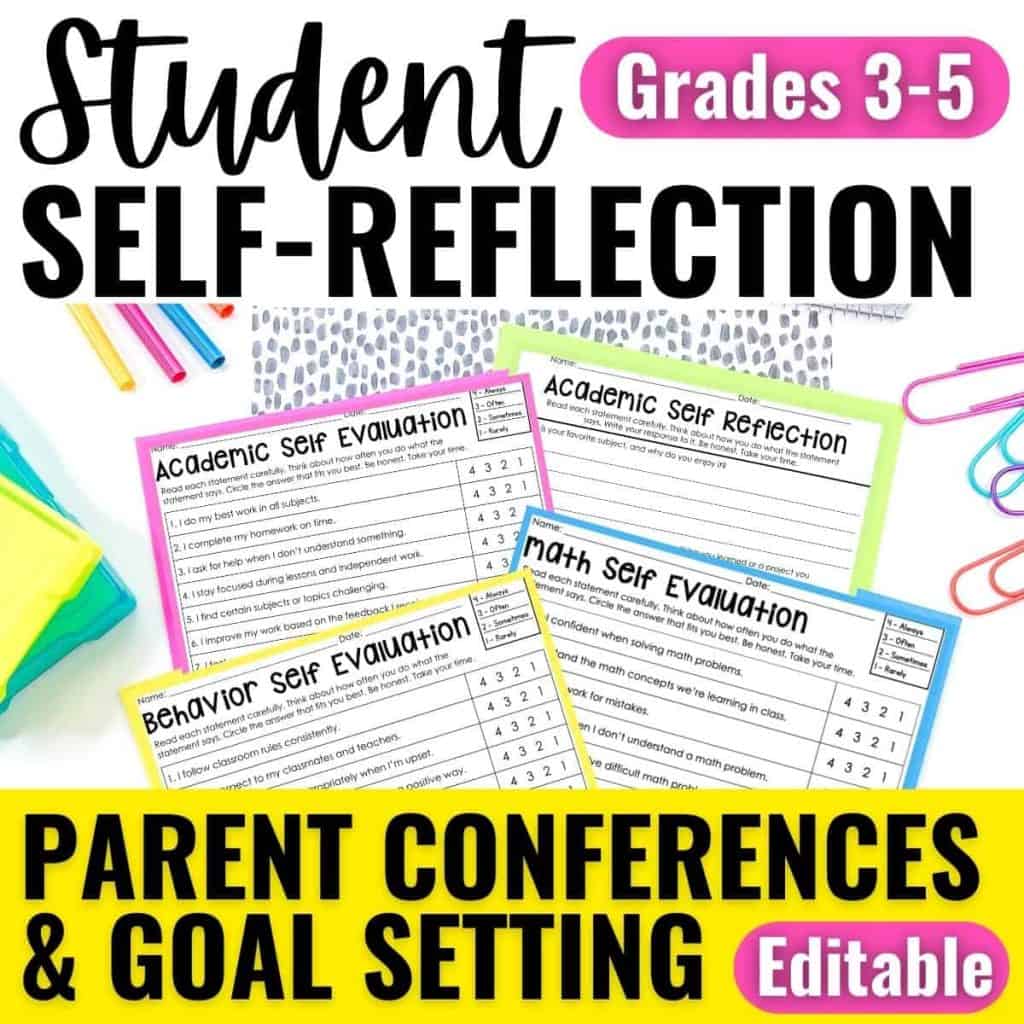
Help students take ownership of their growth with these Behavior & Academic Self-Reflection Sheets. This editable set includes rubrics and short-answer prompts that guide learners in evaluating their work habits, behavior, and academic progress. A simple way to bring clarity and student voice to your conversations.
If you are working with students who receive differentiated instruction, it can also help to have language around why their work may look different from a peer’s. My post on what is differentiated instruction has a clear explanation you could share with families who ask.
Helping Struggling Students Through Thoughtful Comments
Comments are more than a requirement—they’re a bridge between school and home. When written with clarity and kindness, they help families understand what their child needs and how they can support them.
Your words can reassure, redirect, and guide next steps. And for many parents, these remarks are the first time they get a clear picture of their child’s academic and behavioral challenges.
Jessica BOschen
Jessica is a teacher, homeschool parent, and entrepreneur. She shares her passion for teaching and education on What I Have Learned. Jessica has 16 years of experience teaching elementary school and currently homeschools her two middle and high school boys. She enjoys scaffolding learning for students, focusing on helping our most challenging learners achieve success in all academic areas.