
194 Report Card Comments for Elementary Teachers (Positive & Constructive Examples)

Report card comments for elementary students can feel overwhelming, especially at the end of a long school year. Whether you are writing end-of-year report card comments, progress report comments, or academic progress remarks, finding the right words matters.
Teachers want feedback that reflects student growth, highlights strengths, and provides constructive suggestions for improvement. At the same time, comments should remain clear, supportive, and professional.

This list of 194 report card comments for elementary teachers includes positive comments, needs improvement remarks, academic progress statements, and behavior feedback you can adapt for any grade level. Use these examples to save time while still writing meaningful, individualized comments for your students.
Report Card Comment Quick Reference: Categories Covered
These report card comments are organized into categories so you can quickly find the right language for any student.
Jump to the section you need:
- Generic Opening and Closing Comments
- Academic Progress Comments (Reading, Writing, Math, Science, Social Studies)
- Needs Improvement Report Card Comments
- Work Habits and Quality of Work Comments
- Classroom Behavior Comment Examples
- Social Skills and Character Comment Examples
Each category includes positive comment examples for students meeting or exceeding expectations and constructive feedback phrases for students working toward grade-level skills.
Choose a comment that matches the skill (academic progress, work habits, behavior, or social skills). Then swap in the student’s name and add one specific detail you’ve noticed (a skill, example assignment, or growth area).
Looking for comments specifically for struggling students? Use this separate list of report card remarks for struggling students (with academic and behavior examples).
How to Write Effective Report Card Comments
Writing report card comments is easier when you follow a simple pattern: strength + evidence + next step. The goal is to communicate student progress clearly so families understand what their child can do now and what to focus on next.
- Being Specific: Provide detailed examples to support your comments on a student’s performance. Start with general statements and focus on their strengths and areas for improvement. Then, give details about how the student has done in your classroom throughout the school year.
- Focusing on Achievements: Acknowledge and celebrate the student’s accomplishments. Let them know you have seen their efforts and that their hard work has paid off.
- Addressing Challenges: Highlight areas that need improvement. However, be mindful of your language to avoid sounding overly critical. Instead, approach challenges as opportunities for growth.
- Providing Constructive Feedback: Offer suggestions for improvement. Think about how the student can reach their full potential and provide feedback that will help them achieve their goals.
If you’re stuck, start with one of the sentence starters below and add one concrete example (a skill, behavior, or goal). Clear report card comments take less time when you have a structure.
Positive Report Card Comments for Academic Growth
End-of-the-year comments recognize and celebrate students’ academic achievements and progress made throughout the year. Positive academic progress comments go a long way in motivating and encouraging students to continue striving for excellence.
Some examples of phrases to acknowledge academic achievements and milestones include:
- ___ has shown tremendous growth in…
- ___ has reached a significant academic milestone in…
- ___ has demonstrated proficiency in…
Try these sentence frames to keep your tone positive and specific:
- ___ has made steady progress in ___, especially when ___.
- ___ is developing confidence in ___ and is beginning to ___ independently.
- ___ consistently demonstrates strength in ___ and applies this skill when ___.
- ___ has improved in ___ and will continue to grow by focusing on ___.
- ___ works hard during ___ and shows pride in ___.
It is essential to ensure that these types of comments are specific and detailed, focusing on the student’s strengths and areas of improvement. Doing so reinforces student progress and motivates them to strive for success.
A positive and encouraging tone is crucial when writing year-end comments for student reports. However, it is equally important to remain objective and balanced. Balance positive comments with constructive feedback and ensure that the students are aware of their areas of improvement.

Constructive Report Card Comments for Areas of Improvement
Constructive feedback helps students reach their full potential. When writing end-of-the-year comments, addressing any challenges a student may have faced and providing feedback that inspires growth is essential.
Effective report card feedback begins with highlighting areas of improvement. Rather than focusing solely on what needs work, suggestions should also be included on how the student can improve in these areas. For example, if students struggle with time management, suggest strategies to help them better manage their time.
When addressing challenges, use supportive and nonjudgmental language. Avoid negative language that may discourage the student and instead offer feedback that inspires positive change. For example, instead of saying, “___ needs to work harder,” try, “___ has shown great improvement this year and, with a little more effort, can continue to excel.”
Remember, constructive feedback aims to inspire growth and give students the tools they need to succeed. By using supportive, nonjudgmental, and balanced language, you can provide effective report card feedback that empowers students to reach their full potential.
Tip: Skip vague phrases like “needs to try harder” or “could do better.” Families don’t know what that means. Instead, name the skill and give one next step (practice, routine, strategy, or support).
24 Words and Synonyms that Express Praise
Before we discuss the list of report card comments, let’s emphasize the importance of language variety. The words we use in our report card comments can greatly impact how students perceive their performance.
To help ensure your feedback is both engaging and inspiring, consider the alternative words and synonyms below that offer praise and extend beyond the commonly used terms “good” and “excellent.”
- Remarkable
- Exceptional
- Impressive
- Incredible
- Superb
- Stellar
- Magnificent
- Splendid
- Admirable
- Noteworthy
- Superior
- Phenomenal
- Outstanding
- Marvelous
- Brilliant
- Spectacular
- Distinguished
- Exemplary
- Extraordinary
- Fantastic
- Consistent
- Thoughtful
- Dependable
- Determined
Examples of Character Trait and Associated Feedback
To expand the vocabulary you employ when composing your student reports, we’ve compiled a comprehensive list of 25 praise-worthy words and constructive sentences.
These character traits work well in report card comments when you pair them with one short example of what the student did (during group work, independent practice, class discussions, or routines).
- Adaptable: Demonstrates excellent flexibility in adjusting to new situations or challenges.
- Brave: Shows courage and resilience in tackling difficult assignments.
- Curious: Displays a keen interest in learning and discovering new concepts.
- Dedicated: Exemplifies commitment to schoolwork and always strives for improvement.
- Enthusiastic: Approaches tasks with a positive attitude and contagious excitement.
- Focused: Consistently remains on task and avoids distractions.
- Generous: Willingly shares knowledge and resources with classmates.
- Hardworking: Puts in extra effort and time to complete assignments to the best of their ability.
- Inventive: Uses creative thinking to solve problems and generate ideas.
- Joyful: Brings a positive spirit to the classroom, which enhances the learning environment.
- Kind: Exhibits respect and kindness towards peers and teachers.
- Loyal: Shows dedication to the class and supports classmates.
- Motivated: Possesses a strong desire to succeed and sets high standards for themselves.
- Nurturing: Helps foster a supportive learning environment for everyone.
- Organized: Effectively manages time and assignments.
- Punctual: Consistently meets deadlines and arrives on time to class.
- Questioning: Has a healthy curiosity and is not afraid to ask questions to better understand the material.
- Respectful: Shows consideration for the feelings and rights of others.
- Steadfast: Stays focused on goals, even when faced with challenges.
- Thoughtful: Considers the perspective of others and displays empathy.
- Understanding: Demonstrates a strong grasp of course material.
- Vibrant: Brings energy and liveliness to the learning environment.
- Wise: Makes good decisions and has good judgment in all situations.
- Youthful: Maintains a positive, youthful energy that contributes to a dynamic classroom environment.
Generic Opening and Closing Comments
The following list provides examples of generic opening and closing statements you can incorporate into your comments. These phrases, adaptable across various contexts, help foster a positive rapport with the students while acknowledging their efforts and improvements.
- _____ has made tremendous progress this semester, keep up the good work!
- _____’s dedication to _____ work is truly inspiring.
- _____’s consistent effort is reflected in _____ work, great job!
- _____ has shown a great deal of resilience this semester.
- _____’s positive attitude brightens up the classroom.
- _____’s enthusiasm for learning is truly contagious.
- _____ has shown exceptional growth in _____ understanding of the material.
- I am impressed with _____’s ability to handle complex concepts.
- The creativity _____ brings to _____ assignments is commendable.
- _____’s attention to detail is evident in _____ work.
- _____’s ability to work independently has improved markedly.
- _____’s active participation in class discussions is much appreciated.
- _____ has shown great initiative this term.
- I’m proud of the way _____ has embraced challenges this semester.
- _____’s confidence in _____ abilities has grown significantly.
- _____ has excelled in _____ assignments this term, well done!
- _____ has demonstrated a solid understanding of the subject matter.
- _____ has shown great diligence in _____ studies.
- _____’s willingness to help others is admirable.
- _____ has displayed fantastic problem-solving skills.
- _____’s improved focus and concentration are evident in _____ work.
- _____’s perseverance in the face of difficulty is inspiring.
- Keep up the good work, _____’s progress this semester is commendable!

Academic Progress Comments
The following report card comments express academic progress. They are divided by subject area. You can easily exchange some of the content’s specific words and use them for any topic.
Reading
- _____ has made significant strides in reading comprehension this year.
- _____ has become more fluent in reading, it’s a joy to watch _____ read aloud.
- _____’s capability to engage in complex text analysis has advanced considerably.
- _____’s progress in decoding and blending sounds in words is fantastic.
- _____’s comprehension of different types of texts has grown significantly.
Writing
- I am proud of the progress _ has made in _ writing skills.
- I have noticed a great improvement in _ spelling and grammar.
- _____ has shown remarkable progress in _____ vocabulary skills.
- Congratulations on _____’s improved handwriting, it’s much more legible now.
- _____’s ability to identify and use parts of speech correctly has grown impressively.
- The development in _____’s ability to write clear and concise sentences is admirable.
- _____’s progress in expressing _____ ideas through writing is truly impressive.
Math
- _____’s multiplication and division skills have improved tremendously.
- The growth in _____’s ability to solve complex math problems is commendable.
- _____’s grasp of number patterns and sequences has improved significantly.
- I am impressed with _____’s progress in solving word problems.
- _____’s progress in understanding and applying fractions is remarkable.
Science
- _____’s understanding of science concepts has deepened this semester.
- _____’s has made great strides in understanding and applying scientific terminology.
- _____’s has shown great improvement in _____ ability to formulate and test hypotheses in science.
Social Studies
- _____ is showing a deeper understanding of the connection between historical events, keep it up!
Other
- _____ has been pleased with _____ improved ability to present _____ thoughts clearly in discussions.
- The improvement in _____’s ability to engage in critical thinking is evident.
Needs Improvement Report Card Comments
The following comments express the need for improvement. They balance a positive quality and appreciation with a need for improvement. These comments are great for when you need a student to change something, but also want to praise their work and accomplishments.
- _____ has shown potential in [subject], but there is a need to pay more attention to detail in _____ assignments.
- I’ve noticed _____ is struggling with [subject], and I encourage _____ to seek help when needed.
- _____ has the ability to perform better in [subject]. Consider spending more time on revisions.
- _____ participation in class is appreciated, but it’s important to also focus on completing assignments on time.
- _____ has shown improvement in _____ understanding of [subject] but needs to consistently apply this knowledge in tests.
- _____ has made some progress in [subject], but it’s crucial to maintain consistent effort to reach _____ full potential.
- I encourage _____ to continue working on _____ [subject] skills outside of the classroom for better improvement.
- _____ is capable of deeper comprehension in [subject]. Extra focus on study and revisions could be beneficial.
- _____ has demonstrated an understanding of [subject], but there’s room for improvement in translating this into _____ assignments.
- _____’s ability to grasp new concepts in [subject] is good, but applying these concepts consistently is an area for improvement.
- I’ve noticed _____ sometimes has difficulty staying focused during [subject]. Let’s work together to improve this.
- _____’s performance in [subject] has room for improvement. Consider utilizing learning resources to enhance understanding.
- _____ has the potential to achieve higher grades in [subject]. Continued practice and diligence will be key.
- _____ has shown a keen interest in [subject], but additional practice will help _____ improve _____ grades.
- _____ is doing well in [subject], but with more focus, _____ could achieve a deeper understanding of the material.
- I encourage _____ to put more effort into [subject] assignments. Remember, quality over quantity is important.
- _____ shows a good understanding of [subject], but we need to work on applying these concepts in _____ assignments.
- _____ has made good strides in [subject], but regular revision will help _____ improve even further.
- _____’s potential in [subject] is evident, but more consistency is needed in _____ performance.
- I’ve noticed a decrease in _____’s performance in [subject]. Let’s figure out a strategy to get _____ back on track.
- _____’s grasp on [subject] concepts is good, but there’s a need for more application in _____ tasks.
- _____ has shown a love for learning in [subject], but more focus on problem-solving will help improve _____ performance.
- _____’s independent study skills are improving, but _____ could still be stronger in [subject].
- There’s an opportunity for _____ to improve _____ skills in [subject] with more focused study.
- _____ has displayed good effort in [subject], but I believe _____ can challenge _____ even more.
Work Habits and Quality of Work Comments
The following comments focus on work habits and quality of work. There is a mix of positive comments and some needs improvement comments in this section.
- _____’s dedication and positive work habits are clearly visible in the quality of _____ work.
- The effort and diligence _____ put into _____ assignments consistently yields high-quality work.
- _____ has a good understanding of the importance of careful, quality work, and it shows in _____ assignments.
- _____ consistently submits excellent quality work, reflecting _____ understanding and hard work.
- _____’s work habits have significantly improved over the semester, which is reflected in the quality of _____ work.
- _____ tends to rush through _____ assignments. More focus on the quality of _____ work is needed.
- I have noticed a significant improvement in the quality of _____ work when _____ takes _____ time.
- The careful attention _____ gives to _____ assignments results in high-quality work that _____ should be proud of.
- _____ has shown a commitment to producing quality work by regularly going above and beyond the assignment requirements.
- _____’s excellent work habits have led to consistent improvements in the quality of _____ work.
- _____ tends to get distracted easily, which affects the quality of _____ work. Let’s find strategies to help _____ stay focused.
- _____ has demonstrated good work habits, but there’s a need for more consistency to maintain the quality of _____ work.
- _____’s assignments show that _____ takes pride in producing quality work.
- _____’s in-class contributions are excellent; it’s important to reflect the same effort in _____ written work.
- _____’s work often lacks attention to detail. Focusing more on the quality of work will help improve _ grades.
- The quality of _____’s work fluctuates. Consistent efforts and effective work habits will ensure steady improvements.
- _____’s ability to manage time effectively greatly contributes to the quality of _____ work.
- More practice and focus on assignments will improve the quality of _____’s work.
- _____’s perseverance and work ethic are admirable, and it is evident in the quality of _____ work.
- _____’s assignments could be improved with a greater focus on detail and more diligent work habits.
- There’s room for improvement in the quality of _____ ‘s work. Let’s discuss strategies to help _____ focus more on _____ assignments.
- _____’s strong work habits consistently result in high-quality work.
- The effort _____ puts into _____ assignments clearly shows in the excellent quality of _____ work.
- _____’s commitment to producing quality work is commendable.
- _____ demonstrates strong work habits, and it reflects in the quality of _____ assignments. Keep it up!
Classroom Behavior Comment Examples
These comments focus on classroom behavior. Whether how an individual approaches an assignment, works with others, or focuses on their work, you’ll find what you need here.
- _____ shows respect for _____ classmates and engages positively in group activities.
- _____ consistently demonstrates attentiveness during classroom discussions, enhancing the overall learning environment.
- _____ sometimes struggles to follow classroom guidelines, which can disrupt the learning experience for others.
- _____ consistently exhibits good behavior in class, setting a positive example for _____ peers.
- _____ sometimes talks during instruction, which can be distracting for both the teacher and _____ classmates.
- _____’s respectful and polite behavior towards teachers and classmates is commendable.
- _____ is often late for class, which disrupts the lesson. Improvement in punctuality is needed.
- _____ exhibits leadership qualities during group activities and projects.
- _____ needs to work on respecting others’ viewpoints when participating in class discussions.
- _____’s enthusiastic participation in classroom activities enhances the learning experience for everyone.
- _____’s tendency to use electronic devices during class can be disruptive. More respect for classroom rules is encouraged.
- _____ has a positive attitude towards learning which is infectious to the rest of the class.
- I’ve noticed _____ sometimes has difficulty focusing during class. Let’s discuss strategies to improve this.
- _____ often participates in class discussions which adds a lot to our learning environment.
- _____ sometimes has difficulty controlling _____ emotions in class. Let’s work on effective methods to manage this.
- _____ is respectful and courteous in all _____ interactions in the classroom.
- _____ has demonstrated good self-discipline and responsibility in the classroom.
- More active participation in class discussions would be beneficial for _____.
- _____ has a positive attitude in the classroom and is always willing to assist _____ classmates.
- _____ consistently demonstrates respect for classroom rules and norms.
- _____ has made great strides in improving _____ classroom behavior this semester, keep it up!
- _____ demonstrates a level of maturity and responsibility that is commendable.
- _____ has shown a considerable improvement in _____ ability to stay focused during class.
- The respectful manner in which _____ treats _____ classmates contributes to a positive classroom environment.
- _____ consistently demonstrates a positive and respectful attitude in the classroom. Keep up the good work!
Social Skills and Character Comment Examples
This section focuses specifically on social skills and character development. It’s all about cooperation, teamwork, and problem-solving skills.
- _____ displays exceptional empathy towards _____ classmates, understanding and respecting _____ feelings.
- I appreciate the respectfulness and kindness ________ shows towards others.
- _____ consistently demonstrates a high level of integrity, adhering to principles of honesty and fairness.
- The respect and consideration _____ displays towards _____ peers is commendable and contributes positively to _____ class environment.
- _____ has a bright, positive personality that attracts others toward _____. _____ social skills are excellent.
- _____ needs to work on _____ ability to cooperate in team situations. Let’s strategize some ways to improve this skill.
- _____ displays solid leadership skills, taking initiative and guiding _____ peers during group activities.
- _____ tends to monopolize conversations which may prevent others from expressing their views. Learning to listen more will help improve _____ social dynamics.
- _____’s kindness towards _____ classmates is evident and fosters a supportive classroom environment.
- _____ consistently shows respect for different viewpoints, promoting a feeling of inclusivity within _____ class.
- _____ tends to interrupt others while they are speaking. It’s important to practice patience and active listening.
- _____’s strong sense of responsibility is apparent in group tasks and is greatly appreciated by _____ peers.
- _____’s positive attitude and ability to adapt to new situations quickly is impressive.
- _____ sometimes struggles with conflict resolution. Working on effective communication will help.
- _____’s confidence needs a boost. Remember that every opinion matters, including _____.
- _____ consistently displays good manners towards both peers and teachers, setting a strong example for others to follow.
- _____ has demonstrated excellent problem-solving skills in team projects.
- _____ is a good friend, always supportive and understanding.
- _____’s sense of humor adds a light-hearted and enjoyable element to the classroom.
- _____ is an empathetic listener, showing excellent support and understanding to _____ peers’ challenges.
- _____ consistently demonstrates the ability to compromise and work effectively in group settings.
- _____’s resilience and ability to bounce back from setbacks is impressive.
- _____ sometimes acts impulsively without considering others. It’s important _____ thinks before _____ acts.
- _____ has shown significant improvement in _____ ability to communicate effectively with _____ peers.
- The way _____ consistently stands up for what _____ believes in demonstrates strong moral character.
- _____ has shown exceptional growth in _____ ability to work well with others and it reflects positively in _____ social interactions.
Use Student Self-Reflection to Strengthen Report Card Comments
Writing strong report card comments becomes even easier when students are part of the reflection process.
Before finalizing end-of-year report card comments, consider having students complete a structured self-reflection. When students identify their strengths, challenges, and goals, your feedback becomes more specific and collaborative.
I use Behavior & Academic Self-Reflection Sheets to guide students through:
- Evaluating their classroom behavior
- Reflecting on reading and math progress
- Identifying academic strengths
- Setting personal growth goals
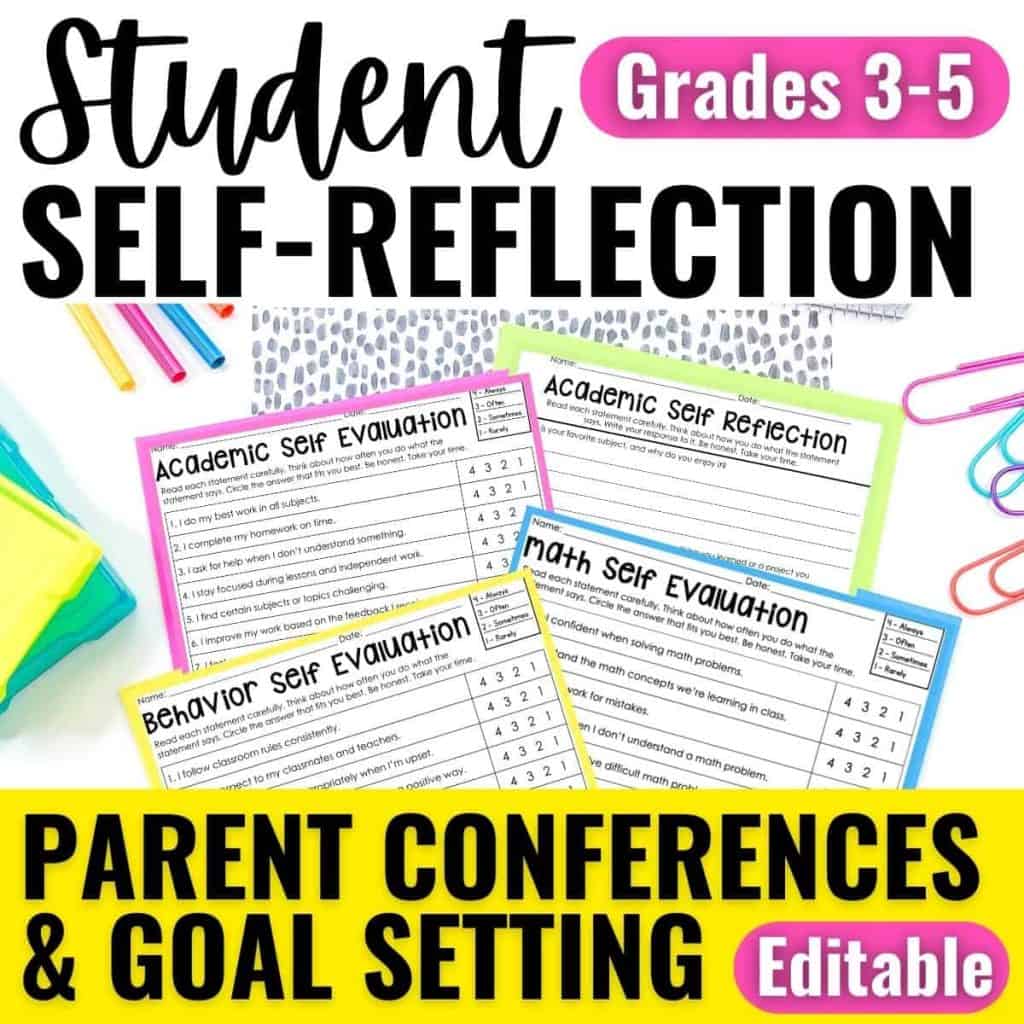
These reflections provide meaningful talking points for parent conferences and make report card comments more personalized and accurate.
Writing report card comments takes time and mental energy that teachers don’t have in unlimited supply. Use these report card comment examples as a starting point, then add one detail that reflects the student’s growth this grading period. A few clear, supportive sentences can help families understand progress and help students feel seen.
If you need more targeted language, use my report card remarks for struggling students for specific academic and behavior support.
Jessica BOschen
Jessica is a teacher, homeschool parent, and entrepreneur. She shares her passion for teaching and education on What I Have Learned. Jessica has 16 years of experience teaching elementary school and currently homeschools her two middle and high school boys. She enjoys scaffolding learning for students, focusing on helping our most challenging learners achieve success in all academic areas.