
Earth’s Spheres Science Stations for 5th Grade (NGSS Earth Systems Centers)
Looking for a way to teach Earth’s systems without relying on another worksheet packet? These Earth’s spheres science stations give your students a hands-on way to explore how the geosphere, hydrosphere, atmosphere, and biosphere interact.
These Earth’s spheres science stations are designed specifically for 5th-grade classrooms and align directly with NGSS Earth systems standards.
They help students move beyond memorizing vocabulary and start thinking about how Earth’s systems work together. Each station focuses on a different type of task, so students stay engaged while building a deeper understanding of key science concepts.

Whether you use them in rotations, small groups, or as part of your full science block, these Earth’s spheres science stations make it easier to teach complex ideas in a structured, manageable way.
If you need a simple explanation of the spheres before starting, read this overview of Earth’s spheres.
What’s Included in These Earth’s Spheres Science Stations
These Earth’s spheres science stations give students multiple ways to explore how Earth’s systems interact.
Students will:
- learn how the four spheres affect each other
- analyze real-world examples of interactions
- explore how systems create changes in landforms and ecosystems
- build understanding of atmosphere layers, biosphere kingdoms, and geosphere processes
Each station is designed to be hands-on, structured, and easy to implement in your classroom.
The stations are designed to help students understand how the Earth’s four spheres interact.
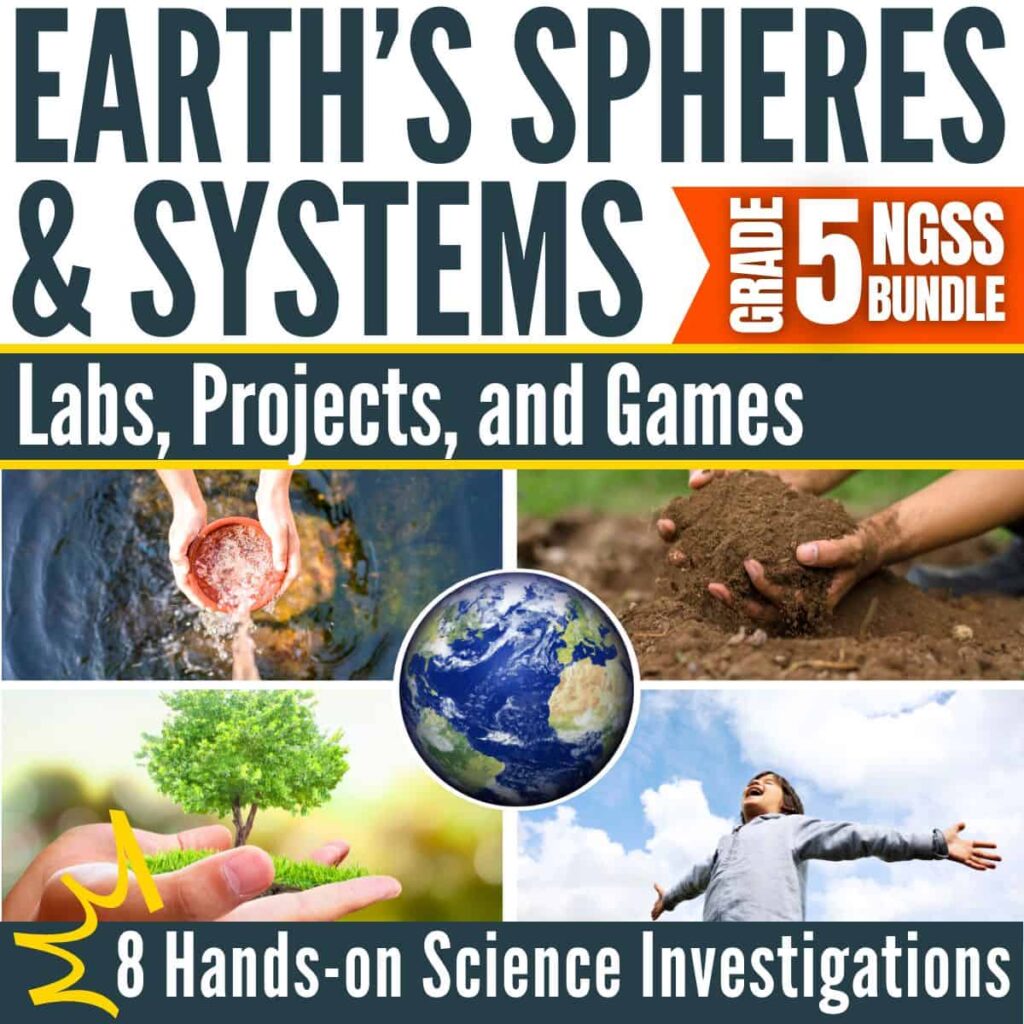
Earth’s Spheres and Systems Science Station UNIT BUNDLE
These Earth’s Spheres and Systems Next Generation Science Stations include eight different science stations where students deepen their understanding of the Earth’s Spheres, the five layers of the atmosphere, the kingdoms in the biosphere, and the systems in the geosphere. The focus is on 5-ESS2-1.
NGSS Alignment for Earth’s Spheres Science Stations (5-ESS2-1)
These science stations are built directly around NGSS 5-ESS2-1:
Develop a model using an example to describe ways the geosphere, biosphere, hydrosphere, and/or atmosphere interact.
Students are not just identifying the spheres—they are modeling interactions, analyzing cause and effect, and applying their understanding to real-world scenarios.
Types of Earth’s Spheres Science Stations Included
Watch Station
Students watch short videos about Earth’s spheres and answer differentiated questions to reinforce key concepts.

Play Station
Students review concepts through a board game, a crossword puzzle, and a word search. Digital versions are also included for independent practice.
With its engaging format and interactive content, it promotes a fun and effective learning experience.


Investigate Station
Students explore how the hydrosphere causes weathering and erosion in the geosphere through hands-on investigation. By recreating the environmental challenge, they identify and solve issues that withstand the hydrosphere’s forces.


Diagram Station
In this station, students focus on how the biosphere and hydrosphere interact within ecosystems.
Students are assigned an ecosystem and given scenarios describing changes within that ecosystem, such as shifts in rainfall or water availability. They analyze how those changes impact plants, animals, and the overall ecosystem.
Using this information, students create a diagram that shows how the ecosystem changes over time. They label key parts of the biosphere and hydrosphere and illustrate how organisms adapt to survive under new conditions.
This activity helps students visualize how water influences living things and reinforces the idea that Earth’s systems are connected and constantly changing.


Read Station
In this station, students build background knowledge of Earth’s four spheres and their characteristics.
Students read an informational passage that explains the geosphere, hydrosphere, atmosphere, and biosphere, including how each system functions and connects to the others. After reading, students demonstrate their understanding using either a worksheet or task cards.

Model Station
In this station, students explore how the geosphere and biosphere interact.
Students are assigned a specific landform, such as a mountain, plateau, hill, or plain, and use a reading passage (and optional research) to identify its key features and the types of organisms that live there.
Next, students analyze a scenario where a change occurs in the geosphere. They determine how that change impacts the organisms in the biosphere and explain the cause-and-effect relationship.
To apply their understanding, students create a three-dimensional model that shows the landform after the change. This activity helps students connect Earth’s physical features to living systems and see how changes in one sphere affect another.


Explore Station
In this station, students investigate how the geosphere affects the hydrosphere, with a focus on mountains and rainfall.
Students read about how wind patterns move clouds and how mountain ranges influence precipitation. They learn how elevation and terrain can impact where and how much rain falls.
Using a data table of towns near a mountain range, students graph precipitation levels and analyze how elevation affects rainfall. This activity helps students connect landforms to weather patterns and understand how Earth’s systems work together.


Sort Station
In this Sort Science Station, students read a passage about Earth’s four spheres. They sort scenarios by how the spheres affect one another.
Students sort scenario cards into groups that describe the two spheres affected in the scenario, for instance
- atmosphere and biosphere
- atmosphere and geosphere
- atmosphere and hydrosphere
- biosphere and hydrosphere
- biosphere and geosphere
- geosphere and hydrosphere
Here are a few examples. Can you determine how to sort them?
- A canyon is formed when rivers weather and erode the rocky surface over many years.
- Water in rock cracks expands when it freezes. Over time, the cracks widen until the rock crumbles.
- If an area floods, many plants and animals cannot live there.
You can also use this Earth’s spheres card sort as a quick review activity.

Built-In Differentiation for Every Science Station
Differentiation is built into every Earth’s spheres science station so all students can access the content. Each station includes multiple response options so you can easily meet the needs of different learners:
- short answer
- fill-in-the-blank
- task cards
- multiple choice
You can assign different formats to different groups or allow students to choose based on their level of independence.
Choose fill-in-the-blank exercises for students who struggle with reading. But go for short-answer exercises only if they can craft responses on their own. Remember, short-answer exercises are the most challenging.
Posters, Vocabulary, Reading, and Digital Components
Like all our science stations, the Earth’s Spheres and Systems stations come with Big Idea posters, vocabulary cards, reading passages, and digital components.
Earth’s Spheres Posters
The posters explain the core science ideas students will learn in this unit of study.
Some of the Big Ideas include:
- The hydrosphere is controlled by the water cycle.
- The geosphere is shaped by three processes: (1) plate tectonics; (2) rock cycle; (3) weathering, erosion, and deposition.

Vocabulary Cards
This resource provides two sets of vocabulary cards. The first has both pictures and word definitions and can be cut apart for use in science centers so students can match the cards. The cards are designed to fit perfectly in pocket charts!


Reading Passages
Reading passages are included in all stations, except the Watch and Play stations. Although optional, they help students build foundational knowledge and reinforce key concepts. Students can use the reading passages to build background knowledge before completing each station.
Google Classroom Components
All our fifth-grade science stations come with components that integrate easily with Google Classroom. Google Forms and Google Slides are included for most stations.
- A Google Form™️ with Reading Passage & Differentiated Questions is available for the Watch, Investigate, Diagram, Read, Model, Explore, and Sort stations.
- Google Slides™️ with Activity Directions & Worksheets are available for the Investigate, Diagram, Model, Explore, and Sort Stations
While the majority of our hands-on activities require physical components, we have made it easy by including clear directions and recording sheets in Google Slides.
Why Teachers Use These Earth’s Spheres Science Stations
These Earth’s spheres science stations are designed to make teaching Earth systems more manageable and engaging.
Teachers use these stations because they:
- Save prep time – Everything is ready to print and use, so you’re not scrambling to pull together activities
- Provide structure – Each station has a clear purpose, which helps your science block run smoothly
- Support NGSS alignment – The stations are built around 5-ESS2-1, so you know you’re targeting the right skills
- Keep students engaged – Students are actively working, discussing, and thinking instead of passively completing worksheets
- Work in any classroom setup – Use them for rotations, small groups, or even whole-class instruction
Instead of trying to piece together lessons, you have a complete system that helps students understand how Earth’s spheres interact in a meaningful way.
How to Use These Science Stations in Your Classroom
One of the best things about these Earth’s spheres science stations is how flexible they are. You can adjust them based on your schedule, your students, and how you like to run your classroom.
Here are a few simple ways to use them:
- Science Station Rotations
Set up each station around the room and have students rotate through them over several days. This works well if you want students to experience all types of activities. - Whole-Group Instruction
Use one station at a time as a whole-class lesson. This is a great option if you’re introducing new concepts or modeling expectations. - Small Group Work
Pull a group of students to work through a station together while others work independently. This is helpful for guiding discussions and supporting students who need more help. - Review and Reinforcement
Use the stations after teaching Earth’s systems as a review before an assessment. The variety of tasks helps reinforce concepts in different ways.
You don’t need a long science block or complicated setup. Start with one or two stations, build routines, and add more as your students get comfortable.
How to Purchase the Fifth Grade Earth’s Spheres and Systems Science Stations
The Earth’s Spheres and Systems Science Station Unit can be purchased on my website or on Teachers Pay Teachers.
Earth’s Spheres and Systems Science Station UNIT BUNDLE
These Earth’s Spheres and Systems Next Generation Science Stations include eight different science stations where students deepen their understanding of the Earth’s Spheres, the five layers of the atmosphere, the kingdoms in the biosphere, and the systems in the geosphere. The focus is on 5-ESS2-1.
Other Fifth Grade Science Stations
We have fifth-grade science stations for all the NGSS Standards. Click below for information about each one!
-
 Product on sale5th Grade NGSS Science Station Yearlong BUNDLEOriginal price was: $316.00.$177.87Current price is: $177.87.
 -
-
-
-
-
-
-
-
-
-
-



Jessica BOschen
Jessica is a teacher, homeschool parent, and entrepreneur. She shares her passion for teaching and education on What I Have Learned. Jessica has 16 years of experience teaching elementary school and currently homeschools her two middle and high school boys. She enjoys scaffolding learning for students, focusing on helping our most challenging learners achieve success in all academic areas.