
50+ Force and Motion Activities to Teach Balanced & Unbalanced Forces & Patterns in Motion
Are you looking for force and motion activities? Ever wonder how you could teach force and motion in a way that brings science alive for your students? Wish you had a ready-made list of helpful ideas, resources, and lesson plans for teaching force and motion and patterns in motion that align with Next Generation Science Standards? Wonder and wish no more. I’ve got you covered with these Force and Motion Activities!

This post is full of ideas, images, and fun experiments for your students to use while exploring force and motion or patterns in motion.
Force and motion is one of the core 3rd grade physical science standards. For a complete look at how it connects to the rest of the NGSS physical science progression, check out my physical science guide for elementary students.
NGSS Third Grade Forces and Interactions Science Standards
For all of our science resources, we follow the Next Generation Science Standards. The NGSS are the national standards for science and many states have adopted them as their state standards. The NGSS also gives us a solid foundation on which to build our grade-level lessons that will meet the needs of most teachers across the US.
We wrote a blog post on How to Read the Next Generation Science Standards that outlines where to start when reading, interpreting, and teaching the NGSS. It is a great place to start if teaching with the NGSS is new for you.
Which NGSS are in these Force and Motion Ideas and Resources?
The ideas and resources in this blog post align with the Next Generation Science Standards for Third Grade 3-PS2 Motion and Stability: Forces and Interactions. For this blog post, ideas and activities for 3-PS2-1 (balanced and unbalanced forces) and 3-PS2-2 (patterns in motion) are combined.
| NGSS Science Dimension | 3-PS2-1 Force and Motion | 3-PS2-2 Patterns in Motion |
|---|---|---|
| Performance Expectation (PE) | Plan and conduct an investigation to provide evidence of the effects of balanced and unbalanced forces on the motion of an object. | Make observations and/or measurements of an object’s motion to provide evidence that a pattern can be used to predict future motion. |
| Disciplinary Core Idea (DCI) | PS2.A: Forces and Motion Each force acts on one particular object and has both strength and a direction. An object at rest typically has multiple forces acting on it, but they add to give zero net force on the object. Forces that do not sum to zero can cause changes in the object’s speed or direction of motion. PS2.B: Types of Interactions Objects in contact exert forces on each other. | PS2A: Forces and Motion The patterns of an object’s motion in various situations can be observed and measured; when that past motion exhibits a regular pattern, future motion can be predicted from it. |
Okay . . . that is the technical stuff. Now that it is out of the way . . . we can focus on how to teach force and motion and how to teach patterns in motion.
Force and Motion 5E Units & Science Stations
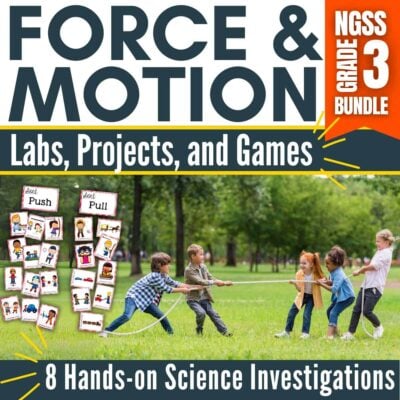
We teach about force and motion through our 5E Units and Science Stations. We have two 5E Units that are separated by the performance expectations above and one set of science stations that combines them.

5E Units for Balanced and Unbalanced Forces & Patterns in Motion with 30 Activities
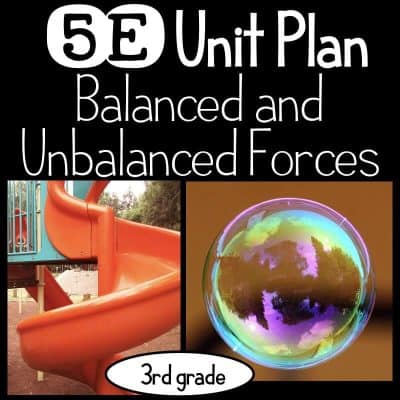
We have two 5E units for force and motion: Balanced and Unbalanced Forces and Patterns in Motion. Each unit follows the 5E Instructional Model, which has five components and each section has three force and motion activities.
Between the two units, there are a total of 30 different activities that follow the 5E model:
- Engage
- Explore
- Explain
- Extend
- Evaluate.
Refer to the 5E Units blog post to find out more information about the units. Below are a couple of pictures from the Forces and Motion Unit.

The above photo is part of the Explain section where students learn about forces.

The above photo is from the Extend section where students play a science review game about force motion with classmates asking and answering questions about forces.
Science Stations: 8 Force and Motion Activities
We also have 8 Different Science Stations for Force and Motion. The science station units include vocabulary cards and 8 stations. Each station engages students in hands-on activities designed to experience force and motion science concepts.
During the Force and Motion Science Stations, students engage in the following force and motion activities:
- Watch one of two videos (see below)
- Play one of two video games (see below)
- Investigate Balloon Races
- Diagram a New Slide
- Read about Force
- Model a Ball Track
- Explore Pinwheels
- Sort Push and Pull forces
Here is an example of the Balloon Races. In this Investigate station, the teacher sets up a string between two sets of chairs with a straw attached to it. Balloons are attached to each, blown up, and then let go. Students race to see which balloon finishes first.

Additional Lesson Ideas for Teaching Forces and Motion and Patterns in Motion
While we have written resources for teaching Force and Motion and Patterns in Motion, there are many more fun force and motion project ideas that you can use in your classroom without purchasing our units and science stations. Below are more awesome force and motion activities, demonstrations and experiments, books, and videos to enhance your science lessons about force and motion.
Create Force and Motion Anchor Charts with Your Students
One of the first things we do with students is to create force and motion anchor charts to show students the big ideas or main concepts you want them to understand for each scientific concept. Samples of these anchor charts are included in our 5E units.
Balanced and Unbalanced Forces Anchor Chart
The anchor chart for Balanced and Unbalanced Forces focuses on these concepts:
- Forces can be balanced and unbalanced
- Unbalanced forces make objects move
- Balanced forces make objects sit still
- A force is a push or a pull on an object
- More than one force can act on an object
- Friction slows an object down
- Gravity is a force that pulls things down to Earth
These are the same big ideas that are included in the 5E Units.

Patterns in Motion Anchor Chart
Below is the anchor chart for Patterns in Motion. It focuses on these key ideas:
- A force is a push or a pull on an object
- Some things have a pattern in their motion
- A pendulum is a weight. It hangs from a fixed point
- Friction is a force that slows things down
- Gravity is a force that pulls things down to Earth

11 Demonstrations and Experiments for Learning About Force and Motion
Below is a list of a variety of FREE and easy force and motion experiments, activities, and ideas to teach students about force and motion and patterns in motion. These can be adapted for different grade levels, but focus on middle elementary grade students. These are great force and motion activities 3rd grade that teach force and motion.
Some of the below ideas could also become engineering challenges for students if you present them with open-ended questions, and materials and allow time to explore and create.
Set up Dominoes
Setting up dominoes is a fun and interactive way to demonstrate the concept of force and motion. The setup involves strategically placing the dominoes in a row, with each one leaning against the next. When the first domino is pushed, it will transfer its energy to the next one, causing a chain reaction of falling dominoes.
This showcases how an initial force can lead to a series of movements in an object. Additionally, by adjusting the spacing between the dominoes, one can also explore the effects of different levels of force on motion. Overall, setting up dominoes provides a hands-on approach to understanding these fundamental physics concepts and makes for an exciting experiment for both children and adults alike.
This is a great demonstration of balanced and unbalanced forces and a way to work in some high-level science vocabulary.

Race Cars Down a Ramp
Racing cars down a ramp is a classic demonstration of force and motion. The steepness of the ramp and the weight of the car determine how far and fast it will go. As the car rolls down the ramp, it gains speed due to the force of gravity pulling it downwards.
This acceleration is an example of Newton’s second law of motion, which states that an object will accelerate in the direction of the net force acting on it. The force of gravity is countered by friction between the wheels and the ramp, as well as air resistance, which can affect the distance traveled by the car. Racing cars down a ramp not only showcases these fundamental principles but also provides an exciting and hands-on way for students to understand them better.
Consider changing variables such as using a different texture on the wheels or the ramp. Adjust the height of the ramp. And use different weights of cars. This experiment can also make a great engineering challenge.
Make a Mousetrap
A mousetrap car is a simple yet effective way to demonstrate the principles of force and motion. The basic idea behind a mousetrap car is that the snapping action of a mousetrap can be utilized to propel a small vehicle forward.
By carefully designing the car’s structure and using various materials, one can explore different ways in which force and motion interact. For instance, by adding rubber bands or changing the placement of wheels, one can observe how these modifications affect the car’s speed, acceleration, and overall movement.
This hands-on project allows students to see firsthand how forces like friction and air resistance play a role in an object’s motion. Making a mousetrap car is not only educational but also fun and engaging for all ages.
For making a mousetrap car, you’ll want to help students with the mousetrap. This is a great experiment using everyday objects to construct a car. This is also a great way to demonstrate force and motion experiments at home.
Here are a few videos to get you started:


Do an Egg Drop Activity
An egg drop activity is a popular experiment that demonstrates the concepts of force and motion. In this activity, an egg is dropped from a height and students are tasked with protecting it from breaking using only certain materials.
The goal is to apply the principles of force and motion to design a contraption that will slow down the egg’s fall and prevent it from shattering upon impact. This hands-on experience allows students to see firsthand how objects move through the air and understand the forces acting on them.
It also encourages critical thinking and problem-solving skills as students must consider factors such as air resistance, gravity, and inertia in their designs. Overall, an egg drop activity is not only entertaining but also a practical way for students to grasp the fundamentals of force and motion.
Make a Catapult
Making a catapult is a fun and educational activity that allows us to witness the principles of force and motion in action. To create a basic catapult, you will need simple materials such as popsicle sticks, rubber bands, and a plastic spoon. The process involves building a frame with popsicle sticks and attaching the spoon to one end as the launching platform.
By pulling back on the spoon and releasing it, we can see how potential energy is converted into kinetic energy, propelling an object forward. This demonstrates the concept of force as well as the transfer of energy from one form to another.
It also helps us understand how different variables such as tension in the rubber bands or size of the projectile can affect the distance and speed at which an object travels. Change variables such as the different strengths of the catapult, different lengths of levers, and different weights of projectiles. This is also a great STEM engineering challenge if students catapult into a target.
Through this hands-on activity, we can gain a better understanding of force and motion while having fun at the same time.
Make a Rube Goldberg Machine
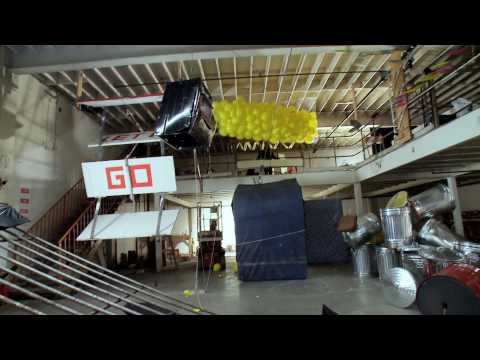
Are you ever transfixed by those videos where people create chain reactions with simple machines to complete basic tasks? That’s a Rube Goldberg Machine. This would make another great engineering challenge.
Here are a few examples from YouTube:


This is one of my favorite Rube Goldberg demonstrations. It is by a popular band, OK Go. You’ll want to watch it first, before showing it to your students but it’s an awesome video that might inspire creativity in your classroom.
Make a Marshmallow Shooter
Making a marshmallow shooter is a fun and creative way to demonstrate the principles of force and motion. Making a marshmallow shooter is a fun experiment! It’s edible, too! It requires a few pieces of PVC pipe and some marshmallows. Or you can create a simpler version with a plastic cup, a balloon, and some tape.
- First, poke a small hole in the bottom of the cup using scissors or a sharp object.
- Cut off the end of the balloon and stretch it over the opening of the cup, securing it with tape.
- Next, place a marshmallow inside the cup and pull back on the balloon, creating tension.
When you release the balloon, it will propel the marshmallow out of the cup with great force, demonstrating Newton’s third law of motion – for every action, there is an equal and opposite reaction. This simple experiment shows how potential energy from stretching the balloon is converted into kinetic energy as it pushes against air molecules to move forward. It’s a perfect way to engage children in learning about force and motion while having fun at the same time!
Here are marshmallow shooters that are made with PVC pipe. You could also have kids aim at a target or even color code the marshmallows and measure the distances.


This is a simpler marshmallow shooter that is easier to make in the classroom.

Make a Balancing Robot
Creating a balancing robot is an excellent way to demonstrate the concepts of force and motion. By designing and building a robot that can maintain its balance, students can observe how different forces affect the robot’s movement and stability.
This is an easy experiment using just paper. The link, Balancing Robot, has a printout you can download and do with your students tomorrow!
Create Marble Art
Make it a STEAM project by adding marble art. Extend the unit to learn about simple machines.
Research Newton’s Three Laws of Motion
If you want to take it up a notch and extend students’ learning, this website will help them learn about Newton’s Three Laws of Motion. It describes each law in kid-friendly language and includes links to more information about each concept.
Color Pictures About Famous Physicists
This famous physicists coloring book is a fun, FREE resource that teaches students about famous scientists, many of whom researched forces and motion.
12 Read Aloud Books to Teach about Force and Motion
We wrote an entire blog post about 12 books you can use to engage students about force and motion. You can read more about it here. Below are images of some of the books in the blog post.
These Force and Motion picture books are primarily designed for students in Kindergarten through Third grade. They offer a delightful reading experience, perfect for independent reading or for you to read aloud to them. The vivid and captivating illustrations add an extra level of engagement, making it a favorite among students.

Videos and Games about Force and Motion and Patterns in Motion
How do you introduce force and motion? Videos make a great introduction to new science topics!
We have included videos and activities for Force and Motion in our 5E Units and Science Stations. Those activities include differentiated questions to ask your students and ways for students to respond to the videos. Here are two videos and two video games that are part of our science stations.
- Watch a Video about Force and Swings, Slides & Science
- Play a Video Game about Surface Tension & Friction
The PLAY stations also include a board game, force and motion word search, and crossword puzzle.


Below are additional videos you can use in your classroom to explore and engage students in learning about forces and motion.
- Force and Motion Science Trek, PBS
- SciShow Kids (many different videos on forces and motion, about 3.5 minutes long)
- TedEd video on Newton’s 3 Laws
- TedEd video on perpetual motion machines
-

-
-
Teaching force and motion and patterns in motion can be a daunting task, but these lessons, teaching ideas, and resources will give you a head start!
Mystery Science Resources that Include Force and Motion Activities
I love using Mystery Science to enhance my instruction. Here


Hi! love your resources, thank you for posting! I was wondering if there is a way for me to download a copy of your anchor charts for my third grade classroom? I don’t think I can replicate it exactly and I love the way you made it.
They’re included in the Force and Motion and Patterns in Motion units.