
Write about Penguins – Informational Reading and Writing for Winter
Read and write about penguins in this great seasonal activity that can be done in January or December. Use it to kick off your informational writing unit. Here is how we studied penguins, extracted information from on-level text, constructed our introductory sentence, and wrote a paragraph about what we learned about penguins.

Although this isn’t the first time we’ve read and written about an animal, January is when we step up our game and become more focused on finding relevant facts, organizing our writing, and shaping it into well-rounded complete paragraphs. We use a couple of tools in our classroom, including on-level informational text, circle mind maps, fact sorts, genius paragraphs, and checklists.
How I Teach Informational Writing
I’m all about using anchor charts and helping students construct their own learning rather than using a lot of worksheets, so what you’ll see is a lot of interactive work. I have a series of blog posts that go into more detail about our process as well as a set of Informational Writing Tools and Animal Articles by Habitat that we used to write about penguins.
Find Out What Students Already Know about Penguins
Children are a wealth of information and they love showing you what they know about something. Before we even begin our reading about penguins, we sit down as a class and I let students tell me all the facts that they know about penguins.
I write down all ideas on circle mind map in the upper part of the oval. Even if an idea is incorrect, I write it down. You can see in the example below that we crossed some ideas out, corrected some misconceptions, and checked off the facts that were correct.

Read about Penguins and Find Relevant Facts
After eliciting ideas from students, we gather our facts. I provide students with a well-written, on-level piece of text about penguins. We generally read the text as a class, and as we are reading, we work with the circle mind map, editing the facts and adding additional facts that we learn.

We also watch videos about penguins and add nonfiction trade books as needed. Here is a sample of the Emperor Penguin Article, QR Codes and Fact Sort resource. Included is a one-page article in black and white, a two-page article with photos, and page of QR Codes for additional research and a fact sort page.
Use a Genius Paragraph Routine to Write our Introductory Sentence about Penguins
To make our introductory sentence a little more interesting, we use a Genius Paragraph routine. Through this routine, students are able to add in prepositional phrases and adverbial clauses that add life to the sentence.
The Blah Sentence
The Blah sentence starts with a simple noun / verb sentence. We brainstorm several blah sentences as a class like penguins swim, penguins slide, penguins eat, etc. As a class, we choose one blah sentence to develop. Our Blah Sentence was Penguins slide.
Why do we brainstorm many sentences? The key to good writing is making a lot of mistakes. By brainstorming a variety of sentences, students see how different nouns and verbs are put together and can be developed into different sentences. Although we focus on one sentence as a class, students can choose to write their paragraph about a different topic and use a different blah sentence to develop their “genius sentence”.
The Spicy Sentence
From there, we add in some more information, like adjectives for the penguins and prepositional phrases to clarify how the penguins slide. Here is some brainstorming about our “spicy sentence.”

The Extender
We make the sentence even longer by add in an extender. The extender can take on many different grammatical forms, but the basic idea is that it adds information.
You’ll notice at this point that we also specifically identified the penguin as “emperor penguin” and added an adjective for bellies. All of this was done with the class, in the moment, and suggestions were made by students. I do have a direction that I want to go (which is adding information and becoming more descriptive), but the specific ideas are from the class.

The Genius Sentence
The genius sentence becomes the introductory sentence for our paragraph. I leave it a little open ended for students to add their own flair, but give many examples orally from which to choose.

Sort Facts about Penguins
During most weeks of our informational writing unit, we also sort facts about the animal into categories. The informational article about Emperor Penguins has facts already typed up ready to be cut and sorted.


Write about Penguins – Expository Paragraph
Since we are just starting our informational writing unit, students generally take the introductory paragraph and add a couple of relevant sentences from our circle mind map. I don’t go into too much depth about making sure the information is relevant or organized. That comes later in our unit.
Right now, I want students to concentrate on reading an article, extracting information, and writing a paragraph. This is where we set the routine. We’ll refine each part of the process in our unit.
Here are a few examples of the paragraphs students wrote:


I did work with a few kiddos on crossing out some extra words. However, you will notice that I did not address the idea of inserting an opinion in informational text. We did address that later in the unit, but that was not my focus for this week of writing.
Penguin Craft Project for Final Drafts
Last year we created these cute penguin craft projects to display our writing.

We glued the paper to a black piece of paper and cut out the parts of the penguin from construction paper.

Overall, students did a great job during their first week back from a long holiday break. We were able to read an expository text, gather facts together from a variety of sources, write a topic sentence and finish a paragraph!
Resources Mentioned In This Blog Post
Although I tend to co-create the tools my students use when reading and writing about informational text, we do rely on a few printed resources. Here are the resources mentioned in this blog post.
- Emperor Penguin Informational Article (TpT)
- Antarctic Animals Informational Article (TpT)
- Animal Articles Bundle (TpT)
- Informational Writing Tools (TpT)
- Books (affiliate links below) – I rely mainly on the informational article that I have written, but I also make other books available to my students. Here are a few of our favorite informational books about penguins:
Are you interested in a FREE resource for your Informational Writing Unit? Click below for a FREE Informational Article about Caribou. This Animal Article includes a two-page article with color photos, a one-page article with only text, QR codes and a fact sort.
Do you need engaging informational texts that your elementary students will actually want to read?
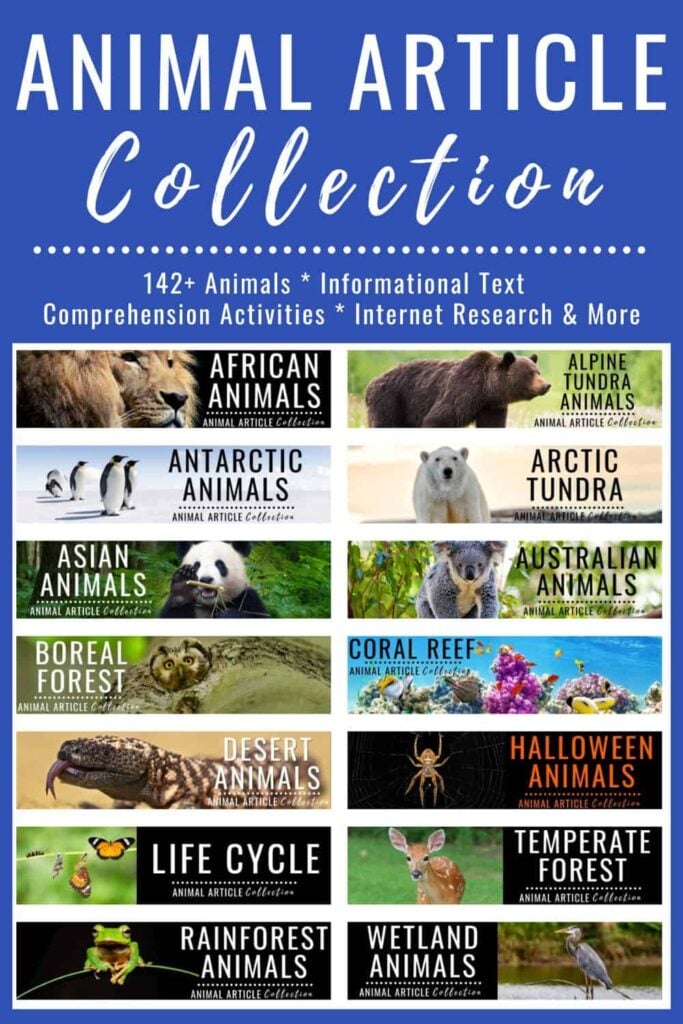
The Animal Article Collection includes 142+ animal articles spanning 14 ecosystems, complete with reading comprehension and structured writing activities. Students can choose their animal while building skills in informational text, research, and report writing.
Jessica BOschen
Jessica is a teacher, homeschool parent, and entrepreneur. She shares her passion for teaching and education on What I Have Learned. Jessica has 16 years of experience teaching elementary school and currently homeschools her two middle and high school boys. She enjoys scaffolding learning for students, focusing on helping our most challenging learners achieve success in all academic areas.