
Why “Keyword” Strategies for Word Problems Don’t Work

As an elementary school teacher, you know all too well the importance of helping your students develop their math skills. As a result, many of us have embraced the use of word problem keywords to represent problem-solving operations in order to instill mathematical confidence – but is this the best approach?

In this blog post, we will explore some potential issues that can arise when using keyword methods for solving word problems – and what other strategies we can use instead. By understanding these issues more deeply and striving for mastery rather than just memorizing key phrases, we aim to equip our children with effective problem-solving tools that will help them succeed not only now but as they move through life — and ultimately become confident mathematicians who give it their very best shot!
When I first started teaching, I used to display lists of word-problem keywords for students to use when solving problems. I thought this was the best idea ever. Give students something to look for when reading word problems to know when to add, subtract, multiply, or divide. Genius. Or so I thought.
Five years later, I learned about problem types and got deep into the work of Children’s Mathematics: Cognitively Guided Instruction (affiliate). I learned that students should be taught how to understand the context of a word problem, not to look for keywords.
This revolutionized my thinking about how I was teaching word problems. I highly recommend the book because of the videos. It was so interesting to watch how children were solving problems and to see what was going on in their heads.
What are Keywords in Word Problems?
Word problem keywords are words or phrases that tell the students which operations (addition, subtraction, multiplication, or division) are needed to solve a word problem. Using keywords, students are training their brains to look for specific words and phrases to determine what mathematical operations are needed.
Here is a list of common word problem keywords that students are taught to find for each operation:
Addition Keywords
add
altogether
both
combine
in all
increase
larger
larger than
longer
longer than
more
more than
perimeter
plus
sum
together
total
Subtraction Keywords
How many less…?
How many more…?
change
decreased
difference
fewer
gave away
left
leftover
less
less than
minus
remain
shorter than
smaller than
take away
Multiplication Keywords
area
cubed
double
each
groups
per
product
quadruple
rows
squared
times
triple
Division Keywords
average
divide
each
equal group
fourth
half
quarter
quotient
ratio
share
separate
split
third
Why shouldn’t teachers teach students to use keywords for word problems?
Word problems are a great way to engage students in mathematical thinking. The experience should not just be about finding keywords, following rote procedures, and computing correct responses.
When solving word problems, it’s important for kids to apply multiple strategies to make sense of the problem. These experiences need grounding in mathematical strategies rather than calculations by finding the keywords.
Teaching students to look for keywords in word problems teaches them to bypass the context of the word problem. Students don’t read the problem to understand; instead, they look for specific words that might help them solve it.
Not all keywords work in all instances. Math problem-solving words provide a pathway, but not a guaranteed way to solve the problem. Younger students will internalize the keywords and think that they always mean a specific operation.
How do I teach students to solve word problems without using keywords?
You can read all about how I teach math word problems and pick up a freebie of the word problems I use in my classroom.
In this blog post, I’m going to give you a few examples as to why teaching students how to look for keywords just doesn’t work and sets students up for failure in the long run. Ready to get started?
A quick Google search landed me on these definitions for addition and subtraction:
Addition: The total amount of two whole numbers combined.
Subtraction: Removing objects from a collection.
Those are the most basic definitions I could find. Keep them in mind as we explore some addition and subtraction word problems and how keywords are used or not used for solving them.
As I do for my classroom, I’m going to remove the numbers in the word problems so that you can concentrate on the words in the problem.

This post on how to teach word problems shows you want to do instead of using keywords.
Different Types of Addition & Subtraction Word Problems
There are nine different types of word problems for addition and subtraction. Below are examples of each one and a brief explanation of why teaching students to use keywords in word problems can be problematic when solving word problems.
Join Problems
JRU (Join Result Unknown)
There were _____ kids on the playground. ____ more kids came onto the playground. How many kids are on the playground?
JCU (Join Change Unknown)
There were ____ kids on the playground. Some more kids came to the playground. Now there are ____ kids on the playground. How many kids came to the playground?
JSU (Join Start Unknown)
Some kids were on the playground. ____ kids came on the playground. Now there are ____ kids on the playground. How many kids were on the playground at the beginning?
All of the above problems are joint problems, meaning the operation is addition, although the unknowns are in different places in each problem. The first two are the most basic problems that you would introduce to kindergarten and first graders. Even second graders solve these types of problems, but with more difficult number combinations.
Did you notice that none of the problems have traditional keywords? However, notice the verb phrase in all the problems that reveals that the problems are join problems are: came on. This set of words can be acted out in a classroom, as simple as using hand motions.
When I set up students to understand the context of a problem. We act out the problem. I emphasize that students are looking for the action of a problem and an unknown. Students can use any strategy to find the unknown. Some students may actually subtract for the last two problem types, but I’d bet that most of my students would count up from the start for the JCU problem.
When students can identify the action of the problem (which is the operation) and the unknown (what they are solving for) they are set for success.
Separate Problems
SRU (Separate Result Unknown)
There were ___ kids on the playground. ____ kids went home. How many kids are left on the playground?
SCU (Separate Change Unknown)
There were ___ kids on the playground. Some kids went home. Now there are ___ kids on the playground. How many kids went home?
SSU (Separate Start Unknown)
There were some kids on the playground. ____ kids went home. Now there are ___ kids on the playground. How many kids were on the playground at the beginning?
Like the Join problems, these separate problems are best learned through identifying the action and placement of the unknown. Number lines are one of the best tools I have found for teaching word problems. Students can physically act out the math on a large number line or draw their own open number lines for larger numbers.

Part-Part-Whole Problems
WU
There are ___ boys on the playground and ___ girls on the playground. How many kids are on the playground?
BAU (this is possible combinations, which is not often taught in the lower grades)
There are ___ kids on the playground. How many could be boys and how many could be girls?
PU
There are ___ kids on the playground. ___ of the kids are boys and the rest are girls. How many girls are on the playground?
Manipulatives are a great resource for part-part-whole problems. As students begin to understand that one color of an object represents one part and another color another part, they can see how the parts come together and get broken apart.
Compare Problems
Compare word problems are the most difficult for students as it is all about comparing the relationship of the numbers. It is the most abstract.
DU
There are ___ boys and ___ girls on the playground. How many more boys than girls are there? (Change more to fewer or difference. It’s the same type of problem but gives students a chance to practice different vocabulary.
CQU
There are __ more boys than girls on the playground. There are ___ girls on the playground. How many boys are on the playground? (Change the more to fewer for a variation).
RU
There are ___ more boys than girls on the playground. There are ___ boys in the playground. How many girls are on the playground? (Again, change out more for fewer)
In all the examples above, can you pick out which keywords were used? Not many. The point? Students cannot depend on keywords to solve word problems and instead need to learn how to identify the action of the problem and figure out the unknown in the problem or what is missing in the word problem.

Addition and Subtraction Word Problems: Teach the Types of Word Problems
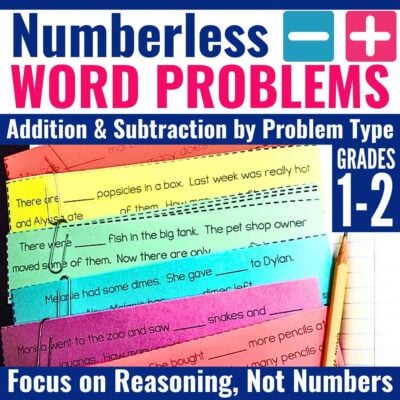
Master addition and subtraction word problems with this year-long resource! Covers all types of word problems, including first grade addition word problems and 2nd grade subtraction word problems, with built-in differentiation, models, and vocabulary support.
When can students use keywords to solve word problems?
Identifying the keywords in a problem can be one of many strategies that students use to help them solve single and multi-step word problems. However, it is not a strategy they should be taught before experiencing all of the other strategies across multiple types of word problems.
Keywords and their use should be discovered by students. Lists should be created with students as they discover the keywords. They should also note the instances when a specific keyword doesn’t work in a problem.
This type of thinking about word problems generally doesn’t happen until elementary students are in the upper grades. They need enough reading comprehension to step outside of the word problem and analyze how the words are used within it.
What about Multiplication and Division Word Problems?
Multiplication and division word problems also have problem types, just like addition and subtraction word problems. When students look for multiplication keywords or division keywords in problems and don’t read the context of the problem, they run into issues with the relationship of the numbers.
Another Resource for Teaching Students to Solve Word Problems
Another good book on the top is John Van De Walle’s Teaching Student-Centered Mathematics (affiliate). There are several books, some for K-2 and some for 3-5. If you’re a second and third-grade teacher I highly recommend checking out both books because you have kiddos that will spend the grad levels.
I’d love to hear about how you help your students solve word problems. Do you have something that works really well for your kiddos? Leave a comment and tell me about it below.
Frequently Asked Questions about Word Problem Keywords
Free Addition & Subtraction Word Problems
Do you want a free sample of the word problems I use in my classroom?
Teaching Resources for Word Problems
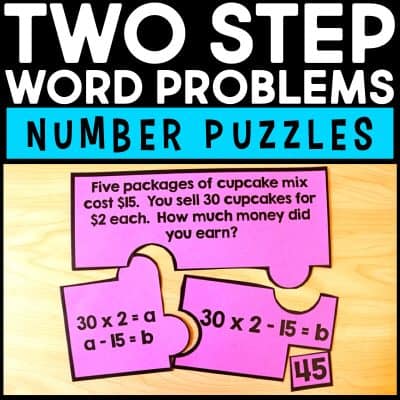
Are you looking for some resources to help you teach word problems? Check out the word problems resources below of on TpT.
-
 Product on saleWord Problem by Problem Type BUNDLEOriginal price was: $48.50.$38.80Current price is: $38.80.
 -
-
-
-


YES! I totally agree! The book we read this yer and did most of our PD on was very similar to this!
I have been researching and preaching the same message this year. It is amazing the difference it makes to teach students about word problems and their structure within problem types. My students actually “think” while they are solving the problems. Keep up the message and children will benefit.
At a conference several years ago, a speaker made the point that if students could create “verbal models” for word problems, they were able to generalize and solve all types of similar problems. The speaker was referring to Algebra 1-level problems, but it certainly could be used here. In a “verbal model,” you are allowed to use boxes, words and operation symbols, but not numbers. It’s hard to show here in this text-only mode, but the playground problems could be:
[number of children on playground at start] + [number of children who came on] = [total number of children on playground]. This applies to all of the “join” problems; it’s just a matter of which “[box]” is the variable. I’ve used this very successfully with 7th and 8th grade Algebra 1 students!
Yes yes yes! I totally agree! I used to use those words too until I realized that it just confuses them! They think it’s their easy way out of actually understanding a word problem, and instead, they just look at the numbers and the key words and get the answers all wrong! Great post!
Our district provided a training a few weeks ago for our new math adoption, Go Math, that was being given by one of the authors Juli Dixion. Most of the staff from my school went and they were amazed. Several of the teachers in my group had posters and bookmarks with the key words and realized that they need to take them down. Once they saw the activity we did about the different types of word problems they understood why some of their students still were confused and had a hard time solving word problems. The presenters suggest that we try to create some of each type throughout our units so students can feel more secure. What a great workshop and there was a lot of information that I feel is going to lead to some great changes at my school this next year! Thank you for sharing.
HI, I am a home school parent and I have read every one comments. I have a 5th grader whom I struggle with teaching him the correct way to learn math, such as in geometry, or algebra. Also the books you all talked about, can they be checked out of a library? If anyone has a simply way of teaching these two things please help, I am up for all advice. Thank you!
I’m not sure if the books can be checked out from the library. Maybe if you have a teacher education program at a local university, that library might have the books, but they probably won’t be at a general, local library. Most libraries have online search systems, so it’s worth a look.
As for the correct way or a simple way to learn or teach geometry or algebra for fifth grade, I’m not sure I can offer much advice in that area. There’s some pretty complicated mathematical concepts in those two strands that need to be developed with a ton of hands-on application. There’s no easy answer or resources I can point you to that encompasses it all. As a homeschooler, you might want to look into a full program that has a scope and sequence of instruction for each grade level.
Shelitha, have you ever used Kahn Academy with your child? It is an online resource that is free and has video lessons and practice and the students earn coins/points. There is also Learn Zillion, another good online resource that is mostly free.
I, and my team, have been discussing this lately; this is the best explanation I’ve seen of how to help the kids. Thanks!
Question: (hope I’m not the only one) What do BAU, DU, CQU and RU stand for?
Never mind…I got it!
You have some great posts that are incredibly helpful for a first year math teacher like myself. Thank you for sharing your expertise with us all, that’s what teaching should be all about – sharing the knowledge for the sake of the children! I really like your anchor charts and strategies thought I had to admit it took me a while to understand the adding to subtract without using the number line to model. I wonder if all these strategies confuse students more in the long run. I would like to know if you go through every strategy on your anchor chart on one lesson or model one, have them practice and continue with the next one another day? I’m really just so new to all of this and it’s hard to imagine the process a skilled teacher like yourself goes through when I see these wonderful anchor charts. Thanks for your help.
Hi, Sandra,
We approach using different strategies in different ways. If a student is telling about how he / she solved a problem and uses a specific strategy, we will name the strategy and apply it to a variety of problems, like these Number Lines. If I am formally teach a specific strategy, I will only teach one a day, even one every few days with a lot of practice. However, if we pulled a math problem out of some work we’re doing and are solving it, I’ll generally just use a strategy that is logically for the math problem. This work with the number of pumpkin seeds is a great example of a math problem that we pulled from work we did in another content area. The anchor chart is something we create mid-way through the year to summarize the strategies we’ve learned so far. As students become more and more fluent at using a variety of strategies, we discuss how some are better for certain types of problems and that students needs to choose strategies that work best for them.
Thanks so much for the reply. What you explained makes perfect sense. I can visualize it now to try and replicate with my kiddos.
I am teaching math intervention to 3rd graders and I have struggled with the idea of giving them the CUBES strategy because those math action words don’t always appear in the problem OR it’s misleading. I love your article! Question: do you actually teach the students the terms for the types of problems (join change unknown, etc) or is that just for your teacher reference?
I’m not familiar with the CUBES strategy. To answer your question, it depends on the grade level. I tend to use the labels for what is happening in the problem, like start, change, result, or compare, more / less, part, whole. I don’t necessarily label problems as join problems with students, but we do talk about how the two groups are joined together (or whatever the action is within the problem).
This is not an either-or problem, but both-and. Using key words to solve word problems is one of many strategies that helps students to learn to comprehend and solve word problems. It may help some students to look for key words, and, if they are there and indicate the operation, then great. I have noticed that use of key words still persists in much Common Core-aligned material, in which cases the key words still traditionally indicate the operation needed to solve the word problems. But if there are no key words in word problems, then students may be taught OTHER strategies to help them comprehend them.
Thank you for your comment and feedback.
The problem arises when students are only taught to look for keywords and when keywords misdirect students or are not included in the word problem. I don’t consider teaching students to look for keywords to be a strategy as much as a shortcut that sometimes works. What you indicated above is that the teaching of keywords comes first and that the OTHER strategies, including the context of the word problem, come second. I would reverse that and teach context first and, if students discover patterns in the words, then have a discussion about similarities of words within certain problem types, with a warning that the generalization doesn’t always work. This way, students have ownership over the discovery of the pattern, it sticks with them in their long term memory, and they have a solid foundation of context.
Another thing to consider is that in elementary school we teach fairly easy word problems. Even the two-step and multi-step word problems aren’t too difficult. However, students encounter more difficult problems in middle and high school. Searching for keywords often doesn’t work with more complex problem.
Mind blowing! This makes so much sense, and especially how our math curriculum uses vocabulary now. This is so simple in teaching word problems! I unintentionally started doing this and now I have a why behind it! Great info.