
Compare Word Problems – How to Teach Students to Solve Them
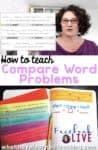
Compare word problems can be some of the most difficult addition and subtraction problems for students to solve. In this type of problem, students are asked to compare two groups of objects and determine which group has more/less/the same. This can be a difficult concept for students to grasp, but with some careful instruction and practice, they can master it!

Do your students struggle with word problems? What about those really hard ones: compare word problems? This is the most difficult addition and subtraction word problem by problem type.
Here are some tips for teaching students to solve compare word problems:
Use Real-World Problems
Teach students how to compare objects by using real-world examples. In our second-grade classroom, we measure our hands and feet and then spend quite a bit of time comparing those measurements.
We attach mathematical language to the activity and help students see how the words more than and less then relate to the measurements. We also show students how those terms can be changed around in the question and answer and the importance of really reading the question.
Model Compare Word Problems
One of the best ways to teach students to solve compare word problems is to model the process for them. Show them how you would approach the problem and think aloud as you work through it. This will help them see that there is a method to solving these types of problems.
Write out a few examples on the board and have students work through them as a class. Then, have students work in small groups or pairs to solve additional problems. Finally, allow students time to work independently on a few problems. By the end of the lesson, students should have had ample opportunity to see and solve compare word problems.
Use Manipulatives
Encourage students to use manipulatives. Many students find it helpful to use manipulatives (e.g., counters, linking cubes, etc.) when solving compare word problems. Manipulatives can help solidify the concept for some students and make the problem-solving process less abstract.
Compare Word Problems – Facebook Live
I have a great Facebook Live where I show you the differences between the Compare problems types. You can watch the Facebook Live below or visit this link to see it on Facebook.
Some other Word Problem Resources
- Join Word Problems – Facebook Live
- Separate Word Problems – Facebook Live
- Addition & Subtraction Word Problems by Problem Type – Product Overview
- 5-Tips: How to Teach Students to Solve Word Problems
- The Problem with Using Keywords to Solve Word Problems
Free Word Problems Sample
Do you want a free sample of the word problems I use in my classroom?

Great website that promotes higher level thinking.
What an amazing presentation! Thank you for sharing your knowledge and using technology so efficiently to model how to solve different comparison word problems.
Thank you for taking the time to create resources that help us teachers be more effective when teaching math concepts/skills! You are awesome!
Thanks Jessicca for sharing such a great tips for the World and students to solve the compare-world problem
Do you have videos on part part whole word problems?
No, sorry. It’s just the one I never got around to doing on video for. It’s also the easiest problem type and generally introduced in Kindergarten with real-world objects that move to students draw the problems. As students progress, they move from objects > drawings > models (like bar-models). The number line will be similar to join / separate / compare, depending on what is known / unknown. However, since there is no movement or comparison, students may choose to use a different strategy to solve the problem.
Do you sell your Word Problem teaching Videos? I would like to be able to view them without having to go to the website. I have learned so much from your videos, please make them available to us.
I have a course on How to Teach Word Problems. You can find out more about it here: https://premium.whatihavelearnedteaching.com/word-problems-course/