
Join Word Problems – Solve Word Problems by Problem Type
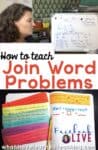
When it comes to teaching students how to solve word problems, one effective approach is to help them develop an understanding of the context in which the problem is presented. Join Word Problems, which involve combining or adding elements, are often considered the easiest type of word problem.
However, they play a crucial role in establishing a strong foundational understanding that will benefit students as they delve into more complex problem types in the future. By focusing on these join word problems, students can gain confidence and build essential problem-solving skills that will serve them well throughout their academic journey.
Below is a video that I recorded on this topic. The text below has some highlights from the video, but the video goes more in-depth.

Three Types of Join Word Problems
There are three types of join problems. I go in-depth about them in the video and in this post about using keywords to solve word problems.
Here are three examples of join problems across the three join problem types. These are different than the word problems in the video.
JRU (Join Result Unknown)
There were _____ kids on the playground. ____ more kids came onto the playground. How many kids are on the playground?
JCU (Join Change Unknown)
There were ____ kids on the playground. Some more kids came on the playground. Now there are ____ kids on the playground. How many kids came on the playground?
JSU (Join Start Unknown)
Some kids were on the playground. ____ kids came on the playground. Now there are ____ kids on the playground. How many kids were on the playground at the beginning?
Teaching Join Word Problems
There are a few routines that I follow when I teach word problems to students. One of the keys is being consistent in the vocabulary and routine.
Use Consistent Vocabulary when Teaching Join Word Problems
When teaching join word problems, I consistently use the same three words when labeling and talking about the word problems. These are also the same words I use when teaching separate word problems. Once students learn them for join word problems they can easily see the relationship between join and separate word problems.
What are those three words? They are start, change, and result.
The start is pretty self-explanatory. It is where the problem starts. It is the beginning of the problem.
The change is what changes within the work problem. What gets added to or taken from the person or object in the problem.
The result is not the answer, rather it is the result of the change.
Be careful when using the word result and be sure not to indicate an “answer” in the problem. The result is only the answer when it is the unknown.
Solve for an unknown not the answer
Another key part of the routine is to always solve for the unknown. The unknown can be any of the three: start, change or result, and how a student solves the problem will change depending on the placement of the unknown.
I consistently use a box for the unknown. As I walk through the problem, I will label the start change and result and use a box for whatever is unknown. That is the part that students need to find out.
Label the word problem using consistent vocabulary
As I walk through the word problem with students I label it with an S, C, and R to signify the start, change and result in the problem. This labeling also helps keep the vocabulary consistent.
Write an equation that matches the Join Word Problem
As we work through understanding the problem, we write an equation. Up until this point, students don’t have any numbers in the problem. You can find out why I don’t include numbers in word problems in this blog post.
Finally, Give Students the Numbers
At this point, give students the numbers for the problem.
Since there are blank spaces, you can easily differentiate the numbers in the problem. I developed this resource to use with my first and second-grade combination classroom. I was easily able to give both grade levels the same problem and differentiate the numbers for each grade level.
Be sure to pay attention to the result and make sure that it’s more than the start or the change.
I know it seems like we’re doing a lot of work on the front end before students get to actually solving the equation. I promise. All this work will pay off in the long run as students will be able to transfer these experiences to solving multi-step word problems.
Video for Join Problems
In the videos, I go in-depth about each of the problem types above and also model how I use a number line when teaching and solving these problems. You can find out more information about a variety of models and strategies as well as specific number lines in the linked blog posts.
Free Word Problems by Problem Type including Join Problems
Do you want a free sample of the word problems I use in my classroom?
Word Problems Teaching Resources for Your Classroom
Are you teaching word problems and do you need more resources to meet the needs of all of your learners? Check out these word problem resources for your classroom.

Hi Jessica! I am a homeschool grandma and I absolutely LOVE the way you explain word problems. Thank you!
What advice do you have for helping students identify the CHANGE in word problems?
This blog post might help: https://whatihavelearnedteaching.com/teach-your-students-to-solve-word-problems/
Basically, I have students look for the action in the problem (something was dropped, put into a shopping cart, erased, etc.). That action is the change.
Hello! Could you please tell me where I can find your Models and Strategies for 2 digit addition?
Yep! It’s here: https://whatihavelearnedteaching.com/models-strategies-for-two-digit-addition-subtraction/
I am a homeschooling mom. I have been using your addition and subtraction word problems for the last 2 years! Your way of teaching word problems works great! Do you have any teaching strategies for multiplication and division word problems? Thank you!
That’s awesome! I’m so glad that it’s working for you! I have a resource for Multiplication & Division here: https://whatihavelearnedteaching.com/product/multiplication-division-word-problems/. I do not have a blog post series for it. Many of the teaching methods will be similar to addition and subtraction. The strategies your child uses will be different. I do have a course for word problems here: https://premium.whatihavelearnedteaching.com/word-problems-course/. The course has all four operations and goes more in-depth about the strategies students could use when solving various problem types.
How can you teach join problems to a child with dyslexia? My son struggles with identifying the change. Any helpful tips or advice?
Yes! You can. The video gives a lot of good tips that I would also use with dyslexic students. Reading word problems is about reading comprehension, not about phonics and decoding. If a student is struggling to read the problem, I would read it aloud to them to make sure that decoding the words wasn’t the barrier.