
Teach Elementary Students to Set SMART Goals with these SMART Goal Setting Lessons
These SMART Goal Setting Lessons teach your elementary students all about SMART Goal Setting through active and engaging lessons. Students learn how to set strategic, measurable, realistic goals with an action plan and time limit.
These SMART Goal Setting Lessons complement my Goal Setting Data Portfolios and also align with the Goal Setting Craftivity.

What Is SMART Goal Setting
SMART Goal setting is a specific system of goal setting that helps students be more focused and responsible for their learning. The SMART acronym exists in several different forms. The one I have chosen to use with students is this:
- S – strategic
- M – measurable
- A -action plan
- R – realistic
- T – time limit.
The SMART Goal Setting Lessons help elementary teachers explain the goal-setting process to students and gives teachers lessons and structures to use in their classroom.

Are you SMART? Goal Setting Lessons
SMART Goals lessons help students understand what it means to set SMART goals. These five lessons have a whole group lesson plan as well as small group and individual activities to help students see and understand the individual components of setting SMART goals. Through these lessons, students will have a deeper understanding of what it means to set Specific, Measureable, Realistic goals with an Action Plan and Time Limit. These lessons compliment my Goal Setting & Data Portfolios available for grades 1-6.
What is Included in the SMART Goal-Setting Lessons
The SMART Goal Setting lessons includes teacher notes, classroom implementation suggestions, posters, and materials to walk students through the process of setting strategic, measurable, realistic goals with an action plan and a time limit.
Each of the SMART Goal Setting Lessons follows an I do, We do, and You do
Specific, Measurable & Realistic

For the Specific, Measurable, and Realistic goals sections,
In my second grade classroom, I create the Frayer model on chart paper and elicit input from students about what the the word means, its characteristics, examples, and non-examples.
During this whole-group teaching time, we do a lot of think-pair-share partner sharing and discussion.

The We do is an example vs. a non-example sort. Students generally do this sort with a partner. It can also be used in a small group or in a more active cooperative learning routine, like inside-outside circle or high-five pair up.
In the sort below, students are presented with goals and have to determine if the goal is realistic or not realistic.

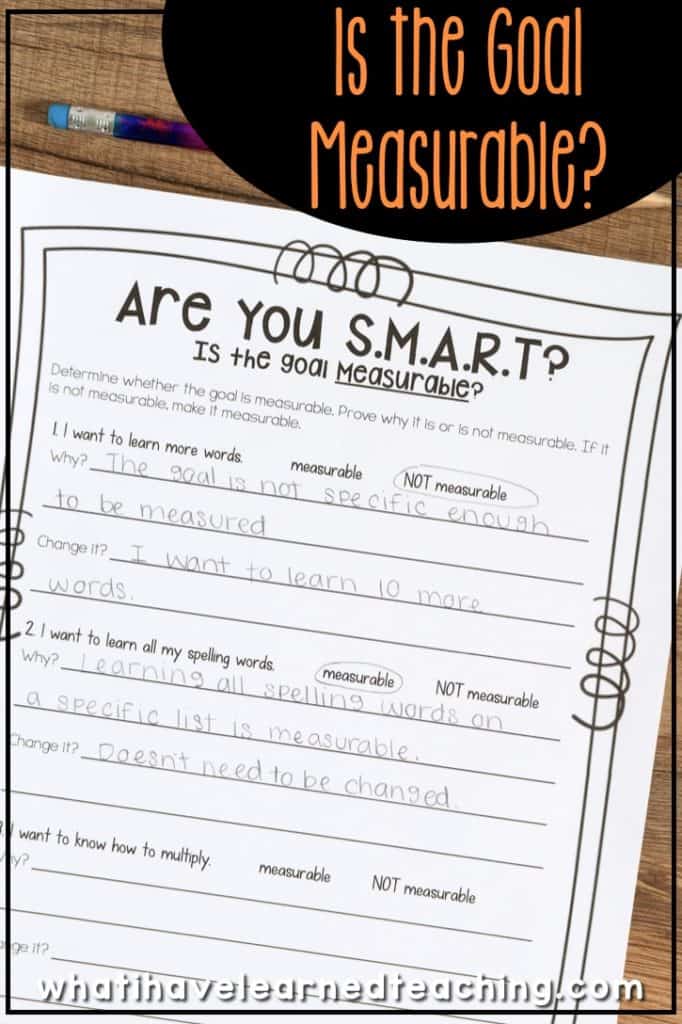
The You Do activity is where students analyze if a statement is measurable, specific or realistic and reflect on how to improve the statement.
During the I Do and We Do activities our class often has an oral discussion about how to improve the goals, this is the opportunity for students to put their thinking into writing and express



Action Plan & Time Limit Sections
The Action Plan section introduces students to the upward arrow and gives students an idea of how to set a goal, identify things they can do to meet their goal, and choose something specific to work on over a period of time.
Below is a photo of the upward arrow. This specific version is included in our Goal Setting and Data Portfolios.

Included in the Goal Setting Lessons is a blank action plan. The Classroom Implementation Guide gives additional suggestions about how to introduce this upward arrow to your students using class goals. I also have several blog posts with examples of how I’ve used it in the classroom to set class and behavior goals.

The Time Limit section includes suggestions for an I do / We do
How to Purchase the Goal Setting Lessons
The SMART Goal Setting Lessons can be purchased on my website or on Teachers Pay Teachers.
-

-
-
Product on saleGoal Setting and Data Portfolio BUNDLEOriginal price was: $74.11.$46.86Current price is: $46.86.


Jessica BOschen
Jessica is a teacher, homeschool parent, and entrepreneur. She shares her passion for teaching and education on What I Have Learned. Jessica has 16 years of experience teaching elementary school and currently homeschools her two middle and high school boys. She enjoys scaffolding learning for students, focusing on helping our most challenging learners achieve success in all academic areas.