
Place Value Games: Dice and Card Games by Grade Level
The fastest way to turn place value practice from a worksheet into something students actually want to do is with a handful of dice and a deck of cards. Place value games give students the repetition they need to build number sense, while offering enough choice and challenge to keep them engaged. Best of all, you already have everything you need in a desk drawer.
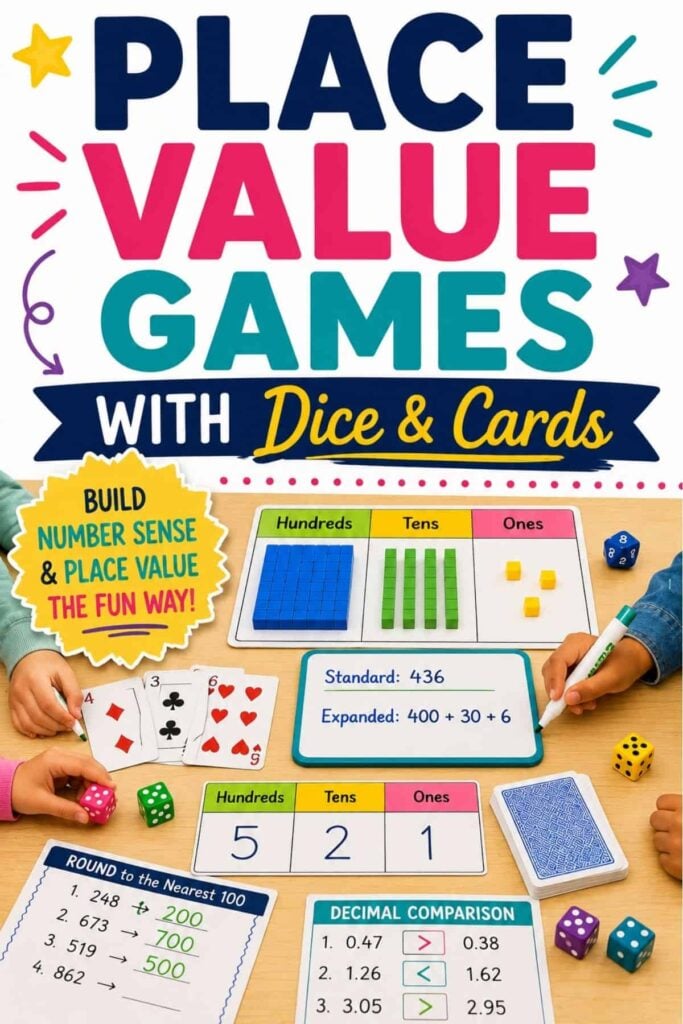
This post rounds up my favorite place value games by grade level, from building teen numbers in kindergarten to comparing decimals in fifth grade, all using simple dice and playing cards.
Why Play Place Value Games?
Place value is abstract, and students need a lot of practice before it becomes automatic. Games give them that practice without the groan that comes with another worksheet. They also let you see thinking in real time: when a student arranges digits to build the largest number, you hear the reasoning out loud.
Games naturally differentiate, too, since the same dice or cards work for a struggling student and a student ready for a bigger challenge. If you want the full picture of how place value develops, my guide to teaching place value in elementary school walks through the progression these games support.
What You Need to Get Started
Two tools cover almost every game in this post:
- Dice. Regular six-sided dice work for the early grades. Ten-sided dice (0-9) are worth buying for the upper grades because they let students roll any digit.
- Playing cards. Pull out the face cards and use ace through nine, with the ace as a 1. You can keep the tens as zeros if you want a zero in play, which is great for talking about placeholders.
Add a place value chart or a small whiteboard for recording, and you’re ready for any of the games below.
Place Value Games by Grade Level
I’ve grouped these by grade band so you can jump to the one that fits your students. Most games stretch up or down a grade with a small tweak, so don’t feel locked in.
Kindergarten and First Grade
At this stage, the goal is to see a ten as a unit and to understand two-digit numbers as tens and ones.
- Roll and Build (dice). Students roll a die, count out that many unit cubes, and keep rolling. Each time they collect ten ones, they trade for a ten. First, to build a target number like 30 wins. The trading is where the learning happens.
- Make a Teen Number (cards). A student draws one card and builds that many ones next to a single ten on a ten-frame or place-value mat, then says the number. Drawing a 4 makes 14, a 7 makes 17. It cements that teen numbers are one ten and some ones.
- Build a Two-Digit Number (cards). A student flips two cards, decides which digit is the tens and which is the ones, builds the number with base ten blocks, and says it out loud. Flipping a 3 and a 6 can yield 36 or 63, which opens a conversation about how position affects value.
- Race to 100 (dice). Players take turns rolling a die and adding that many ones to their pile, trading up to tens as they go, racing to reach exactly 100 on a hundred chart or with blocks. It builds a feel for how ones add up to tens, and tens to a hundred.
- Roll and Compare (dice). Two students each roll two dice, build the larger two-digit number they can make, and whoever has the larger number keeps a counter. First to five counters wins. This is an easy first taste of comparing numbers by place.
Second Grade
Second graders work with three-digit numbers, standard and expanded forms, and number comparison.
- Roll a Number, Write It Two Ways (dice). Students roll three dice, arrange them into a three-digit number, then write it in standard form and expanded form. Roll a 4, 0, and 7, and they might build 740 and write 700 + 40 + 0.
- Place Value War (cards). Each player flips two cards and makes the largest two-digit number they can. The higher number wins both cards. Move to three cards when students are ready. This is the game my students beg to play.
- Closest to 500 (cards). Players flip three cards and arrange them into the three-digit number closest to 500. Whoever is nearest wins the round. Students have to weigh the hundreds place against the tens and ones places, which is real place-value reasoning.
- Build It and Compare It (cards). Both players build a three-digit number from three cards, then write a number sentence comparing them with a greater than, less than, or equal sign. The player with the larger number explains how they know.
- Expanded Form Roll (dice). Students roll three dice, build a three-digit number, and record it only in expanded form, such as 200 + 50 + 8. For a challenge, have a partner read the expanded form and name the standard number.
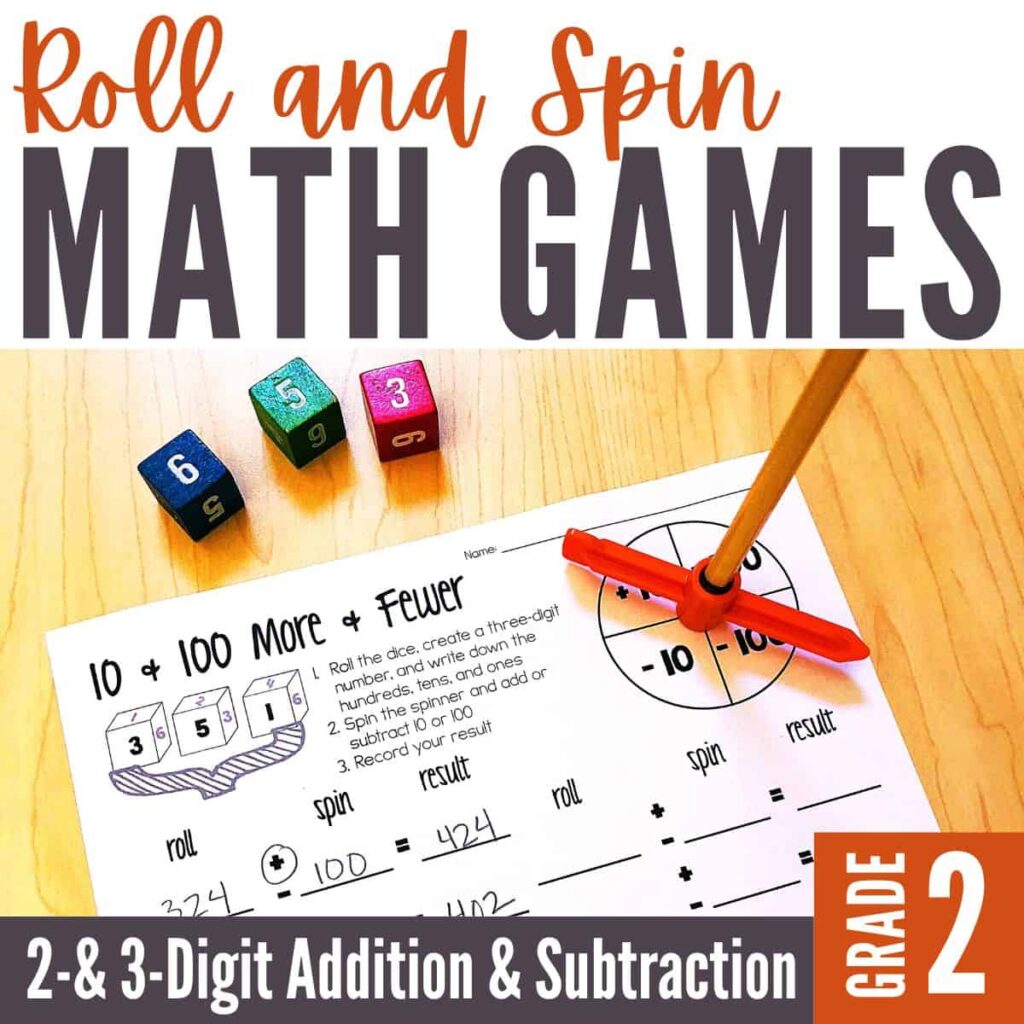
Roll and Spin Math Games for Multi-Digit Addition & Subtraction
These Roll and Spin Math Games focus on developing number sense for two-digit and three-digit addition. The activities help students develop competencies in using a number line and other place-value strategies when adding two- and three-digit numbers.
Third Grade
Third grade brings larger numbers and rounding into the mix.
- Build the Biggest Number (dice). Draw a place value chart with four boxes. Students take turns rolling a die and writing the digit in any box. Once a digit is placed, it can’t move. The biggest final number wins. The strategy of where to risk a low roll makes students think hard about place value.
- Rounding War (cards). Players flip three cards, build a three-digit number, and round it to the nearest hundred. The highest rounded number wins. Students have to know which digit they’re rounding and why.
- Race to 1,000 (dice). Players roll a die and choose whether it counts as hundreds, tens, or ones, adding to a running total. First to reach 1,000 without going over wins. Deciding how to use each roll requires flexible place-value thinking.
- Mystery Number (cards). One student secretly builds a four-digit number with cards and gives place value clues, such as “the digit in the hundreds place is 7.” Partners use the clues to figure it out. This pushes students to use precise place value language.
- Closest to 1,000 (cards). Each player flips four cards and arranges them into the number closest to 1,000, above or below. Nearest wins. Students reason about how much each place contributes to the whole number.
Fourth and Fifth Grade
Upper elementary students push into large numbers and decimals, where the ten-times relationship between places really matters.
- Millions Builder (dice). Use the place-and-keep rule from Build the Biggest Number, but with seven boxes to make numbers into the millions. Students read each number aloud, which is where misreadings show up and get fixed.
- Decimal War (cards). Players flip cards to fill a decimal like ones, tenths, hundredths, and thousandths, then compare. Students quickly learn that 0.5 is greater than 0.45, which is a classic misconception that this game quickly corrects.
- Ten Times Greater (dice). Roll to build a number, then multiply or divide it by ten and watch every digit shift one place. Doing this over and over builds the place-value relationships fifth graders need for decimals.
- Closest to One (cards). Players flip cards to build a decimal to the thousandths place, like 0.842, aiming to land as close to 1 as possible. Nearest wins. Comparing thousandths to a whole number quickly sharpens decimal place value.
- Build and Round Big Numbers (dice). Students roll to build a six-digit number, then round it to a place a partner names, such as the nearest ten thousand. Rounding large numbers shows whether students really understand each place, not just the procedure.
If your students enjoy dice and card games for place value, they’ll use the same tools for other skills. My posts on addition and subtraction games with dice, and on multiplication dice games, are an easy next step once place value is solid.

Digital Place Value Games
When you want a tech option for centers or early finishers, a few free sites do place value well:
- MathBrix place value skills, with interactive, standards-aligned activities.
- Sheppard Software place value games, a long-running set of free practice games.
- Topmarks place value games for ages 7 to 11.
I treat digital games as a supplement, not a replacement. The hands-on trading and arranging students do with real dice and cards builds understanding that tapping a screen doesn’t always capture.
Tips for Using Place Value Games in Math Centers
A few things keep these games running smoothly once they’re in rotation:
- Model the game first. Play a round as a whole class before it goes into the center, so students aren’t stuck on rules.
- Add a recording sheet. Having students write the numbers they build turns a game into accountable practice and gives you something to check.
- Keep the same games, change the numbers. Once students know how to play, you can bump the difficulty just by adding a die or another card, so you’re not teaching new rules every week.
Frequently Asked Questions
Final Thoughts
Place value games take five minutes to set up and give your students the repeated, hands-on practice that builds real number sense. Start with one game that fits your grade, model it well, and add it to your center rotation. Once students know the routine, you can grow the challenge all year just by changing the numbers.
Want ready-to-use options too? My place value games and task cards, like the two-digit domino game and three-digit mystery number task cards, and my place value and NBT cut-and-paste activities give your students structured practice alongside the dice and card games above.
Jessica BOschen
Jessica is a teacher, homeschool parent, and entrepreneur. She shares her passion for teaching and education on What I Have Learned. Jessica has 16 years of experience teaching elementary school and currently homeschools her two middle and high school boys. She enjoys scaffolding learning for students, focusing on helping our most challenging learners achieve success in all academic areas.