
A Marble Run Lesson Plan That Teaches About Gravity in 5th Grade
By fifth grade, students are ready to move beyond simple observations and start thinking like scientists and engineers. They want to test ideas, collect data, and explain what’s happening, not just watch it. This marble run lesson plan is designed to meet that need by giving students a meaningful way to investigate how forces affect motion.
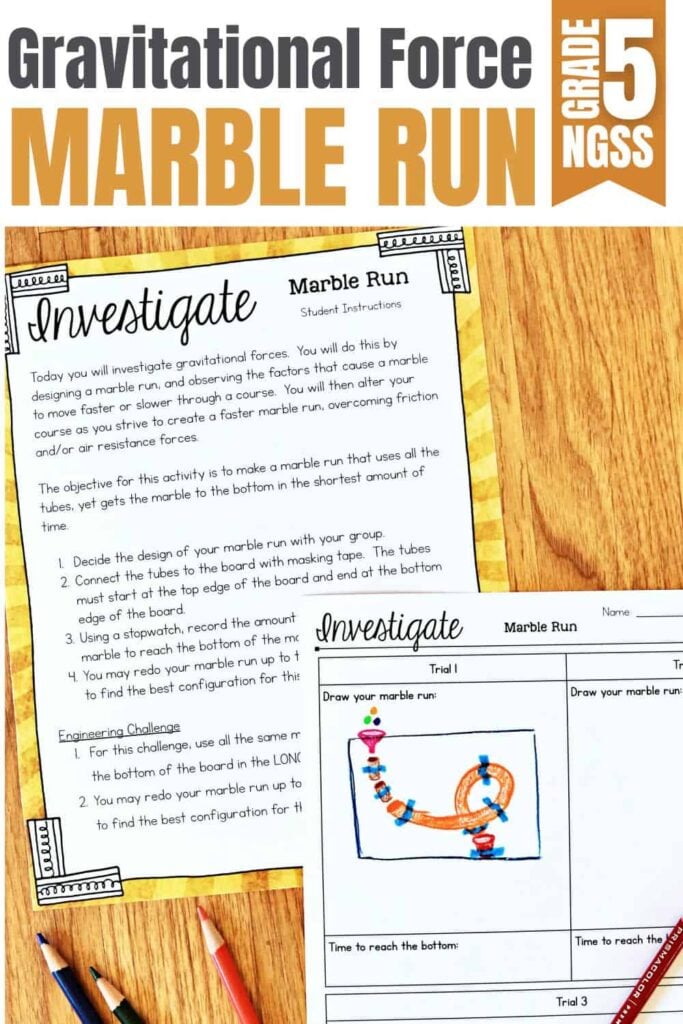
In this investigation, students design and modify a marble run to explore how gravity affects marble movement. They time each trial, compare results, and use evidence to explain how gravitational force, friction, and air resistance impact motion. The activity is hands-on, structured, and designed to align with the expectations of upper-elementary science learning.
This lesson connects 5-PS2-1 to an engineering design context, which is exactly what the NGSS gravitational force standard calls for. My physical science guide for elementary students covers the full 5th grade physical science scope along with the three other standard sets students tackle that year.
What Is in This Gravitational Force Marble Run Investigation?
This marble run lesson plan is a fifth-grade science station focused on gravitational force and aligned to NGSS 5-PS2-1, along with multiple engineering standards (5-ETS1-1, 5-ETS1-2, and 5-ETS1-3). Students investigate how gravity pulls objects downward and how other forces, such as friction and air resistance, affect their motion.
Working in small groups, students design a marble run on a vertical board using tubing and tape. They release a marble, time how long it takes to reach the bottom, then revise their design to improve results. The investigation emphasizes fair testing, controlled variables, and evidence-based reasoning, all while keeping students highly engaged.

This hands-on activity guides students through the scientific inquiry process as they design, test, and refine a marble run to explore how gravity, friction, and air resistance affect motion.
What’s Included in This Marble Run Lesson Plan?
This station is fully planned and easy to implement:
- An optional reading passage that explains gravitational force, mass, weight, friction, and air resistance
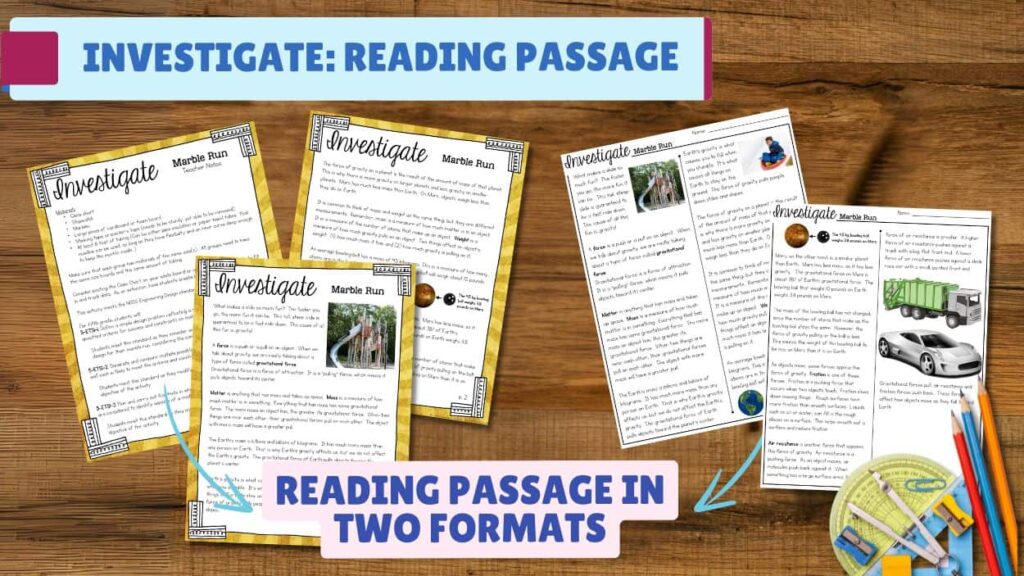
- Clear student direction cards that guide the investigation step by step
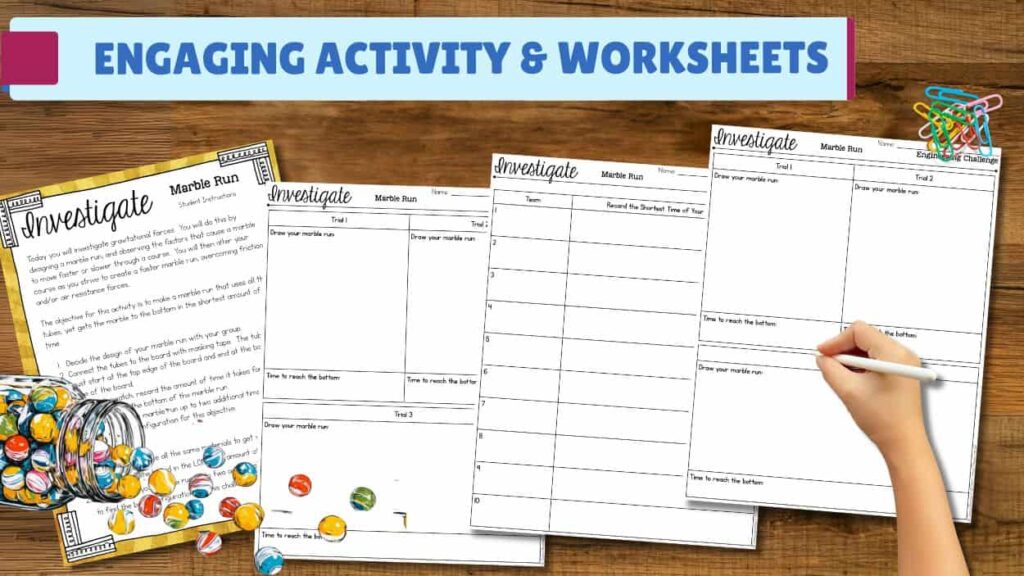
- Data collection sheets for drawing marble runs and recording trial times
- Class charts for comparing results across groups
- An added engineering challenge that flips the goal from fastest run to slowest run
- Multiple response formats, including short answer, fill-in-the-blank, and multiple choice
- Task cards for station rotations
- A complete answer key
- Google Slides and Google Forms versions for digital or hybrid classrooms
Everything in this marble run lesson plan is structured so students spend their time thinking, testing, and discussing—not waiting for instructions.


How Teachers Use This Marble Run Lesson in the Classroom
As an Investigation Science Station
Many teachers use this activity as the Investigate station within a gravitational force unit. Students rotate through their groups, build a design, collect data, and revise it. The built-in class chart encourages discussion and comparison between teams.
As a Data-Driven Engineering Lesson
This investigation places a strong emphasis on timing, measurement, and controlled testing. Students run multiple trials, analyze results, and explain which design choices improved or slowed motion. The extension challenge, making the marble take longer to reach the bottom, adds depth and pushes critical thinking.
As a Writing-from-Evidence Activity
The student questions require more than one-word answers. Students explain why a design worked, how gravity affected motion, and how friction or air resistance changed results. It pairs well with science notebooks or constructed response practice.
As a Digital or Hybrid Station
With Google resources included, teachers can assign the reading and questions digitally while still running the marble investigation in class. This setup works well for shared devices or paper-light classrooms.
How This Is Different from the Fourth Grade Marble Engineering Challenge
Although both the 4th-grade Marble Engineering Challenge and the 5th-grade Marble Run use marbles and tracks, they serve different instructional goals.
The fourth-grade version focuses on:
- Potential and kinetic energy
- Energy transfer and conservation of energy
- Friction as a way to stop motion
- Designing a roller coaster that safely brings a marble to rest
The fifth-grade version shifts the focus to:
- Gravitational force is a pulling force toward Earth’s center
- The relationship between mass, weight, and gravity
- Measuring time and comparing data across trials
- Fair testing, controlled variables, and design optimization
In short, the fourth-grade investigation is about how energy changes, while the fifth-grade investigation is about why objects move the way they do under gravity. The tasks, questions, and expectations are intentionally more complex to match fifth-grade standards and reasoning skills.
Why Teachers Love This Investigation
- Students collect real data and use it to support claims
- Engineering standards are naturally embedded
- The fastest vs. slowest challenge keeps advanced learners engaged
- Concepts like gravity, friction, and air resistance feel concrete
- Materials are simple and easy to prep
- The structure supports meaningful group work
Students aren’t just watching gravity happen—they’re testing it, measuring it, and explaining it.
A Strong Anchor for Fifth Grade Gravity Units
If you’re teaching gravitational force in fifth grade, this Marble Run lesson plan gives students the depth they need. It builds scientific thinking, strengthens engineering skills, and creates lessons students talk about long after cleanup time.
Marbles, stopwatches, data, and real science—all in one station.
This hands-on activity guides students through the scientific inquiry process as they design, test, and refine a marble run to explore how gravity, friction, and air resistance affect motion.
Jessica BOschen
Jessica is a teacher, homeschool parent, and entrepreneur. She shares her passion for teaching and education on What I Have Learned. Jessica has 16 years of experience teaching elementary school and currently homeschools her two middle and high school boys. She enjoys scaffolding learning for students, focusing on helping our most challenging learners achieve success in all academic areas.