
Marble Roller Coasters Engineering Challenge for 4th Grade
Teaching energy in fourth grade can feel tricky. Students can memorize vocabulary like potential energy and kinetic energy, yet still struggle to explain what those ideas actually look like in the real world. That’s where hands-on engineering tasks make all the difference.
The Marble Engineering Investigate Challenge gives students a chance to see energy in action. As they design and test a marble roller coaster, they observe how energy changes form, how friction slows motion, and why engineers think carefully about materials and constraints. It’s messy, exciting, and full of productive problem solving—the kind of science lesson students remember long after the unit ends.

This challenge applies the 4th grade energy standards on potential and kinetic energy in a design context. For more on how energy fits into the full 2nd–5th grade physical science progression, see my physical science guide for elementary students.
What Is the Marble Engineering Investigate Challenge?
This resource is part of the Energy, Energy, Everywhere science stations for fourth grade and targets NGSS standards 4-PS3.A–D and ETS1.A. Students take on the role of engineers as they design a marble roller coaster that must meet specific criteria and constraints.
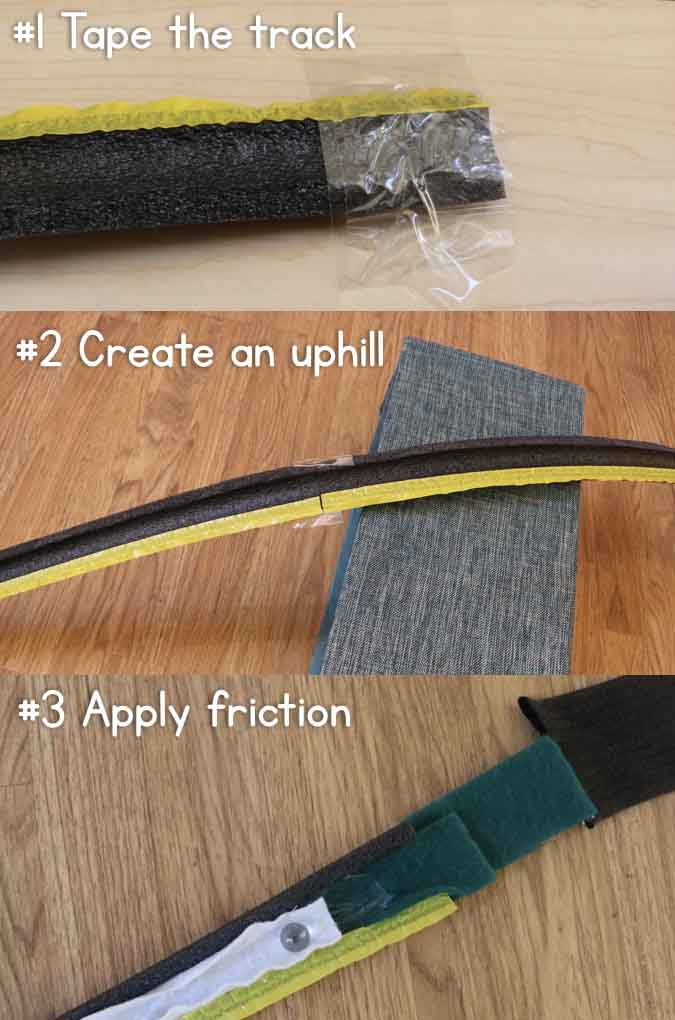
Using simple materials like foam pipe insulation, tape, boxes, and marbles, students build a track that starts high, includes at least one hill or loop, and brings the marble to a complete stop using friction—no walls or traps allowed. Through repeated trials, students refine their designs and explain how energy transfers throughout the ride.
What’s Included in This Investigation?
Everything teachers need is already planned and classroom-ready:
- Clear student directions that walk students through the challenge
- A reading passage that explains potential energy, kinetic energy, and the law of conservation of energy using roller coasters as the anchor example
- Recording sheets for drawing the final design and reflecting on revisions
- Multiple response formats, including short answer, fill-in-the-blank, and multiple choice
- Task cards for flexible station use
- A complete answer key
- Digital versions through Google Slides and Google Forms for easy classroom integration
The investigation is designed to work smoothly within a station rotation or as a focused engineering lesson on its own.
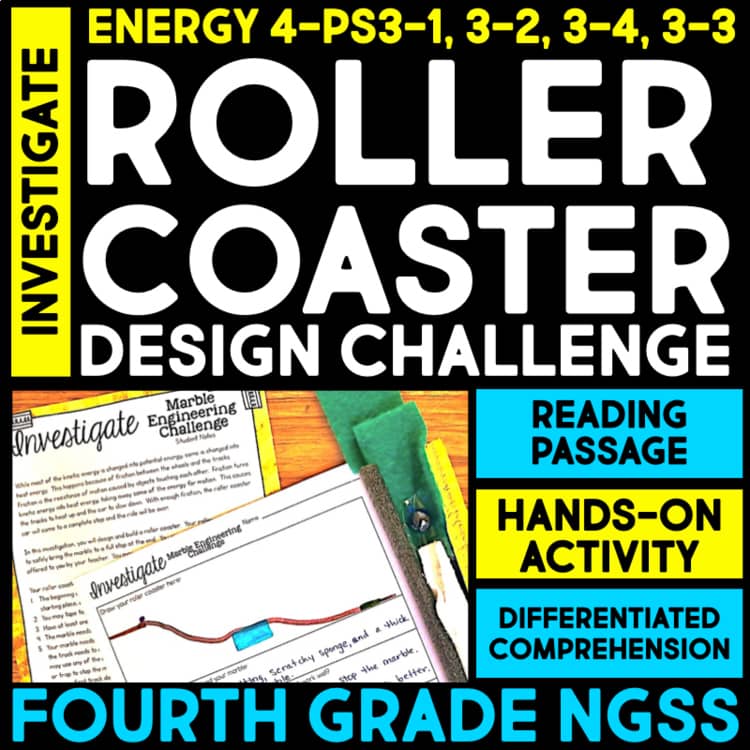
This engaging, NGSS-aligned resource lets students build a roller coaster, test marble motion, and explore the Law of Conservation of Energy—all while integrating science inquiry and collaborative problem-solving.
How Teachers Use This in the Classroom
As a Science Station
Many teachers place this challenge in the Investigate station during an energy unit. Students work in small groups, rotate through materials, and record their thinking in science journals or on the provided sheets. Each station session fits comfortably into a 20-minute block, with students continuing to refine designs across days.
As an Engineering Design Project
This activity works beautifully as a multi-day engineering task. Teachers introduce the problem, review criteria and constraints, then let students test, revise, and test again. The reflection questions guide students to explain why their designs worked or failed, tying every decision back to energy concepts and friction.
As a Cross-Curricular Lesson
The reading passage and written responses connect science with ELA standards like RI.4.1, RI.4.3, and RI.4.4. Students practice close reading, citing evidence, and explaining scientific ideas in writing—without adding extra prep.
As a Digital or Hybrid Option
With Google Forms and Slides included, teachers can assign the reading and questions digitally while still running the hands-on build in class. This setup works well for blended learning or classes with limited paper access.
Why Teachers Love This Resource
- Students stay engaged from start to finish
- Energy concepts move beyond definitions into real-world application
- Trial and error feels purposeful, not frustrating
- Engineering standards are naturally embedded
- Prep uses affordable, easy-to-find materials
- Differentiated response options support a range of learners
Instead of watching energy happen in a video, students cause it to happen—and then explain it.
A Strong Fit for Your Energy Unit
If you’re teaching energy transfer, conservation of energy, or engineering design in fourth grade, this Marble Engineering Investigate Challenge fits right in. It turns abstract ideas into something students can build, test, and talk about with confidence.
Hands-on science, thoughtful reflection, and meaningful learning—all rolling together on a marble track.
This engaging, NGSS-aligned resource lets students build a roller coaster, test marble motion, and explore the Law of Conservation of Energy—all while integrating science inquiry and collaborative problem-solving.
Jessica BOschen
Jessica is a teacher, homeschool parent, and entrepreneur. She shares her passion for teaching and education on What I Have Learned. Jessica has 16 years of experience teaching elementary school and currently homeschools her two middle and high school boys. She enjoys scaffolding learning for students, focusing on helping our most challenging learners achieve success in all academic areas.