
Teaching Elementary Students to Generate Research Questions
When students sit down to research a topic for the first time, most of them ask the same kind of question: “What is a penguin?” They find a one-sentence answer, declare themselves done, and look up. The research is finished before it started.
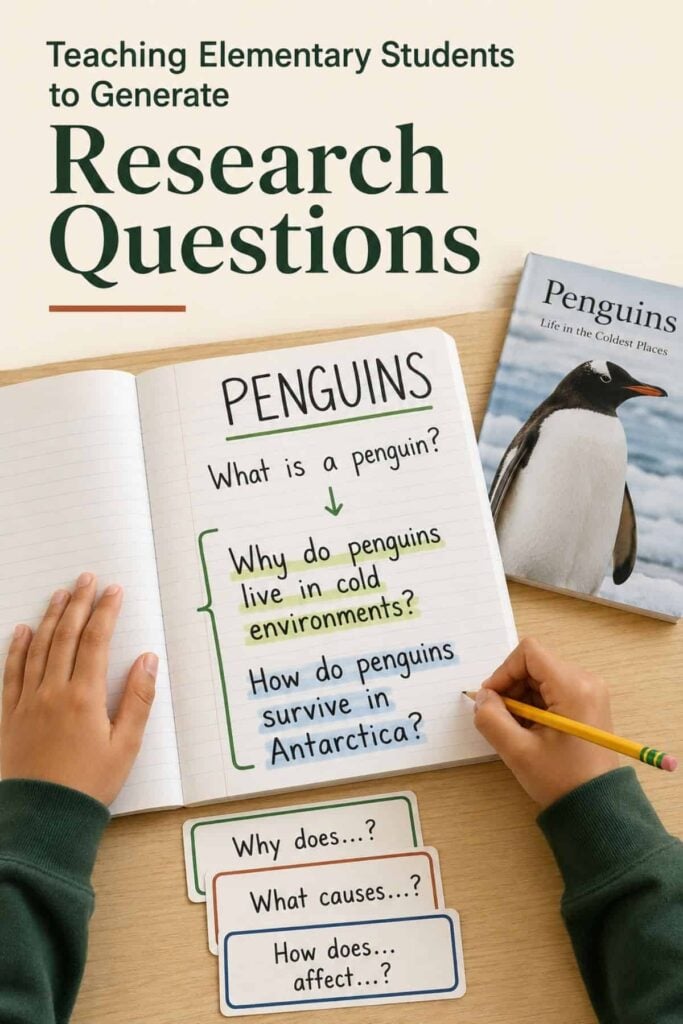
Teaching research questions for students is one of those skills that pays off across every subject — not just science, but social studies, biography projects, animal research, and any inquiry-based work students do throughout the year. Once students understand the difference between a question that sends them to Google for 30 seconds and one that actually requires investigation, every research task they encounter goes deeper. Here is how to build that skill intentionally in your classroom.
Start with a Topic, Not a Question
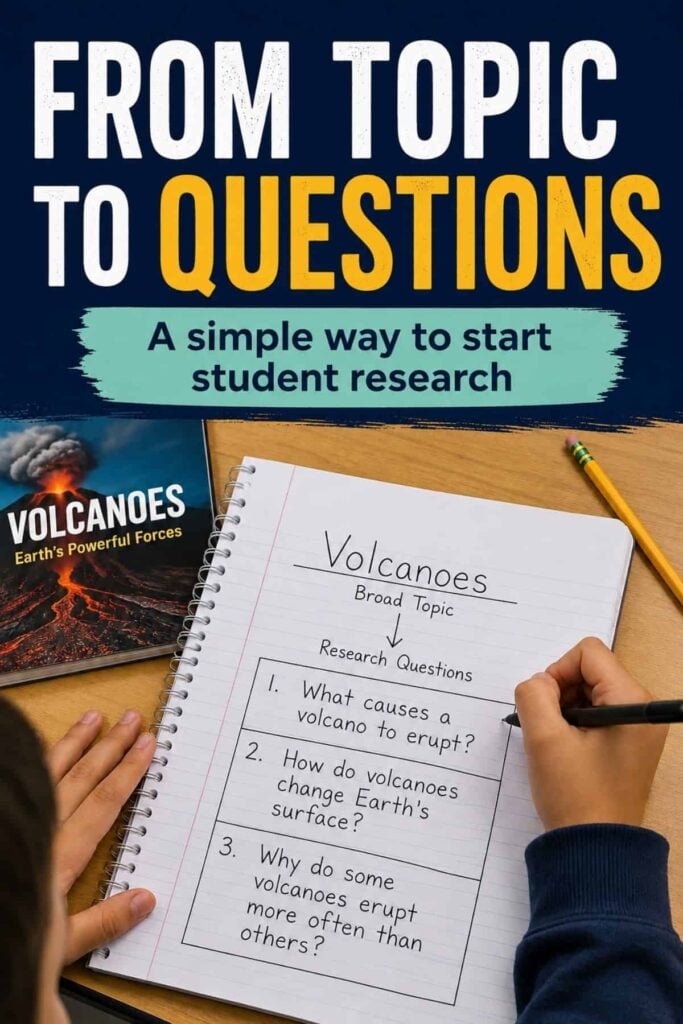
When you first introduce research questioning, give students a topic rather than asking them to come up with one on their own. Generating a topic and questions simultaneously is too much cognitive work for most elementary students.
Broad-but-bounded topics work best: “soil erosion,” “the water cycle,” “a famous inventor,” “an animal from the rainforest.” The topic is narrow enough to stay focused and open enough that students can go in different directions with their questions. Once they have a topic, generating questions about it is the next skill you teach directly — not something students are expected to do naturally.
Show Students What a Strong Question Looks Like
Before asking students to write their own questions, show them yours. During a read-aloud, a science video, or the opening of a new unit, stop and think out loud: “I’m wondering why the article said the Arctic is warming faster than other parts of the planet. That’s the kind of question I want to dig into.”
The point in modeling is to show students that a good research question does three things: it goes beyond the text, it cannot be answered in a few words, and it makes you want to find out more. A question you already know the answer to is a recall question, not a research question. Naming that distinction explicitly helps students start to hear the difference.
Teach the Difference Between Closed and Open Questions
Most students start with closed questions: “How many bones are in the human body?” “Where was Abraham Lincoln born?” These have a single correct answer that can be found in any reference book. They require looking up a fact, not researching a topic.
Open questions ask for causes, effects, comparisons, or explanations: “Why do some animals hibernate while others migrate?” “How did Abraham Lincoln’s childhood affect the way he led as president?” “What causes certain storms to become hurricanes?” These questions require students to gather information from multiple sources and build an explanation — which is what research actually involves.
A useful classroom exercise: give students a closed question and ask them to rewrite it as an open one. “What is photosynthesis?” becomes “Why do plants need sunlight to survive?” It is a small shift that completely changes what the research looks like.
Use Question Stems as a Scaffold
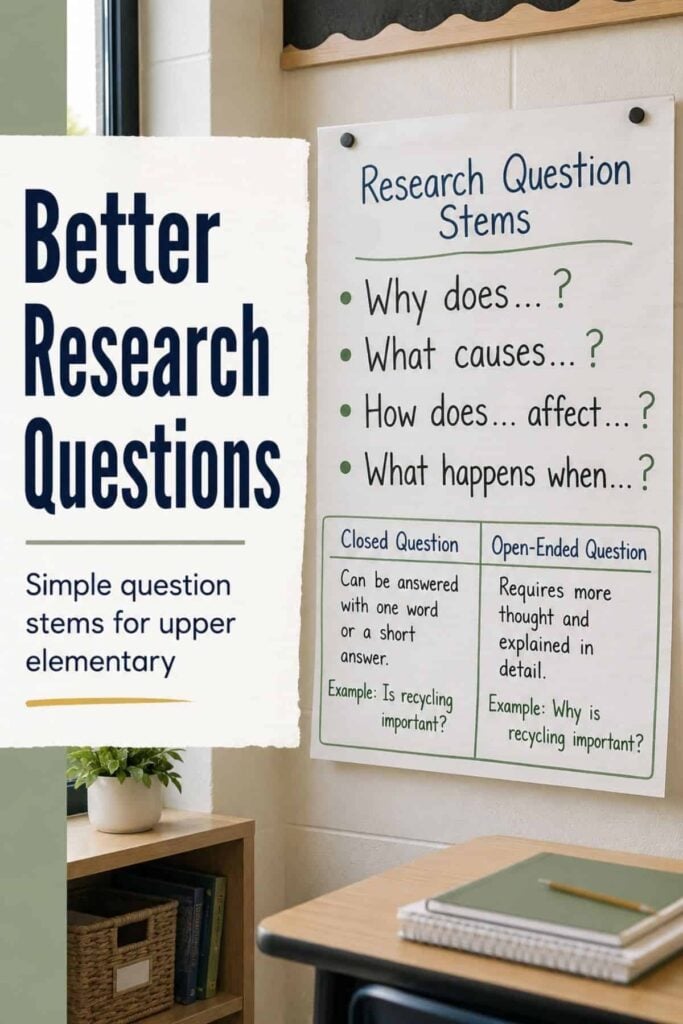
Students who struggle to generate open questions benefit from a set of sentence starters:
“Why does…?” “How does… affect…?” “What causes…?” “What would happen if…?” “How is… different from…?” “What evidence shows that…?”
Post these on an anchor chart and leave them visible during any research work. Students who are just learning to generate questions can use the stems as a starting point. Over time, most students internalize the patterns and no longer need the chart.
Connect Research Questions to Text Structure
Once students have experience identifying text structure in reading — cause and effect, problem and solution, compare and contrast — they can use those patterns to generate questions before they read.
A text about natural disasters using problem-solution structure signals questions like: “What makes a natural disaster so destructive? What have people done to prepare for them?” A compare-contrast article about two animals signals: “How are a dolphin and a shark similar, even though one is a mammal and one is a fish?” Teaching students to notice how information is organized helps them ask questions that match the kind of research they are about to do.
Apply It to Real Research Projects
Once students can generate strong open-ended questions, they are ready to apply that skill in structured research.
A biography report gives students a framework for researching a real person: what they accomplished, what obstacles they faced, and why their life mattered. Students who have practiced open-ended questioning will approach those sections with far more depth than students who default to listing facts. Instead of writing “Abraham Lincoln was president,” they pursue the question “How did Lincoln’s experiences before he became president shape the decisions he made during the Civil War?”
For animal research, the same shift applies. “A giraffe has a long neck” becomes “Why does the giraffe’s long neck help it survive in its habitat?” — a question that leads to a much richer response. The animal research websites for kids post has a list of student-friendly sites to use once students are ready to search.
If your students need help choosing a topic before they can begin generating questions, the research topics for students post has ideas organized by subject and grade level. And before students go online to search, safe online research walks through what they should know before they start clicking.
The goal is not perfect research questions the first time. It is for students to understand the difference between a surface question and one that requires real investigation. That distinction is worth teaching explicitly, and once students have it, it transfers to every research project they encounter for the rest of the year.
Jessica BOschen
Jessica is a teacher, homeschool parent, and entrepreneur. She shares her passion for teaching and education on What I Have Learned. Jessica has 16 years of experience teaching elementary school and currently homeschools her two middle and high school boys. She enjoys scaffolding learning for students, focusing on helping our most challenging learners achieve success in all academic areas.