
Making Waves: Sound Wave Properties Fourth Grade Science Stations
The Making Waves – Wave Properties Science Stations teach about the properties of different types of sound and ocean waves. Within these stations, students learn about sound waves, construct a phone, diagram different types of waves, model vibrations, learn about ocean waves, and learn about transverse and longitudinal waves. The focus is on NGSS 4-LS1.A and D.

Sound wave properties are part of the 4th grade waves standards, which are taught alongside the energy standards in the same year. My physical science guide for elementary students covers the full 4th grade physical science scope and shows how waves connects to energy.
Background About the Wave Properties Science Stations
Many of the stations below teach how sound waves are generated. One or more of these stations may be an appropriate review later on when you are introducing the biology of hearing sounds, which is included in the Structure and Function Science Stations. Alternatively, if you have taught the biology of sound reception first, you may want to review with students what happens to the sound waves when they are picked up by the ear.
Students are encouraged to use their Science Journals with the task cards, but worksheets are provided as well. Also included are checklist to monitor student progress through the stations.
The Science Stations are designed to last about 20 minutes each. Students may do one a day for 8 days or 2 a day for four days. The following checklists will help you organize the stations.
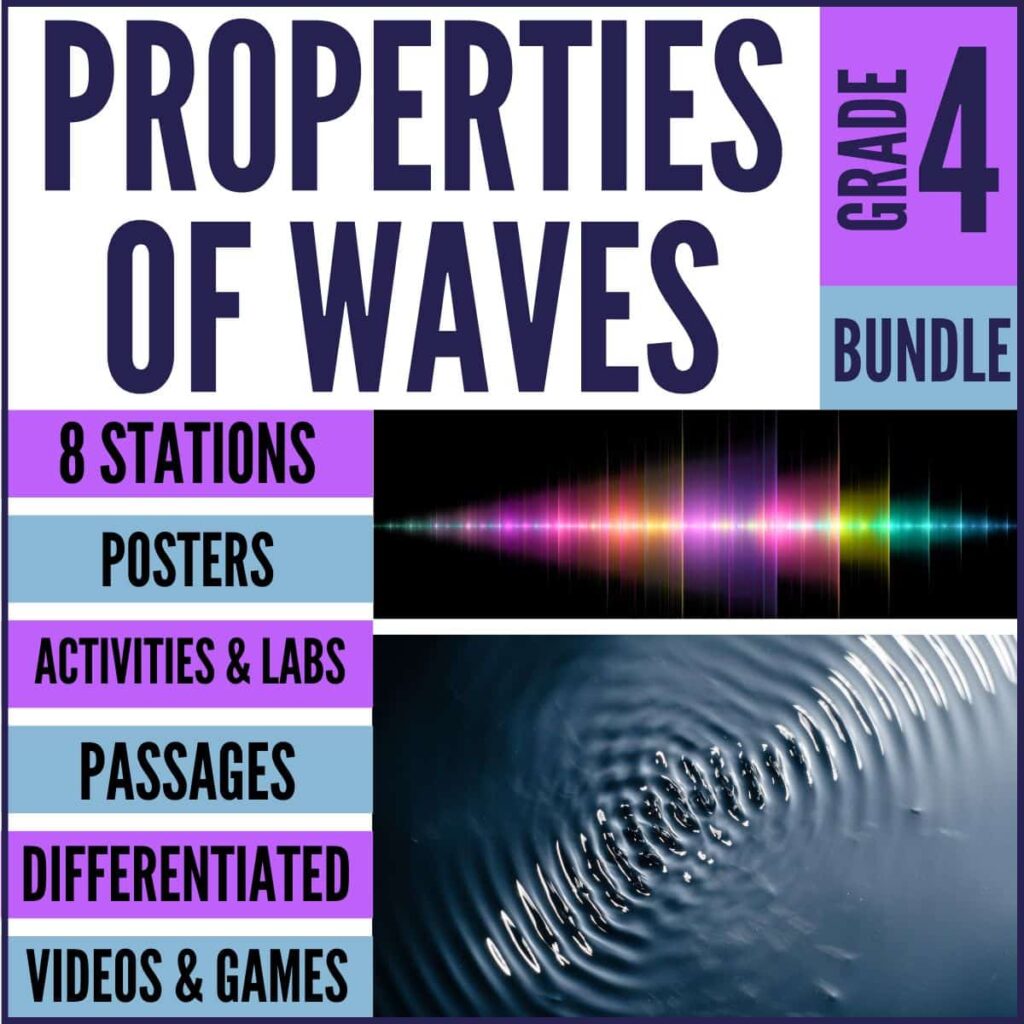
Wave Properties BUNDLE Science Stations
Making Waves Science Stations for Fourth Grade Next Generation Science Standards include 8 different science stations where students can deepen their understanding of wave properties.
An In-depth look at the Making Waves Stations
Vocabulary Cards
The vocabulary cards come in two formats, a three-part card with pictures and full-page cards with just the word and definition. The full-page cards are great for a science word wall.

The three-part cards can be used as a ninth science station or an early finisher station. Cut apart the cards and have students match the word, definition, and picture. Extend the learning and have students record some of the words in their science journals.

Differentiated Responses
These Science Stations have several different ways students can display their understanding. Most of the variations are similar to each other, but differentiated for various classrooms and learning styles.
Included are worksheets for both short-answer and fill-in-the-blank and task cards for both short-answer and multiple choice responses.
To provide even more support, give students a word list for the fill-in-the-blank options. Also included are vocabulary cards in two formats which could become a ninth station if needed.
Watch A Video about Wave Properties
The Watch a Video station has two videos. The first video talks about the causes of sound, how sound is carried through air, pitch, frequency, volume and amplitude. It is full of new vocabulary and engaging concepts.
The second video about ocean waves and is pictured below. This video discusses a wave’s period and is filled with new vocabulary and in depth explanations.

Play a Video Game about sound
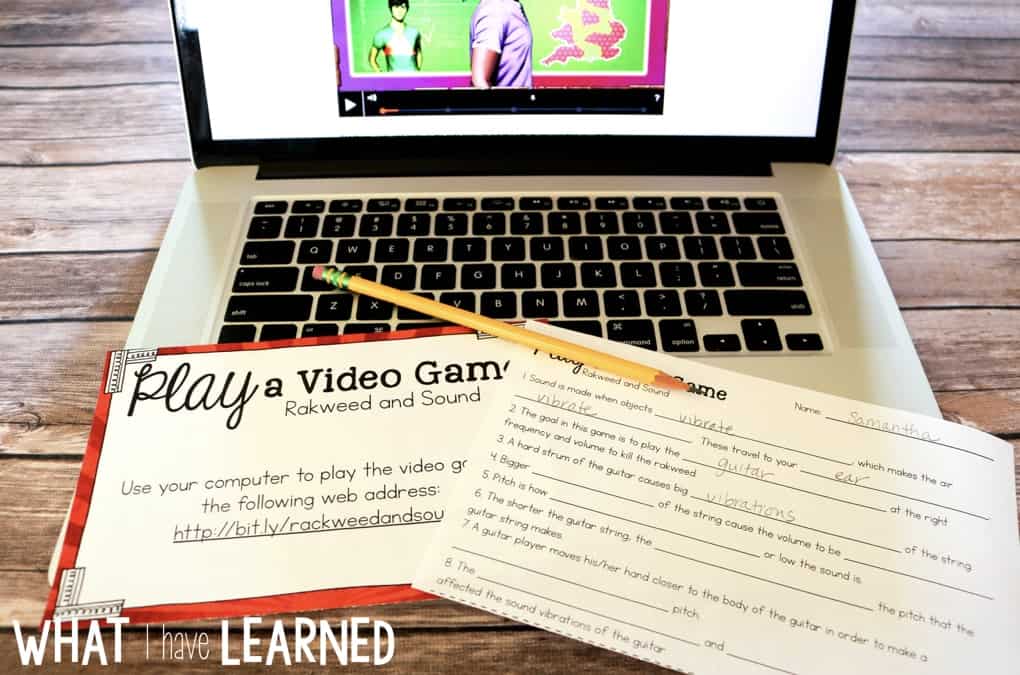
Playing a video game is so much fun! In these stations, students engage with a video game or interactive presentation. Like the watch station, two video games are included: one focuses on sound, pitch, and vibrations, the other on building a xylophone with glass cups.
Investigate Sound Waves using a “Phone”
In the Investigate station students create phones and investigate what types of materials will conduct the best sound. This station meets the DCI standard, “Different solutions need to be tested in order to determine which of them best solves the problem, given the criteria and the constraints.”
Included is an optional reading to build background knowledge, directions, activity response sheet, and differentiated questions to review the concepts in the station.
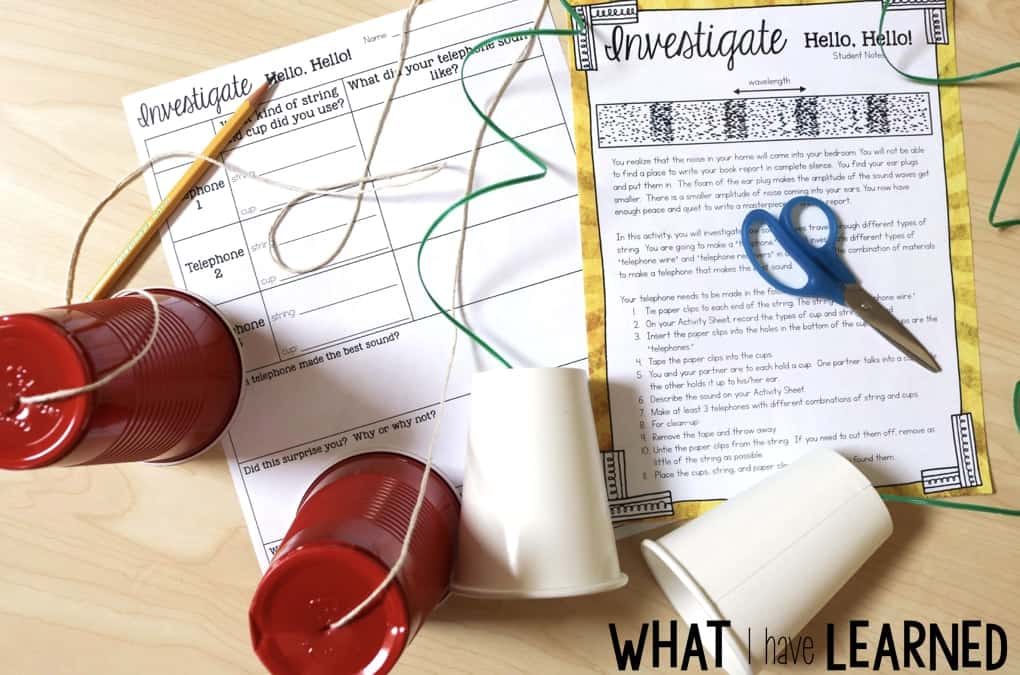
Diagram Different Types of Wave Properties
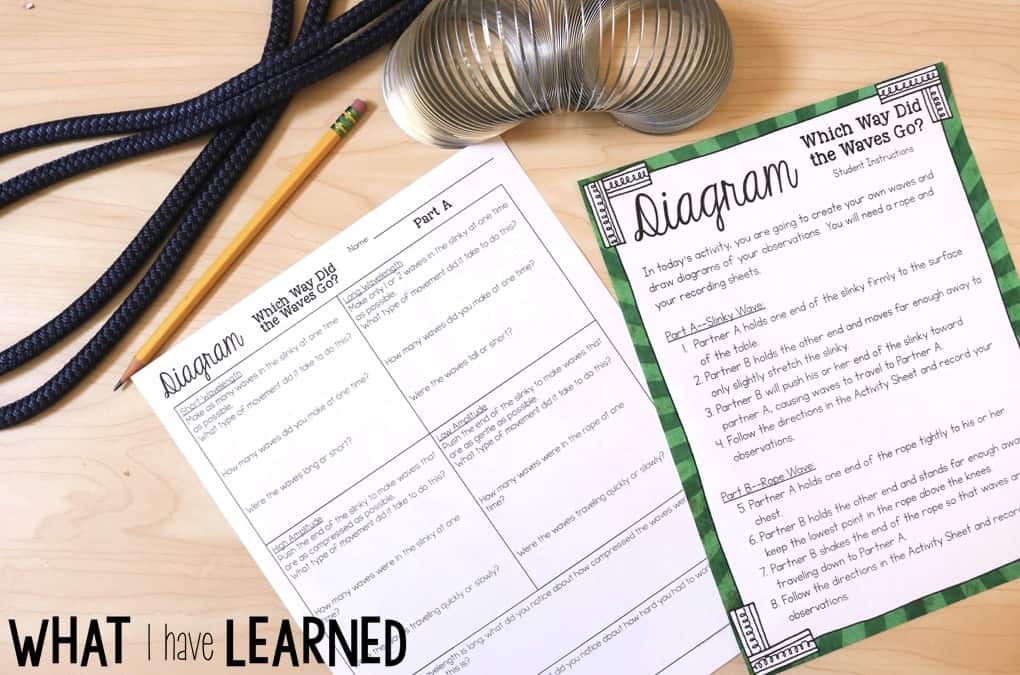
This station is another fun, engaging station where students diagram the peak and trough of waves as well as experience amplitude and wavelength. Students use a rope and a slinky to demonstrate different types of waves.
Included is an activity sheet to record what happens during the activity as well as differentiated responses.
Wave Properties BUNDLE Science Stations
Making Waves Science Stations for Fourth Grade Next Generation Science Standards include 8 different science stations where students can deepen their understanding of wave properties.
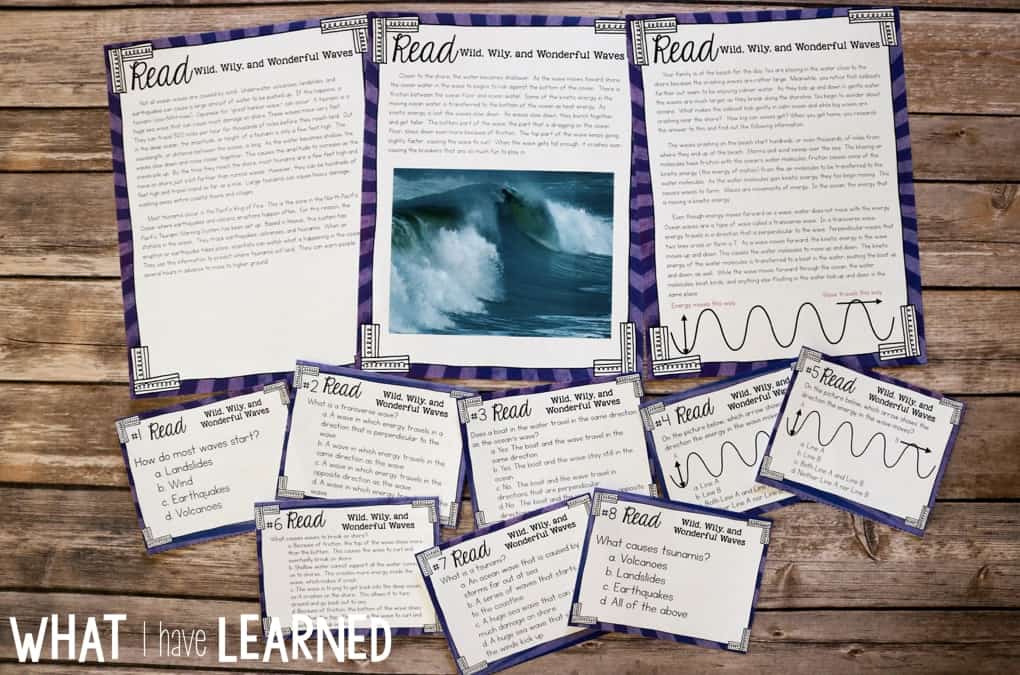
Read a Passage about Ocean Waves
In this station students take a break from experimenting and read a passage about ocean waves and answer questions about the passage.
Below is an example of the multiple choice task cards that are included with each station. Have students use their science journal to answer the questions.
Create a Model about Vibration
It’s back to hands-on experiments where students model vibrations using a tuning fork. Students will be able to see the vibration of the rice when a tuning fork is held against the bowl.
Again, this station comes with an optional reading passage and has an activity sheet to record the experiment as well as differentiated responses in the form of short answer, fill-in-the-blank and multiple choice.

Explore Ocean Waves in a Bottle
This station is a fun one! Students explore transverse waves in a bottle using oil, water, food coloring, and a plastic building brick. This station has a reading passage to build background knowledge an activity response sheet as well as the four types of differentiated responses.

Sort Transverse vs. Longitudinal Waves
Last but not least is the sort. Below you will see both the reading passage, including a sample of the fill-in-the-blank worksheet and the sort cards.

The sort comes in two formats. Below are the color cards that you can laminate for use year after year. Also included is a student cut and paste worksheet that matches the sort cards seen below.

Wave Properties BUNDLE Science Stations
Making Waves Science Stations for Fourth Grade Next Generation Science Standards include 8 different science stations where students can deepen their understanding of wave properties.
How to Purchase
This Making Waves: Wave Properties Science Station can be purchased on Teachers Pay Teachers.
Jessica BOschen
Jessica is a teacher, homeschool parent, and entrepreneur. She shares her passion for teaching and education on What I Have Learned. Jessica has 16 years of experience teaching elementary school and currently homeschools her two middle and high school boys. She enjoys scaffolding learning for students, focusing on helping our most challenging learners achieve success in all academic areas.