
Fossil Activities for 3rd Grade: Teaching Fossil Evidence and Ancient Life (NGSS 3-LS4-1)
Fossils are a core topic in 3rd-grade science and a major focus of NGSS 3-LS4-1. In a 3rd grade fossil unit, students learn how fossils provide evidence of organisms that lived long ago and how scientists use the fossil record to understand ancient environments. Fossils give students one of the most concrete entry points into elementary life science, connecting the plants and animals living today with the organisms that came before them.
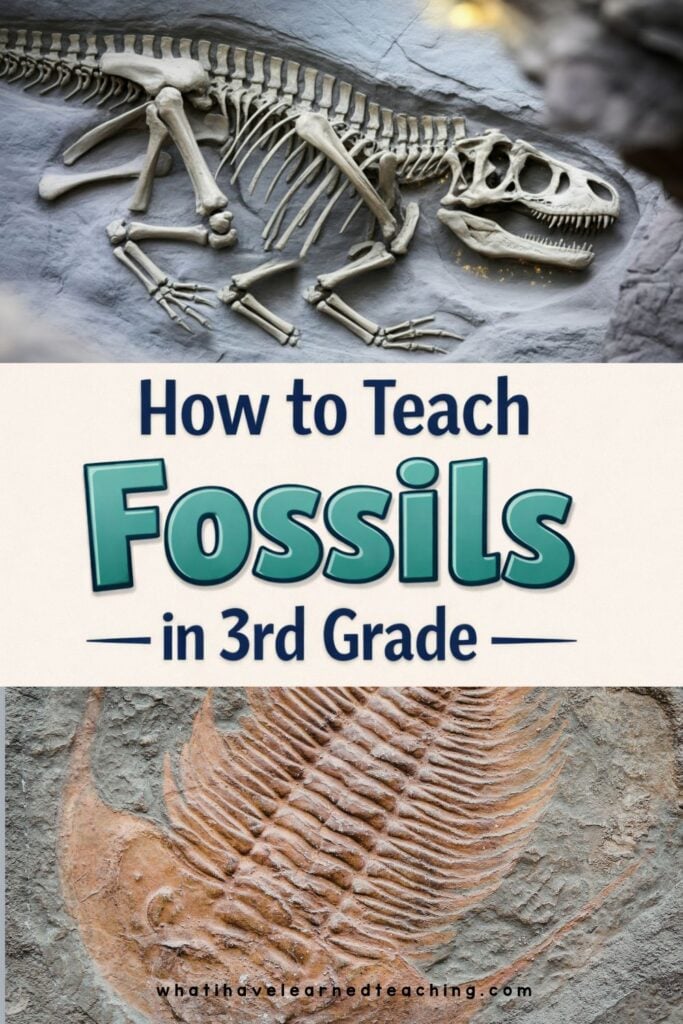
This guide includes hands-on fossil activities, a step-by-step teaching sequence, extension investigations, and structured resources aligned to NGSS 3-LS4-1.
What Are Fossils? (3rd Grade Explanation)
A fossil is the preserved remains or traces of a plant or animal that lived long ago. Fossils can include:
- Bones
- Teeth
- Shells
- Leaf imprints
- Footprints
- Burrows
In 3rd grade, students learn that fossils form when organisms are buried by sediment and protected from decay. Over time, layers of rock build up and preserve evidence of ancient life.
Fossils matter because they show that organisms lived long ago and that some are now extinct. When scientists study many fossils together across different rock layers, they build what is called the fossil record.
Types of Fossils Students Should Know
In 3rd grade, it is helpful to introduce clear categories:
- Body Fossils – Actual remains of organisms, such as bones, teeth, or shells.
- Trace Fossils – Evidence of activity, such as footprints, burrows, or coprolites.
- Mold and Cast Fossils – Imprints and mineral-filled replicas of organisms.
Keeping definitions simple and providing visual supports helps students understand them.
What Is the Fossil Record?
The fossil record refers to the collection of all fossils discovered and the information they provide about life on Earth over time.
In 3rd grade, students begin connecting fossils to rock layers and geological time. They learn that:
- Rock layers form over long periods of time
- Deeper layers are older than the upper layers
- Fossils found in the lower layers are older
- Fossils provide evidence of changing environments
Studying the fossil record helps scientists answer questions such as:
- What animals lived long ago?
- What did ancient environments look like?
- Which organisms are now extinct?
- How have plants and animals changed over time?
Fossils as Evidence of Ancient Life (NGSS 3-LS4-1)
NGSS 3-LS4-1 asks students to analyze and interpret data from fossils to provide evidence of past environments. This means that students should practice examining fossil data (pictures, rock layer diagrams, charts) and using evidence to infer what an ancient environment may have looked like.
In simple terms, students learn that:
- Fossils show that different types of organisms lived long ago.
- Fossils found in specific rock layers give clues about ancient environments.
- Some organisms that once lived on Earth are now extinct.
- Living organisms today may resemble ancient organisms, but are not identical.
When teaching fossil evidence, focus on helping students use fossils as data — not just interesting artifacts.
How to Teach Fossils in 3rd Grade (Step-by-Step)
Step 1: Build Background Knowledge About Fossils with Daily Warm-Ups
Daily warm-ups help students think about fossils in small, manageable pieces before diving into complex concepts. I use warm-ups to build fossil vocabulary before any hands-on work. Students who have talked about sediment, preservation, and rock layers for a few days approach the investigation stations with much more confidence than students who encounter those words for the first time during a station task.
These Ancient Life Fossils Daily Warm-Ups are ideal for:
- Morning science starters
- Science journals
- Exit tickets
- Class discussion prompts
Daily exposure strengthens understanding of fossil evidence, extinct organisms, and ancient environments.
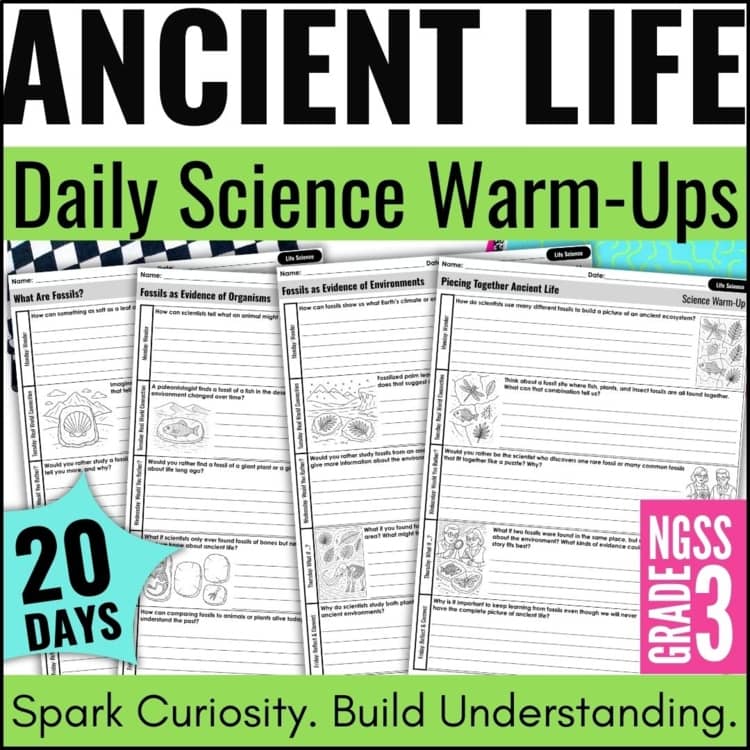
Aligned to NGSS 3-LS4-1, this resource helps students explore how fossils provide evidence about ancient organisms and the environments they lived in.
Step 2: Teach Core Concepts with a 5E Fossils Unit
This Ancient Life 5E Science Unit supports:
- Engage: Observing fossils and asking questions
- Explore: Investigating rock layers and fossil formation
- Explain: Understanding fossil evidence and extinction
- Elaborate: Connecting fossils to ancient environments
- Evaluate: Using evidence to explain past life
A 5E science unit allows students to move beyond memorizing fossil vocabulary and into investigation. In the Explore phase, students spend the most time with actual fossil data—examining images of fossils in rock layers, comparing extinct and living organisms, and using evidence to make claims about ancient environments.
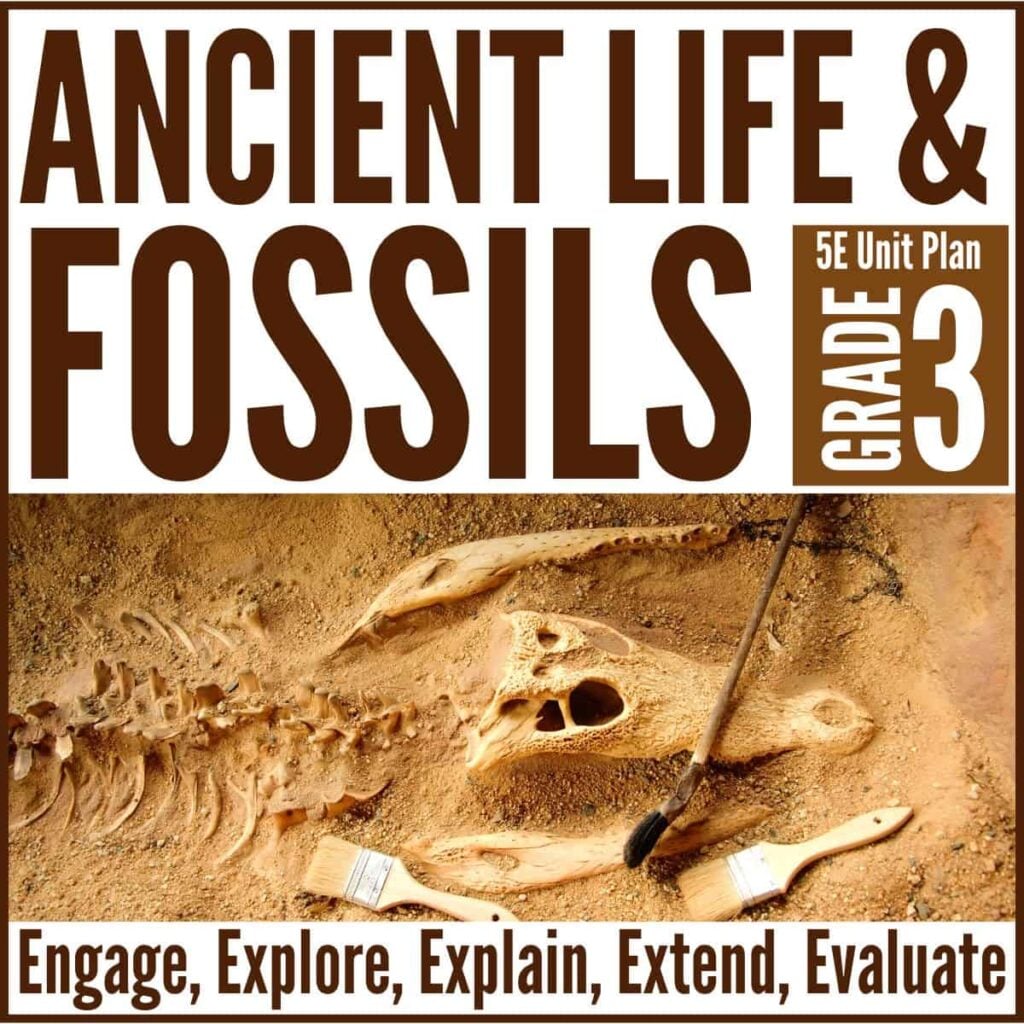
Ancient Life 5E Science Unit Plan for Third Grade
This Ancient Life 5E Science Unit Plan is an inquiry-based unit that focuses on investigating fossils of plants and animals. Throughout the unit, students analyze and interpret data from fossils to provide evidence of the organisms and the environments in which they lived long ago. Students explore types of fossils, paleontologists, and fossil excavation.
Step 3: Reinforce Learning Through Fossil Science Stations
Fossil science stations allow students to rotate through hands-on tasks that reinforce fossil formation, extinction, and evidence of ancient environments.
Fossil station activities include:
- Watching videos about fossils and petrified forests
- Playing vocabulary and review games
- Reading passages about paleontologists
- Comparing extinct and living animals (mammoth vs elephant)
- Modeling fossil formation
- Sorting herbivore, carnivore, and omnivore fossils
- Analyzing dinosaur structure and function
The mammoth vs. elephant comparison station consistently generates the most discussion. Students notice structural similarities and start asking why one survived and the other didn’t—which naturally leads into extinction conversations.
Stations strengthen understanding of:
- Fossil formation
- Extinction
- Structure and function
- Evidence of ancient environments
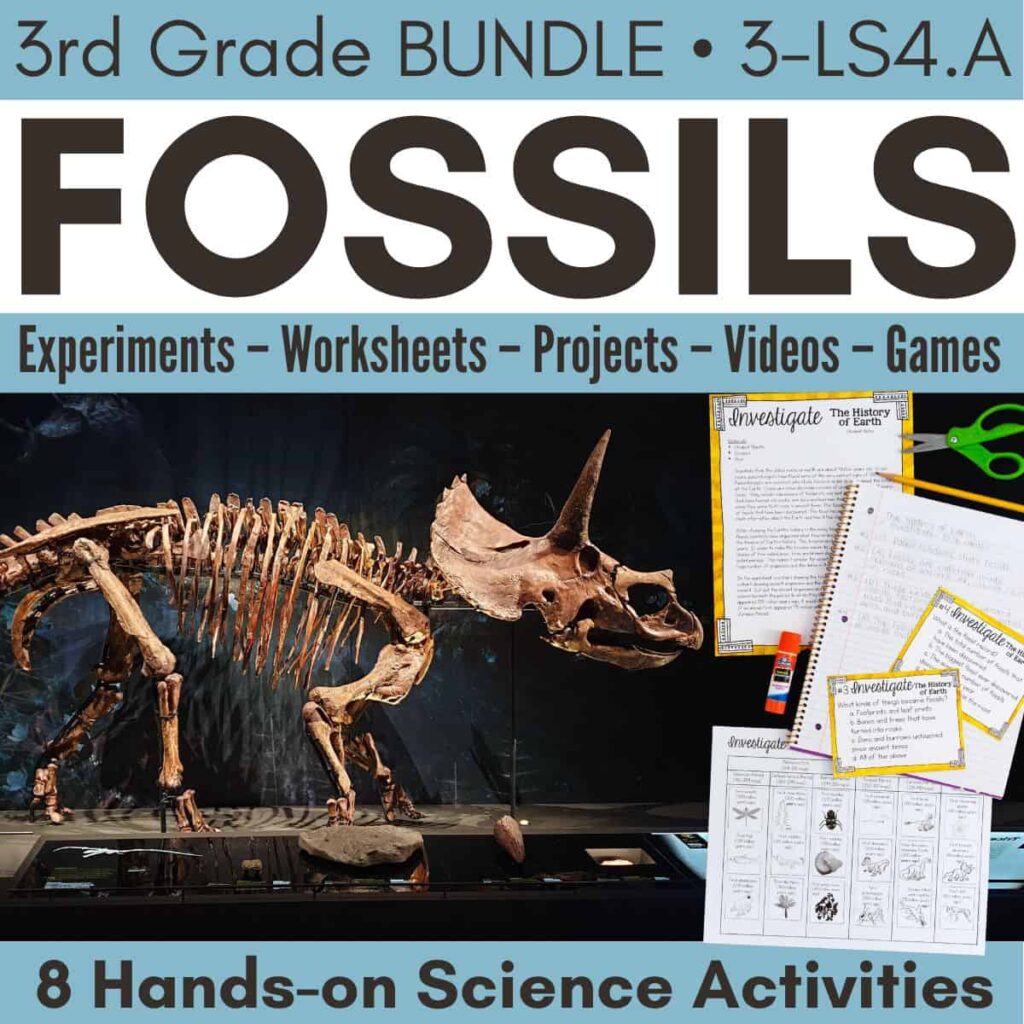
Plants and Animals Long Gone Third Grade Science Stations
The focus is on NGSS 3-LS4.A and includes concepts such as fossils, the history of Earth, comparing the mammoth and elephants, paleontologists, and physical traits of dinosaurs.
Step 4: Assess and Review with Fossil Exit Tickets
Review and assessment should focus on evidence-based reasoning.
These fossil review materials help students:
- Explain how fossils provide evidence of ancient life
- Identify extinct organisms
- Interpret rock layer diagrams
- Use data from fossils to describe past environments
Short, focused assessments help uncover misconceptions early. Rock layer diagrams are the most common source of confusion. Students often assume older fossils should be higher up in the diagram, not lower. A brief class discussion before students work with the diagrams independently helps catch that misconception early.
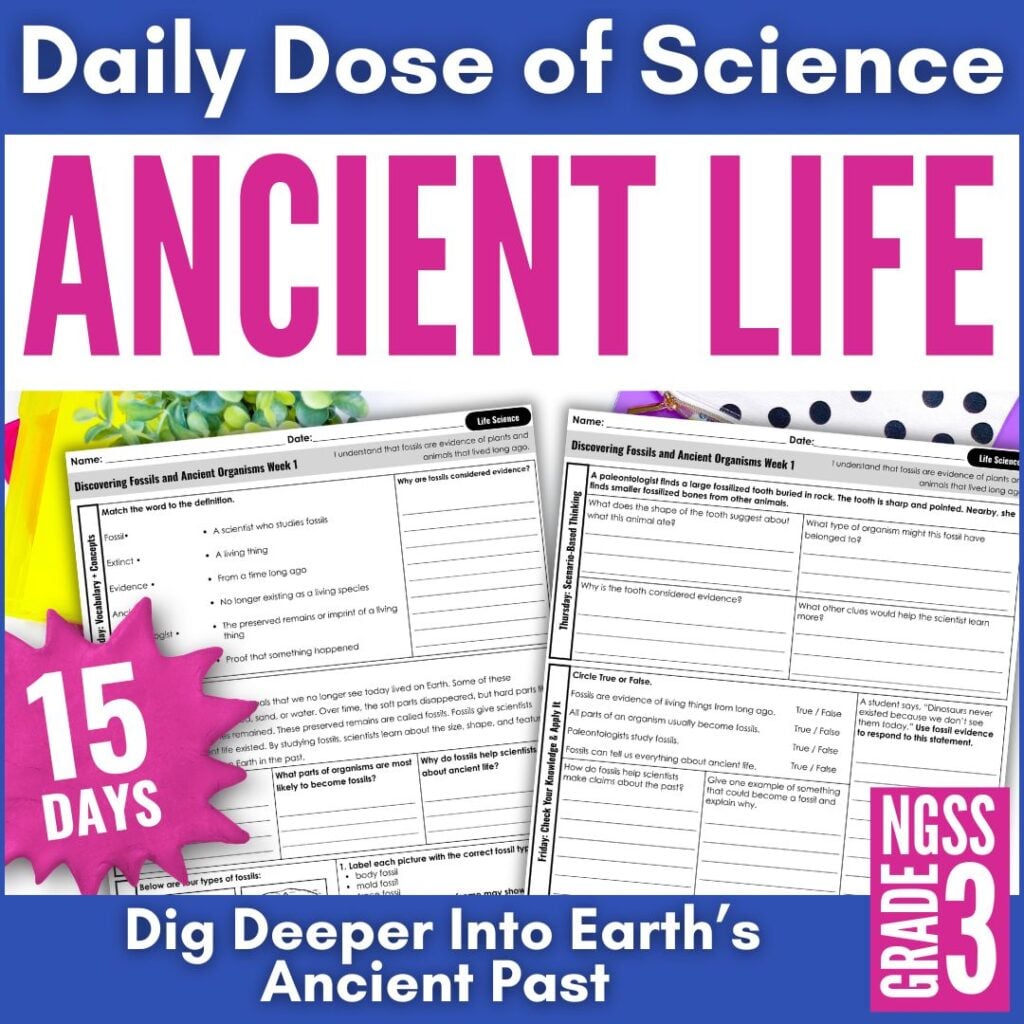
This 3rd Grade Ancient Life NGSS 3-LS4-1 Review Set includes 15 daily science review worksheets designed to help students analyze fossils, interpret rock layers, and explain environmental change, survival, and extinction.
Using the above teaching resources, students should be able to explain that:
- Fossils provide evidence of plants and animals that lived long ago.
- Rock layers form over time, and deeper layers are older than upper layers.
- The fossil record helps scientists learn about ancient environments.
- Some organisms that once lived on Earth are now extinct.
- Fossils provide evidence for claims about the past.
These foundational understandings support NGSS 3-LS4-1 and prepare students to analyze fossil data, interpret rock layers, and explain how environments have changed over time.
Now that students understand these key fossil concepts, you can deepen learning through hands-on modeling, investigations, literacy connections, and extension activities.
Additional Fossil Activities, Extensions, and Enrichment
To deepen student engagement with fossils and ancient life, these hands-on fossil activities make the concepts memorable and concrete.
Hands-On Fossil Modeling Activities
Make Edible Fossils (Amber Simulation)
Create “edible amber fossils” to model how organisms can become trapped and preserved. Students place small items inside gelatin to simulate insects preserved in amber.
This activity helps students visualize fossil preservation in a concrete, kid-friendly way and opens discussion about how rare fossilization actually is.
Make Fossils from White Glue
Students can create simple imprint fossils using white glue. After drying, the glue forms a raised cast fossil model.
This activity helps students understand:
- Mold and cast fossils
- Imprints and preserved structures
- How fossils form in sediment
Create a Fossilization Comic Strip
Have students illustrate the fossilization process step-by-step:
- Organism living
- Organism dies
- Burial in sediment
- Layers build up
- Fossil forms
- A fossil is discovered
Creating a comic strip strengthens sequencing skills and reinforces understanding of fossil formation over time.
Paleontology & Excavation Activities
Be a Paleontologist: Fossil Reconstruction Activity
Show students an image of a fossilized dinosaur skeleton. Then compare it to the anatomy of a large vertebrate such as a horse or alligator.
Ask students to:
- Identify similarities in bone structure
- Infer how the dinosaur may have moved
- Sketch what the organism might have looked like with skin and muscle
- Add coloration and environmental details
This activity reinforces structure and function while helping students see fossils as scientific evidence, not just bones.
Paleo Cookie Dig (Simulated Fossil Excavation)
Turn your classroom into a fossil dig site with a cookie excavation activity. Students carefully chip away at a cookie to uncover “fossils,” modeling how paleontologists excavate fossils slowly and carefully.
This reinforces:
- Fossil discovery
- Excavation techniques
- Scientific patience and observation
Video & Visual Supports
Short, focused videos can reinforce vocabulary and visual understanding.
Recommended channels:
- SciShow Kids — How Do Fossils Form? (approx. 4 min, grades 2-4) — Covers fossil formation, the role of sediment, and why only some organisms become fossils. A good introduction before your investigation stations.
- TED-Ed — How Do Fossils Form? (approx. 5 min, grades 4-5) — More detailed treatment of fossilization chemistry; works well for above-grade-level students or as a teacher background video.
- Becoming a Fossil (PBS Learning Media) — Short animation showing the step-by-step fossilization process. Pairs well with the fossilization comic strip activity.
These videos help students visualize fossilization and ancient environments in ways static images cannot.
Books About Fossils & Literacy Integration
High-quality picture books about fossils and paleontology provide accessible explanations and strong nonfiction models for 3rd grade.
You can add your curated fossil book list here to:
- Support reading-science integration
- Provide mentor texts for informational writing
- Reinforce fossil vocabulary
- Build background knowledge before investigations
This strengthens cross-curricular connections and increases time-on-topic.
Books about Fossils
This list of books about fossils includes picture books for K-2 and intermediate books for older students.
Fossil Coloring Pages for Reinforcement
Coloring pages can be useful for early finishers, centers, or quiet review time.
Suggested topics:
These support vocabulary retention and visual recognition of ancient organisms.
Connecting Fossils to Other 3rd Grade Science Topics
Fossils integrate naturally with other 3rd grade science units, including:
- Structure and function – Examining fossilized bones, teeth, and body shapes helps students understand how the structures of ancient organisms supported how they moved, ate, and survived.
- Adaptations – Studying fossils allows students to see how certain traits helped organisms survive in specific environments and how those traits may have changed over time.
- Inheritance and variation – Comparing extinct organisms to living species helps students see patterns in structure and function over time.
- Environmental change – Fossils found in different rock layers provide evidence that environments have changed and that living things responded to those changes.
- Extinction – Fossils provide evidence that some organisms once lived on Earth but no longer exist, helping students understand what extinction means and how it happens.
This makes fossils an excellent bridge unit before or after heredity.
Why Fossils Matter in 3rd Grade Science
Fossil studies build students’ ability to analyze evidence, recognize patterns in data, and make claims supported by scientific reasoning.
Related: Elementary Life Science Activities and Resources — see how fossils fit into the broader K–5 life science scope.
When fossil instruction follows a clear progression like building background knowledge, investigating through hands-on exploration, reinforcing with stations, and assessing with evidence-based reasoning, students move beyond memorizing dinosaur names and begin thinking like paleontologists.
Jessica BOschen
Jessica is a teacher, homeschool parent, and entrepreneur. She shares her passion for teaching and education on What I Have Learned. Jessica has 16 years of experience teaching elementary school and currently homeschools her two middle and high school boys. She enjoys scaffolding learning for students, focusing on helping our most challenging learners achieve success in all academic areas.