
30 First Day of School Activities for Elementary Students

The first day of school activities, you choose, sets the tone for everything that follows. Students are nervous, curious, and watching everything you do — and the right mix of icebreakers, community building, and creative activities can turn that anxious energy into something that actually works in your favor.
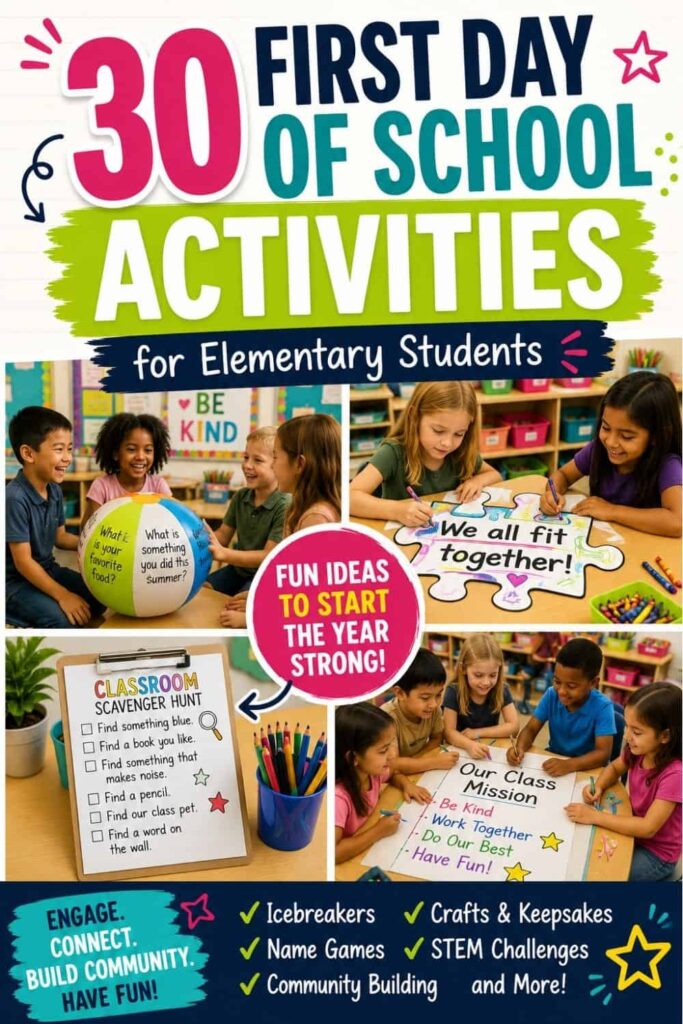
These are 30 first day of school activities for elementary classrooms that help students feel at home, learn each other’s names, and give you a real picture of who you’re working with this year.
This post contains links to affiliate websites, such as Amazon, and we receive an affiliate commission for any purchases made by you using these links. We appreciate your support!
Icebreakers and Name Games for the First Day of School
The earlier students know each other’s names, the faster the classroom starts to feel like a community. These icebreakers are low-pressure, easy to run, and genuinely fun — even for students who are shy.
1. Beach Ball Icebreaker
Write questions on a beach ball with a permanent marker before the day starts. Sit in a circle, toss the ball, and whoever catches it answers any question visible on the ball before tossing it to someone else. It gets students talking without putting anyone too much on the spot. Works at every grade level. Grades K–5.
2. Just Like Me
Sit in a large circle. One student stands and shares something they did over the summer. Any student who did the same thing stands up and says “Just like me!” enthusiastically, then sits back down. Students quickly discover what they have in common, and the energy in the room picks up fast. Grades K–5.
3. Human Bingo / Find Someone Who
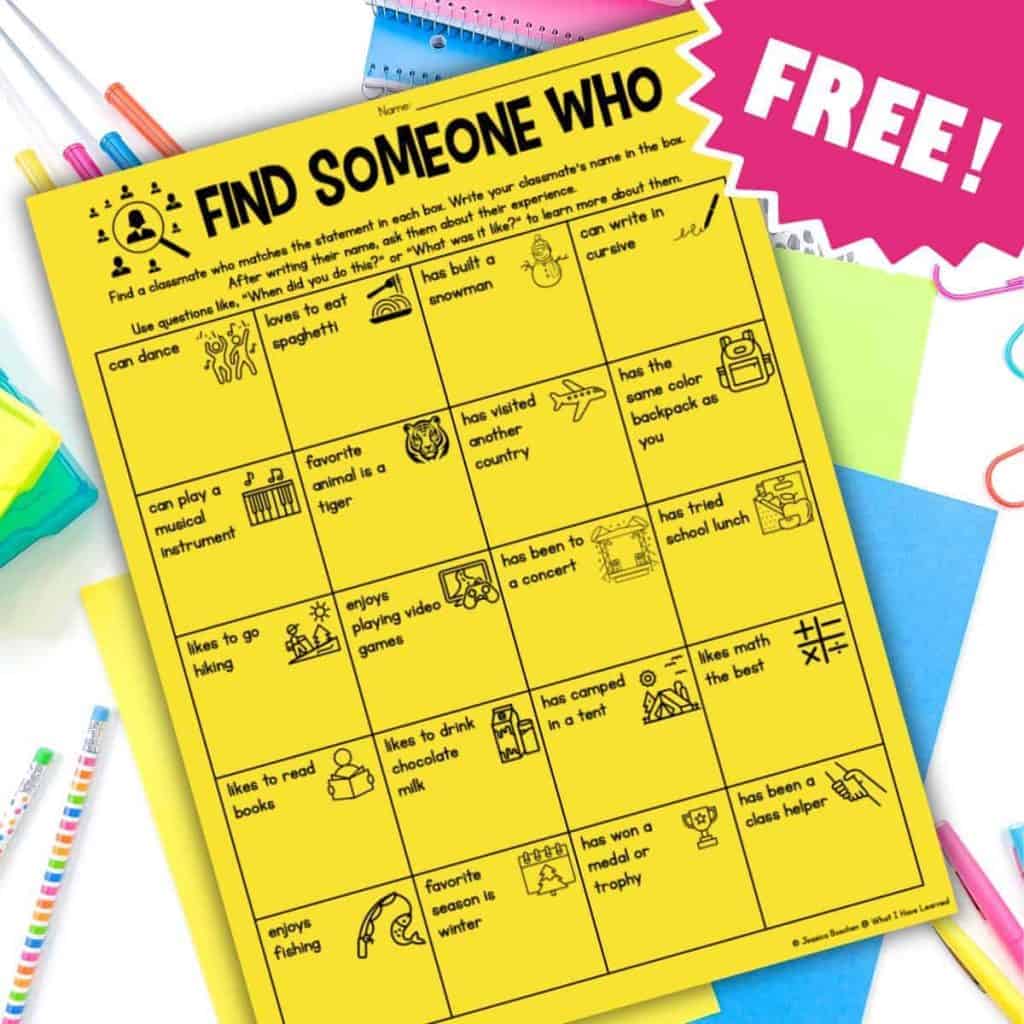
Give each student a bingo-style card with squares like “flew on an airplane” or “has a dog.” Students walk around the room, finding classmates who fit each square and writing their name in it. The first student to fill the whole board wins. This is also called Find Someone Who — you can grab a free version to use right away. Grades 1–5.
4. Two Truths and a Lie
Each student shares three “facts” about themselves — two true and one made up. The class guesses which one is the lie. Prepare for some creative answers and a lot of laughter. It’s also a good way for you to learn surprising things about your students early on. Grades 2–5.
5. Teacher Q&A
Let students ask you questions — favorite food, favorite color, favorite animal, anything they want to know. You can answer on the spot, or turn it into a quiz where they guess your answers first. Students love knowing something personal about their teacher, and it establishes right away that you’re a person, not just a classroom authority figure. Grades K–5.
6. Play a Name Game
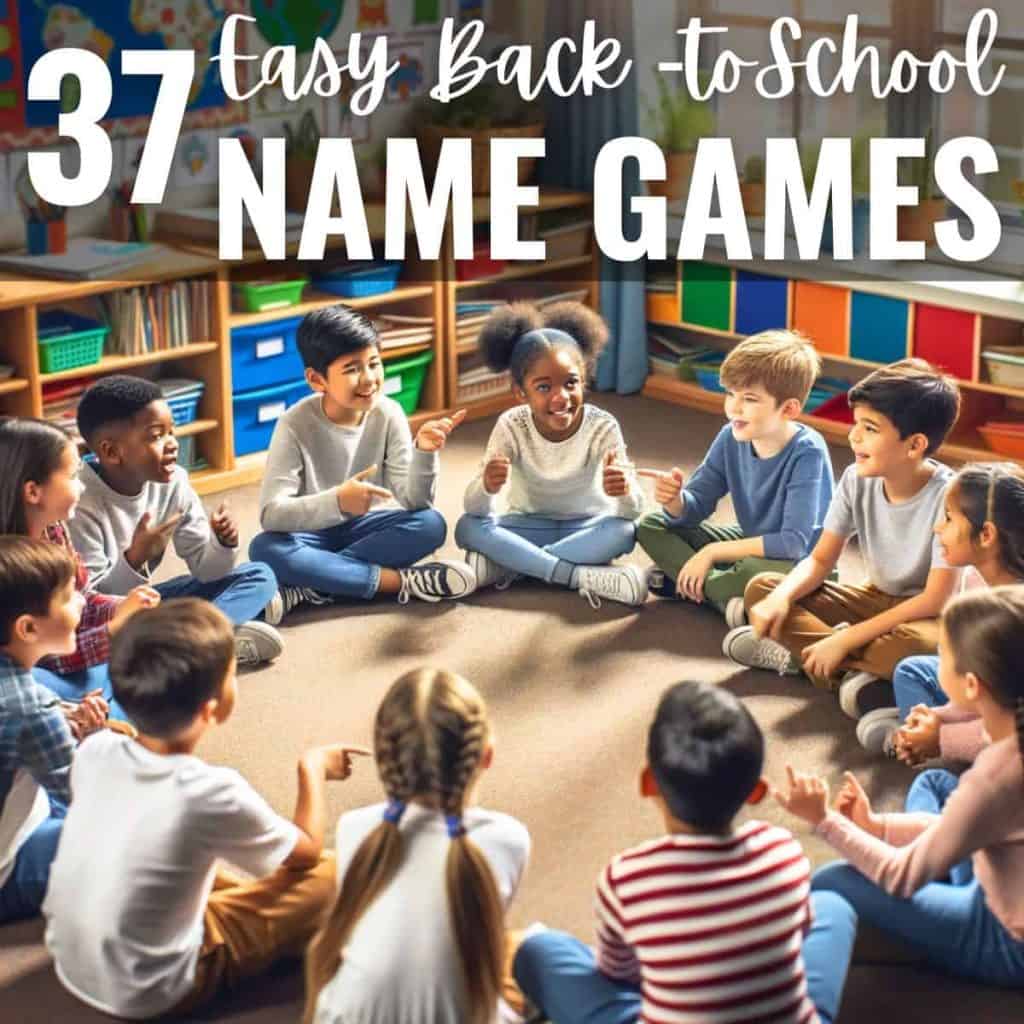
Pick one name game and do it. Any of them. A classic: each student says their name and something they like that starts with the same letter (Marcus likes movies, Sarah likes soccer). Every time students hear each other’s names in a structured context, the names stick a little better. Here are 37 name games if you want options for different grade levels. Grades K–5.
Community Building Activities for Elementary Students
Community doesn’t happen automatically — it’s built deliberately, especially in those first days. These activities give students a shared experience to point back to all year.
7. Community Building Puzzle
Leave a puzzle piece and box of crayons on each desk before students arrive. When they walk in, they write their name and color every inch of the piece. Later in the day, the class assembles the puzzle together — and it becomes a bulletin board display titled something like “A Perfect Fit for a Perfect Year.” It’s a calm morning activity that gives you time to greet families at the door, and the finished puzzle stays up all year as a reminder that everyone belongs. Get the Community Building Puzzle here. Grades K–5.

8. Getting to Know You Small Group Craftivity
Break students into small groups and give each group paper shapes to cut out and decorate. Students complete sentence starters like “I feel appreciated when…” and share within their group. It’s a quiet, creative way for students to learn something real about the people they’re sitting with. Find the full activity here. Grades 1–5.
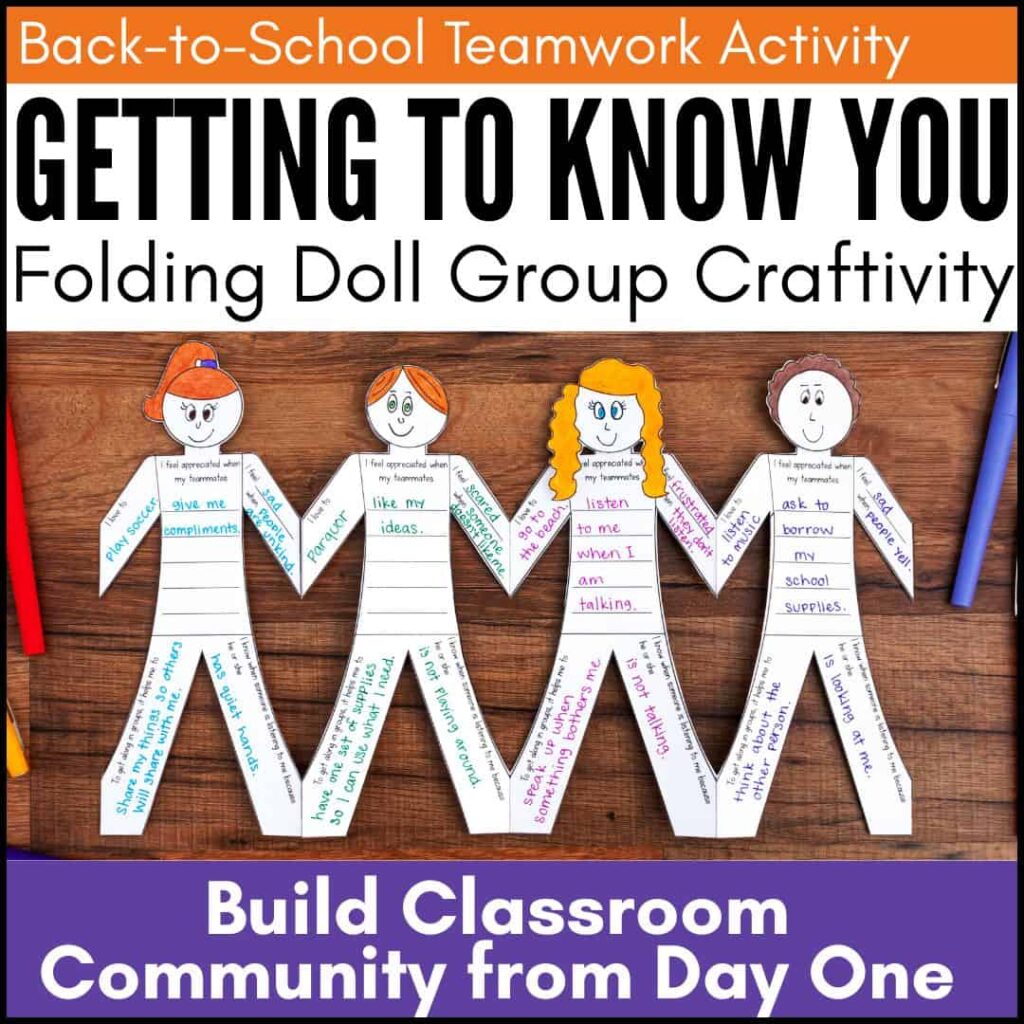
Getting to Know You Small Group Craftivity for Back-to-School
Help your students learn to work together as a team within their table groups. This folding person craftivity asks students to reflect on what they can do to effectively work with other students.
9. Classroom Cheer
Spend a few minutes at the end of the first day brainstorming a class cheer together. Students love contributing to something that belongs to the whole group, and you’ll use it all year to celebrate wins. Keep it simple, silly, and theirs. Grades K–5.
10. Start a Community Circle
A community circle is one of the most useful routines you can establish from day one. Students sit together, share ideas and feelings, and learn to listen to each other. Use it on the first day to introduce yourselves, talk about hopes for the year, or just decompress at the end of the day. The routine pays off all year long. Grades K–5.
Need ideas of questions you can ask your students? This post directs you to the right question for the right purpose.
11. Social Contract
Post four large papers around the room, each with a different question: How do I want to be treated by the teacher? By other students? How do I treat the teacher? How do we solve conflicts? Students write answers on sticky notes and place them on the posters. Then small groups sort the responses and identify the most common themes. The result becomes the class’s Social Contract — a set of expectations students helped create. Because they made it, they own it. Grades 3–5.
12. Class Mission Statement
Work with students to write a class mission statement or pledge they recite each morning. It connects naturally to student goal setting — once students define who they are as a class, they can set goals that align with it. Even younger students can contribute to a simple class promise. Grades 1–5.
13. What I Really Want to Learn
Put up a large piece of chart paper and have each student write one thing they genuinely want to learn this year. Read through the responses and look for opportunities to weave student interests into your curriculum throughout the year. Students notice when you follow through on this. Grades 1–5.
First Day of School Read-Alouds
A good read-aloud on the first day does double duty — it settles the class and opens up conversations about feelings, names, belonging, and community. These three are worth having on your shelf every year.
14. First Day Jitters by Julie Danneberg
First Day Jitters is a perfect first-day read because the twist at the end catches students off guard and gets them talking. After reading, have students write you a letter with advice about why you shouldn’t be nervous. It gets them thinking about their own feelings while building empathy. Bonus: serve Jitter Juice alongside it for a memorable first morning. Grades K–3.


15. The Kissing Hand by Audrey Penn
This one is a kindergarten and first grade staple for good reason — it speaks directly to the separation anxiety many young students feel. After reading, have students trace their hands, add a heart to the palm, and fold the fingers down. Send it home at the end of the day. It becomes a keepsake families genuinely appreciate. Grades K–1.

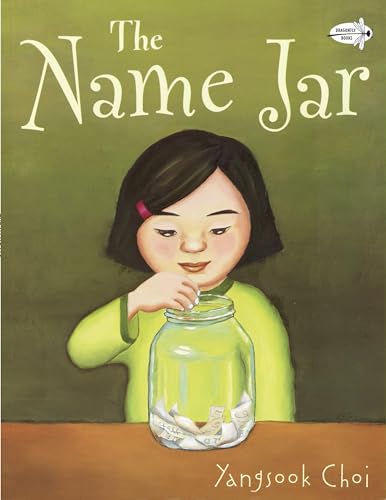
16. The Name Jar by Yangsook Choi
After reading, ask students to go home and find out how they got their name. Have them write about it as their first writing assignment of the year. Students learn something about themselves, share it with the class, and you get a piece of writing that tells you a lot about each student right away. Grades 2–5.
Creative Activities and Crafts for the First Day
Creative activities give students something to do with their hands, which is especially useful during the more anxious parts of the first day. These also produce keepsakes that mean something by the end of the year.
17. Back-to-School Bus Craftivity
This is a great end-of-day wind-down activity. Students complete a flap book where they tell about themselves, reflect on the first day, review the rules, and think about what makes a good classmate. It keeps students productively busy while giving you time to wrap up the day. Parents love taking it home. Get the Bus Craftivity Flap Book here. Grades K–3.
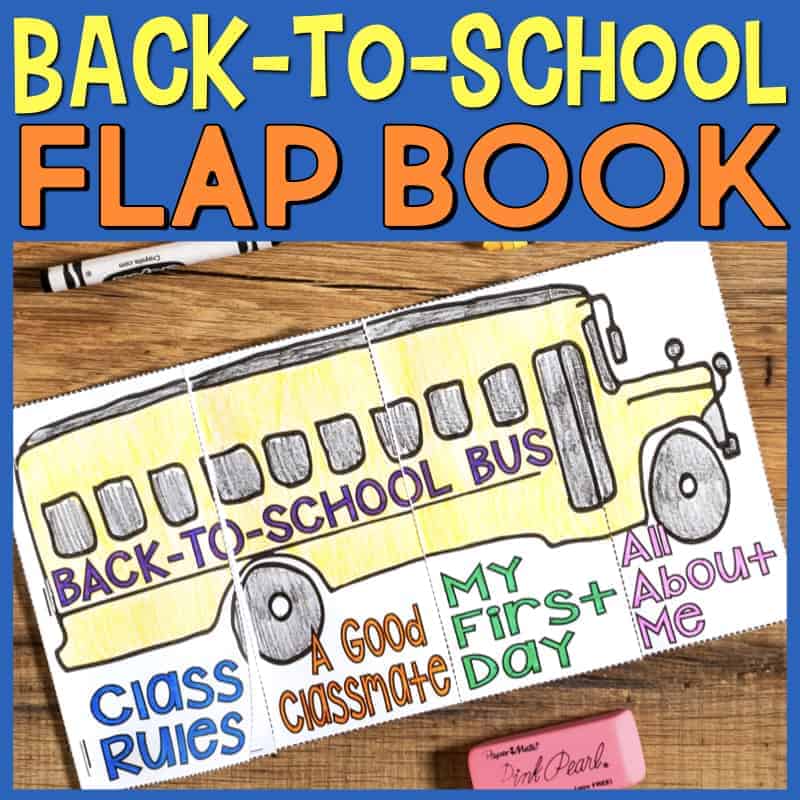
Bus Craftivity Flap Book for Back-to-School
Make back-to-school fun with this engaging flap book craftivity! Perfect for the first weeks of school, this resource helps students share about themselves, learn classroom expectations, and build community through writing and creativity.
18. Self-Portrait
Have students draw themselves on the first day. Keep the portraits and repeat the activity on the last day of school. The comparison between August and June is always striking — both in drawing ability and in how much older students look. Display the first-day portraits in the hallway to welcome visitors to your classroom. Grades K–5.
19. Dear Me Letter
Ask students to write a letter to their future self about what they’re hoping for this year, what they’re nervous about, or how they’re feeling right now. Seal the letters and return them on the last day of school. Students are always amazed at how much their handwriting changed — and how much they’ve grown. Grades 2–5.
20. When I Grow Up
Ask students what they want to be when they grow up — and actually listen. You’ll hear answers that surprise you, and you can use those dreams to make personal connections throughout the year. (“Didn’t you say you wanted to be a marine biologist? We’re studying ecosystems this week — pay attention to this part.”) Grades K–5.
21. Name Tags and Labels
Let students write their own names and decorate a border on name cards for their desks or cubbies. Laminate them for durability. It’s a simple activity that gives students ownership over their space from day one. Grades K–5.
22. Photo Keepsake
Take a photo of each student on the first day and again on the last day. Share the side-by-side comparison at the end of the year — it’s one of those moments students and families genuinely love. If photos aren’t logistically easy, a self-portrait drawing (see #18) works just as well. Grades K–5.
23. Kindness Quilt
Give each student a square of fabric or heavy paper to decorate with kind words and drawings. Assemble the squares into a class quilt and display it in the room all year. It becomes a visual anchor for classroom community and a reminder of what students built together on day one. Grades 1–5.
Exploring the Classroom on the First Day of School
Students who know where things are and how the space works feel safer. These activities turn the classroom itself into content.
24. Classroom and School Tour
Walk students through the classroom first — where supplies live, what areas are just for them, what areas are yours. Then take them on a tour of the school: bathrooms, gym, cafeteria, computer lab. For new students especially, this reduces anxiety about basic logistics. If your social studies standards include maps, this is also a natural hook for a mapping unit. Grades K–2 especially.
25. Classroom Scavenger Hunt
Turn the classroom tour into a scavenger hunt. Give students a list of things to find or questions to answer about the room and school. They can work independently or in pairs. It’s active, it’s social, and students learn the space without it feeling like a lecture. Grades 1–5.
26. Sticky Note Survey
Draw a large bar graph on chart paper. Ask a survey question (“What’s your favorite season?” “How do you get to school?”) and have each student place a sticky note in the correct column. Change the question throughout the day. Students love the interactivity, and you can naturally weave in math concepts like data and graphing — which makes it a genuine lesson, not just a filler. Grades K–5.
27. STEM Challenge
A well-designed STEM challenge on the first day does exactly what you want: it gets students working together, problem-solving, and talking — before they’ve had time to feel awkward about any of it. It also signals right away that your classroom is a place where curiosity is valued. Grades 2–5.

Here are 10 back-to-school STEM challenges designed specifically for the first week.
Classroom Procedures and Expectations
The best first-day activities mean nothing if students don’t know how to function in your classroom. Weave procedures throughout the day — don’t save them for one long block.
28. Teach and Practice Classroom Procedures
Don’t skip this. It’s the most important thing you do on the first day. Go slowly through every routine that matters — how to get the teacher’s attention, how to work with a partner, how to transition between activities. Model the right way, model the wrong way, then model the right way again. Have students practice. Have them practice again. The investment pays off every single day for the rest of the year. Grades K–5.

29. Discuss Student and Teacher Roles
Talk with students about what they expect from you and what you expect from them. Anchor charts that define “what a good student does” and “what a good teacher does” make expectations concrete and give students agency. This connects naturally to goal setting activities you can introduce in the first week. Grades 1–5.
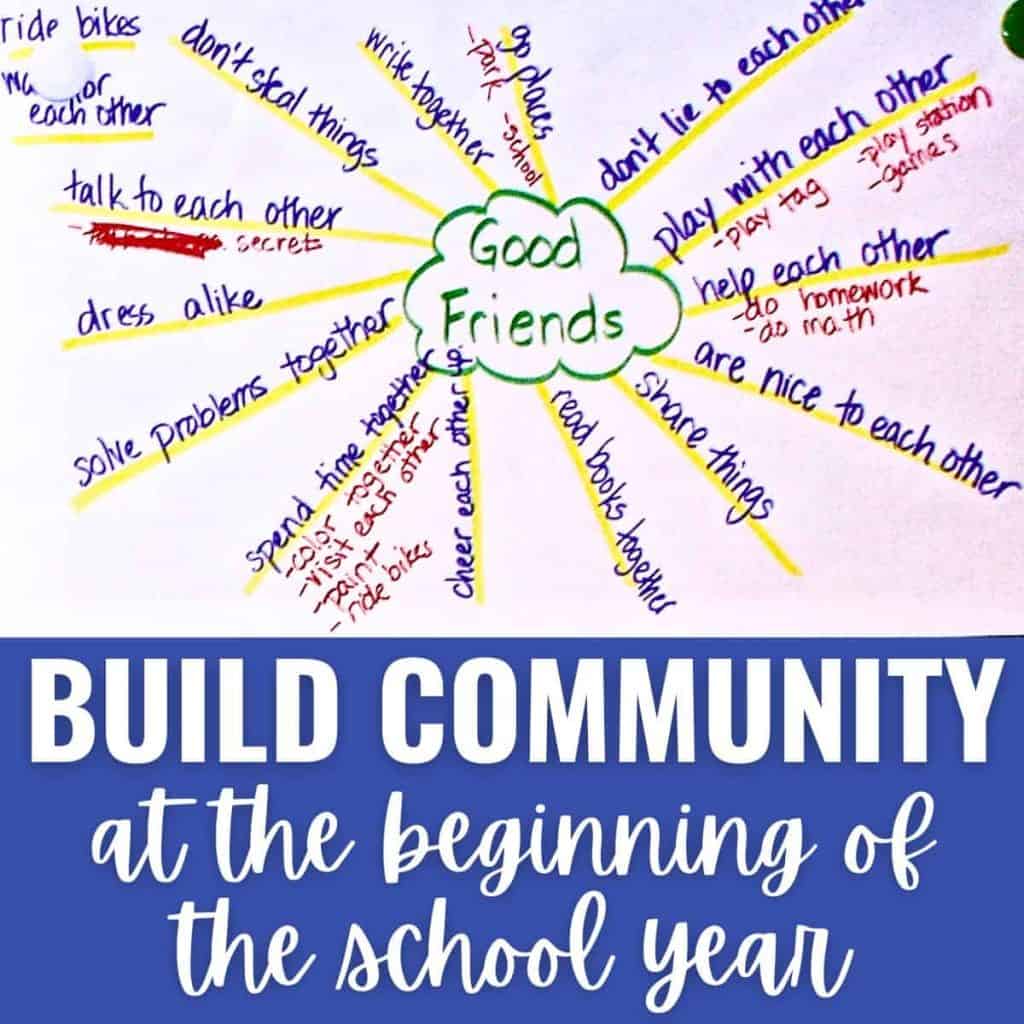
Do students know what their classroom roles are, how to make friends, and how their parents can help them at home? Teach it during the first week of school.
30. One-on-One Time With Each Student
This one isn’t dramatic, but it matters. Find a few moments throughout the day to connect individually with each student — when you’re handing out supplies, during independent work time, or at the door. Say their name. Ask one genuine question. Jot a quick note on a sticky note so you remember. By the end of the first day, you’ll have a richer picture of your class than any first-day activity can give you on its own. Grades K–5.
Building Your First-Day Plan With These Activities
You don’t need all 30 of these first day of school activities for elementary students in one day. Pick 4 to 6 that fit your grade level and your students, and plan more than you think you’ll need. The first day rarely goes exactly as expected — having extra in your back pocket means you’re never scrambling. Mix community building with procedures, creative work with movement, and you’ll end the day with students who feel like they belong in your classroom.
Looking for ready-made resources to use on day one? The Community Building Puzzle, Getting to Know You Small Group Craftivity, and Back-to-School Bus Craftivity are all designed for K–5 and ready to use the moment students walk in.
Want to Reduce Disruptions So You Can Actually Teach?
Check out this 100% FREE Micro Training
from my friend Linda over at Teach 4 the Heart.
Creating a calm classroom environment can be hard…and you probably didn’t learn everything you needed to about classroom management in college. (I know I didn’t!)
But there is hope and a way to make your teaching experience more fulfilling and less stressful.
Watch this quick 28-minute training to learn how you can minimize disruptions so you can actually teach your content (and get to do the projects & activities that make learning more fun for EVERYONE!
Linda WON’T just tell you to “build relationships” because, frankly, even the best connections can’t eliminate all classroom challenges. Achieving a smooth-running class requires a more nuanced approach.

So join me for this FREE 28-minute training and discover their Calm Classroom Blueprint, used by thousands of teachers to:
- Significantly reduce disruptions during lessons & work times.
- Gain confidence In handling challenging situations (that previously left them dumbfounded).
- Lower daily stress levels and find joy in teaching again!

On the first day of school I like to take the kiddos on a tour of the school. I teach first grade and as kinders they “lived” on the other side of the campus. So even though many are not new to the school, they are new to our side and may not know where everything is in relation to their new classroom.
One thing I do on the first day of school is introducing myself to students by sharing pictures of myself from when I was their age! Then I let them ask any questions they want. My favorite from last year was “Have you ever transformed into a cat?”
At the beginning of every school year I gather my 2nd grade friends at the group carpet. I begin the discussion by letting them know that I am always nervous meeting my kiddos the first day of school. I let them know I didn’t sleep well the night before, my stomach may have been nervous, and I was anxious to begin. I also let them know that after meeting them I felt much better knowing that my learning family included each one of them.
On the first day of school I read “First Day Jitters” by Julie Danneberg and serve “jitter juice” to the students. After school I go for ice cream with my teacher friend to celebrate the first day.
One thing I always do is take my mom with me–She is a retired teacher so she is wonderful help to me… but she is also a mom, and a grandma so she is great at giving hugs to anyone who might be nervous!!! I LOVE MY MOM!
On the first day of school, I always introduce myself with a quick slide show (Google Slides). Then I have students work on their own slide shows…the nice thing about using Slides is that students can use images from the web if they don’t have digital photos at home, or don’t have access to the internet outside of school. We share these in a gallery walk near the end of the 1st week or beginning of the 2nd week (depending on lab time).
I always read Name Jar on the first day of school. We discuss the theme and create a line plot using the number of letters in our last names.
I teach preschool and kindergarten so it always their first time in a school. We take a tour of the school and explain what we will do in all the spaces.
On the first day of school, I always have the students make tent name tags. The students have to draw four pictures that are symbolic of who they are in each corner and their name in the middle. Not only does it help me remember the students’ names, I learn who the perfectionists are, who is in sports, etc.
One thing I always do on the first day of school is the “birthday twin ” line up. Without talking I have students line up according to birthdays. I begin by saying december is at the back of the classroom and January begins at the front. My birthday is July 17 so I stand about in the middle. This is a great ice breaker and also gives me a chance to give summer birthday bags…and find out if we have any birthday twins. A fun beginning of the year activity.
I read First Day Jitter and go over classroom procedures.
1 thing I always do on the first day is read, First Day Jitters. We open it up for a morning discussion and way to get to know each other a little better.
I always try to make time to meet every student and try to learn their name when they arrive. I want them to know that I care about them and I want to be the one to invite them into their new home for the year!
We always make name cards for their desks and lockers.
On the first day of school we always write our name and draw a picture of ourselves. 🙂
On the first day of school we always read The Kissing Hand book and talk about first day feelings. We trace the student’s hands and cut them them out, then attach the poem, and send them home with a small bag is Hershey’s Kisses.
I always have them pick a book to read on the very first day of school. In fact, I’ve tried to have them pick a book at Open House so they dive right into that book first thing when they come in on that very first day. I love looking around the room and seeing them all reading! 🙂
I always have a fun activity to ease the first day jitters. We also go on a tour of the school and talk about how we should behave in each area so new to the school students know where everything is.
I always begin our first novel read-aloud. It’s stress free for the kiddos and it instantly makes us all connected through this shared experience.
I always start out with a fun read-aloud. Even older kids enjoy being read to. I also always have them draw a picture of themselves.
I always play “find someone who” games to get the students making new connections and learning about each other. First day jitters is always a must as well–can’t forget that jitter juice ;p
I always do self-portraits! I hang these on a bulletin board with their goals for 4th grade! Eventually, these drawings go in their portfolios.
On the first day of school I always take a picture of each child with a 1st day sign, we put this on the first page of their memory book and they write the sentence “On the first day of school I felt…”. We do the same on the last day of school, with a picture and sentence. The kids and I love to look at how their hand writing has improved and they’re faces have changed!
On the first day, (and the day after that, and the next day . . . ) I go over procedures, procedures, procedures, especially for unpacking, recess, lunch, and packing up. I also always have the kids engage in community building activities and read aloud to the class.
When I begin my first year of teaching, I plan on creating an all about me bag and then having the students create one to share with the group during our morning meetings. When ever I can, I like to have my students sharing their interests with the class and this activity allows students to talk about themselves through showing artifacts such as pictures, rewards/medals, toys, books, movies, etc.
On the first day of school, I always have my students make a decorative name plate to sit on their desks. Also, a lot of modeling expectations for various procedures.
I love reading a picture book to my new class on the first day.
eat chocolate and go to sonic
This is my first year teaching 5th grade. I’m going to let my students decorate bookmarks and laminate them. I hope it will be. Motivator to read and perhaps something they can keep for years to come!
I always do a classroom tour and a get to know your teacher activity
I always Read You’re Finally Here! They love this book and gets everyone laughing!
I always do an ice breaker game – usually a beach ball with questions they voice their opinions on!
One thing I do is play a name game so I can practice learning all of my students names.
This will actually be my first year starting at the beginning of the school year and I am so excited! The one tradition I want to start with my kids is a kindness quilt. The children color their portion of the quilt with a kind message then we put all our pieces together to make one beautiful quilt with kind words for the year. This can double as a bulletin board for parents on curriculum night
On the first day of school I always do a lot of breaks for games, community building, and materials introduction. My favorite activity is making jitter juice and taking the kids on a gingerbread hunt around the school.
One thing I always do is to have my students draw a picture of themselves and write the alphabet. I then do the same thing on the last day of school and we compare how much their drawing and writing has changed 🙂
My first read aloud is always The Little Red Hen. Then I establish my rule: if you don’t work, you don’t eat. We discuss it in adult terms and kid terms. This year I will have four “younger siblings” of former students who can assure the class I mean what I say. Mean? No, but I am firm.
I greet each child individually with a smile and slap a name tag on their shirt.
On the first day of school, I always have students work together to help create our class rules.
I teach 4th grade math and always do a Math About Me on the first day of school. We get to know each other and start the year with math at the same time.
I always make sure that my students feel welcome in the classroom by greeting them at the door and then by doing a morning meeting where everyone gets a chance to tell a little about themselves!
I always read First Day Jitters.
We take “First Day of School” pictures with the mini Polaroid and draw self portraits.
I always have them write a letter to themselves that I hand back during the last week of school. I have them think of goals that they have for the year, something that they want to accomplish, etc. They have a blast reading those letters. Some years I”ll have them trace their hand, we’ll measure them and even take pics.
One thing I always do on the first day of school is begin procedures. No sense in putting it off. Structure and routine need to be established right away, and in between practice we build community and have fun!
This is my first year that I know EXACTLY who and what I am teaching! (Super excited!) I am the goofy teacher at our school, so I like to start out the first day making the kiddos laugh! This year I will be putting up a funny PowerPoint about myself, the class, and what they should expect (using funny 90’s themes and jokes!)
I am entering my fifth year and I ALWAYS go over procedures on the first day of school!!
On the first day of school, I read First Day Jitters, and we drink Jitter Juice. We also go over rules and procedures.
I always go over the rules and class procedures. I also try to do magic play-doh because the kids absolutely love it!
I have 3 Back-to-School/Summer’s over songs that I teach them and I always have a silly read aloud on the first day of school.