
Ecosystems and Biodiversity Third Grade Science Stations
Ecosystems and Biodiversity Science Stations for third-grade help students understand how animals and plants relate to each other and to their environment. They include topics such as food chains, natural selection, and invasive species. Ecosystems and biodiversity are one of the biggest units in elementary life science, especially in third grade where students dig into food chains, habitats, and human impact.

Science is always one of the subjects that I plan last because reading and math take up so much teaching and planning time. That doesn’t mean that I don’t value science, but it is often overshadowed by other subject areas and there is only so much time in the day. It’s difficult for me to plan in-depth units for science in the middle of the year because other things take up so much time. I love having them ready to go when we’ve come to that point in the year.
In a previous post, I outlined the Life Cycles of Plants and Animals set of the Third Grade Science Stations aligned to the Next Generation Science Standards. In this post, I’ll go through the Ecosystems & Biodiversity Science Stations that meet NGSS 3-LS1.B standards, covering topics like food chains, habitats, natural selection, camouflage, invasive species, and deforestation. Some of the photos may be familiar because they are part of the main post describing all the science stations.
Ecosystems and Biodiversity Science Stations for Third Grade
The focus is on NGSS 3-LS2.C and 3-LS4.D and includes concepts such as food chains, food webs, traits of organisms that change due to environmental changes, how animals affect their environment, invasive species, and biomes.
An In-depth Look at the Ecosystems and Biodiversity Science Stations
The topics in this set of stations about ecosystems and biodiversity focus students on how animals affect their environment and depend on each other. They contain challenging material for third graders, with new words and concepts in easy to implement, interactive stations. These science stations are designed to explain how animals and plants relate to each other and their environment. Several of stations contain follow-up activities or teacher notes that can be used to introduce or extend the learning.
Differentiated Responses
Like all the science stations, the Ecosystems and Biodiversity stations have a variety of ways for students to interact with the station. Each station includes four different ways to respond to the experience at the station:
- short answer questions
- fill-in the blank questions
- task cards with short answers
- task cards with multiple choice
All the variations are similar to one another, but require a different level of independence. The fill-in-the-blank is the easiest and perfect for your students who struggle with reading, especially if you provide them with a word bank. The short answer is the most difficult as it requires students to construct their own responses without much support.
Choose the format that best fits your classroom and students. Students are also encouraged to use their science journal via the task cards. Answer keys are included for all of the differentiated response formats.
Some activities also include a worksheet in addition to the differentiated responses. This worksheet is the “work” of the station. The differentiated responses require students to think broadly about the topic and concept.
Vocabulary Cards
The vocabulary cards come in two formats, with and without pictures. Words related to ecology and biodiversity make up this section: ecosystem, decomposer, food chain, photosynthesis, natural selection, etc.
One format has the complicated concept words broken down via short sentences and bright illustrations, perfect for small groups. The other format is just the definition and word, perfect for a word wall.


Watch a Video about Food Chains or Food Webs
In this station, students watch a video. There are two videos available, one about food chains and one about food webs in ecosystems. Choose the video that best suits your students or have them watch both videos. After the video, students answer one set of differentiated questions.
Play a Video Game about Habitats or Food Chains
Students can play one of two educational video games, habitats or food chains. The habitat game takes them through several habitats, introducing the plants and animals that populate it. Tawny owls, water spiders, and algae are some of the animals covered in the habitat video game.
The food chain teaches the difference between carnivores, omnivores, and herbivores, and explains how energy moves through a food chain.
Students will need a computer to play the video games.
Investigate a Changing Environment and the Traits of Organisms
This fun interactive science station helps students understand how environmental changes, like pollution, affect an organism’s color and thus make it easier to see.

Students read an original passage about camouflage, how it relates to natural selection, and how an animal’s offspring can be a different color and the effect that has on natural selection. Pairs of students work together through an investigation which demonstrates how pollution that changes a tree can result in color changes in the traits of insects, and thus allow certain bugs to be seen easier by their predators, the birds. After the investigation, students answer questions about the investigation.
Diagram Sea Otter Ecosystem
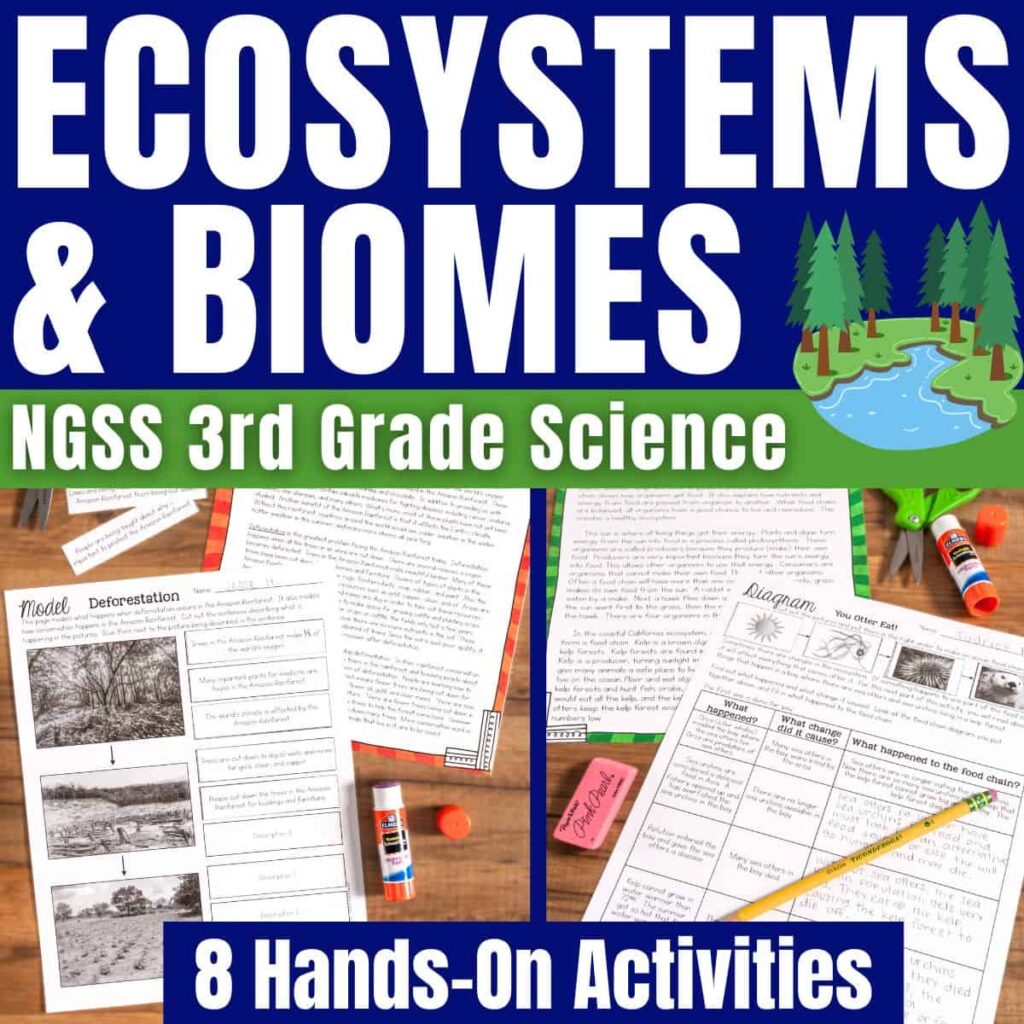
The provided student sheets, scissors, and glue are needed for this station, which explores how food chains help build healthy ecosystems. The station comes with an original reading passage about an ecosystem in a bay populated by kelp, sea urchins, orcas, and otters and explains the relationship between producers, consumers, and decomposers.

Students read the passage, order the food chain, and respond to prompts about the cause and effect relationship of the different organisms. For instance, what happens when pollution enters the bay, orca’s feed on the sea otters, or the water warms up and the kelp didn’t grow. Students practice thinking through what happens when one animal is taken out of the ecosystem. This station has a student worksheet in addition to the differentiated responses.
Read a Passage about How Beavers Affect their Environment
Leave it to Beavers (bonus points for any student who gets the reference) is the reading passage in this section. It includes information on beaver habitats, behaviors, and traits, and how beavers shape lakes and shorelines when they build a lodge or a dam. Questions and answers, fill-in the blanks, and task cards follow the reading passage.

Model Deforestation
This station comes with an original reading passage about Deforestation in the Amazon Rainforest. After reading a passage about deforestation and conservation, students cut out descriptions of the original rainforest, deforestation, and conservation and glue them next to the corresponding picture.

Like the other stations, differentiated response questions are provided. This station also has an extension, which are links to rainforest games and videos on the indigenous peoples of the Amazon. This dense topic may be the first time third graders learn about environmental destruction—the videos are a good aid here.
Explore Food Chains and Invasive Species
Students explore native and invasive species (rats and mongoose in Hawaii) and a food chain pyramid, showing how producers and different level consumers stack up in an ecosystem. The provided reading passage goes in-depth about the topic. Students fill out an invasive species chart using the pyramid as a guide, but with different invasive species from around the world. Invasive species include smothering seaweed, kudzu, European rabbits, snakehead fish, and Burmese pythons, all fun animals for third graders. Students learn what the invasive species does and write about what happens to the environment as a result of the introduction of that species.
Sort animals and plants
The last activity is sorting biomes. After reading a page of descriptions of different biomes and their inhabitants, students cut out animals and plants, and then sort them by biome, gluing them to another sheet with different biome headings and columns. There’s a color sheet to cut and sort, and also a black and white sheet of the same species that your students can color in. After the sorting activity, hand out one of the questions and answer sheets.

Also included
At the front of the science stations are a materials checklist that can be used during set up, a student recording / short note-taking sheet, and an organizer for group rotations.
At the very end of the science stations is a master answers key written in red.
How to Purchase the Ecosystem and Biodiversity Science Stations
Purchase the Ecosystems and Biodiversity Science Stations on my website or on Teachers Pay Teachers.
Ecosystems and Biodiversity Science Stations for Third Grade
The focus is on NGSS 3-LS2.C and 3-LS4.D and includes concepts such as food chains, food webs, traits of organisms that change due to environmental changes, how animals affect their environment, invasive species, and biomes.
Related: Elementary Life Science Activities and Resources — a guide to teaching all the K–5 life science topics.
A Bundled set of all the Third Grade Science Stations are also available for purchase at a 20% discount.
Erin