
CUBES Math Strategy: What It Is and What to Use Instead
The CUBES math strategy is a word problem acronym that breaks problem-solving into five steps: Circle the numbers, Underline the question, Box the keywords, Evaluate what steps to take, and Solve and check. It is one of the most widely used word problem strategies in grades K–2, largely because it is easy to memorize and quick to teach.
But ease of memorization is not the same as effectiveness, and that distinction matters for how students develop as mathematical thinkers. This post explains what CUBES is, looks honestly at its limitations, and offers a research-based alternative that works across all grade levels.

However, despite its popularity, the CUBES math strategy has drawbacks. One main criticism is that it can oversimplify word problems, leading students to overlook critical elements or make misguided assumptions.
Because it’s a one-size-fits-all strategy, it may not adequately serve students with different learning styles or those working on more advanced problems, such as students in grades 3-5. Furthermore, CUBES’s rigid structure does not encourage the flexibility and adaptability in problem-solving that are crucial for mathematical understanding beyond the classroom.
Let’s dive deeper into what the CUBES math strategy is and some of its limitations.
What is the CUBES Math Problem-Solving Strategy?
The CUBES strategy breaks down word problems into five steps. The acronym CUBES stands for:
- Circle
- Underline
- Box
- Evaluate and Eliminate
- Solve and Check
What are the Steps in the CUBES Math Strategy?
The steps of the CUBES strategy are:
- Read the problem out loud.
- Circle the numbers and labels.
- Underline the question.
- Box the keywords.
- Evaluate and Eliminate unnecessary or extra information.
- Solve and Check the answer.
This seems pretty straightforward, right?

Students just need to circle, underline, box, evaluate, and solve. Easy to memorize and easy to execute. Right?
But that’s the problem. The math strategy becomes rote and without meaning. It’s not a math strategy. It’s just an acronym.
Is CUBES a Good Math Strategy?
While students easily remember the CUBES acronym, it doesn’t help them learn how to solve a word problem. Many K-2 students learn the CUBES math strategy and don’t learn how to actually read and solve a word problem.
Why is CUBES Is NOT a Good Math Strategy?
- CUBES prioritizes completing each step rather than reading for meaning.
- CUBES does not work for the more complex problems students encounter in grades 3-5 and beyond.
When students reach grades 3-5 and encounter more challenging multi-step problems, they often feel unsure how to approach and solve them. The CUBES strategy they relied on in grades K-2 no longer works, and they did not learn how to read a word problem for meaning.
The CUBES strategy works for students who already excel at comprehending word problems. It does not work for students who do not know how to read and understand word problems. By following the CUBES approach, students prioritize completing each process step rather than understanding the problem.
If students are not proficient at solving word problems, CUBES will not be an effective strategy for them. Students will go through the motions with the CUBES strategy despite their lack of understanding.
Here are some reasons I use numberless word problems. I want students to focus on reading and understanding the problem BEFORE being introduced to the distracting numbers.
Let’s take a closer look at some steps in the CUBES math strategy and explore its limitations.
Circle the numbers and labels
While circling the numbers and labels can help students identify key elements of the problem, this approach can sometimes be misleading. Students may circle the numbers without fully understanding their role within the context of the problem.
For example, a problem might involve the number of items and their cost, but simply circling the numbers does not help distinguish between them. This can lead to miscalculations and misunderstandings.
Therefore, while circling the numbers may be a good start, students should also be encouraged to comprehend each number’s specific role in the problem.
Underline the question
Underlining the question can be both advantageous and problematic. Its main advantage is that it helps students focus on what is being asked, which is crucial in problem-solving.
However, it might inadvertently encourage students to jump into solving the problem before fully understanding it. Underlining the question might lead students to latch onto a specific operation or method too early. This can block their ability to see alternative paths to the solution or even lead them to use an inappropriate mathematical operation because they haven’t fully understood the problem’s context.
Therefore, while underlining the question can be useful, it should be paired with a thorough understanding of the problem as a whole.
Box the keywords
Boxing keywords in a word problem may seem like a good idea at first, as it highlights important terms that may indicate mathematical operations, but it has downsides. Relying heavily on boxed keywords can inhibit a deeper understanding of the problem. Some problems may lack clear keywords or use language that doesn’t match the list of known keywords.
Moreover, this strategy may encourage students to formulate a solution based solely on a keyword’s occurrence without considering the problem’s overall context. This could lead to incorrect solutions and a failure to fully understand the problem’s nuances. Thus, while boxing keywords can be useful in certain situations, they should not be used as a crutch to bypass a comprehensive understanding of a math problem.
When we remove the circle, underline, and box steps in CUBES, we are left with Evaluate and Solve. Evaluate and Solve are the two crucial steps in solving word problems.
What to Do If Your School Requires CUBES
If your school or district has adopted CUBES as a required strategy, you do not have to abandon it — but you can supplement it in ways that build real understanding. A few ideas that work alongside CUBES:
Start every word problem with a reading-for-meaning step before students circle or box anything. Ask: “What is happening in this problem? Who has what? What changed?” Then move into the CUBES steps.
Use the Evaluate step (“E”) as a genuine reasoning check rather than a procedural box to check. Have students explain out loud what operation makes sense and why before they solve.
Pair CUBES with tape diagrams or bar models so students draw the relationship between the quantities, not just circle the numbers.
What is an Alternative to the CUBES Math Strategy?
Instead of using the CUBES strategy, have students read the word problem, identify the context, and understand what is happening in the problem. One of the biggest challenges in how students approach word problems is translating the words into mathematical equations. Once students have the equation, the math itself is often simple computation. For many students, determining the correct equation can be nearly impossible.
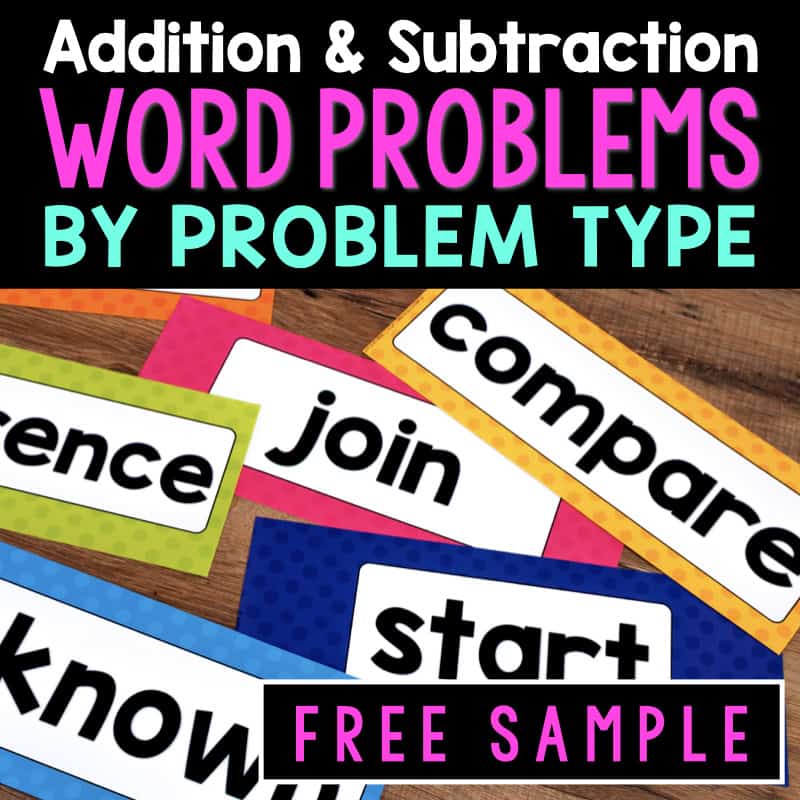
Are things being joined or separated? Is there a comparison happening? Or are there parts being put together or taken apart? These are all great questions to ask for addition and subtraction word problems.
A Research-Based Four-Step Approach to Problem-Solving
A Hungarian mathematician named George Polya developed a four-step approach to problem-solving nearly 100 years ago. His method is a great alternative to the CUBES method because it focuses on understanding the problem and solving it. This method also spans any grade level and any classroom.
The four steps include: Understand the Problem, Devise a Plan, Carry Out the Plan, Look Back. This four-step plan can be shortened to:
- Understand
- Plan
- Solve
- Reflect
Instead of focusing on the physical, mechanical steps of circling, boxing, and underlining, it encourages students to engage deeply with the problem.
Here are more details about each step and how to apply them in a K-2 classroom:
Understand
In the first step, ‘Understand the Problem’, students are guided to comprehend the problem by paraphrasing it, identifying unknowns, and noting the numbers and relationship of the numbers. While circling, underlining, and boxing can be used, they are not the focus.
For Join and Separate word problems, I like students to read to find the action. They then find the start, the change, and the result. For compare word problems, I ask students to find the larger and smaller quantities or amounts. We use different words based on the measurement or the problem context.
Plan
In ‘Devise a Plan,’ students brainstorm various strategies to solve the problem. This is where we use a variety of models and strategies like tape diagrams, bar models, and number lines.
Solve
‘Carry Out the Plan’ involves executing the chosen strategy. This is another reason why I love using numberless word problems. Students cannot start to solve the problem if they don’t have the numbers yet! Also, if I have students who cannot solve multi-digit computation problems, I can give them easier numbers that are either single-digit or do not require regrouping.
Reflect
‘Look Back’ encourages students to reflect on the solution, verifying and interpreting the result. This is where I have students write the solution in a sentence to verify that it makes sense within the context of the problem.
A quick example for grades 3–4:
“Jake had some marbles. He gave 13 to his friend and had 27 left. How many did he start with?”
Understand: something is being separated, and the start amount is unknown. Plan: use a tape diagram with a question mark for the whole and fill in the two parts we know. Solve: 13 + 27 = 40. Reflect: does 40 marbles and giving away 13 leave 27? Yes. The answer makes sense.
This four-step approach strengthens problem-solving skills and promotes a deeper understanding of the mathematical concepts well beyond the CUBES strategy.
Here are 5 tips for solving word problems that will dig deeper into how to use the four steps above.
The four-step approach requires more from students up front—they have to read the problem and think about it before they start solving. That is harder to teach in September than handing out a CUBES anchor chart. But students who learn to understand a problem before they try to solve it carry that skill into third grade, fourth grade, and beyond, when word problems stop being single-step, and the acronym no longer helps.
Your third- and fourth-grade colleagues will notice the difference.
Your upper elementary and middle school colleagues will thank you, too!

Addition and Subtraction Word Problems: Teach the Types of Word Problems
Master addition and subtraction word problems with this year-long resource! Covers all types of word problems, including first grade addition word problems and 2nd grade subtraction word problems, with built-in differentiation, models, and vocabulary support.
Jessica BOschen
Jessica is a teacher, homeschool parent, and entrepreneur. She shares her passion for teaching and education on What I Have Learned. Jessica has 16 years of experience teaching elementary school and currently homeschools her two middle and high school boys. She enjoys scaffolding learning for students, focusing on helping our most challenging learners achieve success in all academic areas.