Below are some tried and true classroom management strategies that work across most grade levels. Teachers particularly favor these strategies due to their simplicity of implementation and ability to establish a strong rapport with students.
The Best Classroom Management Strategy
The best classroom management tool is building trusting relationships with students. These relationships will go a long way in helping manage a classroom and are the most important thing to put time and effort into.
Eight Classroom Management Strategies That Work Throughout the School Day
Keep in mind that there is no magic tool. Some tools will work better than others based on your classroom and teaching style. You may also find that a combination of these tools is the ticket for your students.
Or that after using one for a while, it’s just not working for you. It’s okay to explore, find what works, and stop doing what doesn’t. A teacher’s classroom management skills and repertoire develop over time, each year growing stronger and stronger.
Music gives students a time and volume limit while transitioning from one activity to another. A song has a fixed limit with an end that, once learned, provides students with predictability. Students begin to know the music and internalize how much time they have left to finish the task.
When I taught Kindergarten, I used a 100-counting song in kindergarten, which lasted a few minutes. When the music played, students knew they had to clean up and be on the carpet by the song’s end. Once the routine was set up, students knew just what to do. As a side benefit, students heard the numbers counted up to 100 each time it was played and started to internalize counting patterns.
I kept a copy of the song on a CD in the CD player and just hit play as needed. Once iPhones became more popular, I kept it on my phone, plugged it into the speakers, and hit play.
I have heard teachers use different music for different transitions during the day. Although I only use one song, I can see how using a song for different transitions could be helpful, depending on the transition and amount of time needed. In that case, keep a playlist on your phone or an old iPod. Rename the songs for the specific transition and order them by the time of day that you use them. That will help make it convenient and easy to play the songs.
Incorporate Silent Wait Time
You know when you’ve called for your class’s attention, and you’ve got those one or two kiddos who keep gabbing at their neighbor? Some children just don’t hear you, like physically, aren’t hearing you. They don’t have hearing problems but selective listening issues. My own kids have it.
In all seriousness, though, I truly believe that some students don’t perceive simple nuances in the classroom, like when the whole class quiets down and they’re still talking. Or when everyone is cleaning up, and they’re still engaged in a task. Some of that awareness needs to be taught and made explicit. One way to do that is through silent wait time.
Silent wait time communicates several things. First, it communicates that what you are saying is important and that all students must listen. If you talk over students, that communicates that they don’t need to listen to you.
Along the same lines, silent wait time communicates a need for respect. It communicates that you are in charge and will not allow the disruption to continue. Likewise, you want to ensure students are given the quiet they need when speaking. To create an environment of mutual respect, everyone needs to feel that they are heard and that others are listening.
Praise Positive Behavior
Praising positive behavior can go a long way in the classroom. The younger the students, the better and quicker this classroom management strategy works, but it does work at all age levels.
There are two ways to implement this. If you notice something a student is doing that is not right, find a student who is demonstrating the desired behavior and praise the student who is doing it right. This highlights the desired behavior and elevates it above the negative behavior.
The other way to implement this concept is to identify those students who really need positive praise. They always seem to push your buttons and do the wrong things. Purposely praise the little things that they do correctly. Make it subtle, but do it often. I’ll bet that these children continually have negative interactions throughout their day. The little bit of continuous, positive praise that you give them will go a long way.
Praising positive behavior is one of the hardest things for me to do. I tend to get annoyed by the negative behavior rather than be pleased with the positive behavior.
Years ago, I finally made a list of what students were doing that annoyed me (during the first weeks of school). I turned the list containing what annoyed me into a list of the desired behaviors I wanted from students.
This document became a key for me and the students that year as I tried to work on noticing more good things students were doing rather than negative behavior. We used this document when setting behavior goals and doing SMART Goal Setting.
Count Slowly
Although music is great for transitions, having students become familiar with your voice is key, especially when you’re not in the classroom. Counting down from 10 or 5 is a great way for students to focus and quiet down.
I use this strategy with my own boys at home. For some reason, they can’t hear me give a direction, but when I start counting, they hear the numbers. I’m not sure why it works so well. Maybe it’s a difference between numbers and words.
While using the strategy in the classroom, I imposed some negative consequences at the beginning, like being quiet for a minute, etc. After doing that once or twice, students knew the routine and were generally quiet when I reached 0. Whatever consequence you impose, make sure it aligns with the behavior you’re trying to prevent.
The other thing that counting down orally is good for is giving directions. You can lengthen the “seconds” and give a direction between each number. Counting down helps clue students in that they need to listen, and giving directions tells them what they need to do.
Use a Classroom Economy System
A classroom economy system is a little more complicated to implement, but it worked great for my second graders who were learning how to use money. For me, it doubled as math instruction. I never had to formally teach a money unit because we practiced counting money weekly during our class store time.
Implementing a classroom economy system can look different in each classroom. The general idea is to reward students for positive behavior with some sort of system (money, points, puffballs, stickers, stars, etc.) and allow them to purchase something (an object or a non-monetary reward). Basically, anything that ties a tangible reward to behavior is an economic system, whether points on a board or marbles in a jar. I implement this classroom economy individually, but you could use the same concept for small groups or whole group.
In our classroom, I used the fake money coins that came with our math program. I tell the students that when I’m handing out coins, I don’t pay attention to the value. I just grab a handful of coins, put them in my pocket, and, as students are working, I walk around the room handing out coins.
Once a week, we open up our “store,” and students can purchase things. I started out with random toys from different places like Oriental Trading Company. I’ve upgraded to a combination of non-monetary rewards and a grab bag of toys. I let students choose what they want each week. Some students really enjoy the non-monetary rewards, while others gravitate toward the toys.
The name of this can take on different forms. Some call it a calming corner, some a cozy corner, and still others a goodbye place. Whatever you call it, it is a place in the classroom where students can be “alone” to refocus, center themselves, and rejoin the class. This is not a punitive place but a place that is filled with calming images and a place of comfort for students who need some downtime away from the whole group.
A bean bag works well for younger students, while older students may prefer a desk or the choice between the two. Whatever the format, the location is a consistent, dedicated classroom area where students know that they can safely calm down and rejoin the class when they’re ready.
Some teachers put a time limit on the calming area, and some allow students to self-regulate their time in it. Play around with both strategies and see what works for you. Discuss with the individual students who are using the area most often. I have found that some students are really good at knowing when they can rejoin the whole class. Others need some reminders and check-ins more often.
This area aims to build self-awareness and self-regulation so that students can become more knowledgeable about their own bodies and minds. When students have the ability to tell you that they need some time alone, you know it has worked. That means that the child is starting to become aware of his or her own capacity for certain classroom activities.
This was a new one for me a couple of years ago. Yes, I’d always taught the “I’m sorry” and the “I don’t like it when . . . “ sentence starters to students, but I began to notice that students need more. They needed more language to talk about their feelings and they needed more language to figure out and express what was going on in specific situations.
I started to pay attention to things that were happening in our classroom and teach students very specific language to coincide with certain situations. For instance, we had a couple of students in the class who were basically bullying other students, but it wasn’t overt bullying, it was more subtle putdowns. The Julia Cook books are wonderful for teaching students how to they get along in the classroom, so I built some language frames around how to help students express their feelings, their thinking, and what they want to happen using the books as a foundation for the topic.
A good administrator is worth his or her weight in gold. Seriously. If you’ve had the experience of working with someone to troubleshoot classroom or school issues who truly listens and brainstorms solutions, who works well with parents and teachers, who is a good communicator, then you know you never want to let go of that person.
If you don’t have a good administrator, start to depend on your team and the teachers around you. While your immediate grade level team is the best, sometimes that is not possible, so expand your reach. Find one to three teachers at your school site where you can let down your guard, ask questions, get input, and who is on your (and the kids’) side. Having a support system around you is important, no matter how long you’ve been teaching.
Other Classroom Management Strategies and Tools
Physical Classroom Resources and Tools
Here are a few physical tools and programs that I have used over the years. I’ve used them on and off, some more consistently than others. Yes, they work, but I don’t necessarily think you need to go out and purchase things or set up completely new systems if what you have is working okay. The below links are affiliate links (disclosure policy).
This Visual Timer has been useful to help students see how much time is left for a certain activity. Many children have difficulty gauging time and understanding that it’s time to stop when an activity is over or even knowing how much time to spend on an activity. The visual timer helps them move toward self-regulation at that time and prevents some meltdowns.
Class Dojo is a computer and phone app where you can record specific student behaviors. I loved it at the beginning when it first came out. After a while, I found it a bit too cumbersome and all-consuming. It’s a good tool, but takes commitment to implement.
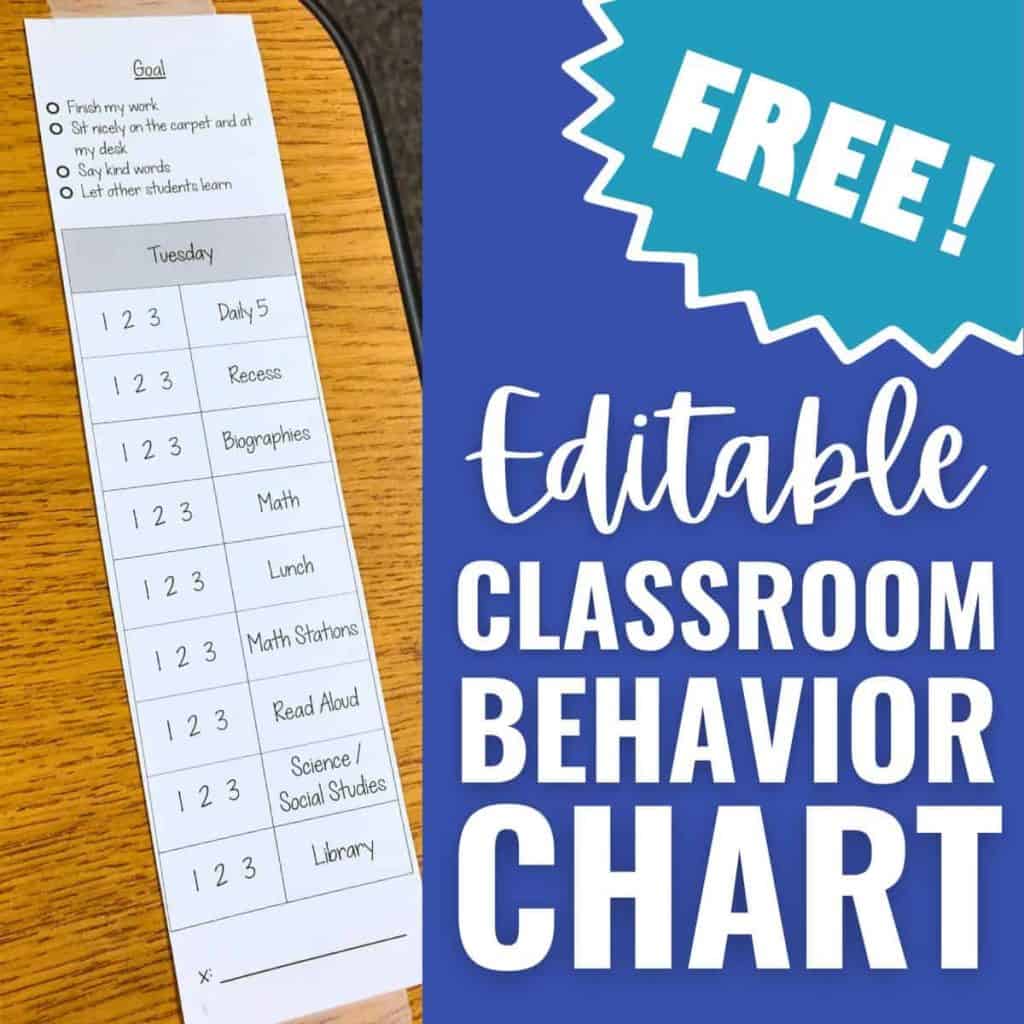
Individual Classroom Behavior Chart – This one is a free resource on my site. What I love about it is that it meets the needs of individual students and moves them from something that is highly regulated toward independence.
Other Blog Posts with Classroom Management Strategies
If you’re looking for a bit more on strategies to implement in your classroom, take a look at some of these posts:
Want to Reduce Disruptions So You Can Actually Teach?
Check out this 100% FREE Micro Training from my friend Linda over at Teach 4 the Heart.
Creating a calm classroom environment can be hard…and you probably didn’t learn everything you needed to about classroom management in college. (I know I didn’t!)
But there is hope and a way to make your teaching experience more fulfilling and less stressful.
Watch this quick 28-minute training to learn how you can minimize disruptions so you can actually teach your content (and get to do the projects & activities that make learning more fun for EVERYONE!
Linda WON’T just tell you to “build relationships” because, frankly, even the best connections can’t eliminate all classroom challenges. Achieving a smooth-running class requires a more nuanced approach.
So join me for this FREE 28-minute training and discover their Calm Classroom Blueprint, used by thousands of teachers to:
Significantly reduce disruptions during lessons & work times.
Gain confidence In handling challenging situations (that previously left them dumbfounded).
Lower daily stress levels and find joy in teaching again!
Jessica is a teacher, homeschool parent, and entrepreneur. She shares her passion for teaching and education on What I Have Learned. Jessica has 16 years of experience teaching elementary school and currently homeschools her two middle and high school boys. She enjoys scaffolding learning for students, focusing on helping our most challenging learners achieve success in all academic areas.
This was such a great blog post full of ideas that will really work in a classroom. I say that because I have read so many books with classroom management suggestions that make you wonder if the author has ever really been in a classroom :). Thanks for sharing!
I appreciate the information given in this article about the factors which should be taken into consideration to get better control over the class. Development of a trusted relationship between the teachers and students is essential.
These tips are wonderful! As a 4th grade teacher, I use music a lot for transitions. I also use sentence starters to help my kiddos know HOW to communicate effectively; instead of just assuming that they already know how to do that. These tips are practical and easy to implement for teachers. Thanks for sharing.





This was such a great blog post full of ideas that will really work in a classroom. I say that because I have read so many books with classroom management suggestions that make you wonder if the author has ever really been in a classroom :). Thanks for sharing!
I appreciate the information given in this article about the factors which should be taken into consideration to get better control over the class. Development of a trusted relationship between the teachers and students is essential.
These tips are wonderful! As a 4th grade teacher, I use music a lot for transitions. I also use sentence starters to help my kiddos know HOW to communicate effectively; instead of just assuming that they already know how to do that. These tips are practical and easy to implement for teachers. Thanks for sharing.