
Building Character in the Classroom: Activities and Strategies

Teaching character in the classroom means more than posting a quote on the wall. These are the strategies that have actually helped: behavior goals, a monthly character-trait focus, and literature that gives students language for their choices.
The past couple of years, I have had quite the groups of students. I teach in a low-income school, and there are so many emotional and social issues that students bring to school each and every day. Sometimes I feel like I’m putting out more fires and reacting to the social issues than I am actually teaching grade-level content.

As I reflect on the conversations I have with my own kids at home about life, integrity, and how to interact with others, I wonder how many of these conversations happen in my students’ homes. I can see my students’ home life reflected in their behavior at school. For some, it is nurturing, loving, and uplifting. For others, not so much.
This year, I have spent quite a bit of time building students’ character and doing specific activities that require them to reflect on their behavior. Unfortunately, no magic trick fixes all the little issues in my classroom. I wish there was! It’s been a constant focus and time of reflection all year long. I try a few things; they work for a while, then I need to switch it up and do something different.
Here are a few things I have done this year that have helped the overall culture in our classroom and built students’ character:
Set Behavior Goals
I’ve written blog posts before about goal setting. At the beginning of the year, we did a lot of goal setting around behavior and how to be in the classroom. There are a variety of ways to set behavior goals. Students can set individual goals like I explained in this blog post or you can set class goals, Whole Brain Teaching style. This works well when you have taught a particular character trait that you want students to practice or a particular skill you want them to develop.

The beauty of keeping a list of goals is that you can reflect on it all year long, adding to it as students’ behavior changes. What were problems at the beginning of the year (above) aren’t much an issue now, but other things have come up.
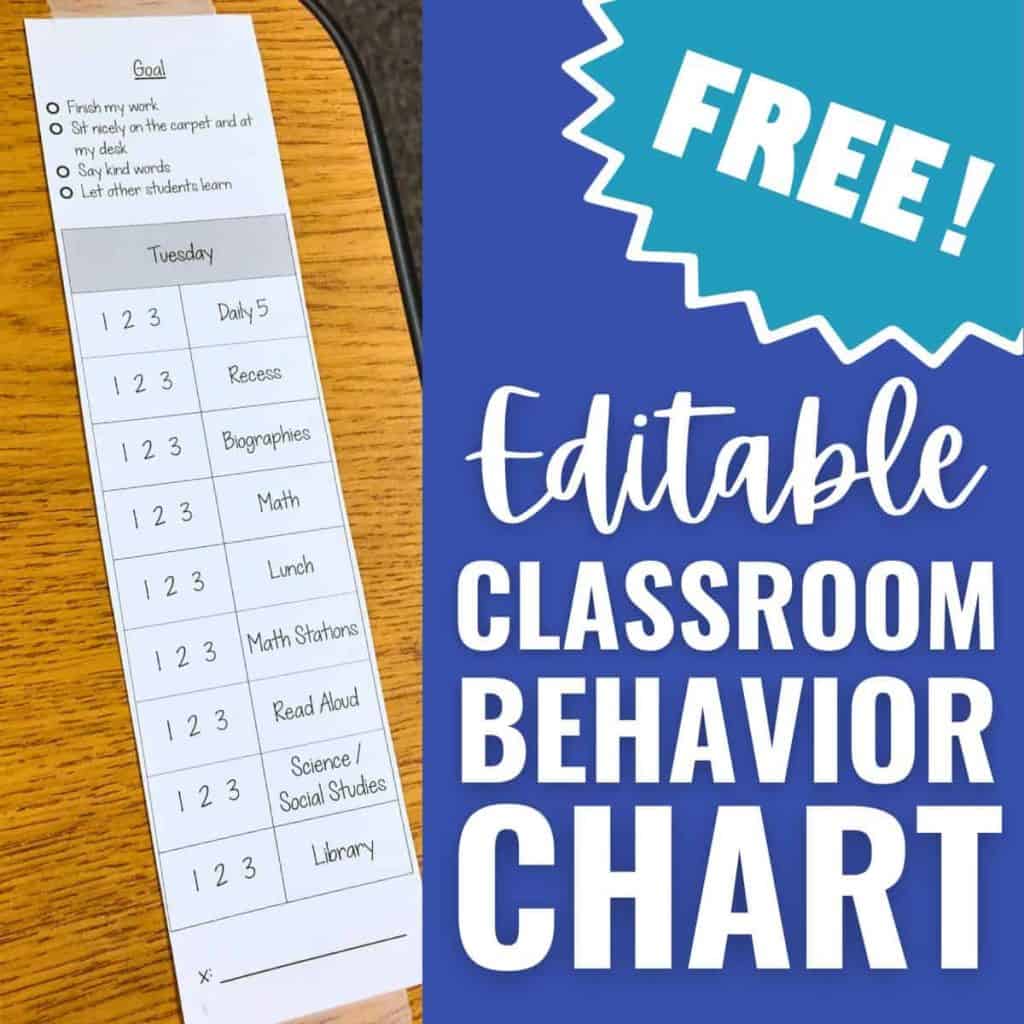
Included in setting behavior goals is the use of a Behavior Chart. This year, I switched up my behavior chart to include specific goals on it. You can read about it in the linked blog post.

Behavior charts will work for some students, but not others. It is a great communication tool to use with parents or outside counselors. One commenter on a previous post mentioned having students fill out the rubric rather than the teacher. That is another great way for students to take ownership of their behavior.
SPECIFICALLY Teach Character Traits
Our school this year is focusing on one character trait each month. Admittedly, I’ve been a bit inconsistent in my teaching of character traits related to our school focus. I started out strong but lost steam amid all the academic and content area teaching. Here is an anchor chart we created on responsibility.

All month, we practiced the character trait and at the end of the month, as a class, we chose a student who we felt did a good job representing that character trait. The example below is for Respect. From the anchor chart (like the one for Responsible), students chose one student in the class and wrote down how that student represented that character trait.
I revealed the chosen student to the rest of the class by displaying a blank circle map. I had the title in place and the circles drawn. I explained that this chosen student listens to the teacher, helps others, raises her hand, etc. These were all suggestions that the class had given me in their notes. Then, I glued a picture of the student in the center as the reveal.

Doing this type of focus on the behavior that encompasses a character trait, really helps students see specific actions that it takes to be respectful, be responsible, etc.
Teach Through Literature
More recently, we have been reading books that deal with a particular problem, challenge, or behavior. We read the book, talk about the characters, the events in the story, and do some activity with the book.
The key with the two books below is that I’m not as focused on the individual doing the bullying but on the others’ reactions to the bullying. Both books provide the other students in the class with a voice and a sense of empowerment that they have choices.


The above is from The Juice Box Bully, which is a great book about bullying and being an upstander.
We have also focused on teasing or put-downs. As I taught the teasing or put-downs book this week, I saw students’ light bulbs go off as they realized that they had the power to respond or not respond to others’ teasing. Several of my kiddos who have been the brunt of teasing this year got really excited about now having clear choices.
I still had two of my students come up to me yesterday complaining about other students and I pointed to the wall and said, what are you going to choose to do?


It will take a lot of practice to translate the realization that students have choices into actions, but it’s a start. The above examples are from the book Simon’s Hook.
Last year I had ordered quite a few books to use with our class, and this year I’ve written a few lessons to go along with them.


So far, I’ve only written The Juice Box Bully and Simon’s Hook. We have so much work to do in our classroom, and I need the resources!
These lessons can take as little as one day or stretch over a couple of days, depending on how many activities you want to do.
Keep Moving Forward
The last thing that will make a world of difference is consistency. If students know what to expect, know the boundaries, and have clear rules, they tend to follow through and work with those boundaries. Most students, anyway. If I’m consistent and clear with the whole class, then I can better focus on the students who need a little more attention.
The three strategies here — behavior goals, character trait focus, and literature — work best when they reinforce each other. A student who has reflected on what “responsible” looks like (from the anchor chart discussion) is more likely to connect with a character in a book who makes a responsible choice. Consistency across all three is what makes the difference over time.
If you’re looking for a starting point, the character traits list post has vocabulary students can use to name what they see in themselves and others — useful for the anchor chart discussions and the book response activities.
Are you interested in helping students manage their behavior in small chunks throughout the day? A behavior chart is the perfect tool, and it’s great for parent communication, too!

This is pure gold! Thank you so much for sharing!
Erin
Learning to be awesome
I love this post! Thank you so much:)
At our school, we have our students participate in character education as a prep. I think it is great to bring it into the classroom.
I so wish we had that!
Anothegr awesome blog post. Thanks for sharing it Jessica.
Another awesome blog post. Thanks for sharing it Jessica.
I LOVED this post! I am not a teacher, I am a mental health case manager who has worked in a high school and now this year I’m at an elementary school. For many of the kiddos I work with, teachers are the one constant in their lives, so unfortunately, a lot of character building is done at school instead of at home. Keep up the fantastic work with youth!
You’re so incredibly generous with useful and honest insights, practical advice and “how-to’s.” Thank you. I’m just curious if you sometimes create opportunities for kids to think about and express their understanding – in their own words – about the positive guidelines you’re giving them. I’ve been reading that, according to brain science, that step is essential for deep ownership of knowledge. When groups of kids have opportunities to answer open-ended questions around topics important to them, some pretty impressive ‘eye-openers’ have been known to happen.
Thank you!
Yes, having students articulate and reflect is definitely part of our classroom routines. We use it for academic concepts more often than social interactions, but I definitely do have students express their own understanding.
I teach in a low-income high English learner population and our students often don’t have the vocabulary and sentence structure to express the sophistication of their thinking. Sentence frames and word lists given them a spring board. Some students rely on the scaffolds and others are able to move beyond them quickly.
Fantastic. So important. Of course you’re providing those opportunities for your students!
For quite awhile I’ve been experimenting with creating the kinds of questions that spark kids’ engagement with the “interactions” side of their lives. (The ‘social-emotional’ label doesn’t fully capture the scope of it all.) I taught for 20+ years, and LOVED seeing the “lights go on” when kids perceived the scope of their impact on situational outcomes, and how many choices they had to create more ‘win-wins,’ and even ‘win-win-wins.’
I would love to share some examples with you … just to see if they result in saving you time and energy as they did for me. (I’m sure you’re aware that ELL’s are especially “tuned into” peers’ efforts and steps of progress with new language, and creating purposeful discussions around topics kids 100% relate to can boost that learning curve.)
~ Nini
Thank you for this post! It is amazing! My school is also doing a character trait each month as part of our becoming a No Excuses University School. Each class also chooses a student who demonstrated that trait each month, and the student gets to have their picture made a take home a yard sign showing they are the student of the month for that trait and keep it for an entire month. I teach in a K-5 behavior classroom, and we read “Chrysanthemum,” “The Energy Bus for Kids,” (the adult book is awesome as well), and of course a bucket filler book. My kids really latched onto the thoughts on positive energy from the energy bus text and bucket filler book. Thanks again!
I understand everything you mentioned. the books you mentioned will go on my “to read” list. I also like the way you specifically break down what each character trait means and how to show it because just saying “be responsible” isn’t enough. I don’t know if you have heard of the organization Responsive Classroom. They have an awesome program and library of character Ed type books. The Morning Meeting is high on my list as a way to build classroom community. I have had good success with it. Also they have a book about team building activities. Their website is responsive
classroom.org. (All one word).
Liar, Liar Ethan McWyer is a great book that teaches about Integrity and boys love it! Jeanie Blair, Author Extraordinaire is the first book in the Character Club series and teaches about compassion. Thanks for your resources!!
Would love a copy of the editable behaviour chart – am already a subscriber – do I have to re-subscribe to get a copy?
cheers
Sue Kemsley
Yes! It’s the easiest way to get it sent to your email. You don’t need to reconfirm your email, but you do need to sign up, indicating that you want it 😉