
What Is Successive Blending? A Phonics Intervention for Struggling Readers
Successive blending is a phonics intervention strategy for students who can identify individual letter sounds but struggle to retain all three sounds long enough to blend them into a word. If you have ever watched a student sound out every letter in a CVC word and then say a completely different word, successive blending may be exactly what that student needs.
Most beginning readers learn to blend CVC words through continuous blending without any extra support. But for students who can’t make that leap, successive blending reduces cognitive load by breaking the process into two steps rather than three. This post explains what successive blending is, how it differs from continuous blending, when to use it, and how to teach it in a small group setting.

Successive Blending: How It Works
Successive blending is a phonics intervention for students who can identify letter sounds but struggle to hold all three sounds in working memory long enough to blend them.
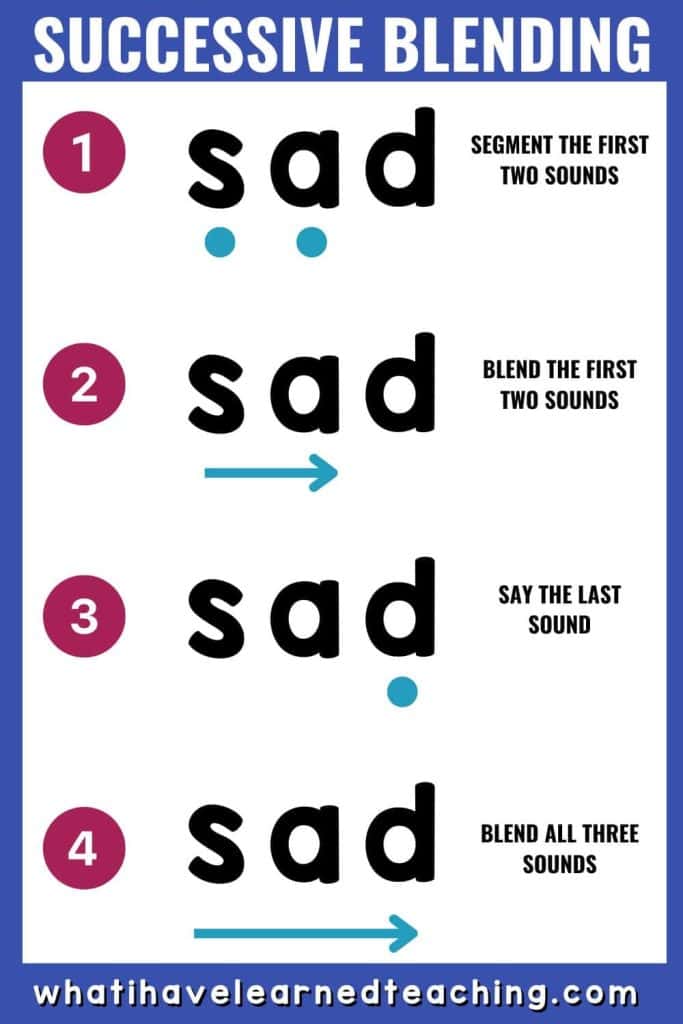
The teaching sequence (using the word “sad” as an example):
- Show the first letter. Student says /s/.
- Show the second letter. Student says /a/.
- Student blends the first two sounds: /ssaa/.
- Student repeats /ssaa/.
- Show the third letter. Student says /d/.
- Student blends /ssaa/ + /d/ = “sad.”
This two-step process reduces cognitive load compared to continuous blending, where students hold all three sounds at once.
Who Needs Successive Blending? (And Who Doesn’t)
Because this blending technique is an intervention strategy, most students learning to read will not need to use it. Most students will be successful with continuous blending.
For students who are not successful with continuous blending, successive blending could be a strategy to bridge the gap and help them connect the sounds. This intervention strategy lessens the cognitive load on working memory and helps students make connections between the letters and sounds in a CVC word.
How Do I Teach Successive Blending?
With successive blending, students say or segment the first two sounds in a word, then immediately blend them. Then they say the third sound and blend that sound with the first two sounds. It helps students focus on the blending process.
Successive Blending Example: How to Blend the Word Sad
Here is a teaching sequence for how to help children successively blend the word SAD:
- Look at the first letter and say /s/
- Look at the second letter and say /a/
- Blend the first sound and second sound /ssaa/
- Repeat /ssaa/.
- Look at the last letter and say the ending sound /d/
- Blend /ssaa/ and /d/ together.
Successive blending can be incorporated into your existing small-group phonics instruction and word-work activities. It is student-based, meaning it is a strategy you can use with some students who need it, while other students use continuous blending techniques.
Try It with Free Short A Blending Cards
If you want to practice successive blending right away, grab these free Short A blending cards. Each card shows a short A CVC word with blending lines to help students track the sounds as they blend. They are a simple, no-prep way to work through the sequence of successive blends with your small group.

When Should Students Be Taught Successive Blending?
Students should be taught successive blending if they have difficulty blending CVC words continuously. If students are having difficulty holding the three sounds in their heads and are unable to blend them, they could benefit from this intervention strategy.
Successive blending places less demand on working memory or short-term memory compared to continuous blending. Some students will need to spend more time working with successive blending than others. The goal is for students to continuously blend CVC words and then move on to blending words with four sounds, and so on.
Successive blending is one piece of a broader phonemic awareness skill set. Students who are working on successive blending are likely still developing other phonemic awareness skills alongside it, so keep the bigger picture in mind as you plan your small-group instruction.
Continuous Blending vs. Successive Blending: What’s the Difference?
Continuous blending is sounding out words without stopping or pausing between sounds. Honestly, I always called this blending and compared it to segmenting, where the sounds are said in isolation. Now that we have more strategies and labels for them informed by the Science of Reading research, we need to differentiate between continuous and successive blending.
To learn how to continuously blend words, students start by blending two sounds, like /aamm/, then move on to three, like /ssaad/, then four, etc. By the time students are continuously blending four sounds, they have likely internalized the process and need to apply that process to new sounds and spelling patterns.
For students who cannot move from continuously blending two sounds to three sounds, successive blending might be a good intervention strategy.
One thing I want to make clear is that learning to read is a process. Blending is a process. When you work with students, focus on helping them learn the blending process. While the individual sounds are important, the focus is on the process.
How do I know students are having difficulty with continuous blending?
Several signals will indicate whether students are having difficulty with continuous blending.
- Students might say all of the sounds of a word, but then read a completely different word. For instance, students might blend /taag/ and then say tap, got, or bag. Likewise, students might produce a word with additional sounds that our sounds out of sequence. This suggests that students are unable to remember all three sounds and are guessing at a word with similar sounds.
- Students might have gaps in their continuous blending, especially between the second and third sounds. This tells you that they need to “let go” of what they are holding in their head to figure out the last sound.
- Students might also add a schwa sound to letters. Successive blending will help students connect the sounds to eliminate the schwa sound.
Do I need special blending cards for successive blending?
Successive blending is a teaching strategy, not a physical tool. Any set of blending cards, word cards, phonics task cards, or letter cards can be used to practice this blending strategy. The idea with successive blending is to reduce the cognitive load of short-term memory so that students focus on only two sounds at a time.
To do this with a regular blending card or word card, use a blank index card to cover up the third sound so that students only see the first two letters in the word.
While some task cards may include blending lines to show students how to move their fingers under the letters, beginning readers should also practice words without the lines.
What Do Students Need to Know to Be Able to Use Successive Blending?
To use this blending strategy, students should know most of their letter sounds, and they must know the letter sounds in the words you are using to teach this strategy.
What Words Can I use for Successive Blending?
Choose the same words that students are having difficulty with using continuous blending. Start with words that begin with continuous sounds like s, m, or r, then move onto words that start with stop sounds like p, t, d. Be sure that students practice successive blending with different words so they can apply the skill to different letter sounds, and so you can see where they might be making mistakes.
Short a CVC words are a great starting point since they include several continuous consonants. If you need word work practice to go alongside successive blending instruction, these short a phonics worksheets work well as a companion activity.
Successive Blending Activities to Practice in Small Groups
Successive blending is a teaching strategy, so it works with any materials you already use for word work. Here are a few simple ways to practice it in a small group setting.
Cover-and-Reveal with Blending Cards
Use a blank index card to cover the third letter of a CVC word, showing only the first two letters. Have students blend the first two sounds together, then slide the card to reveal the third letter and blend all three sounds. This is the most direct way to practice the successive blending sequence.
Two-Sound to Three-Sound Word Chains
Start by having students blend just two sounds, such as /s/ and /a/, into /sa/. Then add the third sound: /sa/ + /d/ = sad. Keep the first two sounds stable, and change only the final sound to build fluency with the process before varying all three positions.
Letter Tile or Sound Box Work
Place letter tiles or letter cards in three boxes or sections. Students tap and say the first two sounds, blend them, then tap the third sound and blend all three. The physical movement helps reinforce the two-step process.
What do I do once Students have Mastered Successive Blending?
You likely determined that students needed to learn the successive blending strategy because they could not blend CVC words. Once students have mastered this strategy, return to continuously blending CVC words. You may need to go back and forth between successive blending and continuous blending to solidify the process. Once students are continuously blending CVC words, move on to either digraphs or blends.
Keep the Successive Blending Process in Mind
When you teach students to blend words, you are teaching them a process for doing something. There are a couple of things to keep in mind when teaching students a process:
- Reduce the cognitive load. Start with two sounds. When students have mastered two sounds, move on to three sounds. If students cannot blend three sounds, try successive blending.
- Use consonants with continuous sounds instead of stop sounds. Then, move on to words with stop sounds.
- Practice this skill using phonemic awareness activities.
At some point, students will move beyond blending words by their individual sounds. At the same time, students will revert to blending when presented with unfamiliar words until they have learned to read words by syllables. Even then, they will revisit what they know if presented with unfamiliar syllables. Learning to read is a process and a journey. It’s not a straight line.
The Confusion Between Successive Blending and Open Syllables
When the first two letters in successive blending are presented to students without the third letter, those two letters look a lot like an open syllable. Students who need an intervention like successive blending will not yet be reading words with open syllables. They should not yet have the concept of open syllables in their knowledge base. However, students may have been exposed to open syllables in their general education classroom. You may need to address this with students who present you with a long vowel sound when blending the first and second sounds in a CVC word.
Also, when students start learning open syllables, they may be confused about why the vowel sound is now long. Teaching open and closed syllables together will help students see the differences between them.
Whether students are using successive blending or have progressed to continuous blending, the goal remains the same: fostering confident and proficient readers. Recognizing the cues when a student struggles with continuous blending and knowing when to introduce successive blending as an intervention can make all the difference in your early reading phonics instruction. It might not always be a straight path, but with patience, understanding, and effective teaching strategies, every child, even struggling readers, can learn to read.
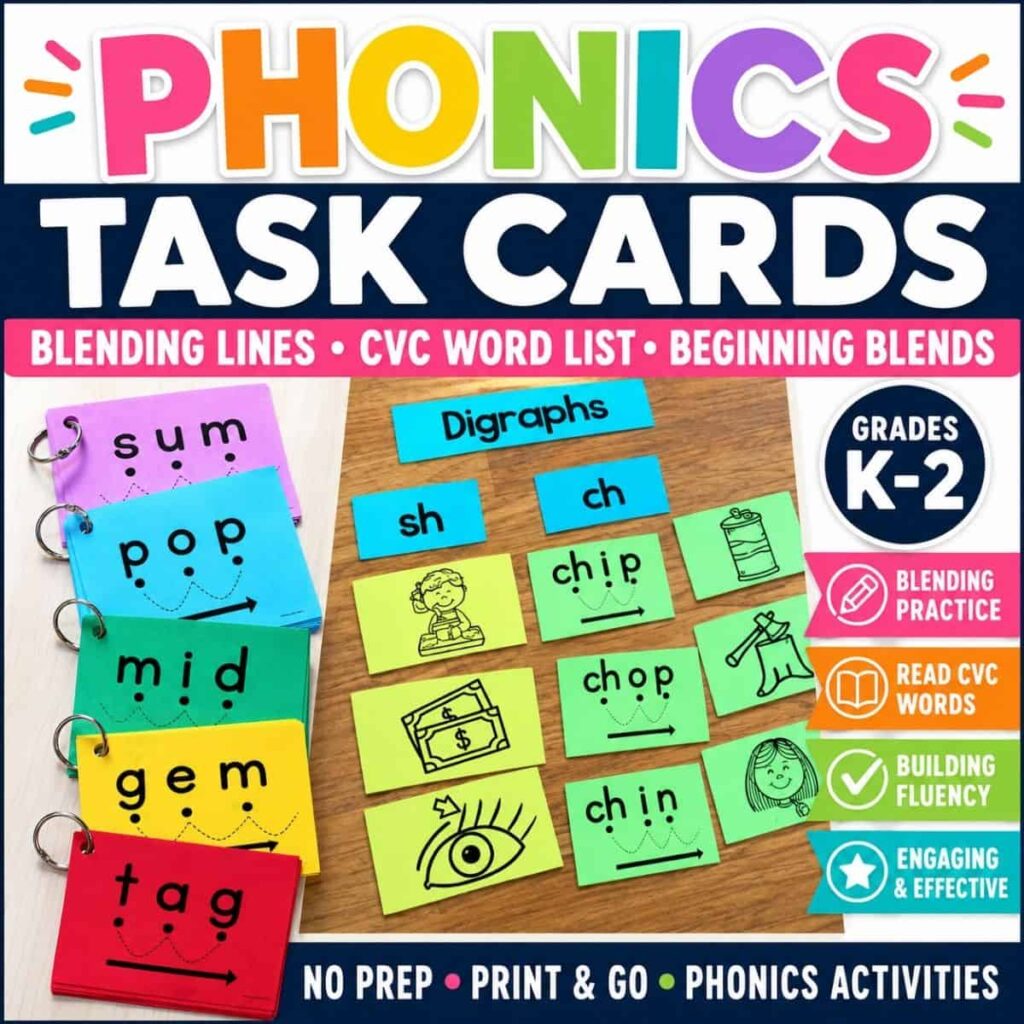
Blending Cards for Kindergarten & First Grade | Phonics, Decoding & Reading Fluency
Support beginning readers with Blending Cards designed to teach smooth blending, decoding, and word reading. These printable phonics cards help students segment sounds, blend sounds together, and read words automatically using a consistent, research-based routine. Perfect for Kindergarten, First Grade, and Second Grade RtI intervention.
Jessica BOschen
Jessica is a teacher, homeschool parent, and entrepreneur. She shares her passion for teaching and education on What I Have Learned. Jessica has 16 years of experience teaching elementary school and currently homeschools her two middle and high school boys. She enjoys scaffolding learning for students, focusing on helping our most challenging learners achieve success in all academic areas.