
The Importance of Phonemic Awareness in Kindergarten and Preschool
Phonemic awareness is a key component of early literacy development, particularly for preschoolers and kindergarteners. This skill is akin to an auditory playground where children learn to manipulate individual sounds, or phonemes, and understand their role in words without the visual aid of letters. Before a child can embark on the journey of reading, this auditory skill must be well-established.

This post contains links to affiliate websites, such as Amazon, and we receive an affiliate commission for any purchases made by you using these links. We appreciate your support!
It became clear to me, while observing my second-grade classroom, that students who grappled with phonics often had an underdeveloped phonemic awareness (PA). They could not isolate nor blend the constituent sound units that make up words.
This deficit in phonemic awareness was also the first sign of my own child’s reading challenges when he was a preschooler. It later became clear that he had an auditory processing disorder which required speech and language intervention as well as intense tutoring for dyslexia.
Blending is one of the phonemic awareness skills that some students need extra support with. If students can identify individual sounds but cannot pull them together into a word, successive blending is a targeted intervention strategy that can help bridge that gap.
What is phonemic awareness?
But what exactly is phonemic awareness? It is the ability to hear, identify, and manipulate individual phonemes—the tiniest sound units phonemic that are the building blocks of words. Crucially, this is all done sans letters; when letters enter the picture, we transition into the realm of phonics.
Effective phonemic awareness instruction is pivotal as a precursor to introducing explicit phonics instruction.
Components of Phonemic Awareness Instruction
Phonemic awareness is comprised of several key components that focus on the sounds within words. To build strong phonemic awareness skills, a combination of these components are taught to students. Here’s a list of those components:
- Rhyming and Alliteration: Recognizing and producing words that rhyme and identifying the repetition of the same initial sound in a series of words.
- Phoneme Isolation: Identifying and isolating individual sounds in a word (e.g., the first, middle, or last sound).
- Phoneme Identity: Recognizing the common sound in different words (e.g., the sound /m/ in mat, mop, and map).
- Phoneme Categorization: Understanding which word in a set of three or four words has the “odd” sound.
- Phoneme Blending: Combining individual phonemes to form words, or, for speaking, merging separate sounds into a single word.
- Phoneme Segmentation: Breaking words down into their individual phonemes (e.g., the word ‘cat’ is segmented as /c/ /a/ /t/).
- Phoneme Deletion: Identifying what word remains when a phoneme is removed from an existing word.
- Phoneme Addition: Creating a new word by adding a phoneme to an existing word.
- Phoneme Substitution: Substituting one phoneme for another to make a new word.
- Sound Manipulation: This includes adding, deleting, and substituting sounds in words. This is often considered the most complex phonemic awareness skill.
According to reading research, these components are essential for the development of early reading skills, as they form the basis for understanding how letters represent sounds and how those sounds form words. Teaching and reinforcing these skills can greatly improve a child’s ability to learn to read and spell.
Here are a few more details about some of the components of phonemic awareness:
Rhyming and Alliteration
Rhyming is one of the earlier phonemic awareness skills to develop. It is present in most of our nursery rhymes and songs for young children. Alliteration is similar to rhyming but takes place on the other side of the word.
Rhyming is a difficult skill to learn for some readers, especially English language learners. Although rhyming is a phonemic awareness skill, I wouldn’t focus intervention on it.
Teach it, yes. Do songs, poems, and rhymes in your classroom, yes. However, if a student is not able to produce rhyming words after some instruction, I would move on to the other phonemic awareness skills.
Is Rhyming Ability Important in Reading? is a great article about how much emphasis to put on rhyming. The basic conclusion is that the other components of phonemic awareness are more influential in reading success than rhyming.
Oral Blending and Segmenting
Oral blending is the ability to put units of sounds together. Oral segmenting is the ability to break a word apart into the units of sound. For example, say the word cat. Tell me the sounds in cat. /k/ /a/ /t/. Both segmenting and blending should be practiced regularly.
How to use Blending and Segmenting with Phonemic Awareness
Start with (1) compound words, such as pancake, then move on to (2) two-syllable words, then on to (3) cvc words with continuous sounds. Finally do (4) open syllables, (5) cvc with stop sounds, and (6) long vowel patterns.
When I teach students to segment into syllables, we often use our hands, putting out a hand for each syllable. For blending, we often use slinkies to emphasize elongating the word.
Initial, Final, Medial Sound Isolation & Identification
Consonant isolation is the ability to tell the first sound of a word. For instance, say the word cat, tell me the first sound, /k/. Teach and practice the initial, final, and then medial sounds. Start with consonants in the initial and final positions before you work on the vowels.
Deletion and Substitution
Advanced phonemic manipulations involve deletion (removing a sound from a word) and substitution (replacing one sound with another), both reinforcing the understanding that words are composed of sound units that can be manipulated.
Deletion is the ability to remove a sound from a word and tell what is left. For instance, say the word cat. Remove the /k/. What is left?
Substitution is similar to deletion, but a little more advanced. It requires a student to remove a sound and place another sound in its place. For instance, say the word cat. Replace the /k/ with /b/. What does it say?
Following the recommendations of the National Reading Panel, these activities not only build a robust phonemic awareness foundation but also reinforce the mutually reinforcing nature of phonemic skills, which in turn improves phonemic awareness and overall reading proficiency. These efforts are integral to a comprehensive phonemic awareness program designed to support students, including those with auditory processing disorders, in developing the phonemic awareness necessary for successful word reading and, ultimately, reading fluency.
Phonological Awareness Activities & Teaching Tips
Most phonemic awareness activities should be done daily for short intervals of time throughout the day. When teaching phonemic awareness, the best method is short, frequent interactions with the sounds to build competency, moving from simple cvc words to more complex blends. Also, move from simple rhyming and identification tasks to segmenting, blending, deletion, and substitution tasks.
Which words do teachers need to choose?
Choose words based on the activities that you’re doing in class and stories that you’re already reading with students. Pull words that are familiar to students and play around with the words. Having some familiarity with the words will help students break them apart into individual sounds or phonemes.
The above components can be done with almost any set of words. Simply choose a few words from a recently read story and find some rhyming words, segment the sounds, identify the initial and final sounds, delete a sound, and replace a sound.
Use Elkonin Boxes for Sound Isolation
One of the tried and true methods for developing phonemic awareness is the use of Elkonin boxes, also called sound boxes. They are just boxes for each sound. Students move an object into the box when saying the sound.
In the example below, using the cvc word cat, the /k/ has already been said. As I say the /a/ sound, I move the middle circle into the box and then move on to the last sound, /t/ when I say it.

You use the number of boxes needed for the number of sounds in a word, and the boxes are touching each other. Combining the boxes with picture clues is also useful. Likewise, draw spaces or lines for each sound in a word and have students point to the lines as they say the sounds. The idea is that there is one space for each sound in the word.
These CVC Phoneme Blending Cards are a great way to transition from using oral language only to using some print resources. It includes images with Elkonin boxes and blending cues.
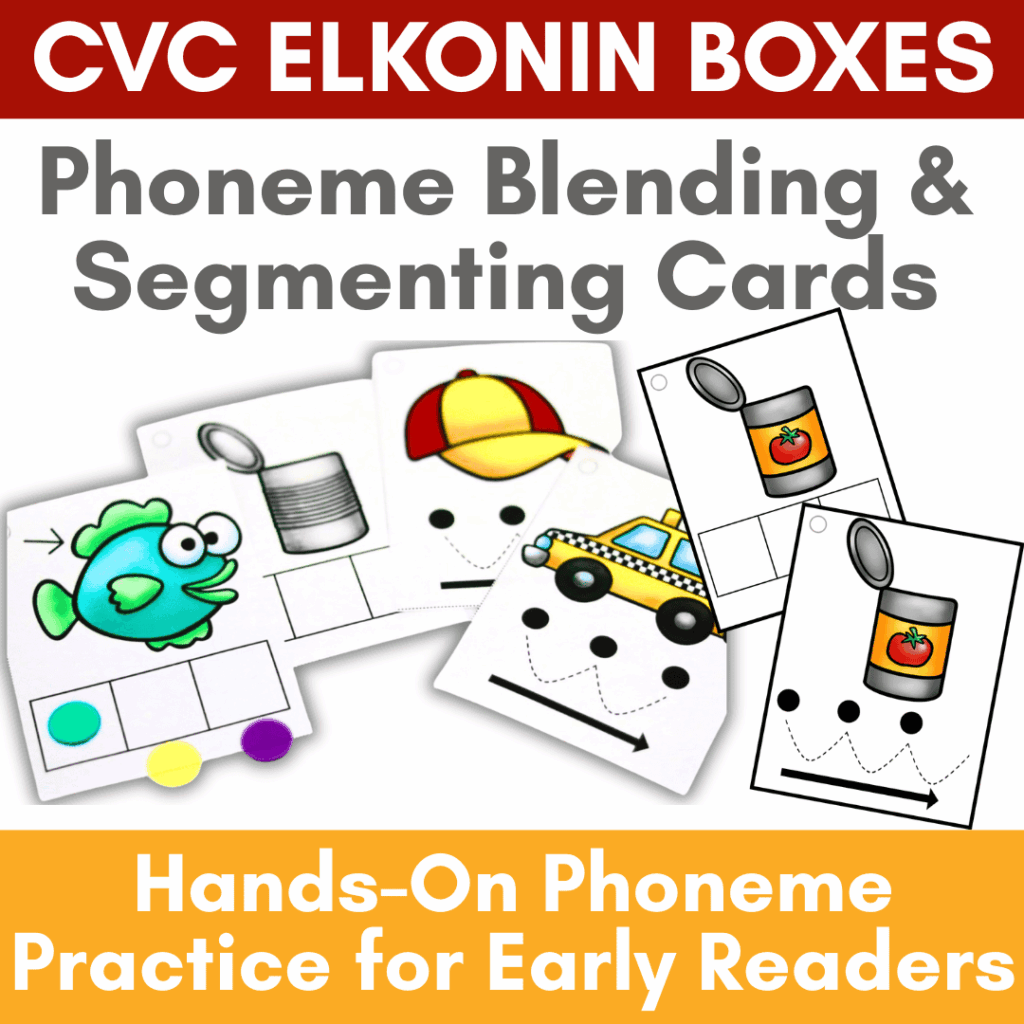
CVC Phoneme Blending & Segmenting Cards
CVC Phoneme Blending & Segmenting Cards is a teaching tool to help students segment and blend sounds in CVC words. This resource builds students’ phonemic awareness skills.
Phonemic Awareness Teaching Tips
Below are a few teaching tips to keep in mind when teaching students to hear and manipulate sounds.
Be Accurate When Pronouncing the Sounds
Be sure you are pronouncing the sounds consistently and accurately. The stop sounds are the most difficult because we want to put an /uh/ sound after them, like buh.
Do your best to isolate the sound. Like for /p/, put your hand in front of your mouth and feel the air. It’s quick. Likewise, exaggerate the continuous sounds more than usual. Like, /m/ should be mmmmmmmmmmmm . . . emphasize that it’s a continuous sound. This over-emphasis will pay off when you get to blending.
Use the Letter Sound, not the Name
Use the letter sound, not the name, when you’re working on phonemic awareness skills. Using the sound consistently helps students form a pattern isolating the sound.
Focus on the Sounds, not the Symbols
Do not use letters or symbols. I said this earlier, but this is an important distinction. Phonemic awareness is the awareness of sound without letters. When you add letters, it becomes phonics.
Pictures of the words help, especially for English learners or students with speech issues. If you can, find a good source for pictures of common cvc words. Picture Sorting for Phonemic Awareness has some good pictures.
Use the Full Body
Adding a physical movement will help students remember the sounds and connect them.
I often had students hold up their fists and then fingers to isolate sounds. I would have them put their hands together with the fingertips touching and draw them apart to blend sounds slowly. (Slinkies are a great tool for this, too!)
Here are a few more ideas for physical movement:
- Have students hop each sound.
- Draw some boxes or dots onto the floor and have students hop or walk the sounds.
- Clap hands for sounds or syllables.
Pay Attention to Your Students
Your students will tell you what they need in order to learn and where they are stuck. Assessments help to understand where a student is in their phonemic awareness journey.
Can they rhyme or identify initial, final, and medial sounds? Can they delete sounds? Substitute sounds?
I know assessments are a lot of work, but they also give you a lot of information if they’re the right assessment, and they can guide your instruction to make it meaningful, focused, and valuable for the majority of students in your classroom. Assessments will also tell you which students are not successful so you can focus more on targeting instruction with them in small groups.
Figure Out What Works
Whatever works for your students, use it. If something is not working, try something else. There is no right way to teach phonemic awareness to all students.
Some things will click for some students and other things for other students. The point is that students are learning to play with sounds and learning how to blend and segment sounds so that they can apply those skills to reading and phonics instruction.
Resources to Develop Phonemic Awareness
These have been a few of my favorite resources over the years. They contain ton of fun activities and are great for small-group instruction.
- Phonemic Awareness: Playing with Sounds to Strengthen Beginning Reading Skills is one resource I keep going to year after year for word lists, activities, and games.
- Phonemic Awareness in Young Children: A Classroom Curriculum is just a classic phonemic awareness book. It has lessons and sequences of instruction for preschool/kindergarten classrooms. I tend to pick and choose what I use from it, but it’s a very good book to learn more about phonemic awareness.
- Picture Sorting for Phonemic Awareness is a great resource for pictures if you don’t have access to clipart.
Do you have any favorite phonemic awareness activities that you do in your classroom? I’d love to see and hear about them in the comments below.


This us exactly what I created and patented for French language! Awesome! Bien fait!
This is incredibly helpful! Great ideas that I can incorporate into my lesson plans to help differentiate instruction as well. Thank you!
Love your website, but I must disagree with you on the rhyming point. I just tested 3 classes of Kindergartners and the “high” kids can all rhyme. We are a majority Hispanic school. I would teach it through song and play. When I tested kids at my former school in the older grades, the majority with learning problems could not rhyme. I believe in research, but I would have to see more studies on this to refute my enormous personal experience.
Thanks for the comment! I agree that, in general, the high kids can all rhyme and that a majority of students with learning difficulties can’t rhyme.
However what I said in the blog post is that I wouldn’t focus intervention on it. I still teach it, but if a student can’t rhyme, it’s likely that they have difficulty with other phonemic awareness skills. I would focus intervention on the other skills and not rhyming. It’s likely that once students get the other skills under their belt, rhyming will come easier. Although we start with rhyming when teaching phonemic awareness, I wouldn’t start with it when doing intervention.
This is one of the better responses I’ve seen regarding rhyming and reading success it references the National Early Literacy Panel (2008). I linked to it above, too.
Hi, I found the bit about not associating the sounds to letters interesting and it makes a lot of sense. I’m a mum who is preparing my son for Prep which is the Australian equivalent of Kindy in America. We play eye spy in the car as we live out bush and regularly have trips of an hour or more. We started when he was younger using colours but now we use sounds mainly with beginning sounds. It sometimes morfs into rhyming or just identifying words that start with that sound. I haven’t gone to blended sounds but I might do that now. Thanks Megan
This is great information! Thank you so much for posting! I was wondering, do you have this information in a little cheat sheet version?
Thanks! I currently don’t have a cheat sheet available, but I will look into creating one!
Thank you so much for this post. This is exactly the problem my kid is facing, and I am glad to know more about what I can do to help.
Thank you for sharing this information in such a comprehensive yet organized way. Your resources are great!