
Stretch a Sentence Examples for Students (With Step-by-Step Modeling)
When students are told to “add more detail” to their writing, many don’t know where to begin. That’s where stretch a sentence examples make a big difference.
Seeing how a simple sentence grows step by step helps students understand how to stretch a sentence in a clear, structured way. Instead of guessing what to add, they can follow a model.
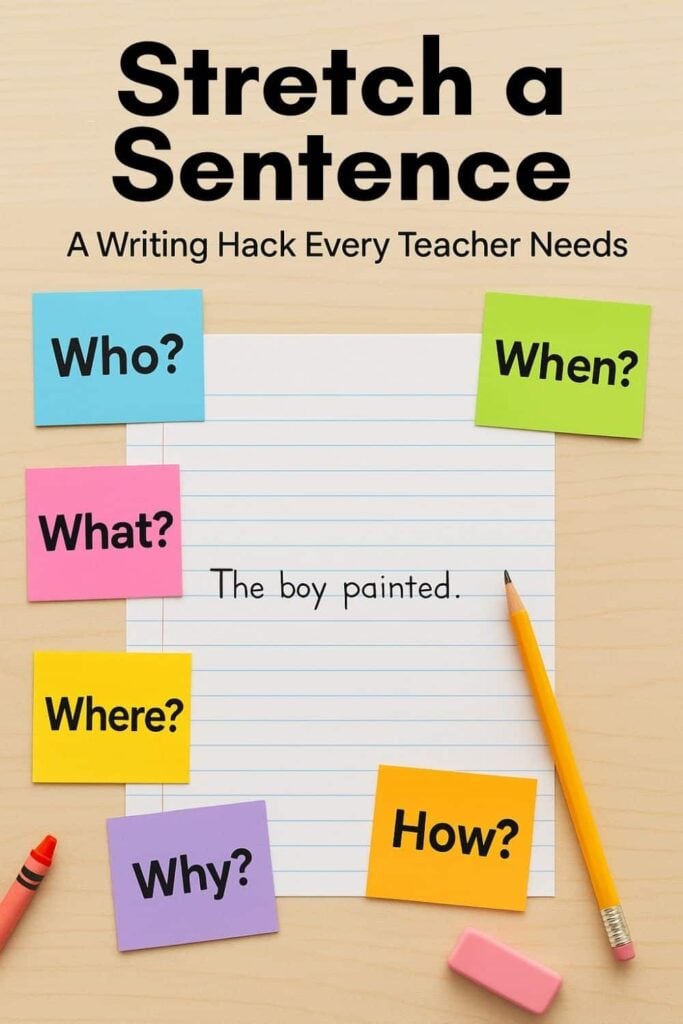
If you’re new to this strategy, start with this overview of stretch a sentence, including simple examples and a daily routine you can use all year.
In this post, you’ll find stretch a sentence examples for students, along with brainstorming activities that help them generate ideas before writing.
How to Stretch a Sentence (Example)
Start with a simple sentence:
The dog ran.
Then add details step by step:
- The dog ran.
- The brown dog ran.
- The brown dog ran across the yard.
- The brown dog ran across the yard after the ball.
- The brown dog ran across the yard after the ball during recess.
This step-by-step process helps students see how one detail at a time builds a stronger sentence.
Stretch a Sentence Examples for Students
Below are several stretch a sentence examples you can use for modeling, whole-class discussion, or guided practice. Each one starts with the same simple sentence but grows in a different direction based on the details students choose.
These examples work best when students already understand the basic structure of how to stretch a sentence.
Example 1: Descriptive and Serious
Start with the basics:
- Who or What? Mateo, a fourth grader
- Did What? Painted a mural of a tree
- When? Saturday afternoon
- Where? School hallway
- Why? To make the hallway look beautiful
- How? Carefully with bright colors
Stretched Sentence:
On Saturday afternoon, Mateo carefully painted a giant mural of a tree in the school hallway to make it look beautiful.
This type of example works well for modeling academic writing or narrative detail during whole-group instruction.
Example 2: Silly and Fun
Stretching doesn’t always have to be serious! Letting students play with their ideas keeps the activity engaging.
- Who or What? My brother
- Did What? Painted his face green
- When? At night
- Where? In the bathroom
- Why? Because he wanted to look like the Hulk
- How? Messily with finger paint
Stretched Sentence:
At night, my brother messily painted his face green in the bathroom because he wanted to look like the Hulk.
Silly examples are especially effective during shared writing or morning meetings to lower the stakes.
Example 3: Short but Effective
Some students may not add as many details at first—and that’s okay! This still shows growth from the original sentence.
- Who or What? The boy
- Did What? Painted a rainbow
- When? During art class
- Where? On white paper
- Why? To show his teacher
- How? Quickly with markers
Stretched Sentence:
During art class, the boy quickly painted a rainbow on white paper to show his teacher.
This shows students that sentence stretching doesn’t have to mean adding every detail at once.
Brainstorming Activities to Support Stretch a Sentence
Brainstorming is where the magic happens. Here are a few strategies to help students generate ideas before they write:
1. Partner Brainstorm
Have students turn and talk with a partner to come up with details for each question (Who? Did what? Where? When? Why? How?). Partners can share their favorite ideas with the class.
2. Table Group Collaboration
Assign each table group one question (like Where? or How?) and have them generate a list together. When groups share out, you’ll have a variety of ideas to use for sentence stretching. The Numbered Heads cooperative learning strategy works well for this type of brainstorming.
3. Sticky Note Brainstorm
Give each student a sticky note and one question to answer. Collect the notes and sort them on the board by category. Together, build a bank of class ideas for stretching the sentence.
4. Whole-Class Brainstorm
Write the sentence starter on chart paper and fill in answers to the questions as a group. This makes a great anchor chart for students to reference later.
Why Sentence Stretching Examples Help Students Add Detail
Using sentence stretching examples helps students see how details fit together before they try it on their own.
Examples help students:
- Learn how to add details with purpose
- Connect grammar (like adjectives and adverbs) to real writing
- Practice revising in a manageable way
- Build confidence in expanding their ideas
And because the base sentences are simple, every student has a place to start. Over time, you can increase expectations by encouraging longer stretches, combining sentences, or focusing on one type of detail (like adverbs) each week.

If you want to learn how to teach stretch a sentence step by step, including lesson routines and classroom strategies, read this full teaching guide.
💡 Want to try these sentence stretching examples with your students? Grab a FREE sample Stretch-a-Sentence page here.

And if you’re ready for a full year of practice, the Stretch a Sentence Yearlong Bundle includes daily writing prompts, grammar challenges, and seasonal themes to keep your students engaged all year long.

Stretch a Sentence Yearlong Bundle
Support students in writing stronger, more descriptive sentences with this Daily Sentence Stretching Bundle! With monthly themes and easy-to-use prompts, each worksheet guides students to expand a simple sentence using who, what, when, where, why, and how.
Jessica BOschen
Jessica is a teacher, homeschool parent, and entrepreneur. She shares her passion for teaching and education on What I Have Learned. Jessica has 16 years of experience teaching elementary school and currently homeschools her two middle and high school boys. She enjoys scaffolding learning for students, focusing on helping our most challenging learners achieve success in all academic areas.