
Numbered Heads Together Strategy: A Simple Cooperative Learning Routine That Gets Every Student Involved
The numbered heads together strategy is a cooperative learning routine that helps students discuss ideas, share their thinking, and work toward a shared answer as a team. Instead of responding individually, students collaborate with their group and prepare a response together, creating a classroom where everyone participates in the learning process.
Cooperative learning strategies help students practice academic conversations, explain their reasoning, and listen to different perspectives. Structured routines give students clear expectations for discussing ideas, listening to one another, and contributing to group learning. When students work together in structured ways, they build both understanding and confidence.
The Numbered Heads Together strategy is one of my favorite cooperative learning structures. It is easy to train students, and I use it often during whole-group lessons.
This simple routine encourages discussion, builds teamwork, and keeps every student involved in the learning process.
What Is the Numbered Heads Together Strategy?
Numbered Heads Together is a cooperative learning strategy developed by Spencer Kagan. It helps ensure that all students participate in group discussions and understand the material being taught.
Students work in small groups, usually with 3–4 students per group. Each student receives a number. When the teacher asks a question, students put their “heads together” to discuss the answer. After the discussion, the teacher randomly calls a number. The student with that number responds for the group.
Since students do not know which number will be called, everyone must understand the answer before the discussion ends.
How the Numbered Heads Together Strategy Works
The routine is simple and easy to implement in almost any subject area.
1. Assign Numbers
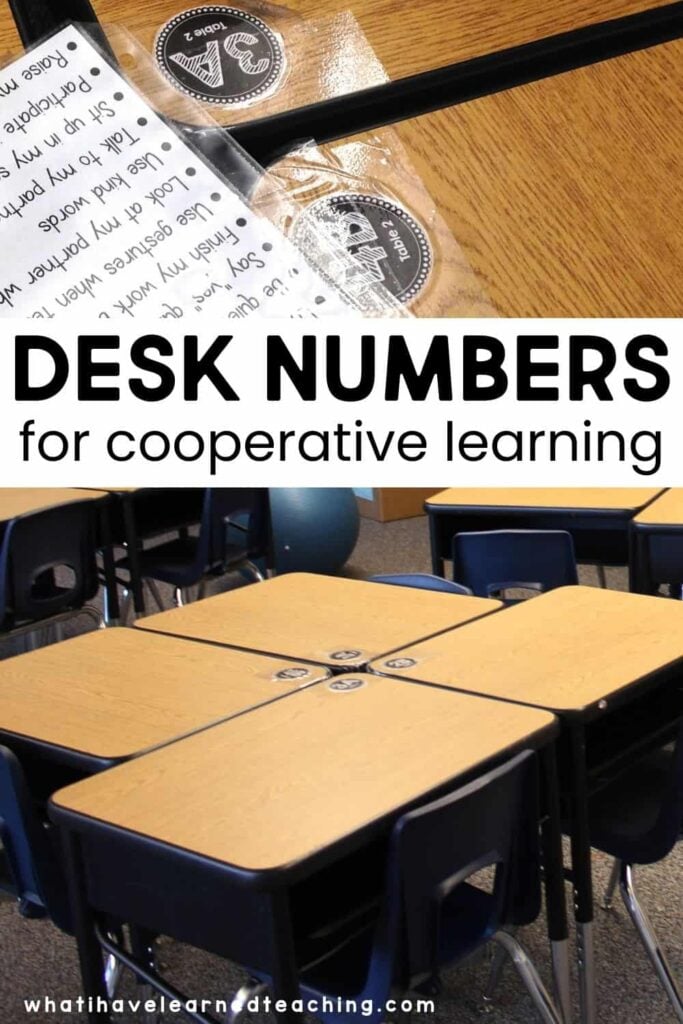
in elementary classrooms, it is easiest to number the desks within a group of 3-4.
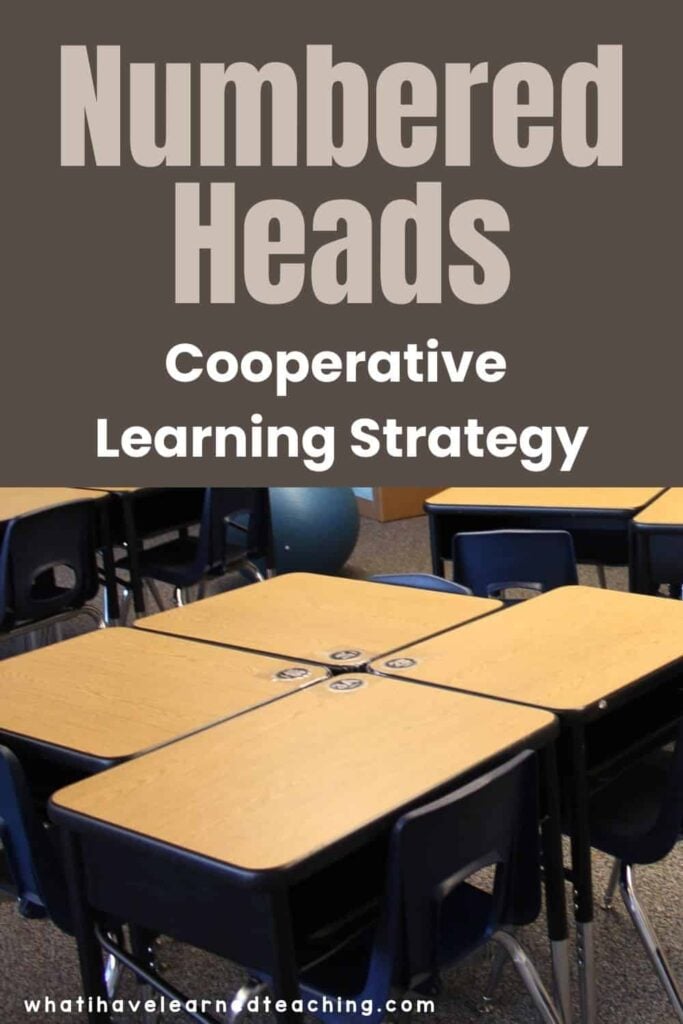
I have numbers taped to my student desks. Each desk has a number and a letter. I use the number for Numbered Heads and the letters for Think-Pair-Share. All of my desks are in groups of 4. Depending on class size, I’ll have a group of 2 or 3.
I set them up in a T-shape and label the desks in the center. Before we use the cooperative learning strategy, I’ll have students raise their hands if they are number 1, 2, 3, or 4 to make sure they know which number they are.
2. Ask a Question or Present a Task
The teacher asks a question or gives students a problem to solve.
Examples:
- Solve a math problem
- Identify the main idea in a reading passage
- Explain a science concept
- Predict what might happen next in a story
3. Heads Together
Students lean in and discuss the answer with their group. During this step, students share ideas, explain their thinking, and work together to agree on a response. They check that everyone in the group understands the answer so that any member can confidently share it when their number is called.
4. Call a Number
After a set amount of time, the teacher randomly calls a number.
Example:
“Number 3!”
Every student who is number 3 stands or raises their hand and answers the question for their group.
This step keeps every student accountable since any group member could be called.
Tips for Using Numbered Heads Together in the Classroom
Here are a few simple ideas to make this strategy run smoothly.
Use Small Groups
Groups of 3–4 students work best. Also consider desk arrangement. The t-shape brings the group together toward the center of the table.
Give Thinking Time
Allow students enough time to discuss the answer before calling a number. I often tell students they have one minute to talk with their group. I also use a visual timer so they can see the countdown.
Randomize the Numbers
Call numbers randomly to maintain accountability so that every student stays prepared to respond. You can do this by drawing number cards, pulling popsicle sticks with numbers written on them, or spinning a digital number wheel to select the number that will answer for each group.
Listen to Discussions
Walk around the room while students talk. This helps you hear misconceptions and guide conversations when needed. It also keeps groups on task and accountable since they know you will be listening in on their conversations.
Why Teachers Use the Numbered Heads Together Cooperative Learning Strategy
The Numbered Heads Together strategy supports several important classroom goals.
1. It Increases Student Participation
Students cannot rely on one strong student to answer for the group. Everyone must understand the response before the discussion ends. It helps the group support weaker students.
2. It Encourages Academic Conversations
Students talk through ideas, explain reasoning, and clarify misunderstandings while working together. I often give students sentence frames to use when talking with their groups. This gives them the structure needed to have these high-level conversations.
3. It Builds Accountability
Each student is responsible for learning the material and contributing to the group discussion. At the same time the group is responsible for ensuring that every member of the group can answer the question.
4. It Supports English Learners
Students can rehearse their thinking with peers before answering publicly. This extra discussion time helps build confidence and language skills. Students get time to practice explaining ideas before speaking to the whole class.
Classroom Examples of Numbered Heads Together
The Numbered Heads Together strategy can be used in almost any subject area.
Math
Ask students to solve a problem and explain their reasoning.
Example:
“What strategy did your group use to solve this multiplication problem?”
Students discuss the strategy before the numbered student shares the answer.
Reading
Students discuss comprehension questions about a text.
Example:
- What is the main idea of this paragraph?
- Why did the character make that decision?
Science
Students explain scientific concepts or observations.
Example:
“What evidence shows that this animal is adapted to its environment?”
Social Studies
Students analyze historical events or discuss cause and effect relationships.
Example:
“Why was this invention important?”
How Numbered Heads Together Fits with Other Cooperative Learning Strategies
Many teachers rotate between several cooperative learning structures during each day or even lesson. Each strategy supports student discussion in a slightly different way.
You might combine Numbered Heads Together with other routines, such as:
- Turn and Talk teaching strategy – quick partner discussions during lessons
- Quiz Quiz Trade cooperative learning strategy – movement-based review with question cards
- Think Pair Share strategy – students think independently, discuss with a partner, then share with the class
Using a variety of cooperative learning strategies keeps classroom discussions fresh and gives students multiple ways to interact with content.
FAQ: Common Student Misunderstandings About Cooperative Learning
Bringing Cooperative Learning Into Your Classroom
The Numbered Heads Together strategy is simple to introduce and requires no special materials. With just a few groups and numbered students, teachers can turn a typical question into a collaborative discussion where every student participates.
If you’re building a toolbox of cooperative learning routines, this strategy works well alongside other classroom discussion structures like Turn and Talk, Quiz Quiz Trade, and Think Pair Share. Rotating between these strategies helps students practice explaining ideas, listening to peers, and building confidence as learners.
Over time, routines like Numbered Heads Together can transform classroom conversations from a few raised hands to a room full of students thinking, discussing, and learning together.
Jessica BOschen
Jessica is a teacher, homeschool parent, and entrepreneur. She shares her passion for teaching and education on What I Have Learned. Jessica has 16 years of experience teaching elementary school and currently homeschools her two middle and high school boys. She enjoys scaffolding learning for students, focusing on helping our most challenging learners achieve success in all academic areas.