
Morse Code Activity: A Hands-On STEM Lesson with Binary Code Connections
If you’re looking for a Morse code activity that goes beyond paper-and-pencil and actually gets students thinking, building, and communicating, this one checks all the boxes. It blends science, engineering, and a little bit of history into a lesson your students will remember (and probably talk about at recess).
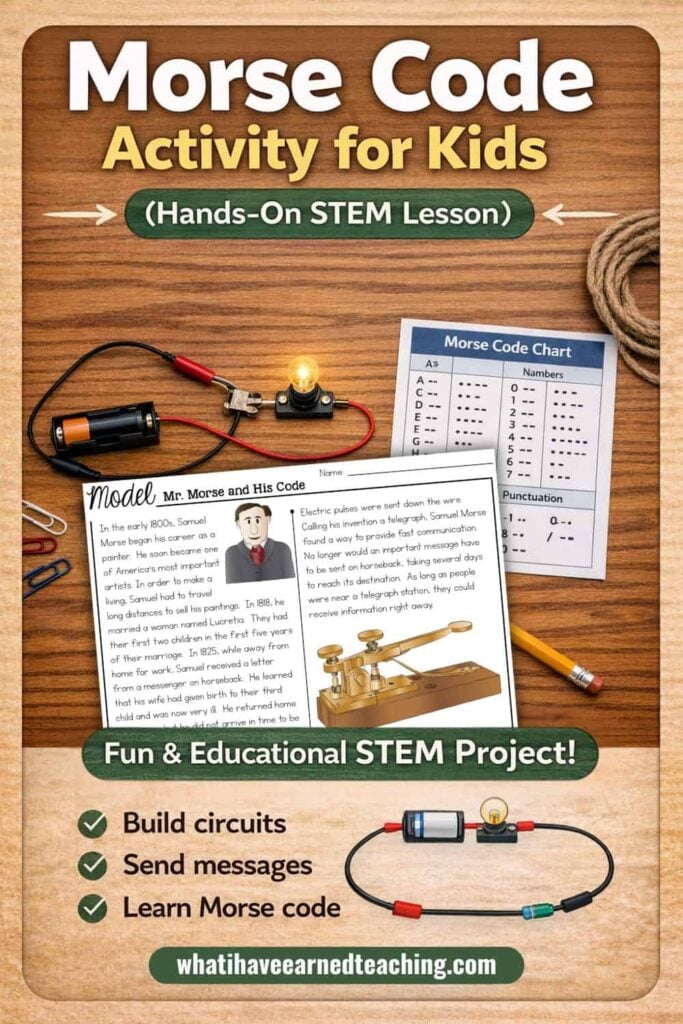
Even better, this activity naturally connects to binary code and modern technology, making it a great fit for STEM instruction. Students don’t just learn about Morse code. They experience how information is sent, received, and translated using patterns.
This activity connects directly to 4-PS4-3, the standard on wave patterns and information transfer. My physical science guide for elementary students covers the complete 4th grade physical science scope, including all three sets of waves standards.
What Is Morse Code (and Why Should Students Care)?
Morse code is a system of communication that uses dots and dashes (or sounds and light signals) to represent letters and numbers. It was developed in the 1800s as part of the telegraph system, allowing people to send messages quickly over long distances.
In your classroom, this becomes more than just a history lesson. It turns into a way for students to understand:
- How information can be encoded and decoded
- How patterns are used to communicate
- How early technology connects to modern digital systems
Students quickly realize this isn’t just “old-timey communication.” It’s the foundation of how messages still travel today.

This engaging Morse code activity allows students to explore Morse code, build a working telegraph model, and understand digital communication technology in an accessible, fourth-grade-appropriate way.
How This Morse Code Activity Works
This activity is part of a larger STEM-focused science station set where students explore communication through codes and technology.
At this specific station, students:
Read and Learn
Students begin with a short informational passage about Samuel Morse and the development of Morse code. They learn how electrical signals are sent through wires to communicate messages.

Build a Morse Code Transmitter
Here’s where things get fun (and a little noisy, depending on your setup).
Students create a simple transmitter using:
- A battery (power source)
- Wires (conductors)
- A switch (paper clips or alligator clips work great)
- A signal output (light or buzzer)
They are essentially building a basic circuit capable of sending signals.
Send and Receive Messages
Students work in pairs to:
- Send a message using Morse code
- Receive and decode their partner’s message
- Check for accuracy
And yes, there will be a lot of “Wait, was that a dot or a dash?” happening.
Reflect and Improve
Students analyze:
- What worked well
- What was challenging
- How could they improve their design
This ties directly into engineering practices like testing and refining solutions.

Where Binary Code Comes In
This is where you can really stretch the learning.
Morse code is not binary code, but it’s a perfect stepping stone.
Once students understand Morse code patterns, you can introduce binary code as another system that uses patterns (1s and 0s) to represent information.
Here’s an easy way to connect them:
- Morse code = dots and dashes
- Binary code = 0s and 1s
- Both = systems for encoding information
In fact, another station in this resource has students work directly with binary numbers and diagrams.
This helps students see that:
- Communication systems evolve
- Digital technology builds on earlier ideas
- Patterns are at the heart of STEM

This activity helps students understand how computers use a two-symbol code (binary) to represent letters and numbers.
Why This Works So Well for STEM
This activity brings together multiple STEM components in one lesson, making it a strong fit for integrated instruction.
In science, students learn about circuits, electricity, and how signals are transmitted. They see firsthand how a complete circuit allows information to travel.
In technology, students explore how information is sent using different systems, from early telegraphs to modern communication methods.
In engineering, students design, test, and improve their Morse code transmitter. They make decisions about materials and revise their setup based on what works.
In math, patterns, sequences, and logic come into play as students encode and decode messages.
This activity also aligns with NGSS expectations focused on transferring information using patterns, making it both engaging and standards-based.
Tips for Classroom Success
A few things that will make your life easier:
- Use lights instead of buzzers if your class is sensitive to noise (you’ll thank yourself later)
- Model a simple message before students try it independently
- Start with short words before moving to full sentences
- Keep a Morse code chart visible for reference
And prepare for students to start tapping on their desks in Morse code for the rest of the day.
This engaging activity allows students to explore Morse code, build a working telegraph model, and understand digital communication technology in an accessible, fourth-grade-appropriate way.
Taking It Further
Once students understand Morse code, you can extend the lesson by:
- Comparing Morse code to binary code
- Creating secret messages using different coding systems
- Having students design their own communication code
- Connecting to modern technology like texting, computers, or satellites
This Morse code activity is one of those lessons that sticks. Students aren’t just learning vocabulary. They’re building, testing, communicating, and thinking like engineers.
It naturally bridges into binary code and helps students understand how information travels, making it a strong addition to any STEM block.
And let’s be honest, any lesson where students get to send secret messages to each other is already a win.
Communication & Technology Science Stations (4th Grade NGSS)
This Morse code activity is part of the Talk to Me Science Stations, a set of 8 engaging stations designed to help students understand how communication works through codes and technology.
These stations are aligned with 4th-grade NGSS, focusing on 4-PS4.C, in which students explore how information is transferred through patterns. Throughout the unit, students interact with concepts like computer coding, cell phones, satellites, Morse code, binary numbers, drum code messages, and digital vs. analog technology.

Communication through Codes & Technology BUNDLE Science Stations
Talk to Me Science Stations for Fourth Grade Next Generation Science Standards include 7 different science stations where students deepen their understanding of communication through codes & technology.
Jessica BOschen
Jessica is a teacher, homeschool parent, and entrepreneur. She shares her passion for teaching and education on What I Have Learned. Jessica has 16 years of experience teaching elementary school and currently homeschools her two middle and high school boys. She enjoys scaffolding learning for students, focusing on helping our most challenging learners achieve success in all academic areas.