
Irregular Words List: 180 Words That Can’t Be Sounded Out
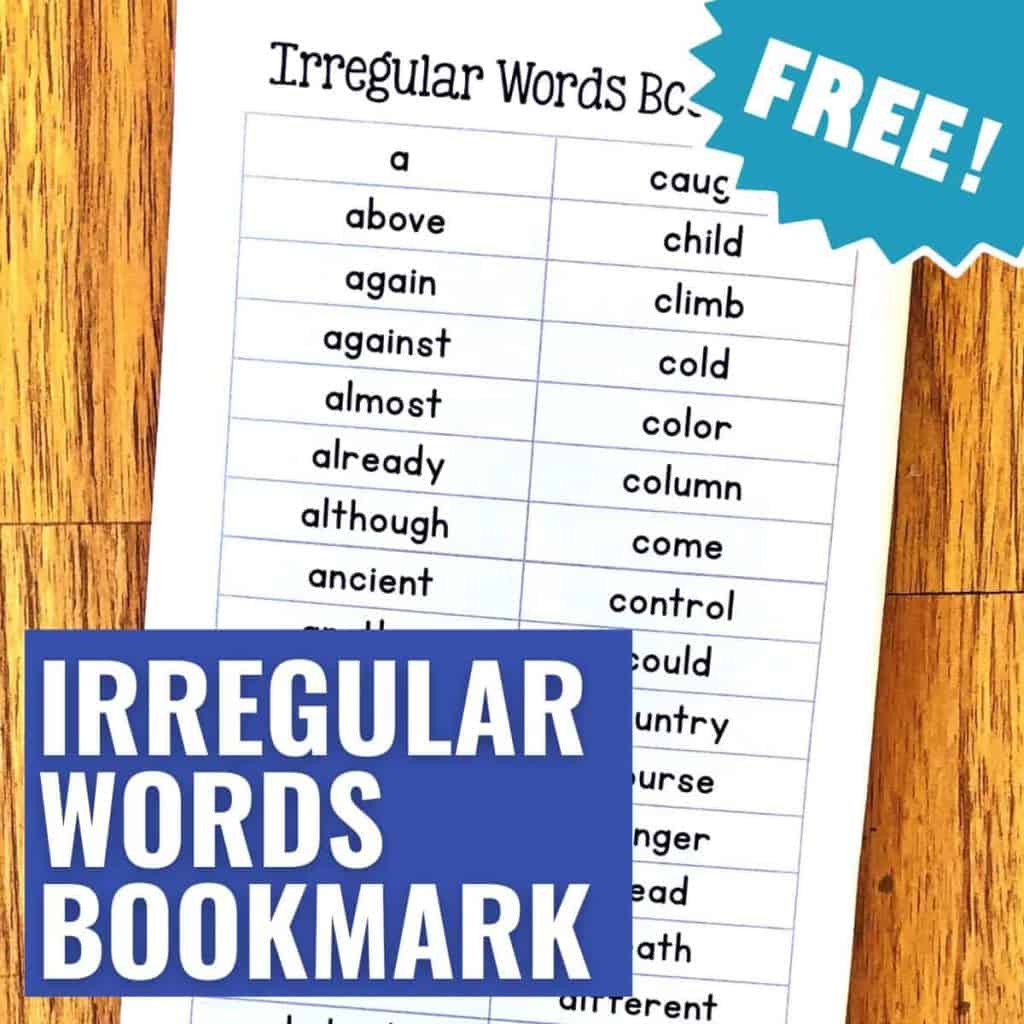
We all have students in our classrooms who misspell irregular sight words. How do you help your students learn to correctly write these difficult-to-spell irregularly spelled words? This Irregular Sight Word Bookmark is the perfect tool for students to use when writing irregularly spelled words.

What Are Irregular Words?
Irregular words are words that cannot be decoded using common phonics patterns. Their spelling does not match their pronunciation, so students cannot sound them out and need to learn them another way. Teachers sometimes call them heart words, tricky words, or irregularly spelled words.
What are Irregular Sight Words
Sight words have many names that are often used interchangeably, including the term high-frequency words. Teachers also use many other cute names that they have adopted over the years.
The basic premise of sight words is words that are read from sight, not decoded. They are words that teachers ask students to memorize and read rapidly.
High-frequency words are words that appear more frequently than others. They’re usually in a specific order. Dolch and Fry’s word lists are common high-frequency word lists. High-frequency words include sight words and decodable words.
Irregular sight words are words that cannot be decoded and don’t follow traditional English spelling rules. There are reasons the words are spelled that way, but it’s usually an obscure rule or adaptation over many years. It’s not a phonics pattern that is normally taught. Thus, it is an irregularly spelled word.
Which words should you consider sight words?
That depends. Does your school provide a list of words that students need to learn at your grade level? Use that list. Is there a list of words that your grade level has determined students need to know? Use that list.
If you are not provided a list, the Dolch List sand Fry’s Lists are a great starting place for high-frequency words. They are some of the more common lists used and many lists have some of the same words but in a different order.
The words on the Dolch and Fry’s lists will include decodable and non-decodable words.
Why teach only Irregular Words as Sight Words
Since it takes students so long to learn sight words, I like to limit the amount of sight word instruction to words that are common AND irregular or not decodable.
If you are teaching a phonics-based reading program while teaching students to memorize sight words, then they will learn how to decode and, had, last, then, with, not, much, etc. as they progress through the reading program.
Don’t waste valuable time teaching students to memorize decodable words if you don’t have to.
I also want my students’ first strategy to be the decoding skills they have been taught. I don’t want them to depend on memorizing words when learning to read.
Why?
There are thousands of words in the English language. Students cannot memorize all those words, and as they progress into higher levels of reading with many derivational patterns, the skill of memorizing words becomes a deficit if students cannot also break the word apart into meaningful chunks.
FREE Irregular Sight Word Bookmark
This Irregular Words Bookmark is a great tool for students to use when writing. It contains 180 irregular words that students cannot decode.
My own kids have been writing a ton of stories this past year. I’ve been encouraging my youngest to do his own writing, rather than asking me to write what he says. He does a great job transferring the sounds he hears in words to write his stories. However, he needs a lot of work spelling these irregularly spelled words.
I developed this bookmark for my own kids to use when writing. This bookmark has ONLY words that cannot be decoded using phonics patterns.
Irregular Words List: All 180 Words on the Bookmark
Here is the full irregular words list from the bookmark, 180 words in three sets of 60, in order of frequency. Every word on this list is permanently irregular or contains a pattern so rare that it is not worth teaching as phonics. These are the words I want students to spell correctly without stopping to sound them out.
Set 1: The 60 Most Frequent Irregular Words
| the | of | a | to | you | was |
| are | they | from | have | one | what |
| were | there | your | their | said | do |
| many | some | would | other | into | two |
| could | been | who | people | only | find |
| water | very | word | where | most | through |
| another | come | work | does | put | again |
| old | great | every | should | give | something |
| thought | both | often | world | want | different |
| together | school | once | enough | sometimes | four |
Set 2: The Next 60 Irregular Words
| head | above | kind | almost | earth | mother |
| country | father | eyes | today | sure | told |
| young | heard | answer | against | learn | toward |
| money | move | done | group | true | half |
| cold | course | front | early | brought | though |
| become | behind | ready | built | hold | piece |
| talk | blue | instead | either | friend | already |
| warm | mind | says | heavy | beautiful | everyone |
| watch | hour | carry | although | heart | wild |
| weather | someone | field | gold | build | walk |
Set 3: 60 More Irregular Words for Older Students
| buy | listen | whose | measure | caught | color |
| war | machine | ocean | pull | child | woman |
| iron | trouble | business | won’t | eight | month |
| wrong | sign | guess | brother | dead | weight |
| island | women | son | meant | pretty | break |
| bought | bear | control | spread | ancient | death |
| busy | love | laugh | soldier | wear | wonder |
| shoe | sugar | won | bread | parent | narrow |
| knowledge | column | neither | climb | familiar | push |
| receive | million | symbol | danger | shoulder | breakfast |
The printable bookmark puts these same words in students’ hands in two formats, one in order of frequency and one in alphabetical order, so they can find a word quickly while writing.
Permanently Irregular vs. Temporarily Irregular Words
Not all irregular words stay irregular. Permanently irregular words, like of, was, and said, never follow a phonics pattern students will learn. These words need to be taught explicitly and practiced until students can read and spell them automatically.
Temporarily irregular words only look irregular because students have not learned the pattern yet. A word like out is irregular to a kindergartner who only knows short vowels, but once students learn vowel teams, it becomes fully decodable. Temporarily irregular words do not need to be memorized. They just need to wait for the right phonics lesson.
The bookmark only includes words from the first group. If a word becomes decodable as students move through a phonics scope and sequence, I leave it off and let phonics instruction do its job.

Learn more about the Heart Word Method and how words can shift categories.
How to use the Irregular Words Bookmark
The Irregular Words Bookmark comes in two formats. One format in is order of frequency. The second bookmark is in alphabetical order. I might use the order of frequency with younger students, who are learning the words, and alphabetical order with older students, who can read most of the words, but just need help spelling them.
The alphabetical bookmark is especially useful as a 3rd grade sight words reference. Students at that stage can read most of these words but still need support spelling them during writing. Download the free PDF above and print it back-to-back.

Print the bookmark back-to-back and fold it on the dotted line. Students have three sets of words to reference when writing. On the fourth column are blank spaces where students can write in words that are difficult for them to spell. These might include words that have phonics patterns that have not been taught yet. Students can write in extra words that are decodable but beyond a student’s reading level.

Consider highlighting specific words during writing conferences for students to use and pay attention to when writing.
Irregular Words FAQ
Additional resources to help you teach sight words to elementary students
Are you in need of additional ideas for sight word practice? Check out these other blog posts and ideas.
- 5 Hands-on Sight Word Activities – a blog post about some activities you can do in your classroom to enhance your sight word instruction.
- Irregular Word Practice and Flash Cards – These are worksheets and cards where students can read, trace, and write sight words.
- Student Dictionary for Irregular Words – This student dictionary uses the same words above, but with more room to write additional words.
- Blending Cards for CVC Words – These blending cards are not focused on sight words, but do help students develop reading strategies with phonics patterns.
Jessica BOschen
Jessica is a teacher, homeschool parent, and entrepreneur. She shares her passion for teaching and education on What I Have Learned. Jessica has 16 years of experience teaching elementary school and currently homeschools her two middle and high school boys. She enjoys scaffolding learning for students, focusing on helping our most challenging learners achieve success in all academic areas.