
Apple Lesson Plans for Third Grade and Above – Thematic Apple Ideas for Upper Elementary
As an upper-grade teacher, I often lamented all of the fun thematic activities in the early elementary grades. Students got to learn about Fall, apples, and pumpkins while diving deep into our social studies and science. Some days I just wanted to take a break and learn all about apples. These Apple Lesson Plans informational articles and comprehension activities are specifically designed for third-grade through fifth-grade and focus students on more in-depth concepts and scientific ideas about apples.

Why study about apples in upper elementary grades?
September is a great time to study apples in the classroom. Apples are a great example of seasonal produce that can teach kids about nutrition and how food grows. Apples can also teach a variety of science topics, such as botany, photosynthesis, and the water cycle.
Most importantly, studying apples gives students hands-on experience with an accessible, engaging subject. Through activities such as apple picking, pressing cider, or making homemade applesauce, elementary students will have fun while learning about one of nature’s most popular fruits!
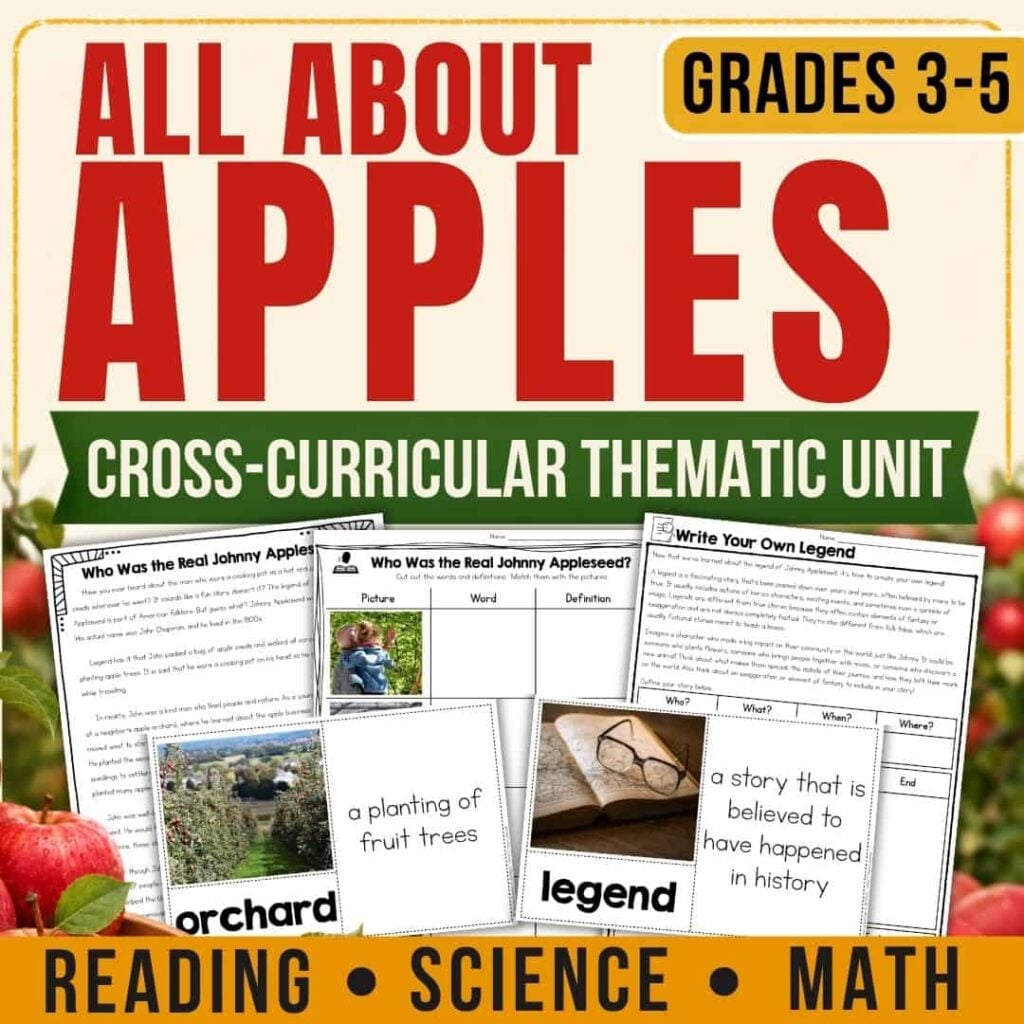
Students explore apples through six informational texts, hands-on science experiments, differentiated math word problems, and engaging activities as they build reading, writing, science, and critical-thinking skills.
What is Included in these Apple Lesson Plans for Upper-Grade Students?
These apple lesson plans for upper elementary include six informational reading passages, reading comprehension activities, vocabulary cards, and five hands-on science experiments — all designed for grades 3 through 5. Topics span biography, social studies, science, language arts, and math word problems differentiated for grades 2-5. Each section comes with an informational article, comprehension questions (short answer, fill-in-the-blank, and multiple-choice), and a related activity.
Apple Informational Articles
Included in the resource are informational articles about these topics and content areas:
- Biography / Legend: Who Was the Real Johnny Appleseed?
- Social Studies: How Do Apples Get From the Orchard to the Grocery Store?
- Science: Why Do Apples Turn Brown?
- Science: What Is the Life Cycle of an Apple Tree?
- Science: How Do We Taste Apples?
- Language Arts: How to Make Applesauce in a Crockpot
- PLUS: 4 Sets of Math Word Problems differentiated for grades 2-5.
Each Apple Reading Passage Has:
- Vocabulary Cards with real images
- Vocabulary Activities
- Audio Support via a QR Code
- Comprehension Questions – Short Answer, Fill-in-the-Blank, Multiple Choice
- Related Activity
Apple Activities Include:
- Writing a Legend
- Farm-to-Table Process Timeline with Problem/Solution
- Five Science Experiments using the Scientific Method designed for small groups
- Life Cycle Order plus Writing
- Taste Test with Upper-Grade Graphing Activities
Article #1: Legend & Biography – Who Was Johnny Appleseed?
The first informational article is about the Real Johnny Appleseed. It includes five paragraphs that explain the legend of Johnny Appleseed and give details about the real man, John Chapman. It discusses how John Chapman created apple nurseries and helped the settlers have food as they moved west.
This section’s activity focuses on legends. Students learn what a legend is and write their own. Included is a graphic organizer and writing pages.

Article #2: Social Studies – How do Apples get From the Orchard to the Grocery Store?
Apple lesson plan number two is great for social studies. It explains how apples get from the orchard to the grocery store and focuses on what happens at the apple processing plant, as well as how apples are transported between places.
The activity for this section is a process timeline in which students explain what happens at each step. They also brainstorm some problems that could occur and solutions to those problems.

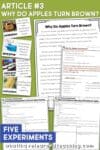
Article #3: Science – Why do Apples Turn Brown?
The third section explains why apples turn brown. It focuses on academic language and scientific concepts around oxidation and chemical reactions.
It includes five different science experiments about apple oxidation. Each science experiment changes one part of the process. Have each small group perform an apple experiment then come together to discuss the findings. As a class, figure out what happens with different liquids, different apples, different temperatures, and more!

Article #4: Science – Apple Life Cycle
The fourth Apple lesson plan is the easiest article and activity. It is about apple life cycles. This reading passage is shorter, and the activity should be more familiar to students. This section includes more academic vocabulary, with a word bank to support students as they work with tier-three terms.

Article #5: Science – How Do We Taste Apples?
Article five correlates well with Fourth Grade NGSS. It’s all about taste buds! The informational article discusses the sense of taste and how we can sense the difference between tart and sweet tastes.
The activity in this section is a taste test. The data-gathering worksheets are designed for older students and include a scale and an open graph where students create their own X-axis.

Article #6: How to Article – How to Make Applesauce
In this informational article, students read a recipe for making applesauce in a crockpot. The recipe includes ingredient measurements, steps, and anecdotal text that adds voice and engagement. Like the previous articles, this one includes vocabulary cards, activities, and a reading comprehension page.
The activity in this section is executing the recipe. You can make applesauce in the classroom!

Apple Math Word Problems
The last section includes sets of word problems. The word problem sets include:
- Addition & Subtraction
- Multiplication & Division
- Two-Step Word Problems with all operations
- Fractions
There are 10 word problems per section. An answer key is included.

Apples aren’t traditionally taught in upper-grade classrooms, but that doesn’t mean that they shouldn’t be! These apple lesson plans span a variety of content areas and are great for an apple-themed week or even a few days!
Students explore apples through six informational texts, hands-on science experiments, differentiated math word problems, and engaging activities as they build reading, writing, science, and critical-thinking skills.
How to Purchase the All About Apples Resource
You can purchase this robust Apples Thematic Unit on Teachers Pay Teachers.
Books About Apples
Books about apples offer elementary students an engaging and informative gateway to science, history, and culture. The books below focus on apple growth, apple cultivation in America, and the cultural significance of this fruit. Reading these alongside the unit helps students connect the science and social studies content to stories and narrative nonfiction they can explore independently.

Jessica BOschen
Jessica is a teacher, homeschool parent, and entrepreneur. She shares her passion for teaching and education on What I Have Learned. Jessica has 16 years of experience teaching elementary school and currently homeschools her two middle and high school boys. She enjoys scaffolding learning for students, focusing on helping our most challenging learners achieve success in all academic areas.