
20 Earth Day Science Experiments & Activities for Elementary Students
Earth Day is one of those times of year when science, curiosity, and real-world connections all come together. Students are thinking about how their actions impact the planet. And let’s be honest… anything that involves water, dirt, or building something out of “trash” is already a win in an elementary classroom.

If you’re looking for engaging Earth Day science experiments and activities, this collection gives you a mix of hands-on investigations, simple experiments, and STEM challenges. These ideas work well for 2nd–5th grade classrooms and connect directly to science standards while still feeling fun and meaningful.
Connect Earth Day to the Scientific Method
Earth Day activities are the perfect opportunity to reinforce how scientists think and work.
When students complete these experiments, they can:
- Ask questions about the environment
- Make predictions
- Test ideas through hands-on investigations
- Record and analyze results
Using scientific method posters and experiment recording sheets helps students organize their thinking and turns simple activities into meaningful learning experiences.

Scientific Method Posters & Recording Sheets for Science Experiments
Teach the scientific method with posters, vocabulary cards, differentiated science experiment recording sheets, and a science experiment flipbook. This flexible resource helps students follow each step of the scientific method during hands-on science experiments and activities.
Add Reading with a Pollution Informational Article
To deepen understanding, pair your Earth Day science experiments with nonfiction reading about pollution.
Students can learn about:
- Air pollution
- Water pollution
- Land pollution
This builds background knowledge and gives students a reason behind the experiments they’re doing. You can easily tie in comprehension skills like cause and effect, main idea, and supporting details.
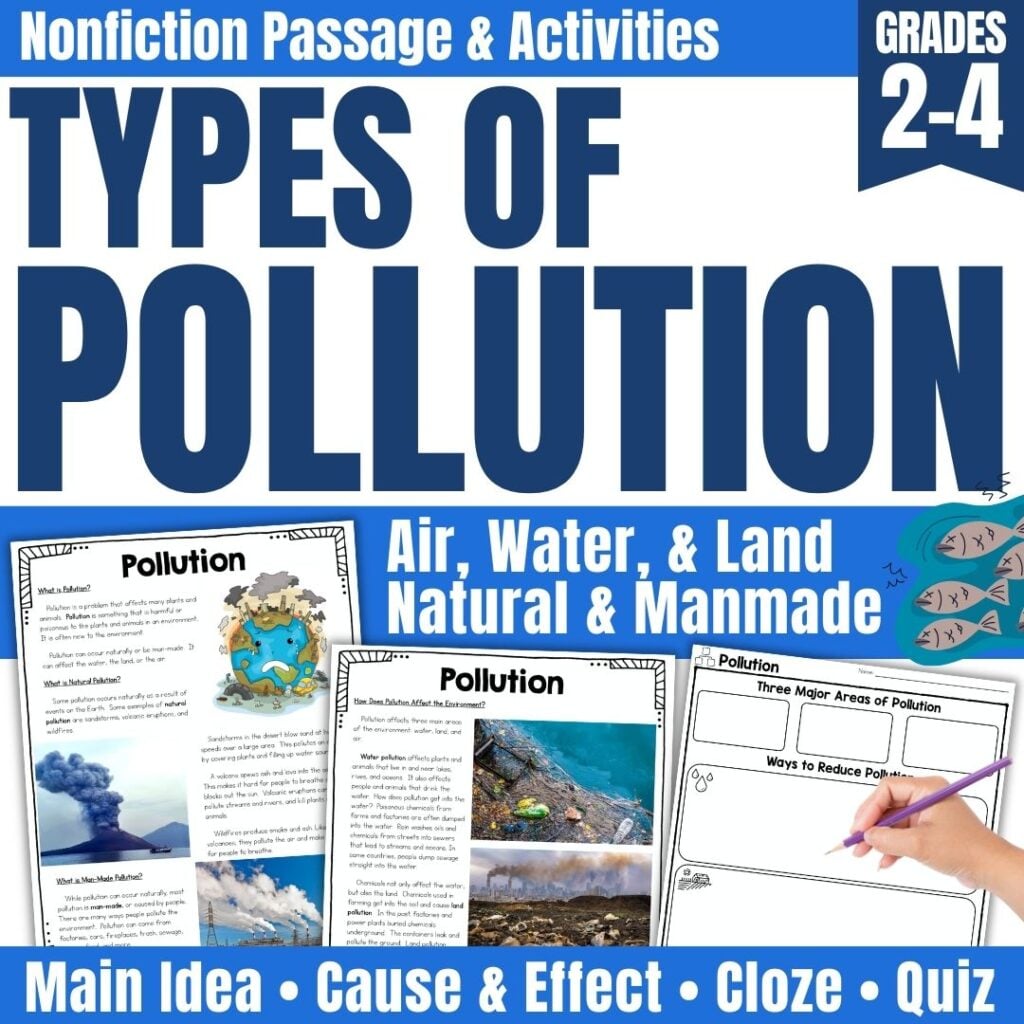
Pollution Reading Passage & Comprehension Activities | Earth Day Resource
Teach students about pollution and environmental responsibility with this engaging reading passage and comprehension resource! Perfect for Earth Day and environmental science lessons, students learn about water, land, and air pollution while practicing reading comprehension, main idea and details, cause and effect, writing, and critical thinking skills.
20 Earth Day Science Experiments (Organized by Topic)
These Earth Day activities are grouped into physical science, earth science, life science, and STEM. This makes it easier to match them to your standards and units.
Physical Science Earth Day Activities
These Earth Day activities focus on matter, properties, and simple chemical and physical changes.
Recycled Paper
We know we should use recycled paper, but have you ever made recycled paper? Now it is your chance! Students will love this hands-on look at making their own brand-new paper.
Last year, my son begged for a paper-making kit. Here he is making paper with it! This was a fun activity for him. He was in first grade at the time and needed some help, but he was able to do most of it on his own!

Water Pollution Science
Students investigate how pollution affects water and brainstorm solutions. This works well with a read-aloud or short article.
Water Filtration
Students design and test filtration systems using materials like sand, gravel, and cotton. They compare results to determine which filter works best.
Earth Science Earth Day Activities
These Earth Day activities connect to rocks, soil, and Earth systems.
Soil Model
A delicious treat that takes a good look at the different layers of soil. It’s a great addition to your students’ studies of the Earth’s layers.
If you want to do a deeper study of Earth’s layers, we have a set of science lessons on plate tectonics.
Chocolate Rocks
Need a way to teach your students the differences between igneous, sedimentary, and metamorphic rocks? Want to make them a snack at the same time? This activity has you covered! A perfect addition to all your geology studies.
3 Water Cycle Experiments
Three great activities to teach your students all about the water cycle. One simple activity for each part of the cycle: evaporation, condensation, and precipitation.
Sorting or Classifying Rocks
What are the ways we can classify rocks? Students learn ways to identify rocks beyond the three main classifications. What makes two rocks the same? What makes them different? What creative ways will your students develop to categorize their rocks?
If you would like some more ideas for sorting and classifying rocks, take a look at these second-grade science stations about physical properties or these fourth-grade science stations about how the Earth has changed over time.
Simple Soil Science
What makes some soil better for certain plants? A more in-depth look at soil than the desert activity above. This activity provides a great opportunity for students to observe, hypothesize, and experiment.
Life Science Earth Day Activities
These Earth Day science experiments and activities focus on ecosystems, plants, and environmental impact.
Tabletop Biosphere
This article provides detailed instructions on building a biosphere. Students will learn how to create a completely self-sustained ecosystem.
Repurposed Dryer Lint
What is needed for plants to grow? Is it as simple as soil and water? This activity teaches students about the effects soil loss has on plant life and what they can do about it. Plus, it’s a great look at what repurposing can do.
Effects of Environmental Change
This detailed lesson from PBS teaches students the damage climate change can wreak on plant life and animal life. It is filled with videos, games, and other activities.
Eggshell Garden
This repurposing activity teaches students how different soils can affect plant life. Students get to experiment to see which soil is best for their plants.
Plantable Seed Paper
What does it mean to compost paper? In this activity, students learn just that while also learning about plant life.
STEAM Activities for Earth Day
These seven Earth Day science experiments and activities will help your students explore science, technology, engineering, art, and math to find new ways to save our planet!
Trash Tower Building Challenge
Do your students love to build? In this activity, you can help them release their creativity while repurposing trash. Teach them to see what they throw away in a new light.
Upcycled Catapult
Another great activity to teach students is to reuse trash instead of throwing it away. Plus, catapults. Everyone loves catapults!
Wind-Powered Stem Challenge
What can you do with the power of the wind? This fun activity will challenge students to find creative ways they can use wind power.
Solar Heat
What is solar energy? What can we use it for? This activity explores those questions and more while inspiring students to find new uses for solar energy.
We also have a Solar Oven Science Station in our Natural Resources Unit for fourth grade. In this science station, students read a passage about solar light energy and how solar cells convert it into electrical energy. Students construct a solar oven and cook something in it!

If you want to further students’ study of the solar system, check out these solar system project ideas!
Lemon-Powered Light
This is a classic activity that students have used for years at science fairs. Your students will love turning fruit into electricity. And let’s face it, you’ll enjoy it, too.
Recycled Art
PBS offers detailed lessons in drawing and recycling. The lesson plan offers students the opportunity to take what they’ve learned and put it into action. How do the worlds of art and conservation merge?
Robot Design Challenge
Recycled robots. Those two words alone are probably enough to get your students excited about this activity. Put their creative minds into gear and find out what science-fiction masterpieces they’ll create with your repurposed junk.
I hope these Earth Day Science Activities will engage your students in fun experiments that help them learn to take care of our planet!
How to Use These Earth Day Activities in Your Classroom
You don’t have to do all 20 activities (your sanity will thank you).
Instead, try:
- Using them as science stations
- Spreading them across a full week of Earth Day lessons
- Choosing one activity from each category
- Pairing experiments with reading and writing tasks
This gives students a balanced experience without overwhelming your classroom schedule.
Earth Day science activities give students a chance to connect what they’re learning to the real world. They’re not just completing an experiment—they’re thinking about how their choices impact the environment.
And if a lesson happens to include dirt, chocolate, or building something out of what used to be “trash”… that’s just a bonus.
Jessica BOschen
Jessica is a teacher, homeschool parent, and entrepreneur. She shares her passion for teaching and education on What I Have Learned. Jessica has 16 years of experience teaching elementary school and currently homeschools her two middle and high school boys. She enjoys scaffolding learning for students, focusing on helping our most challenging learners achieve success in all academic areas.