
53 Solar System Project Ideas: 3rd, 4th, and 5th Grade
Solar system projects work best when students get choice, structure, and clear expectations. Projects that tap into how students learn, whether through art, building, research, or writing, tend to produce stronger work and keep students engaged through the unit.
These ideas are designed for grades 3-5 elementary classrooms and homeschool settings where students build content knowledge, explain scientific ideas, and apply what they learn.

Below you’ll find classroom-tested solar system project ideas organized by learning style. These projects fit easily into a space unit, science fair preparation, or end-of-unit assessment.
Let Students Choose a Solar System Project
Choice increases motivation and improves the quality of student work. When students select a project that fits how they learn best, they spend more time thinking, revising, and explaining their ideas.
Students might:
- Build a model
- Create artwork
- Research and write
- Act out scientific concepts
- Design games or challenges
The goal is not one perfect project format. The goal is meaningful learning paired with clear science explanations.
Here are some solar system projects your students can complete for classroom projects or homeschool explorations:
53 Solar System Project Ideas Sorted by Learning Styles
Read on for more ideas that will spark creativity, collaboration, and critical thinking in learners of all ages. The below solar system crafts and project ideas are organized by learning style and make great classroom or homeschool solar system science activities for any astronomy unit or science fair project.
Creative Art Hands-on Project Ideas (Grades 3-5)
Art-based solar system projects work especially well for 3rd and 4th grade classrooms where students are learning the planets for the first time and benefit from making a physical model or illustration they can reference.
- Bake planet-themed cookies in different sizes. Decorate them to match each planet.
- Using clay or playdough, have students sculpt a solar system model.
- Design a comic book featuring characters from each of the planets.
- Write a book for a younger grade level about an aspect of the solar system. Bonus: Read the book to a younger child.
- Create individual postcards for every planet in the solar system that features creative artwork and a description of the planet. Place the postcards on a complete solar system poster to display in the classroom.
- Create a space-themed board game complete with questions and answers about the planets.
- Write a space adventure story.
- Design alien life forms based on different planet environments
- Make shadow puppets of the constellations.
- Create a paper mache solar system and display it against black construction paper.
- Write and sing a song about the solar system.
- Draw a diagram of a spacecraft.
- Have students design a mural of the solar system, complete with pictures and solar system facts about each planet.
- Write a poem or haiku about each of the planets in the solar system. Be sure to include specific features of the planet learning during research.
- Paint a canvas with your interpretation of outer space, including stars, galaxies, and planets. Go beyond the Milky Way.
- Compose a short piece of music that represents each planet’s characteristics.
- Create a flipbook animation featuring a journey through the solar system.
- Design and create solar system-themed jewelry.
- Create an edible solar system or a solar system cake.

Research-Focused Solar System Projects (Grades 3-5)
Research projects work best in 4th and 5th grade, when students have enough reading stamina to gather information from multiple sources and can organize their notes independently.
- Observe the night sky with a telescope. Record a video of the experience and share a clip with the class.
- Watch documentaries about space exploration. Write down new facts that were learned
- Visit a planetarium. Take photos of the exhibits.
- Read books about the solar system. Write a review of the books.
- Explore NASA’s website for kids. Explain how to navigate the website to other students.
- Watch the live feed from the International Space Station. Tell about something that was observed.
- Create a timeline of space exploration history.
- Read a biography of an astronaut, like Mae Carol Jemison, and write a minibiography report.
- Interview an astronomer or a space scientist and share their insights with the class.
- Create a solar system-themed crossword puzzle or word search.
- Using VR technology, take a virtual tour of the International Space Station.
- Curate a mini-exhibit about the solar system using various materials and resources.
- Write a persuasive essay about the importance of space exploration.
Movement and Building Projects (Grades 3-5)
Building and engineering projects are strong choices for 4th and 5th grade classrooms where students are ready to apply design thinking and can handle more open-ended construction challenges.
- Create a mobile solar system that rotates. Explain about the rotation and revolution of the planets.
- Build a rocket model.
- Set off model rockets in a large open space.
- Construct a sundial. Learn about how people used them to tell time in the past.
- Make a 3D model of the Mars Rover.
- Create a scale model of the International Space Station.
- Build a comet with dry ice.
- Make a DIY planetarium with a cardboard box.
- Design and launch water rockets.
- Design and create a model of your ideal space habitat.
- Create a 3D map of the Mars surface.
- Using recyclable materials, build a model of a future Mars colony.
- Grow crystals at home to simulate how minerals might form on other planets.
- Create a diorama of the lunar surface.
Interactive and Game-Based Projects (Grades 3-5)
Games connect well to 3rd, 4th, and 5th grade science because they give students a way to demonstrate understanding without a test.
- Host a space trivia game. Bonus if you play the game another student created above!
- Role-play astronauts on a space mission.
- Participate in a “Mission to Mars” simulation game.
- Develop a solar system escape room for your classmates.
- Organize a ‘Capture the Flag’ game, but the flags are planets. Use 9 planets. Require the person capturing to tell a fact about the planet when capturing it.
- Create a solar system scavenger hunt with clues relating to each planet. The prize can be Marsbars.
- Conduct a debate on the topic: “Should humans colonize Mars?”
Build Background Knowledge Before Starting a Solar System Project
Solar system projects are more successful when students understand the basics before they begin. Students need shared language and common facts so their projects show understanding, not guesswork.
Before assigning a project, students should know:
- The order of the planets
- Basic characteristics of each planet
- How rotation and revolution work
- The role of the sun
- Vocabulary tied to space science
Spending time on background knowledge leads to clearer explanations, better models, and stronger presentations.
Here are a few ways teachers can build background knowledge about the solar system before having students choose a solar system project of their own:
Solar System Informational Articles for Grades 3-5
Using short, focused informational texts helps students gather accurate facts before choosing a project. Reading passages give students access to scientific vocabulary, clear explanations, and reliable information they can reference during research and writing.
These solar system articles focus on:
- Each planet
- Pluto and dwarf planets
- The sun, moon, and stars
- Key space science concepts
They work well for whole-group lessons, small groups, or independent research and support students who need structure while learning new content.
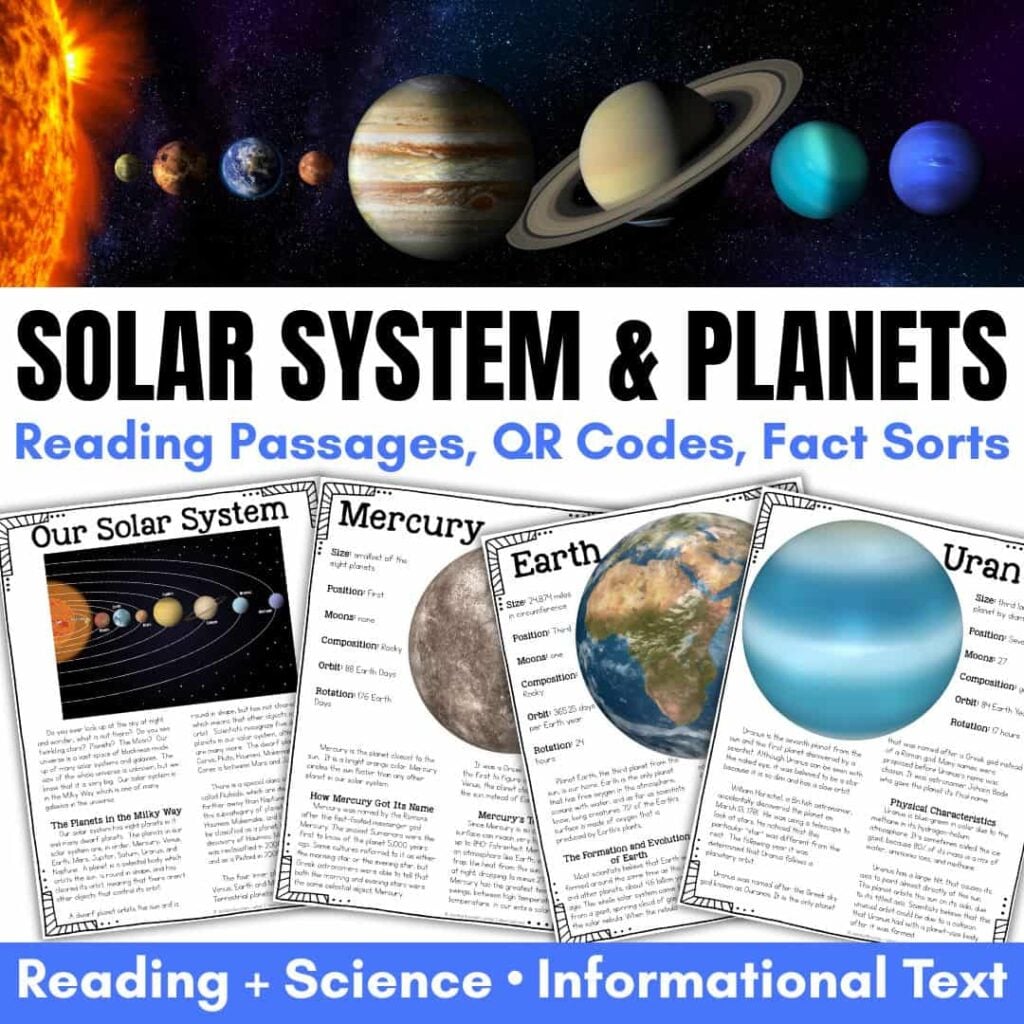
Designed for upper elementary learners, this resource combines engaging informational articles, graphic organizers, and research tools to build understanding of the planets, stars, sun, and moon.
Science Stations for Rotation, Revolution, Day, and Night
For older elementary students, hands-on science stations build understanding of movement in space. Stations focused on Earth’s rotation, revolution, seasons, and the moon’s orbit help students visualize concepts they will later explain in projects.
Stations are a strong option for fifth grade classrooms and align well with space science standards that focus on patterns and relationships in the Earth–sun–moon system.
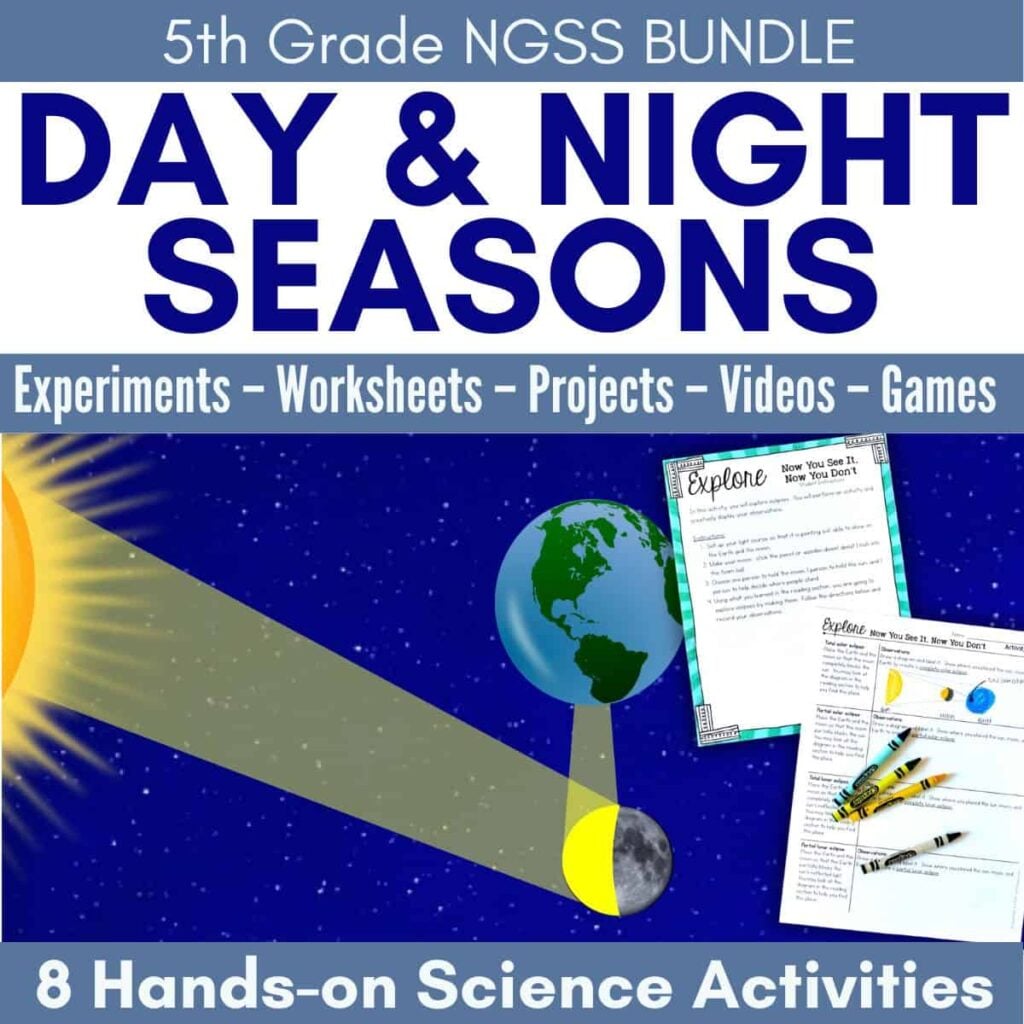
Day to Day, Season to Season Science Stations | NGSS 5-ESS1-2
Help fifth graders explore patterns caused by the Earth, moon, and sun with these Day to Day, Season to Season Science Stations! Students investigate day and night, seasons, moon phases, rotations, revolutions, Earth’s tilt, eclipses, seasonal changes, and observable sky patterns through eight NGSS-aligned stations with print and digital options. Aligned to NGSS 5-ESS1-2.
Wrapping Up a Solar System Unit with Projects
Solar system projects give students a chance to show what they understand in creative, meaningful ways. When students have background knowledge, clear expectations, and project choice, their work reflects real science learning.
These project ideas support a wide range of learners and fit easily into elementary science units, enrichment time, or homeschool planning. Whether students build, write, draw, or design games, each project keeps the focus on understanding how our solar system works.
Jessica BOschen
Jessica is a teacher, homeschool parent, and entrepreneur. She shares her passion for teaching and education on What I Have Learned. Jessica has 16 years of experience teaching elementary school and currently homeschools her two middle and high school boys. She enjoys scaffolding learning for students, focusing on helping our most challenging learners achieve success in all academic areas.