
How to Teach Subtraction with Regrouping to Second-Grade Students
Are you teaching your second-grade and third-grade students how to subtract with regrouping? This math concept can be difficult for students to understand, but some place value math strategies can make it easier.
Below are strategies for teaching students to subtract with regrouping. I use these strategies in my classroom at different times during the school year with different students. Different strategies work better than others for students who need more scaffolding and support.
There is no one-strategy-fits-all approach. But there are better approaches.

Each student will understand each strategy differently and at a different level. Also, some math problems lend themselves to using specific strategies better than others.
I suggest that you explore all of the strategies with students. The goal is to move them toward efficiency while maintaining accuracy. What is efficient with one student may not be efficient for another student.
Spend time having students reflect on why a specific strategy worked best for a specific problem and why students chose a specific strategy over another one.
These discussions and visual references will deepen students’ understanding of subtracting using regrouping strategies.
Skills to Teach Before Teaching Subtraction with Regrouping
Before diving into subtraction with regrouping, it’s crucial to ensure that students have a strong understanding of several key concepts:
- Place Value and Expanded Notation: Students should be comfortable with place value, recognizing how each digit in a number has a specific position and value. Teaching expanded notation helps reinforce this concept by breaking down numbers into their parts (e.g., 456 as 400 + 50 + 6).
- Subtracting Friendly Numbers: Start with more straightforward subtraction problems that do not require regrouping, such as subtracting multiples of 10 (e.g., 87 – 30). This builds confidence and familiarity with the subtraction process.
- Subtraction Without Regrouping: Ensure students can successfully subtract smaller numbers when regrouping is unnecessary. This solidifies their understanding of the basic subtraction of multi-digit numbers.
Strategies & Models Students Can Use to Subtract with Regrouping
As I mentioned above, the goal when using the following math strategies is to move students toward efficiency.
Manipulating physical base-10 blocks is the most straightforward, hands-on way to teach subtraction with regrouping, but we don’t want students to stay there.
Start with physical base-10 blocks, then move from the physical base-10 blocks to drawing base-10 blocks. After having students work with drawing base-10 blocks, move to have them use expanded notation to write the value of each set of blocks.
Then, remove the blocks entirely and have students only use the expanded notation or break-apart strategy. From there, focus on decomposing a ten or hundred, where students only decompose one number.
Can you see the progression?
Move from concrete objects to drawing representations to using place value strategies. This develops authentic number sense.
As you introduce a new strategy, create pathways between the strategies so students see their connections.
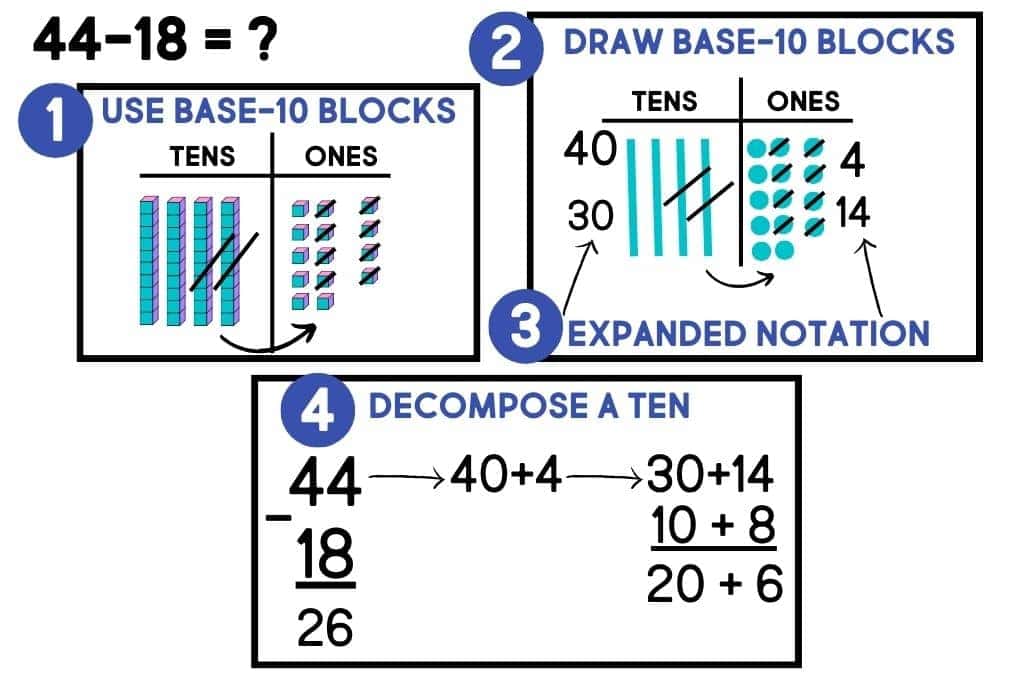
1 – Use Base-10 Blocks
This hands-on approach helps students visualize the subtraction process. By manipulating blocks to represent tens and ones, students can physically regroup a ten from the tens column into the ones column. Hands-on manipulatives make abstract concepts more concrete.
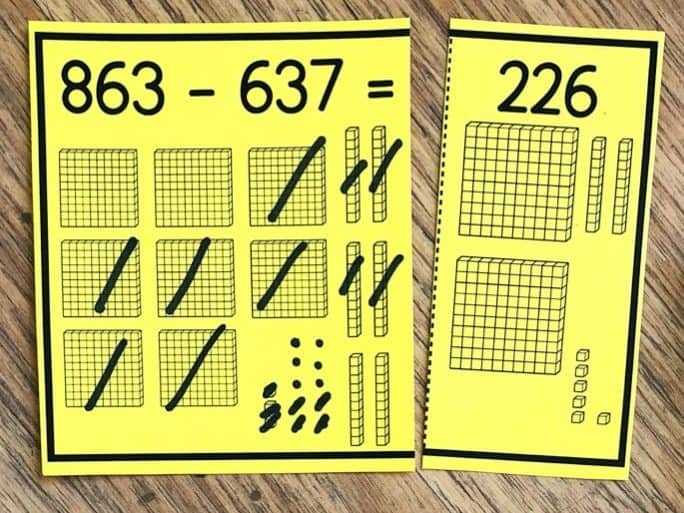
Students should be able to move from using concrete objects to using the base-10 blocks AND drawing representations of the hundreds, tens, and ones to JUST DRAWING the representations.
2 – Use Expanded Notation or Break Apart the Numbers or Decompose a Ten
Encourage students to decompose each number into its place values (e.g., 53 as 50 + 3). This method helps them see what happens when they must regroup to subtract effectively. Students can decompose both numbers or just the top number.
I have called this method different labels over the years.
I like to call this “decompose a ten” when I’m initially teaching students how to do this. We spend a lot of time anchoring the idea that we are decomposing or breaking apart a ten. When we move onto hundreds, we say we’re decomposing a hundred and then a ten.
While we do this with base-10 blocks, I also do it with drawings. There is a difference between the model and the strategy. The MODEL are the base-10 blocks. The STRATEGY is the process of expanding or decomposing the numbers.
Another suggestion is to attach language to math skills. Have students say the number and how they are decomposing it to subtract. Have them explain the process to another student.
All of these interactions trigger different parts of the brain and move the process from short-term to long-term memory.

3- Use Number Lines
Number lines are a visual model that can help students understand subtraction as the distance between numbers.
- Think Addition – Count Up on the Number Line: Instead of subtracting, students find the difference by counting from the smaller to the larger number.
- Count Down on the Number Line – Traditional subtraction can be visualized by counting backward, reinforcing the concept of taking away.
There are MANY different ways to use a number line. While students can count by ones, fives, or tens, the idea is always moving them toward efficiency.
Below is a vertical number line that I loved using with my son. Instead of having the visually distracting hooped lines, I drew one straight line that allowed us to clearly write on either side. We moved down the number line on the left and added up our “jumps” or difference on the right.

4 – Compensation
This advanced strategy involves adjusting both numbers to make the subtraction easier and correcting the result accordingly. There are a few different ways to use compensation. For 1000-499, students could:
- Simplify 1000 – 499 to 1000 – 500 + 1 = 501
- Take one from 1000 and shift 499 down one, so it becomes 999 – 498 = 501

Tips for Helping to Solidify these Subtraction Strategies
Encourage 2nd and 3rd-grade math students to reflect on their chosen strategy and its effectiveness.
Regular discussions can deepen understanding and help students articulate their thought processes, enhancing their mathematical reasoning skills.
Teachers can ask students: Why did they choose that strategy? What made it a good fit for the math problem? Did another student choose a different strategy?
Creating visual charts for each strategy and comparing the math concepts can also be helpful for students.
By offering multiple approaches, we equip our students with the tools to tackle mathematical challenges confidently and successfully.
Jessica BOschen
Jessica is a teacher, homeschool parent, and entrepreneur. She shares her passion for teaching and education on What I Have Learned. Jessica has 16 years of experience teaching elementary school and currently homeschools her two middle and high school boys. She enjoys scaffolding learning for students, focusing on helping our most challenging learners achieve success in all academic areas.