Skip to content
Free printables and teaching tips Get them here
What I Have Learned Logo
  • AboutExpand
    • Frequently Asked Questions
    • Contact
    • Legal Policies
    • How to Teach Word Problems
  • Teaching StrategiesExpand
    • Classroom Management
    • English Learners
    • Differentiation
    • Goal Setting
    • Explore by GradeExpand
      • Kindergarten
      • First Grade
      • Second Grade
      • Third Grade
      • Fourth Grade
      • Fifth Grade
  • Teaching IdeasExpand
    • Math
    • Reading
    • Writing
    • Science
    • Seasonal
Shop on TPT
What I Have Learned Logo
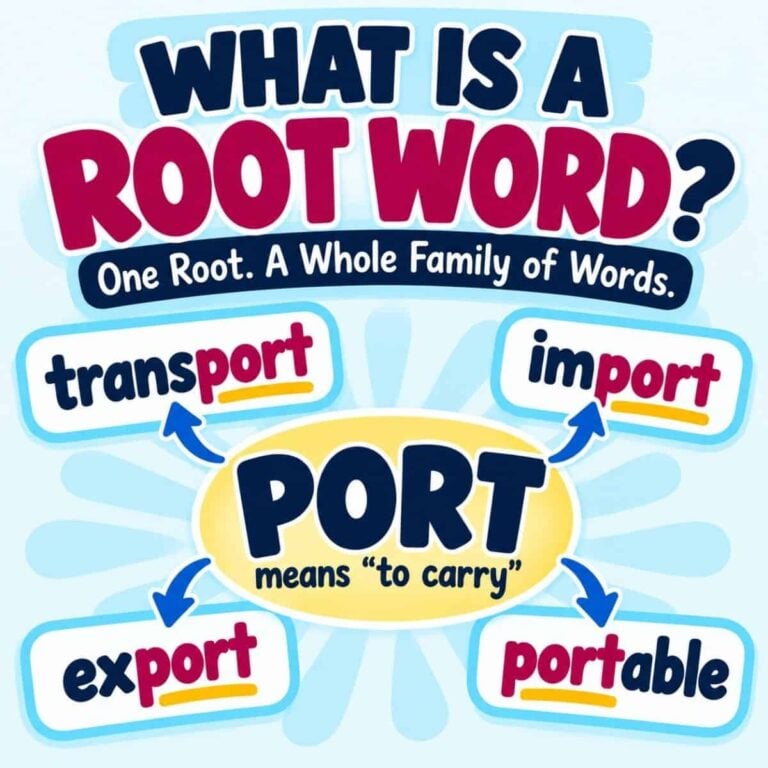
  • Colorful graphic explaining what is a root word, featuring port (meaning to carry) with examples: transport, import, export, portable—each highlights port in red within the word.
    Reading

    What Is a Root Word? Definition and Examples for Kids

    A student hits the word transportation and freezes, sure they have never seen it before. But hidden in the middle is a root they may already know: port, meaning to…

    Read More What Is a Root Word? Definition and Examples for KidsContinue

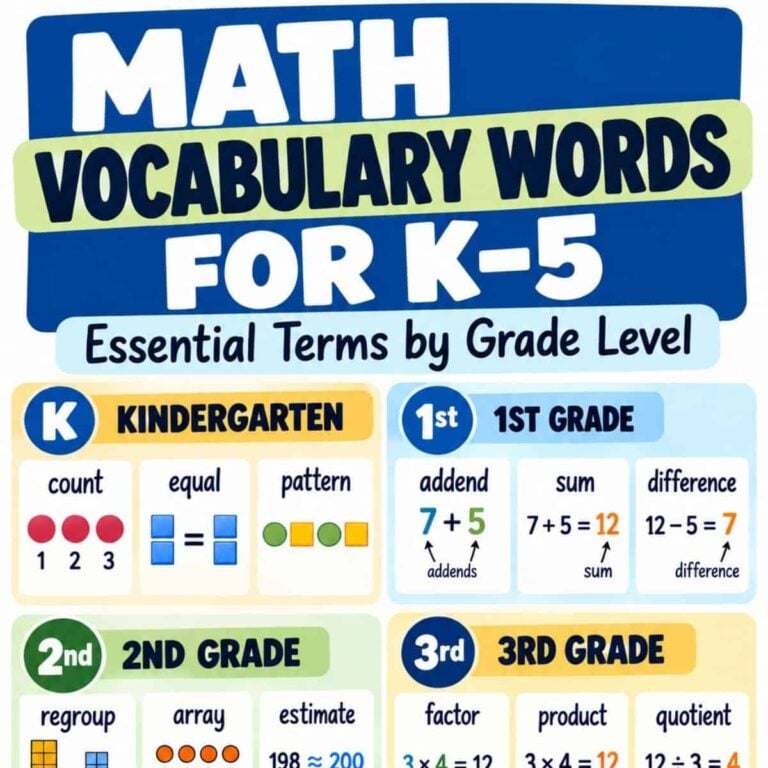
  • The math vocabulary words chart features essential math terms by grade level with examples and icons for kindergarten, 1st, 2nd, and 3rd grades.
    Math

    Mathematics Words: A Complete K-5 Math Vocabulary List

    A student can solve 7 plus 5 and still freeze when you ask them to explain how they found the sum. The gap is almost always vocabulary. Math words like…

    Read More Mathematics Words: A Complete K-5 Math Vocabulary ListContinue

  • Text reads: Context Clues helps kids figure out words without a dictionary. In the sentence, “The path was so arduous that the hikers had to stop and rest,” arduous is highlighted in pink. A phrase is highlighted in yellow to show how types and examples of context clues can help kids understand new words.
    Reading

    Context Clues: Types and Examples for Kids (Grades 2-5)

    A student reads, “The path was so arduous that the hikers had to stop and rest,” and even without knowing the word arduous, they can figure out that it means…
    Read More Context Clues: Types and Examples for Kids (Grades 2-5)Continue

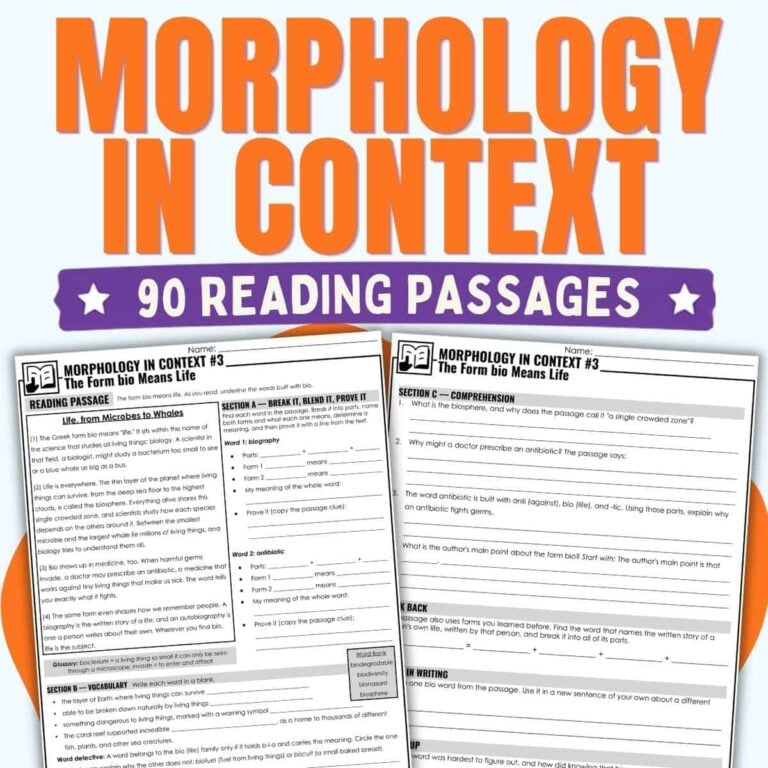
  • Cover features the title Morphology in Context POST. Below, two sample worksheet pages display a reading passage focusing on word parts such as “bio,” along with related comprehension and writing questions.
    Reading

    Morphology Reading Passages: Word Parts in Real Reading

    Your students can define a prefix on a worksheet, but the real test comes when they hit a long, unfamiliar word in the middle of a science article and have…
    Read More Morphology Reading Passages: Word Parts in Real ReadingContinue

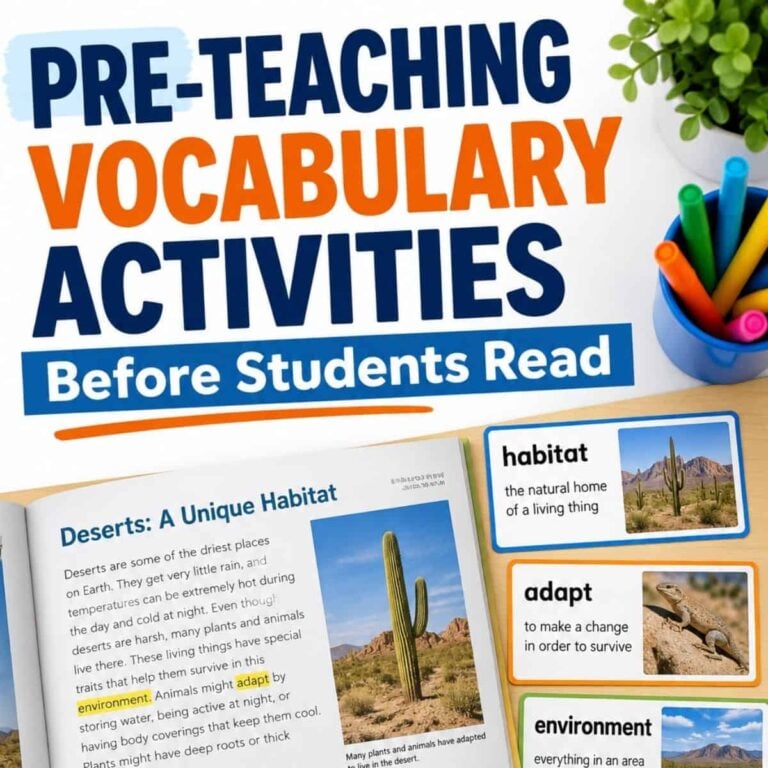
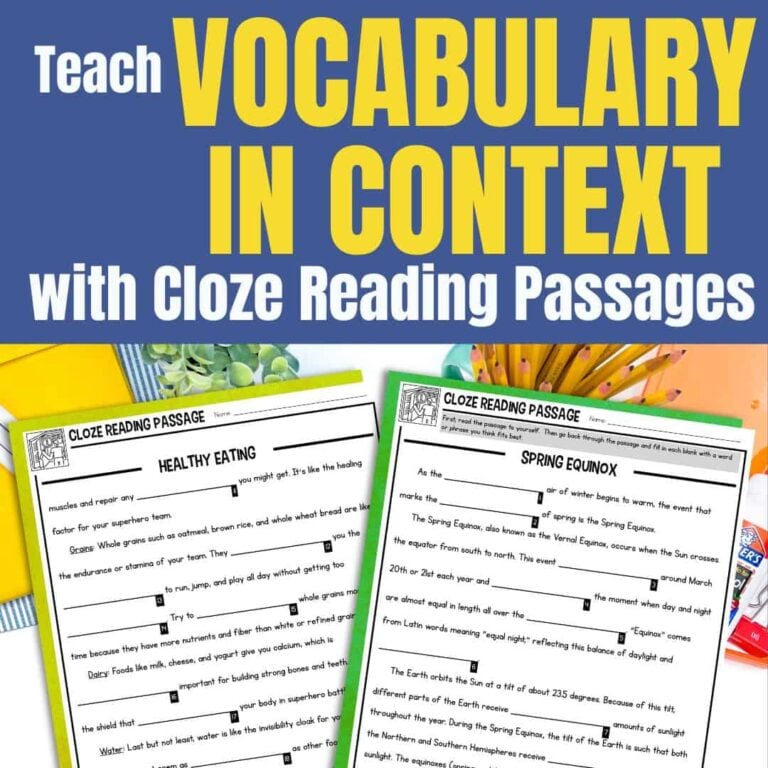
  • On the desk, the “pre-teach vocabulary” book about deserts is next to vocabulary cards for habitat, adapt, and environment, with colored pencils in a cup nearby. The heading says: Pre-teaching Vocabulary Activities to Boost Comprehension Before Students Read.
    Reading Comprehension

    Pre-Teaching Vocabulary Activities That Boost Comprehension

    You hand out a new science article, students start reading, and within a paragraph, three hands go up: “What does habitat mean? What’s adapt?” By the time you have answered,…
    Read More Pre-Teaching Vocabulary Activities That Boost ComprehensionContinue

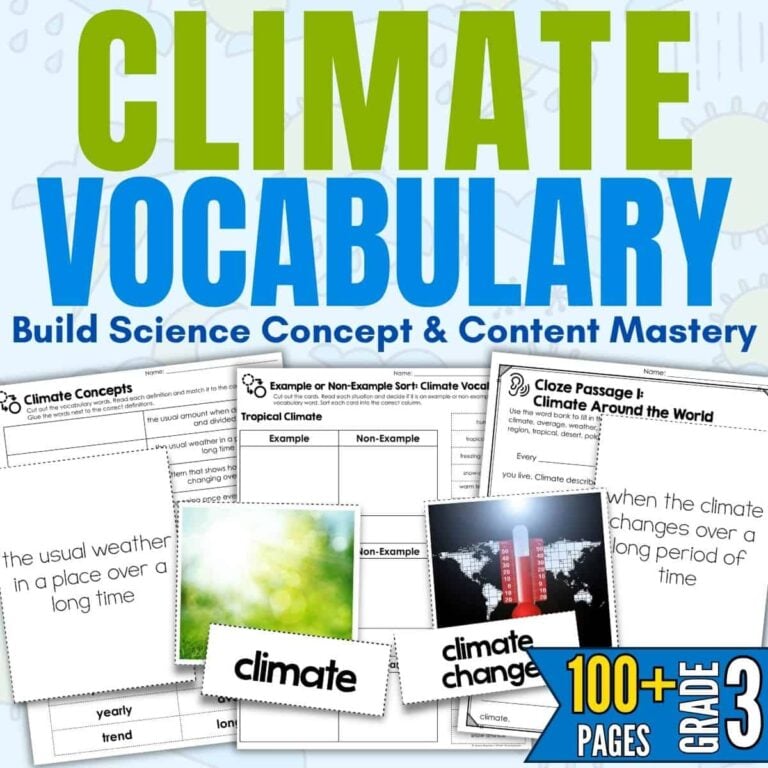
  • The Climate Vocabulary Activities cover for Grade 3 features worksheets, word study cards, images, and highlights “Build Science Concept & Content Mastery”—ideal for upper elementary science with over 100 pages of resources.
    Earth Science

    Climate Vocabulary Activities for 3rd Grade Science

    Climate vocabulary activities give 3rd grade students repeated, structured exposure to the terms they need to understand weather patterns, climate zones, and human impact, before those concepts show up on…
    Read More Climate Vocabulary Activities for 3rd Grade ScienceContinue

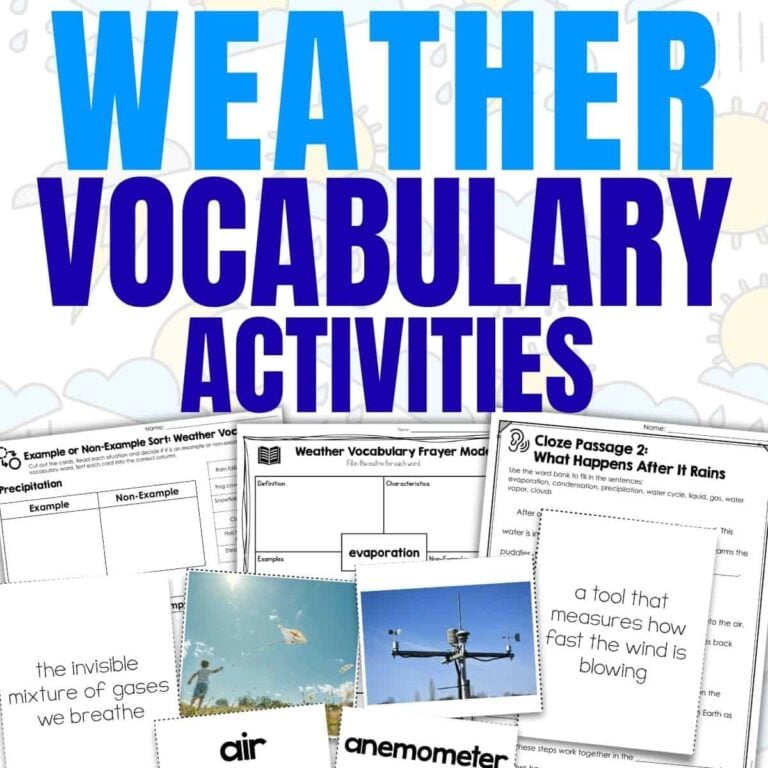
  • Collage featuring the bold text "SQUARE Weather Vocabulary Activities (1)" above worksheets and flashcards with weather terms such as air and anemometer, and illustrations of weather scenes and tools.
    Earth Science

    Weather Vocabulary Activities That Actually Stick (and Don’t Feel Like Test Prep)

    If you’ve ever taught a weather unit and felt like students could recognize words like evaporation or precipitation, but couldn’t actually use them, you’re not alone. Finding effective weather vocabulary…
    Read More Weather Vocabulary Activities That Actually Stick (and Don’t Feel Like Test Prep)Continue

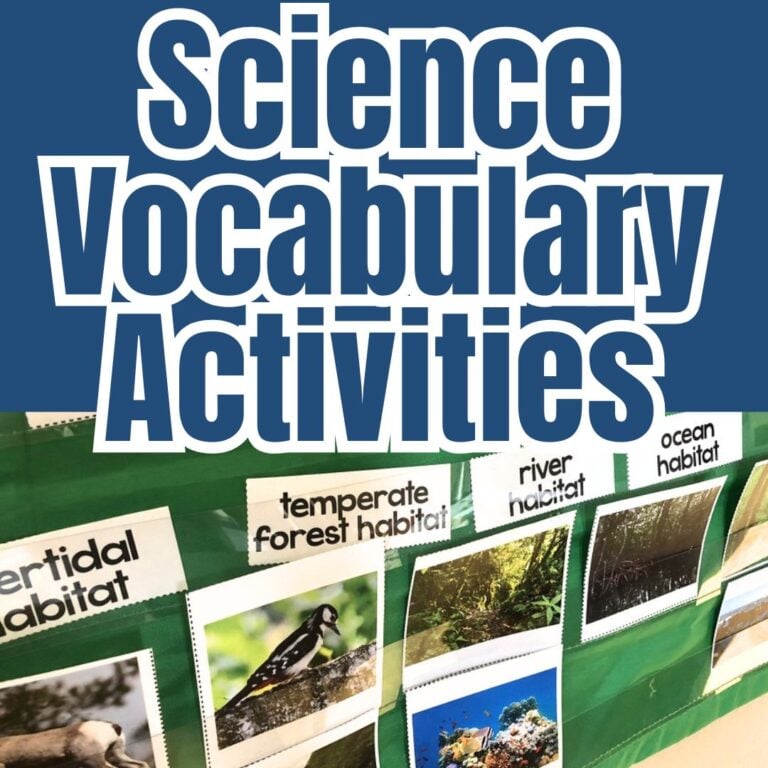
  • A classroom display labeled SQUARE science-vocabulary-activities-elementary features habitat cards and images, highlighting science terms like estuarine, temperate forest, river, and ocean habitats.
    Science

    Science Vocabulary Activities for the Elementary Classroom

    Science vocabulary cards are one of those simple tools that can do a lot of heavy lifting in your classroom. Whether you’re teaching life science, earth science, or physical science,…

    Read More Science Vocabulary Activities for the Elementary ClassroomContinue

  • A graphic titled Using Frayer Models shows a Frayer Model for Habitat with definition, characteristics, examples (rainforest, arctic, desert), and non-examples (spaceship, toy store).
    Reading Comprehension

    How to Use Frayer Models in 2nd Grade (Yes, They Can Do It!)

    If you’re looking for a clear Frayer Model example or wondering how to use a Frayer Model in 2nd grade, you’re in the right place. A Frayer Model is a…
    Read More How to Use Frayer Models in 2nd Grade (Yes, They Can Do It!)Continue

  • what is cloze reading?
    Reading | Reading Comprehension

    Cloze Reading Passages: A Teacher’s Guide to Vocabulary in Context All Year

    Vocabulary instruction works best when students see words doing real work inside meaningful text. That’s where Cloze reading shines. Cloze reading passages ask students to think beyond guessing a missing…

    Read More Cloze Reading Passages: A Teacher’s Guide to Vocabulary in Context All YearContinue

  • Text reads “Halloween Words Shades of Meaning” with a bat graphic. Below is a spooky scene with a glowing jack-o’-lantern, a dark path, twisted trees, and a haunted-looking house in the background.
    Fall | Reading | Writing

    Halloween Words for Kids: 100 Vocabulary Words and Activities

    Halloween gives you a natural hook for vocabulary work in October. Students already know many of these words from books, movies, and trick-or-treating, making them a low-lift way to teach…
    Read More Halloween Words for Kids: 100 Vocabulary Words and ActivitiesContinue

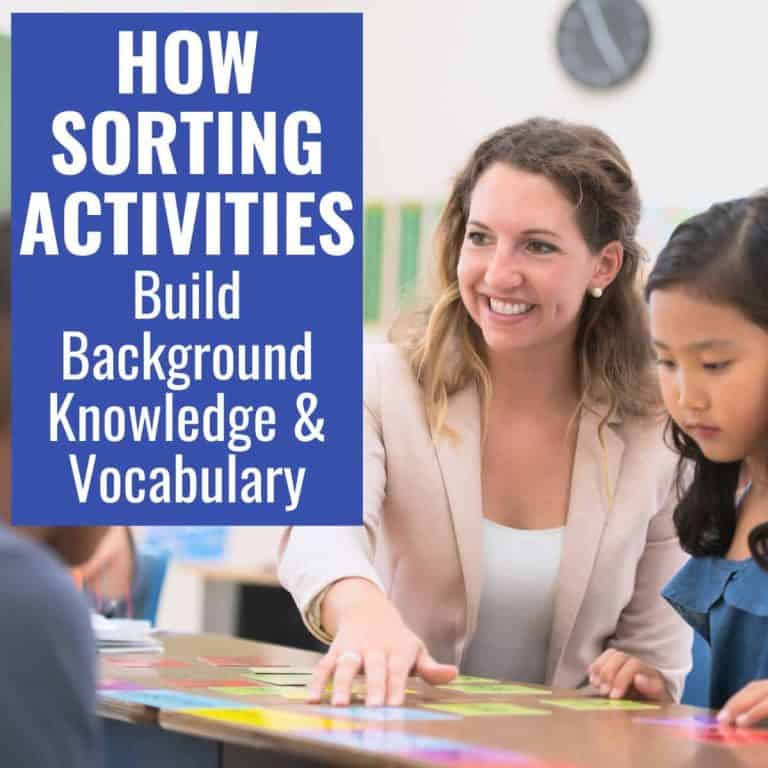
  • A smiling teacher sits at a table with two young students, engaging in sorting activities. Text overlay reads: How sorting activities build background knowledge & vocabulary.
    Differentiation

    Use Sorting Activities to Build Background Knowledge, Vocabulary, and Higher-order Thinking Skills

    Sorting activities can be a great resource in the elementary classroom. They allow students to explore their background knowledge creatively and build upon new ideas and vocabulary words. These activities…

    Read More Use Sorting Activities to Build Background Knowledge, Vocabulary, and Higher-order Thinking SkillsContinue

Page navigation

1 2 Next PageNext

Become a part of the Email Community!

Sign up to get a free resource of your choice!

Click to Get a Free Resource
WIHL Footer Logo homepage.
  • Facebook
  • Pinterest
  • Instagram
  • Amazon
  • YouTube

Information

  • About
  • FAQ
  • Shop
  • Contact

Topics

  • Math
  • Science
  • Reading
  • Writing

Teaching Ideas

  • Seasonal
  • Differentiation
  • Management
  • English Learners
  • Privacy Policy
  • Refund Policy

© 2026 What I Have Learned

  • What I Have Learned
  • Learn
    • Math
    • Reading
      • Early Reading
    • Writing
    • Science
    • Instructional Strategies
      • Seasonal
      • Classroom Management
      • Goal Setting
  • Shop
    • Bundles
    • Animal Articles
    • Goal Setting
    • Craftivities
    • Math
    • Phonics
    • Social Studies
    • Science
  • About
    • Courses & Collections
    • FAQ
Search