
Mathematics Words: A Complete K-5 Math Vocabulary List
A student can solve 7 plus 5 and still freeze when you ask them to explain how they found the sum. The gap is almost always vocabulary. Math words like sum, difference, and equal are the tools students use to talk about their thinking, and without them, even a strong problem solver sounds stuck. Clear math vocabulary is what lets a child say “I regrouped ten ones into one ten” instead of “I did the thing with the numbers.”
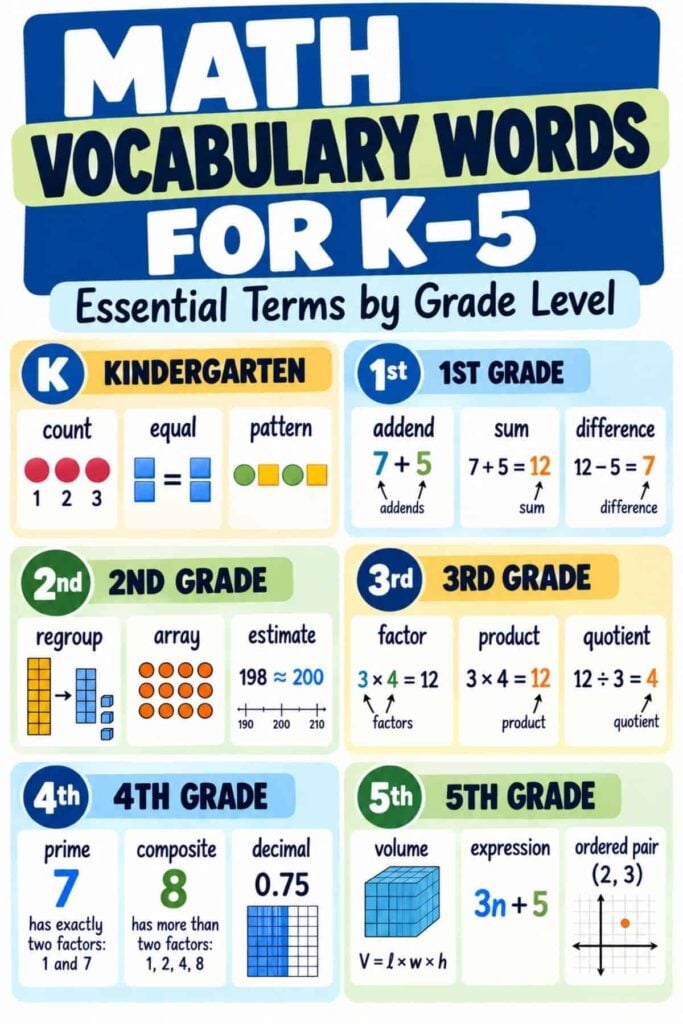
This post gives you an organized, grade-by-grade list of the math vocabulary words students need from kindergarten through fifth grade, each with a simple definition and an example, plus practical tips for teaching academic math language so it actually sticks.
Why Math Vocabulary Words Matter for Elementary Students
Math is a language as much as it is a set of procedures. When students do not have the words for what they are doing, three things happen. They struggle to explain their reasoning out loud, which is exactly what most standards and assessments now require. They misread word problems because a single term like difference or product tells them which operation to use. And they lose access to higher-level thinking, since you cannot reason about something you cannot name.
Precise vocabulary also levels the playing field. Students who hear rich math language at home walk in with an advantage, and explicit vocabulary instruction is one of the most reliable ways to close that gap for everyone else. That is why building math vocabulary deserves real time in your week, not just a glance at the glossary in the back of the textbook. The rest of this post lays out which words to teach at each grade and how to make them stick.
What Are Math Vocabulary Words? Terms, Definitions, and Examples
The vocabulary of mathematics falls into two broad groups, and it helps to know the difference before you teach it. Some are everyday words that carry a specific meaning in math. Others are formal terms that exist only in math. Students need both, but they often confuse the two, and that confusion shows up on tests.
Math Vocabulary Words vs. Mathematical Terms
Everyday math words are familiar words doing double duty. More, less, equal, share, and take away all mean something in ordinary conversation and something slightly more precise in math. Mathematical terms, on the other hand, are formal vocabulary that students meet first in a math classroom: sum, quotient, denominator, perimeter. These mathematical vocabulary words do not have an everyday twin, so students have to learn them outright. A strong math program teaches students to move from the informal word they already own to the formal term they will see on an assessment.
A Simple Example of a Mathematical Term
Here is a concrete example of a mathematical term. The word sum is the formal term for the answer to an addition problem. In 7 + 5 = 12, the number 12 is the sum. A student might call 12 the “total” or “how many altogether,” and that is not wrong, but sum is the precise term that shows up in directions, word problems, and test questions. Teaching the formal term alongside the informal one gives students a way in and a way up: they understand the idea through the familiar word and then attach the academic label that the rest of math will expect them to know.
Kindergarten Math Vocabulary Words
Kindergarten vocabulary centers on counting, comparing, and describing shapes. Keep definitions short, and tie each word to something students do with their hands.
- Count: to say numbers in order to find how many.
- Number: a symbol that tells how many, like 3 or 8.
- More: a greater amount than another.
- Less: a smaller amount than another.
- Equal: the same amount as another.
- Same: alike in some way, like size or number.
- Different: not alike.
- Sort: to put things into groups that go together.
- Pattern: things that repeat in an order, like red, blue, red, blue.
- Shape: the form of an object, like a circle or square.
- Zero: a number that means none.
- Cardinal number: a number that tells how many, like 5 apples.
- Ordinal number: a number that tells position, like first or third.
Example in action: when a student lines up ten counters and says “ten,” then adds one and says “eleven,” they are using count and number together. Pointing out those words as they work helps the vocabulary take hold.
1st Grade Math Vocabulary Words
First grade introduces the language of addition and subtraction and the beginnings of place value. These are the first true mathematical terms many students meet.
- Addend: a number being added to another.
- Sum: the answer to an addition problem.
- Difference: the answer to a subtraction problem.
- Number line: a line with numbers in order used to count and compare.
- Tens: the place value for groups of ten.
- Ones: the place value for single units.
- Place value: the value of a digit based on its position in a number.
- Fact family: a set of related addition and subtraction facts using the same numbers.
- Greater than: larger in value, shown with the symbol >.
- Less than: smaller in value, shown with the symbol <.
- Double: two of the same number added together.
- Half: one of two equal parts.
Example in action: in 7 + 3 = 10, the 7 and the 3 are addends and the 10 is the sum. Naming the parts of the equation, not just the answer, is what turns a number sentence into language students can talk about.
2nd Grade Math Vocabulary Words
Second grade deepens place value into the hundreds, introduces early multiplication thinking through arrays, and brings in the first geometry terms.
- Regroup: to trade between place values, like ten ones for one ten.
- Digit: any single symbol from 0 to 9 used to write numbers.
- Three-digit number: a number with a hundreds, tens, and ones place.
- Expanded form: a number written as the sum of each digit’s value, like 300 + 40 + 2.
- Estimate: a close guess based on reasoning, not an exact count.
- Even: a number that can be split into two equal groups.
- Odd: a number that cannot be split into two equal groups.
- Array: objects arranged in equal rows and columns.
- Skip count: to count by a number other than one, like 2, 4, 6, 8.
- Line segment: a straight path between two endpoints.
- Right angle: a square corner that measures 90 degrees.
Example in action: to add 28 + 5, a student adds the ones to get 13, then regroups ten of those ones into one ten, writing 33. The word regroup is what lets them describe the trade instead of just moving a digit. Line segment and right angle show up in nearly every glossary, so defining them with a quick sketch is an easy way to make your lists clearer than the competition.
3rd Grade Math Vocabulary Words
Third grade is a vocabulary-heavy year. Multiplication, division, and fractions all arrive with their own precise terms, and students need them to follow instructions and word problems.
- Multiplication: repeated addition of equal groups.
- Division: splitting a number into equal groups.
- Factor: a number that is multiplied to make a product.
- Product: the answer to a multiplication problem.
- Quotient: the answer to a division problem.
- Fraction: a number that names part of a whole.
- Numerator: the top number in a fraction, showing how many parts you have.
- Denominator: the bottom number in a fraction, showing the total equal parts.
- Unit fraction: a fraction with a numerator of one, like 1/4.
- Equivalent: equal in value, like 1/2 and 2/4.
- Area: the amount of space inside a flat shape, measured in square units.
- Perimeter: the distance around the outside of a shape.
Example in action: in 3 x 4 = 12, the 3 and the 4 are factors and the 12 is the product. Flip it to 12 ÷ 3 = 4, and the 4 is the quotient. When students can name those parts, a word problem that says “find the product” tells them exactly what to do.
4th Grade Math Vocabulary Words
Fourth grade extends fractions and multiplication and adds the vocabulary of factors, number types, and the geometry of lines and angles.
- Improper fraction: a fraction where the numerator is greater than the denominator, like 7/4.
- Mixed number: a whole number and a fraction together, like 1 3/4.
- Decimal: a number that uses a decimal point to show parts of a whole.
- Factor pairs: two factors that multiply to make a given number.
- Prime number: a number greater than one with exactly two factors, one and itself.
- Composite number: a number with more than two factors.
- Long division: a step-by-step method for dividing larger numbers.
- Remainder: the amount left over when a number does not divide evenly.
- Angle: the space formed where two rays meet at a point.
- Parallel: lines that stay the same distance apart and never meet.
- Perpendicular: lines that cross to form right angles.
- Isosceles triangle: a triangle with two equal sides.
Example in action: 7 is a prime number because its only factors are 1 and 7. Compare that to 8, a composite number, whose factors are 1, 2, 4, and 8. For long division, walk through 92 ÷ 4 step by step so students hear the vocabulary, divide, multiply, subtract, bring down, as they do each move.
5th Grade Math Vocabulary Words
Fifth grade brings the vocabulary students will carry into middle school: volume, the coordinate plane, expressions, and new categories of numbers. Keep definitions grounded in fifth grade standards rather than jumping to middle-school complexity.
- Volume: the amount of space a solid figure takes up, measured in cubic units.
- Exponent: a small number that shows how many times to multiply a base by itself.
- Order of operations: the agreed order for solving an expression with more than one step.
- Numerical expression: a combination of numbers and operations without an equals sign.
- Coordinate plane: a grid made by a horizontal and a vertical number line.
- Ordered pair: two numbers that give a location on the coordinate plane, like (3, 5).
- Decimal point: the dot that separates whole numbers from parts of a whole.
- Ratio: a comparison of two amounts.
- Square root: a number that, multiplied by itself, makes a given number.
- Scientific notation: a short way to write very large or very small numbers using powers of ten.
- Natural numbers: the counting numbers starting at one.
- Real numbers: all the numbers on the number line, including fractions and decimals.
Example in action: to solve 2 + 3 x 4, the order of operations tells students to multiply first, giving 2 + 12 = 14, not 20. For volume, a box that is 2 by 3 by 4 units holds 24 cubic units. Working a quick example under each term keeps these abstract words concrete.
Fun and Unusual Math Words Worth Teaching
Not every math word has to be on a test to be worth knowing. A handful of surprising ones build curiosity about mathematical language and make great candidates for a weekly word of the day.
- Vinculum: the horizontal bar in a fraction that separates the numerator from the denominator.
- Apothem: the distance from the center of a regular polygon to the middle of one of its sides.
- Oblate spheroid: a sphere that is slightly flattened at the top and bottom, like the shape of the Earth.
- Googolplex: a 1 followed by a googol of zeros, a number almost too large to imagine.
- Regular polygon: a shape with all sides and all angles equal, like a square or an equilateral triangle.
Words like these give students the sense that math has a rich vocabulary worth exploring, and they spark the kind of questions that make a math block feel alive.
How to Teach Math Vocabulary So It Sticks
A list of math vocabulary words only helps if students actually use the words. Vocabulary sticks when students hear it, say it, and write it in context, not when they copy definitions once and move on. These three strategies do the most work.
Use Sentence Frames for Math Talk
Sentence frames give students a structure for using new terms out loud. A frame like “The ___ is greater than the ___ because ___” forces students to plug in vocabulary and reasoning at the same time. Post two or three frames near your math area and expect students to answer in them during discussion. Over a few weeks, the frames fade, and the language becomes their own.
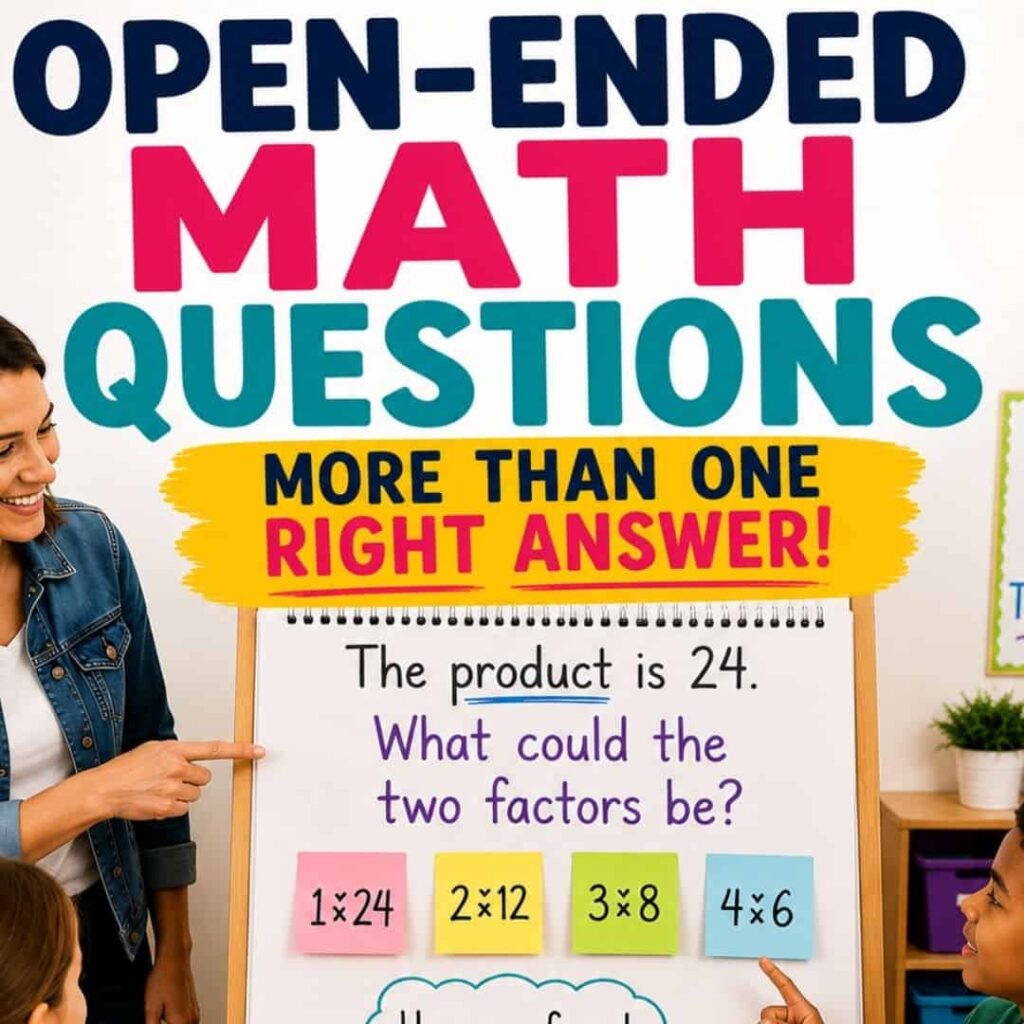
If you want more ways to get students reasoning out loud, my post on open-ended math questions pairs naturally with this.
Build a Math Word Wall
A math word wall keeps vocabulary visible, but most teachers leave every word up all year until it becomes wallpaper students stop seeing. Rotate the wall by unit instead. Put up the ten or twelve words students need right now, with a picture or example beside each, and swap them when you move to the next topic. A smaller, current wall gets used far more than a crowded one. For geometry units, an anchor chart of the shape vocabulary works alongside the wall.
My shapes anchor chart post shows how to set one up for terms like right angle, regular polygon, and isosceles triangle.
Teach Formal vs. Informal Math Language
Students arrive with informal math words, and the goal is not to replace them but to connect them to the formal terms they will see on assessments. Make the link explicit with a simple comparison:
| Informal phrase | Formal math term |
|---|---|
| take away | subtract |
| how many altogether | sum |
| times | multiply |
| split into groups | divide |
| the answer | sum, difference, product, or quotient |
| flat shape | two-dimensional figure |
Showing both columns tells students their everyday language is valid while making clear that the formal term is what a test or a word problem will use. This same move of naming the precise term pays off in word problems, where a single keyword signals the operation. My post on multiplication keywords for word problems goes deeper on that, and teaching generalizations in math is a related academic-language skill worth building alongside vocabulary. (Swap in exact slugs before publishing.)
Frequently Asked Questions About Math Vocabulary
Building Strong Math Vocabulary All Year
Math vocabulary is not a single lesson. Teach it explicitly, use it in context, and review it throughout the year, the same way you would treat reading vocabulary. Print the grade-level lists above as a reference sheet or a word wall starter, pull the terms your current unit needs, and keep the language alive through sentence frames and math talk. For a standards-aligned reference on the exact terms expected at each grade, the Common Core math glossary is a reliable source to check against.
If you want to keep building academic math language, a few related posts go deeper: fractions on a number line reinforces the third and fourth grade fraction vocabulary with a hands-on approach, multiplication keywords extends this vocabulary into word problems, and open-ended math questions give students a reason to use the words out loud. Teach the vocabulary with the same care you give the math itself, and your students will not just get the right answer. They will be able to tell you how they got there. (Swap in exact slugs before publishing.)
Jessica BOschen
Jessica is a teacher, homeschool parent, and entrepreneur. She shares her passion for teaching and education on What I Have Learned. Jessica has 16 years of experience teaching elementary school and currently homeschools her two middle and high school boys. She enjoys scaffolding learning for students, focusing on helping our most challenging learners achieve success in all academic areas.