
Open-Ended Math Questions: How to Use Them in Grades 3-5
The first time I put an open-ended math question on the board for my third graders, half the class sat frozen. They kept asking, “But what’s the answer?” They had spent years being trained to hunt for the one right number, and a problem with dozens of correct answers felt like a trap.
Within a few weeks, those same students were arguing about strategies and defending their thinking, and I could finally see how each of them actually understood the math. If you teach grades 3 through 5 and want a simple way to build reasoning, reach every learner, and uncover what students really know, open-ended math questions are one of the most useful tools you can add to your math block.
What Are Open-Ended Math Questions?
An open-ended math question is a problem that has more than one correct answer, more than one path to get there, or both. Instead of asking students to compute a single solution, it asks them to make choices, test ideas, and explain their reasoning. The math is still rigorous, but the focus shifts from getting the answer to showing how you think.
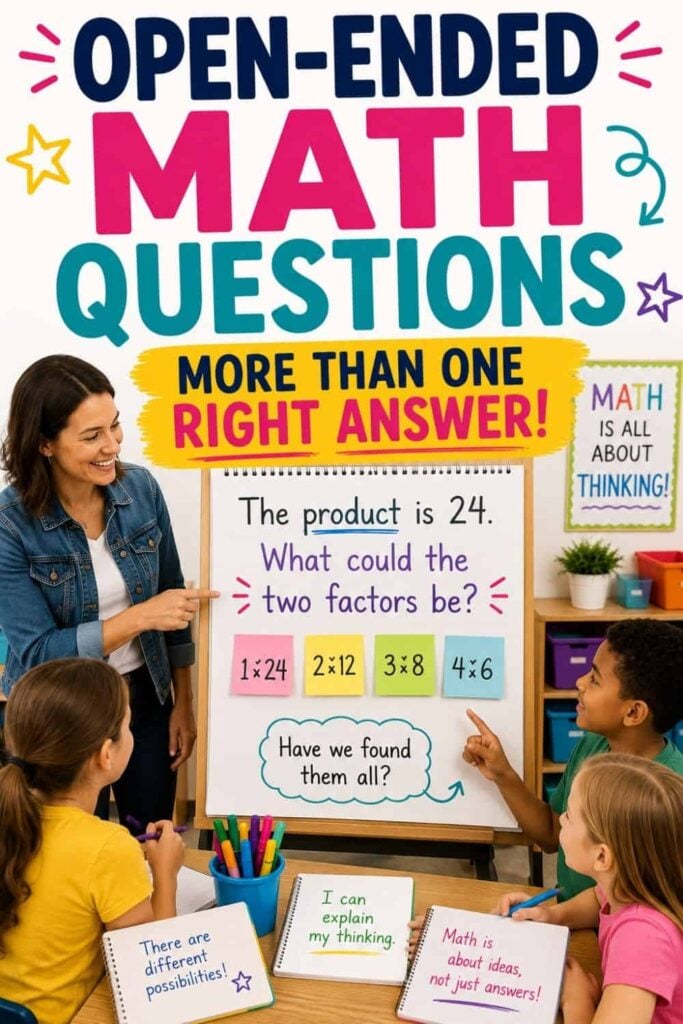
Here is the difference in action. A closed question asks, “What is 6 x 4?” An open-ended version asks, “The product is 24. What could the two factors be, and how many pairs can you find?” One has a single answer. The other has several, and it pushes students to think about factors, patterns, and how to know when they have found them all.
Open-Ended vs. Closed Math Questions
Closed questions have an important place. Students need fluency, and they need practice with procedures that lead to one correct answer. The problem is when that is the only kind of math students ever see. A steady diet of closed problems rewards speed and memorization, and it hides the students who got the right answer for the wrong reason.
Open-ended questions change the experience in a few key ways:
- They have multiple correct answers, so students cannot simply copy a memorized procedure.
- They invite more than one strategy, which makes student thinking visible.
- They are naturally differentiated, because a student can answer at their own level and still be correct.
- They shift the focus from the answer to the reasoning behind it.
This is the same reason I am a believer in teaching students more than one way to solve a problem. When students have a toolbox of strategies and the confidence to choose one, they become flexible thinkers. If you want to dig into that idea, I wrote more about it in why I teach students multiple strategies to solve math problems.
Why Use Open-Ended Math Questions?
The biggest reason I keep coming back to open-ended math questions is that they tell me the truth about my students. When a problem has one answer, a correct response tells me almost nothing about how a student got there. When a problem has many answers and asks for reasoning, I can see the whole picture: what they understand, where the misconceptions are, and which students are ready for more.
A few more reasons they earn their place in the math block:
- They reach every student. A struggling fourth grader and a student ready for a challenge can work the same problem and both feel successful.
- They build math language. Explaining and defending an answer forces students to use vocabulary precisely.
- They work as a formative assessment. One good open-ended question can replace a worksheet for showing you what students know.
- They build confidence. Reluctant students are far more willing to start a problem when there is no single answer to get wrong.
How to Write Open-Ended Math Questions
You do not need a special curriculum to start. The fastest way to write open-ended math questions is to take the closed problems already in your materials and open them up. Here are three reliable methods.
1. Reverse a Closed Question
Take a closed question and give students the answer instead of the problem. A closed question asks, “What is 248 + 175?” Reverse it: “The sum of two numbers is 423. What could the two numbers be?” Now students have to reason about place value and combinations instead of running one procedure. You can raise the floor or ceiling by adding a constraint, such as “and both numbers must be greater than 100.”
2. Ask Students to Prove or Justify Their Thinking
Start the question with a word like prove, show, explain, or describe. “Show three different ways to represent 3/4.” “Explain why 0.5 and 1/2 are equal.” These questions have one underlying truth but many valid ways to demonstrate it, which is exactly the kind of flexible thinking you want in grades 3 through 5.
3. Ask Students to Compare Two Concepts
Choose two ideas from your current unit and ask students to find similarities and differences. “How is a rectangle different from a rhombus?” “How are 2/3 and 4/6 the same?” Comparison questions surface the connections between concepts, and they tend to produce rich classroom discussion because students notice different things.
Open-Ended Math Question Examples for Grades 3-5
The examples below are ready to use or adapt. Notice how each one ties to a standard upper-elementary topic while leaving room for multiple answers and strategies.
- Place value and rounding: A number rounds to 500 when rounded to the nearest hundred. What could the number be? List as many as you can.
- Multiplication: The product is 36. What could the two factors be? How do you know you have found them all?
- Division: You have 48 markers to share into equal groups. What are all the ways you could group them?
- Fractions: Two fractions add up to a number greater than 1 but less than 2. What could the two fractions be?
- Measurement and area: A rectangle has an area of 24 square units. What could its length and width be, and which rectangle has the smallest perimeter?
- Data and averages (grade 5): The mean of four test scores is 85. What could the four scores be?
These look a lot like word problems, and that is on purpose. The same habits that help students with traditional word problems, like reading carefully and thinking about the situation instead of grabbing at keywords, apply here too. If word problems are a focus in your classroom, my guide to word problems in math pairs well with this work.
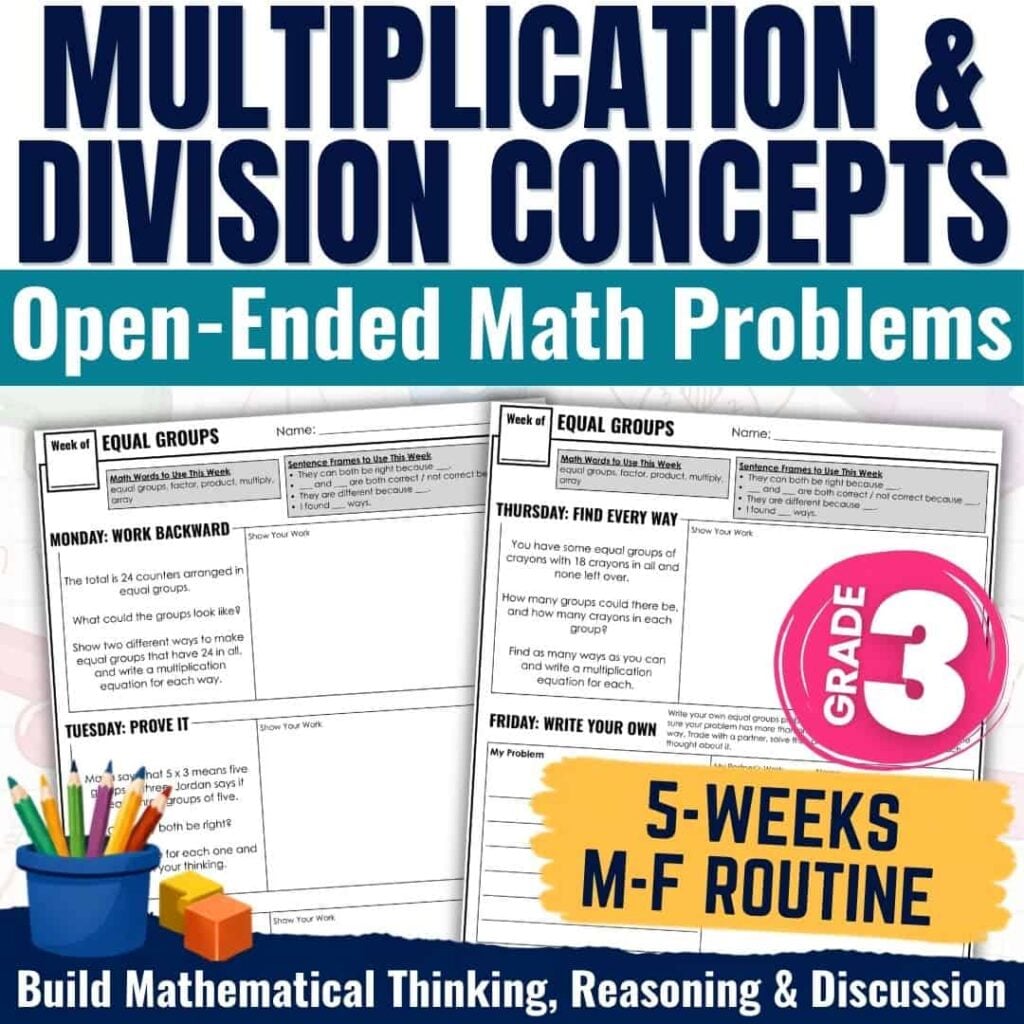
Looking for some done-for-you open-ended math problems? Get them here.
How to Use Open-Ended Math Questions in Your Math Block
You do not need to overhaul your schedule to fit these in. One or two open-ended questions a week is plenty to start. A few ways they fit naturally:
- As a warm-up. Put a question on the board, give students quiet think time, then have them share strategies with a partner before a whole-group discussion.
- As a math center. Open-ended tasks are ideal for stations because students cannot race through them, and they stay productive the whole rotation.
- For early finishers. A student who finishes independent work can always go deeper on an open-ended question rather than waiting.
- As a unit check. Use one at the end of a unit to see how flexibly students can apply what they learned.
Whatever the setting, protect time for students to share. The conversation is where the learning happens. When a student hears that a classmate solved the problem a different way, it stretches their own thinking more than any worksheet can.
How to Assess Open-Ended Math Questions
Grading is the part that worries most teachers, because there is no answer key. If you are using the question as a formative check, you do not need to grade it at all. Read the responses, note who is secure and who needs support, and adjust your next lesson. That is the highest-value use of these tasks.
If you do need a grade, use a simple rubric that scores the things you actually care about: Is the math accurate? Did the student use a workable strategy? Did they explain or justify their thinking? Share the rubric with students ahead of time so they know that a complete, well-reasoned answer matters more than a fast one. Reasoning, not speed, is the point.
Frequently Asked Questions
Final Thoughts
Open-ended math questions take a small shift to start and pay you back quickly. Try reversing one closed problem from your next lesson and giving students the room to reason through it. You will learn more about your mathematicians in ten minutes than a stack of worksheets could tell you, and your students will start to see themselves as thinkers, not just answer-getters. For more on building that kind of flexible problem solver, the National Council of Teachers of Mathematics has helpful guidance on putting reasoning and problem solving at the center of math instruction.
Jessica BOschen
Jessica is a teacher, homeschool parent, and entrepreneur. She shares her passion for teaching and education on What I Have Learned. Jessica has 16 years of experience teaching elementary school and currently homeschools her two middle and high school boys. She enjoys scaffolding learning for students, focusing on helping our most challenging learners achieve success in all academic areas.