
Generalizations in Math: Examples and Teaching Strategies
When I taught third grade, we spent a lot of time noticing what was always true about numbers, not just what happened with one example, but the rule underneath the pattern. That work of noticing, naming, and testing is what a math generalization is: a statement that describes a pattern that holds every time, not just sometimes.
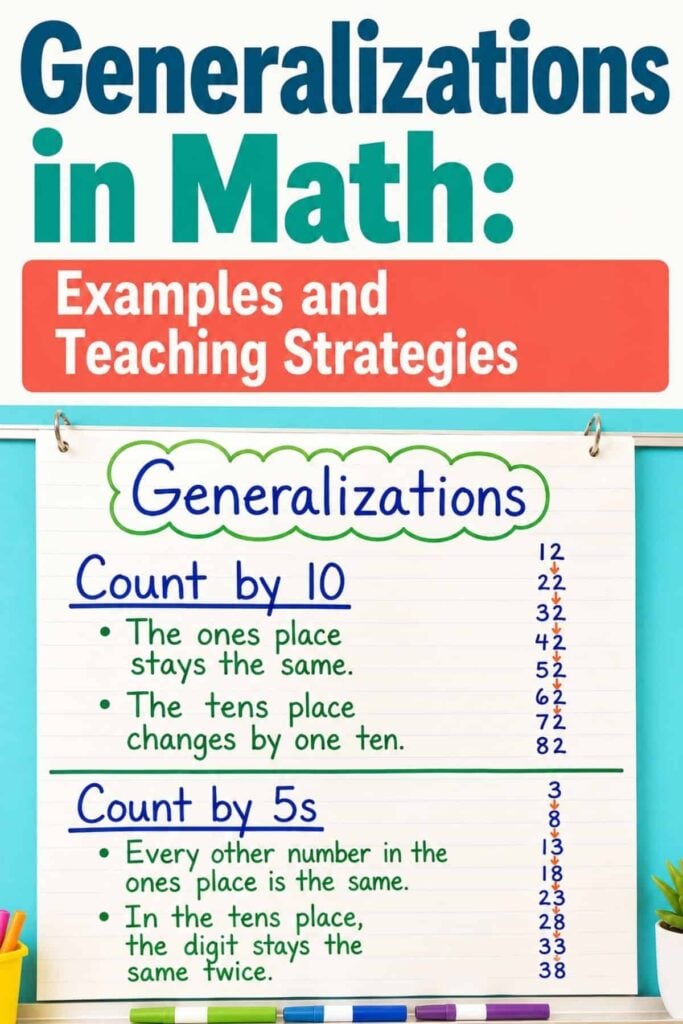
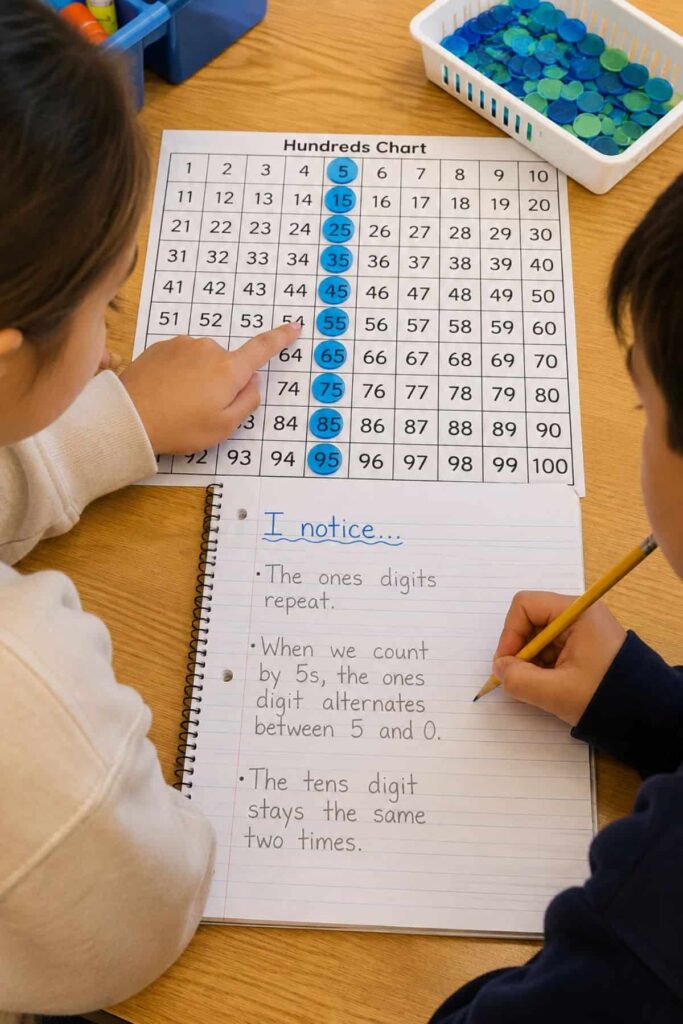
Teachers build generalizations into instruction all the time without labeling them as such. When first graders look at a hundreds chart and discover that moving down one row always adds ten, they are making a generalization. When second graders count by 5s and notice that the ones digit alternates between 0 and 5, they are making a generalization. The concept runs through elementary math, from kindergarten counting routines to the relationships between multiplication and division in the upper grades.
What Is a Generalization in Math?
A math generalization is a rule about a pattern that is always true for any number that fits the situation.
The key word is always. Students can notice that 5, 10, 15, 20 “go by fives” without being able to say what is actually staying the same or changing. A generalization requires going further: stating the rule precisely enough that someone could apply it to a new number without having seen it before.
“The ones digit is always 0 or 5 when you count by 5s” is a generalization. It is precise, testable, always true. “They skip” is an observation, not a generalization.
Teaching students to cross that line is the real work.
Classroom Example: Counting by 10
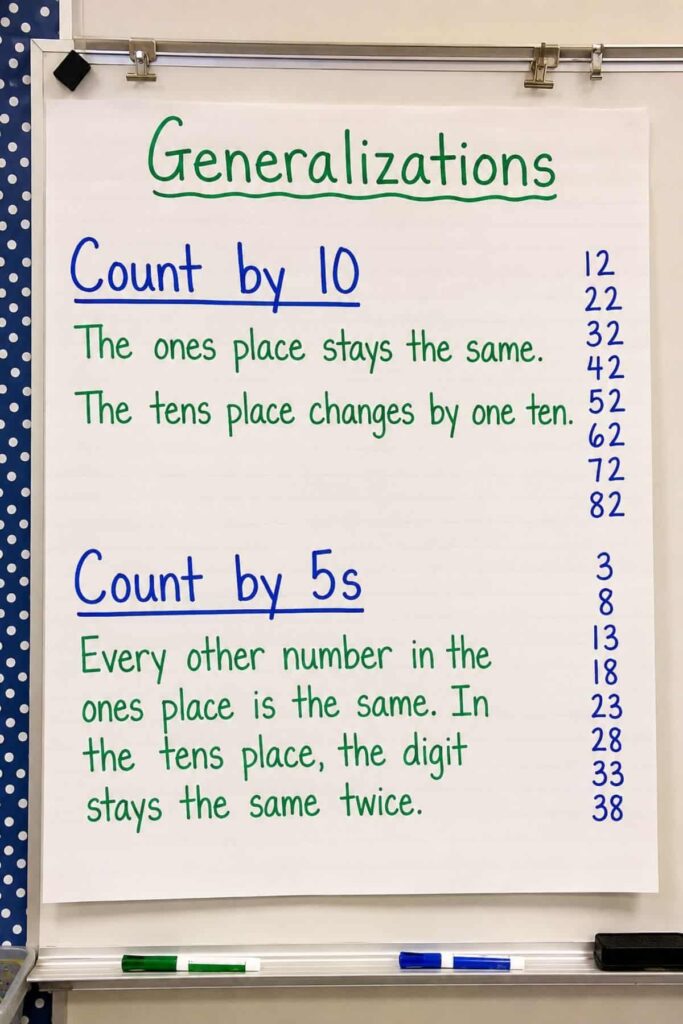
Here is a generalization anchor chart my third graders made after several days of counting by 10s from different starting points:
Count by 10 The ones place stays the same. The tens place changes by one ten.
We built toward this by counting forward by 10 starting from non-round numbers: 12, 22, 32, 42… or 7, 17, 27, 37. After a few rounds on different days, students started to see that no matter where you started, the ones digit never moved. That observation became a generalization they could state, test, and apply to numbers they had never counted before.
The process matters as much as the outcome. We did the counting routine first, then discussed what stayed constant and what changed. The generalization came from the conversation, written in their language, not mine.
Classroom Example: Counting by 5s
Counting by 5s from a non-zero starting number is harder, and the generalization is more complex.
Count by 5s: Every other number in the ones place is the same. In the tens place, the digit stays the same twice.
When we counted from 3: 3, 8, 13, 18, 23, 28… students could see the ones digits alternating (3, 8, 3, 8…) but describing what was happening in the tens place required more careful language. Some students noticed it quickly. Others needed a nudge to focus on the tens digit in isolation rather than the whole number.
One student said “the tens place changes by one” when talking about counting by 10s. She was on the right track but hadn’t yet captured that the digit repeats before it increases. That is a useful moment: acknowledge the mathematical thinking (“you are noticing something real about the tens place”) and then press on the precision (“does it change right away, or does something happen first?”). The goal is not to give them the generalization. It is to help them get there with language precise enough to be true.
How to Build the Generalization Routine
The routine that worked well in my classroom followed a consistent sequence.
Start with counting. Do the counting routine orally for several days before asking for any written generalization. Students need enough examples to see a pattern. One round of counting by 10s is not enough to generalize from.
Move to discussion. Ask: “What do you notice? What is always true? What would happen if we started at a different number?” These questions push students from observation to rule-making. “It goes up by ten” is an observation. “The ones place never changes” is a generalization.
Write it together. When students have articulated a generalization in discussion, write it down using their language as much as possible. The anchor chart does not need formal mathematical vocabulary — it needs to be accurate and precise enough to test. “The ones place stays the same” is clearer for a third grader than “the ones digit is invariant.”
Test it. Have students apply the generalization to new numbers. If we said the ones place stays the same when counting by 10, does that hold when we start at 47? At 83? At 129? Testing helps students understand that a generalization is a rule, not just a description of examples they have already seen.
Where Generalizations Show Up Beyond Skip Counting
Once students have the idea, they start to notice generalizations across math topics.
Multiplication is rich with them: any number multiplied by zero is zero, any number multiplied by one stays the same, an even number times any whole number is always even. These feel like facts students memorize, but they can be discovered through examples and stated as generalizations — which makes them more durable than rules handed down from the teacher.
Addition has them too: changing the order of the addends does not change the sum. Any number plus zero stays the same. These become more interesting to students when they are arrived at through investigation rather than announced.
If you are working on number relationships and want a structured way for students to explore and generalize about multiplication and division, third grade number puzzles are built around exactly this kind of noticing. Students work with related sets of equations and look for what is always true about the relationship between the numbers.
The ability to make a generalization, to move from “I see what happened this time” to “here is what will always be true,” is mathematical thinking at its best. It is also something students can do more readily than we expect, as long as they have enough examples to work from and enough time to talk through what they are noticing.

THANK YOU VERY MUCH
Not only small kiddos, big kiddos too. 32 years old and counting. Great help for someone that studies maths later in his life.
Thank you so much. Montreal.