
Your students can define a prefix on a worksheet, but the real test comes when they hit a long, unfamiliar word in the middle of a science article and have to keep reading. That gap is what morphology reading passages are built to close.
Instead of practicing word parts on an isolated list, students meet them in real text, where they can combine a root’s meaning with the surrounding clues to unlock a word they have never been taught.
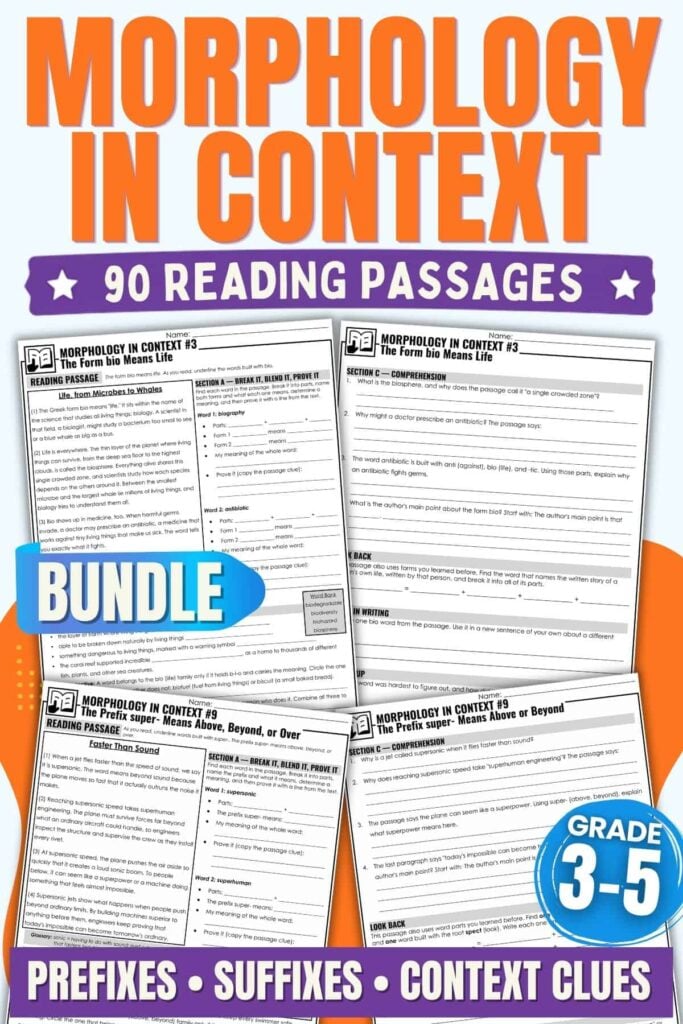
This post explains what teaching morphology in context looks like, why reading passages work so well for decoding multisyllabic words, and how to use them across grades 3 through 5.
What Are Morphology Reading Passages?
Morphology reading passages are short readings written so that a target word part shows up naturally several times. Students read the passage, spot the words built from that part, and use the meaning of the part plus the context to figure out what each word means. A passage focused on the root port might include transport, import, and portable, so students see the same meaning of “carry” surface again and again in a real context.
This is different from teaching word parts on a list. A list builds recognition, but a passage builds transfer- the ability to actually use word parts while reading. If you want the foundation behind why this matters, my post on what is morphology explains how word parts support reading.
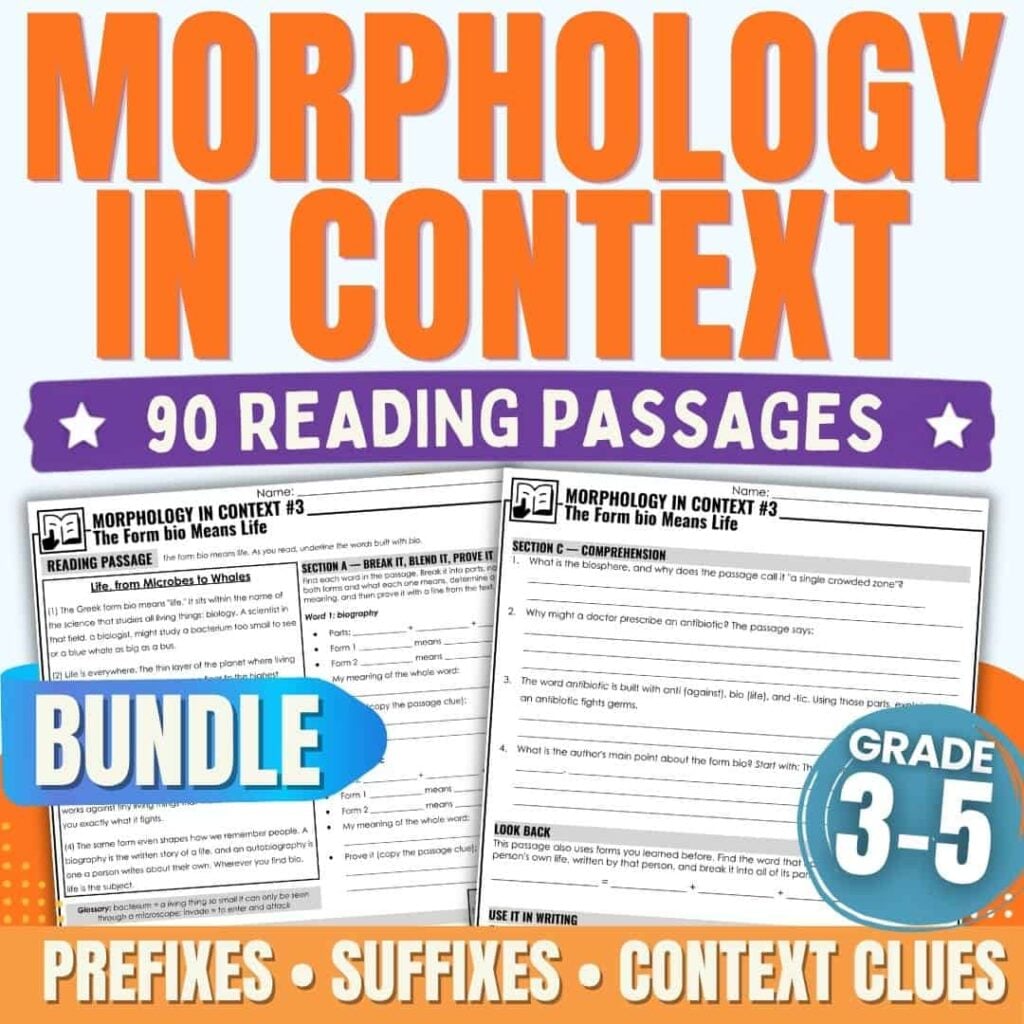
Morphology Morning in Context | 3rd–5th Grade Prefixes, Suffixes & Roots
Build stronger vocabulary and word-analysis skills with this 3rd–5th grade morphology morning work bundle featuring 90 passage-based activities. Students practice prefixes, suffixes, Greek and Latin roots, morphemes, vocabulary, reading comprehension, and using context clues to determine meaning as they learn to break apart unfamiliar words and use text evidence to confirm meaning.
Why Teach Morphology in Context?
Reading passages solve the biggest problem with word-part instruction: transfer. Students often ace a prefix quiz and then freeze at the same prefix inside a paragraph. Teaching morphology in context fixes that in a few ways:
- It builds real decoding of multisyllabic words. Long words feel less overwhelming when students break them into a known part plus the rest, right where they meet them.
- It combines two strategies. Students learn to use the word part and the surrounding context together, which is how strong readers actually figure out unfamiliar words.
- It supports comprehension. Because the practice happens within a reading with comprehension questions, students build understanding, not just word skills.
- It aligns to the standards. Using roots, affixes, and context to determine word meaning is exactly what the Common Core language standards ask for in grades 3 through 5.
Reading Rockets offers helpful background on how roots and affixes support reading, and passages are how you move that knowledge into practice.
How to Use Morphology Reading Passages
Each passage works as a short, self-contained routine you can drop into your week:
- Name the word part first. Tell students the focus part and its meaning before they read, so they know what to watch for.
- Read and underline. As students read, they underline every word built from that part. This trains their eyes to spot the part inside longer words.
- Combine part plus context. For each underlined word, students use the part’s meaning and the clues in the sentence to define it.
- Answer comprehension questions. A few questions check that students understood the passage, tying the word work back to meaning.
Because each passage names its focus and stands on its own, you can pull whichever one matches the part you are teaching that week. They work as morning work, a reading warm-up, a small-group text, or independent practice.
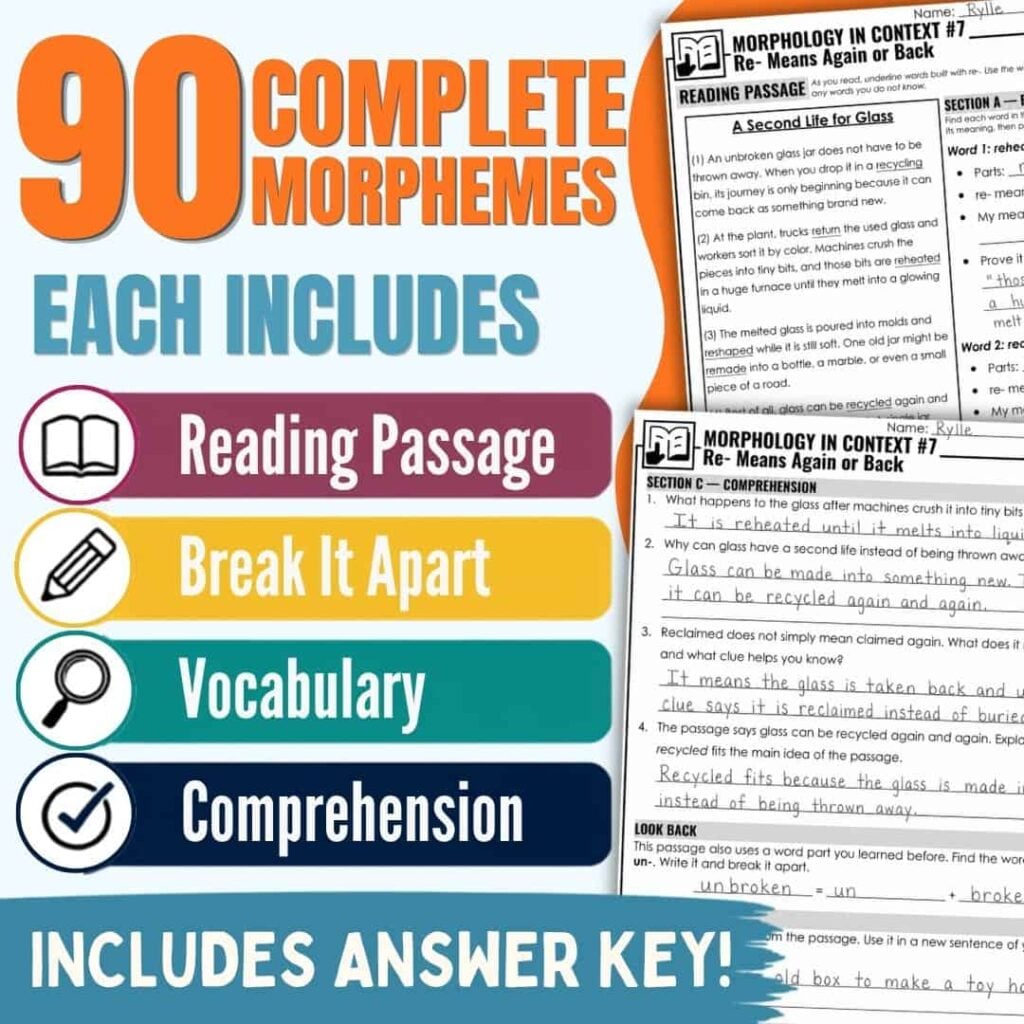
What Morphology Reading Passages Cover by Grade
The word parts build in difficulty across the grades, moving from familiar endings to true academic roots:
- 3rd grade: Starts with a review of inflectional endings like -s, -es, and -ed, then moves through the most common prefixes and suffixes, so students build confidence with word parts they partly know.
- 4th grade: Introduces academic roots and affixes like trans-, -tion, port, struct, inter-, and rupt, the parts that power content-area vocabulary.
- 5th grade: Takes on Greek combining forms like auto-, graph, bio, -ology, geo, tele, and scope, aligned to the 5th grade language standards and the science words students meet everywhere.
For the full list of the highest-value roots and which to teach when, see my common Latin and Greek roots post.
Morphology in Context: A Quick Example
Here is what the thinking looks like in action. Say a passage focuses on the root port, which means carry, and includes this line:
“The workers loaded the crates onto the truck so they could transport them to the port, where a ship would carry the portable containers across the ocean.”
A student underlines transport, port, and portable, then reasons through each one: transport has trans (across) plus port (carry), so it means to carry across, and the sentence about loading a truck confirms it. Portable is port plus -able (able to be), something able to be carried, and “carry the containers” is right there as a clue. The student never needed a definition. They combined the word part with the context and unlocked the word themselves, which is exactly the skill that carries over to independent reading.
How to Decode a Multisyllabic Word
Give students a simple routine for the long words that stop them cold. It turns an intimidating string of letters into a few manageable pieces:
- Find a part you know. Look for a prefix, suffix, or root you recognize, like bio in biography.
- Chunk the rest. Break the remaining letters into smaller, readable pieces.
- Blend it together. Read the parts in a row to say the whole word.
- Check the meaning. Put the part’s meaning with the context and ask whether the word makes sense in the sentence.
Practicing this routine inside a passage, rather than on a word list, is what trains students to reach for it on their own the next time they meet a big unfamiliar word.
Before students meet these word parts in a passage, it helps to build the words directly. My root word worksheets give them that hands-on practice first.
Supporting Striving Readers and Multilingual Learners
Morphology reading passages are a strong scaffold for the students who need the most support, because a known word part gives them a foothold in a hard word instead of a wall. A few ways to lean into that:
- Pre-teach the part. Introduce the word part and its meaning before students read, so they walk in already holding the key.
- Read it aloud first. A quick read-aloud of the passage lets students focus on the word work without the added load of decoding every other word.
- Use the glossary and prompts. Built-in glossaries and underline prompts keep the task focused and reduce overwhelm.
- Connect to cognates. Many Latin and Greek roots appear in Spanish and other languages, so a multilingual student who knows familia already has a bridge to familiar.
Because so many roots power the vocabulary of science and social studies, this work pays off well beyond the reading block. My post on how to teach science vocabulary activities shows how word parts help students tackle content-area terms.
Where Reading Passages Fit in Your Morphology Routine
Morphology reading passages are the application step in a bigger routine. A strong sequence looks like this: introduce a word part through a short daily warm-up, keep it visible on a word wall, practice it with games, and then apply it in a reading passage where students use it to unlock real words. Each piece reinforces the others:
- My morphology morning work introduces one part at a time in a daily routine.
- My morphology word wall keeps the parts posted and active.
- My Greek and Latin root word games give students playful review.
- These reading passages are where students put it all to work in real text.
Frequently Asked Questions
Morphology Morning in Context | 3rd–5th Grade Prefixes, Suffixes & Roots
Build stronger vocabulary and word-analysis skills with this 3rd–5th grade morphology morning work bundle featuring 90 passage-based activities. Students practice prefixes, suffixes, Greek and Latin roots, morphemes, vocabulary, reading comprehension,…
Bringing It All Together
Word parts only pay off when students can use them in real reading. Morphology reading passages give students that practice, combining a target part with context so they can decode unfamiliar multisyllabic words on their own. Pair them with a daily routine, a word wall, and a little game-based review, and students move from recognizing parts to actually reading with them.
Want it ready to teach? My Morphology in Context reading passages give you 30 short passages for 3rd, 4th, and 5th grade, each focused on a word part students underline, define in context, and use to answer comprehension questions, aligned to grade-level language standards.
Jessica BOschen
Jessica is a teacher, homeschool parent, and entrepreneur. She shares her passion for teaching and education on What I Have Learned. Jessica has 16 years of experience teaching elementary school and currently homeschools her two middle and high school boys. She enjoys scaffolding learning for students, focusing on helping our most challenging learners achieve success in all academic areas.