
Morphology Morning in Context | 3rd–5th Grade Prefixes, Suffixes & Roots
$27.30
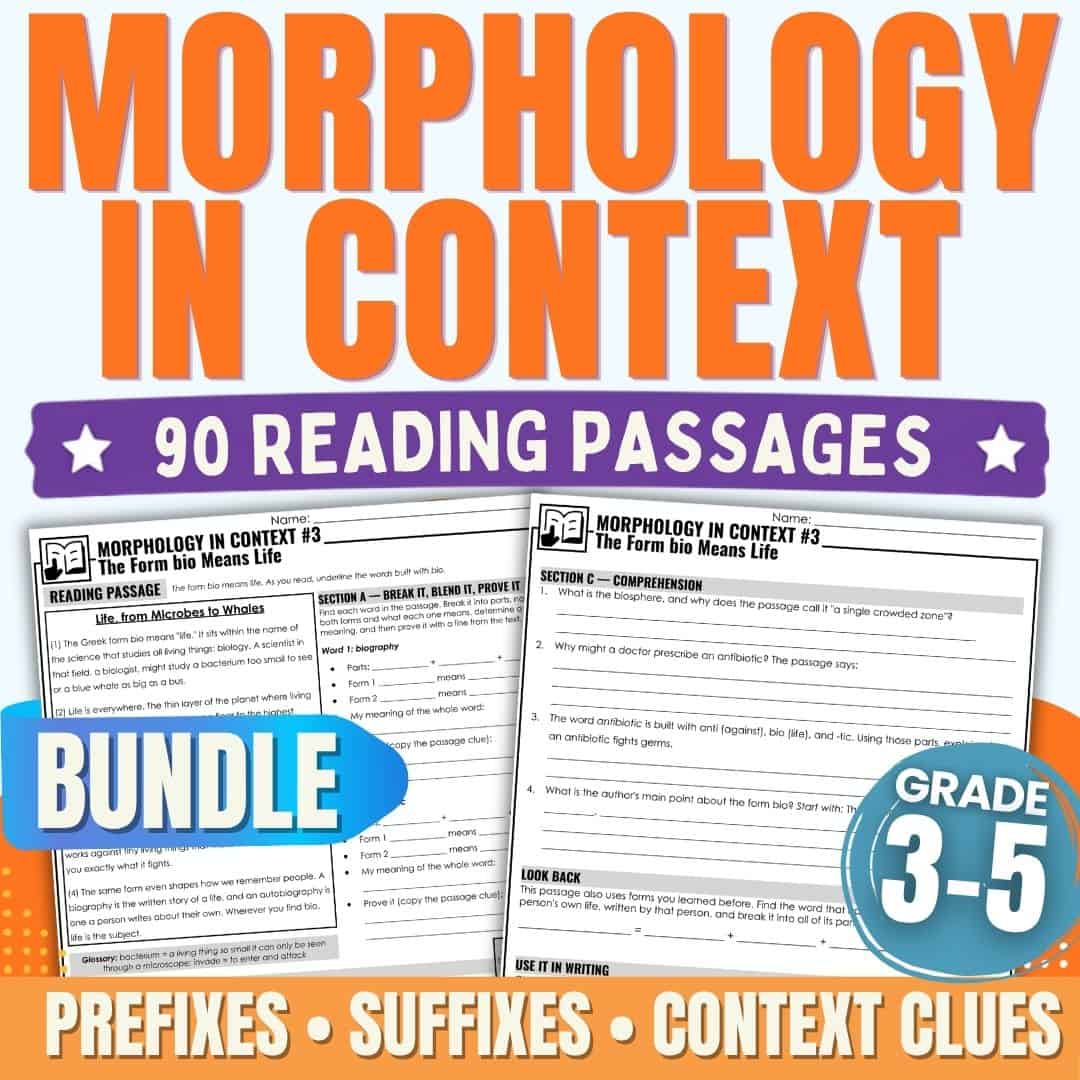
Build stronger vocabulary and word-analysis skills with this 3rd–5th grade morphology morning work bundle featuring 90 passage-based activities. Students practice prefixes, suffixes, Greek and Latin roots, morphemes, vocabulary, reading comprehension, and using context clues to determine meaning as they learn to break apart unfamiliar words and use text evidence to confirm meaning.
Help students stop guessing at unfamiliar words and start breaking them apart, analyzing meaningful word parts, and using context to determine meaning.
This 3rd–5th grade morphology morning work bundle includes 90 passage-based morphology activities designed to build vocabulary, word analysis, and reading comprehension across upper elementary grades.
Students practice prefixes, suffixes, roots, base words, inflectional endings, Greek and Latin forms, and context clues through a consistent routine that asks them to Break It, Blend It, and Prove It. Instead of studying word parts only in isolation, students apply morphology strategies within engaging reading passages and use text evidence to confirm their thinking.
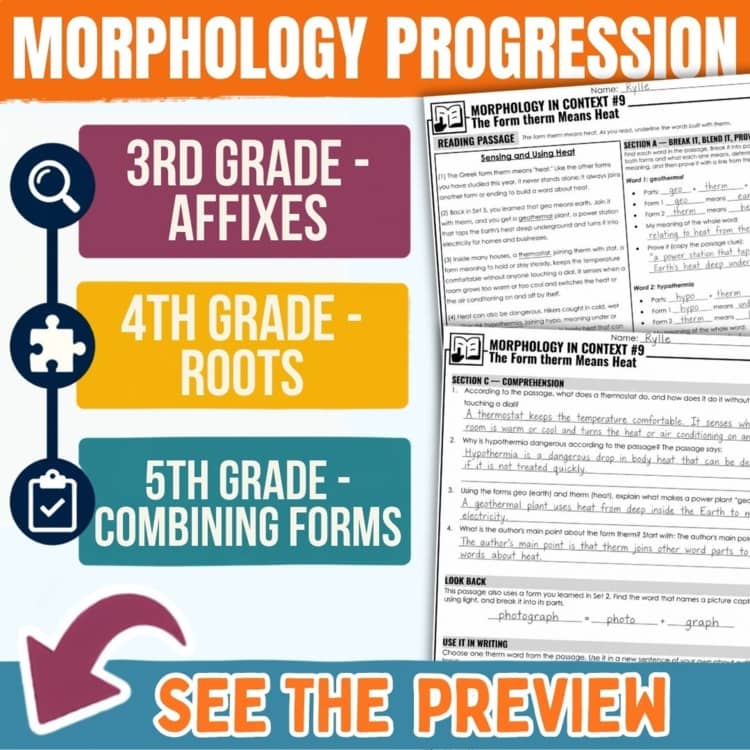
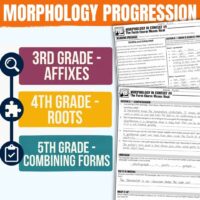
The bundle provides a purposeful progression from foundational morphology skills in third grade to increasingly complex Greek and Latin word analysis in fifth grade, helping students develop strategies they can transfer to words they have never been directly taught.
What’s Included
- 3 complete morphology resources for grades 3, 4, and 5
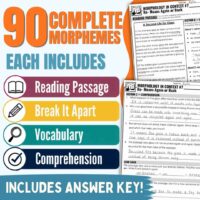
- 90 total passage-based word study sets
- 30 third grade sets
- 30 fourth grade sets
- 30 fifth grade sets
- Short reading passages that place target morphemes and vocabulary in meaningful context
- Informational topics connected to science, social studies, nature, technology, history, and other content areas
- Brief glossaries for challenging content vocabulary without giving away target-word meanings
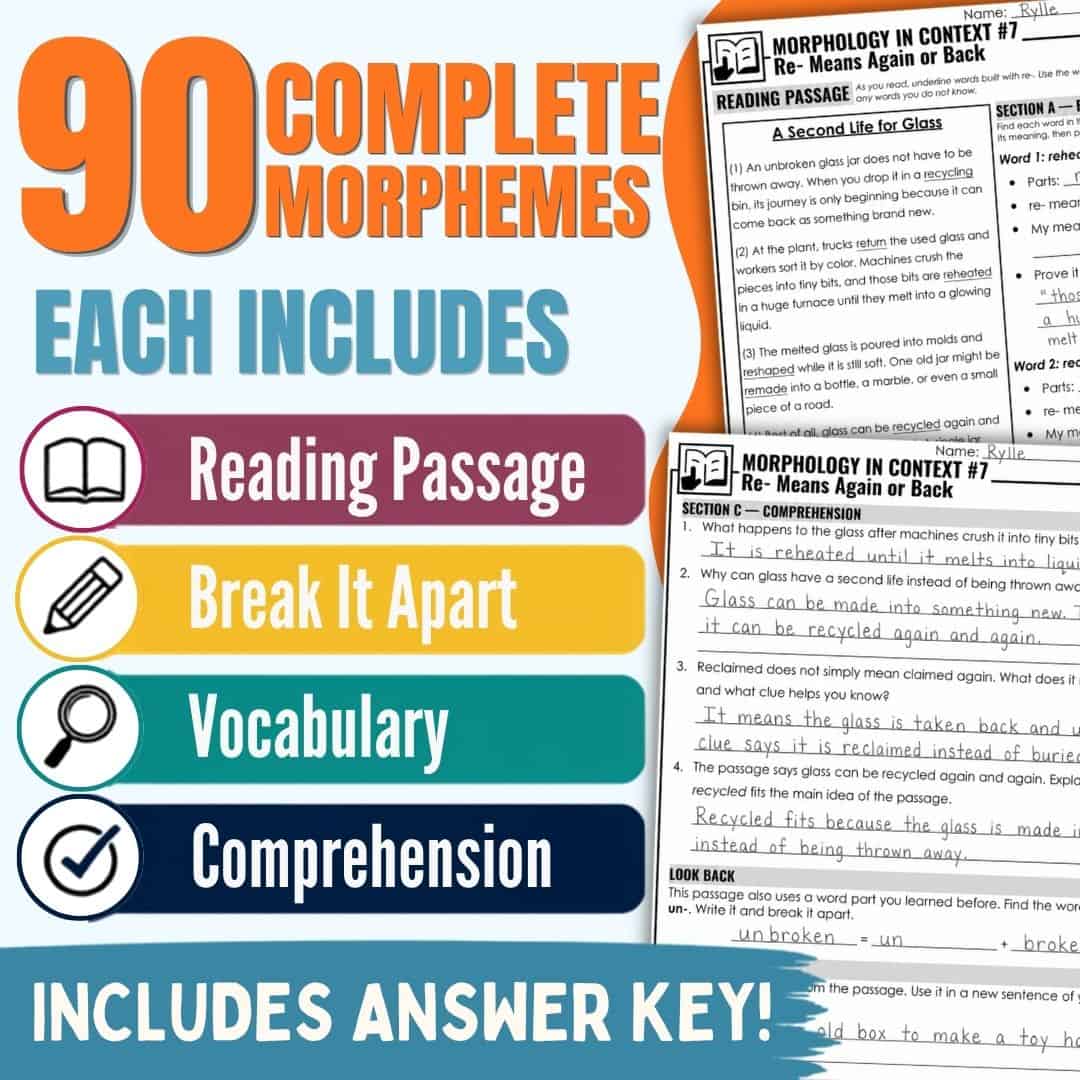
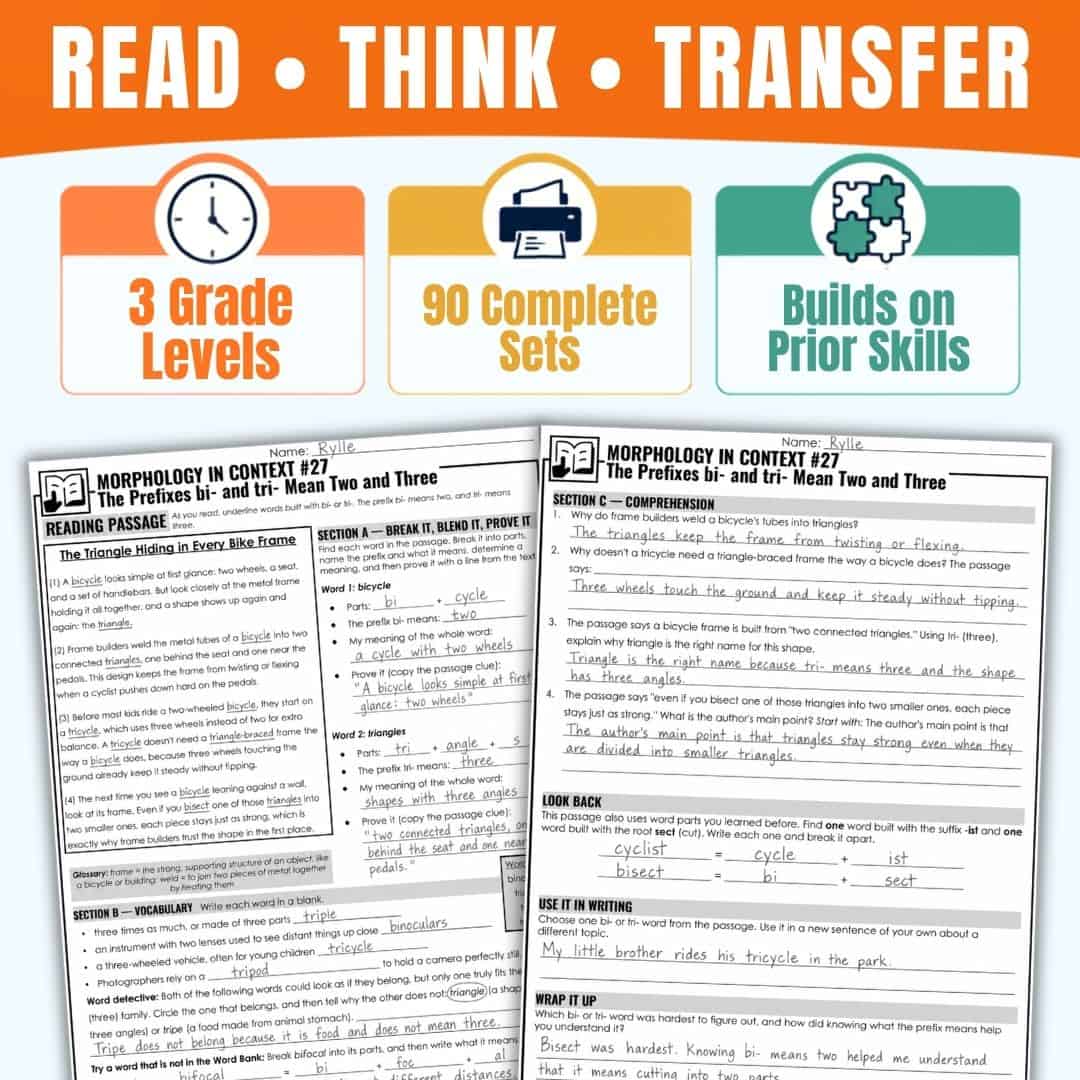
- Break It, Blend It, Prove It word-analysis activities
- Vocabulary practice using word banks, word families, and new contexts
- Transfer tasks requiring students to apply known word parts to unfamiliar words
- Reading comprehension questions
- Inference and short constructed-response practice
- Spiral review of previously taught morphemes
- Vocabulary application in writing
- Student reflection prompts
- Complete answer keys with word breakdowns, model responses, and guidance for open-ended questions
- Cumulative review opportunities in the upper-grade resources
Skills Covered
Students practice:
- Identifying prefixes, suffixes, roots, base words, and inflectional endings
- Breaking unfamiliar and multisyllabic words into meaningful morphemes
- Using known word parts to determine word meaning
- Using context clues to determine meaning
- Combining morphology knowledge with passage context
- Analyzing Greek and Latin roots and combining forms
- Recognizing related words within word families
- Distinguishing true morphological relationships from look-alike words
- Predicting meanings of unfamiliar vocabulary
- Applying known morphemes to new words
- Supporting word meaning with text evidence
- Reading informational passages for understanding
- Answering literal and inferential comprehension questions
- Responding to constructed-response questions
- Applying new vocabulary in writing
- Reviewing previously learned word parts for long-term retention
A Progressive Grade 3–5 Morphology Sequence
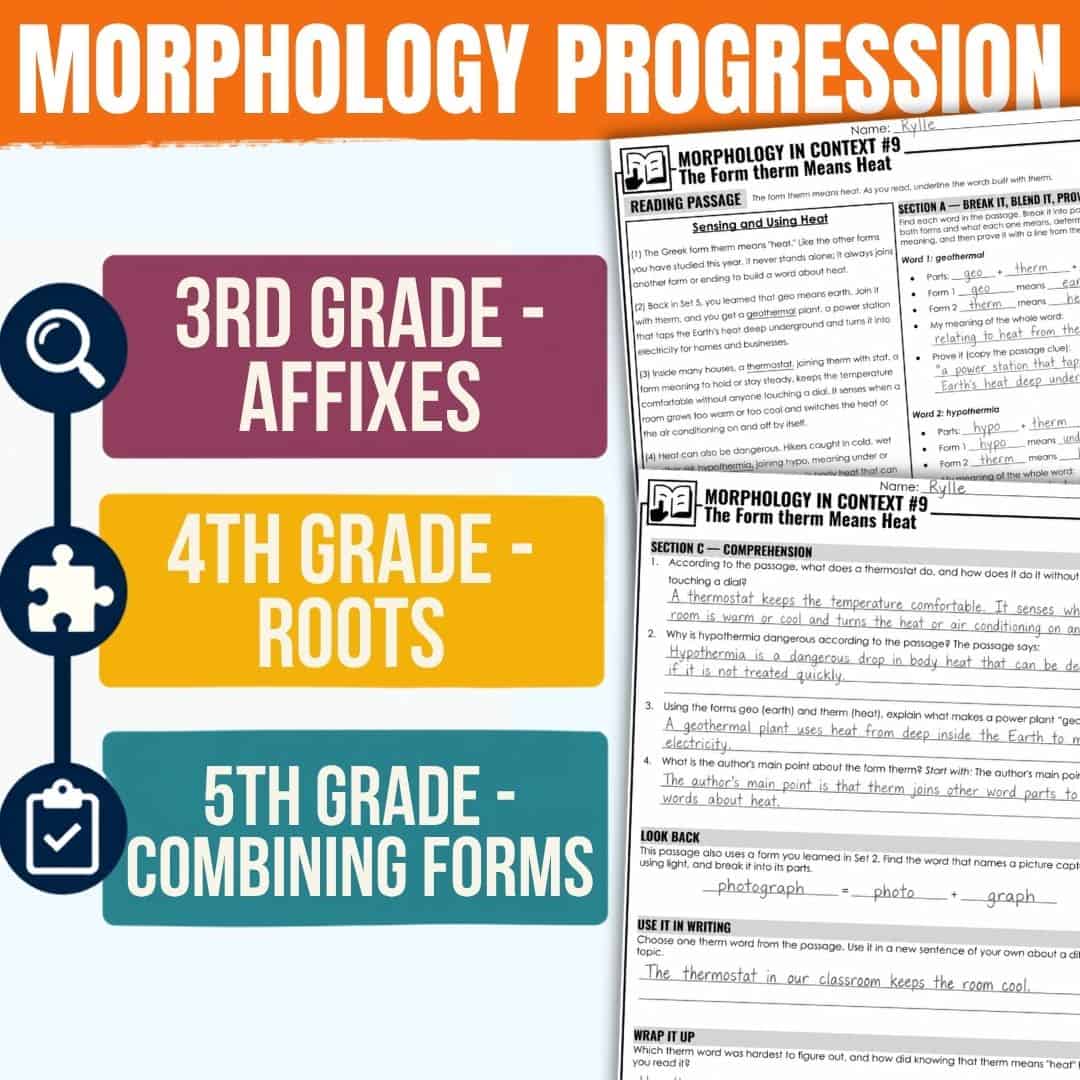
Grade 3: Build the Foundation
Third graders begin with familiar base words and explore how common endings, prefixes, and suffixes affect meaning.
The 30 sets include practice with:
-s/-es, -ed, -ing, -er/-est, un-, -ful, re-, -less, dis-, -ly, pre-, -y, mis-, -er/-or, non-, -ness, in-/im-, -ment, over-, -able/-ible, under-, -en, mid-, -ish, sub-, -ion/-tion, fore-, -ous, de-, and semi-.
Students repeatedly break words into parts, combine the meanings of those parts, and use evidence from the passage to confirm their thinking.
Grade 4: Move Into Roots and Complex Words
Fourth graders progress into bound roots, additional affixes, and longer multisyllabic words.
Word parts include prefixes such as:
- trans-
- inter-
- super-
- multi-
- anti-
- pro-
- post-
- bi-/tri-
Students also work with suffixes such as -ion/-tion, -ive, -ist, -al, -ic, and -ous and roots including:
port, struct, rupt, spect/spec, tract, dict, form, graph, phon, aud, ject, scrib/script, sect, migr, and mot/mov
This level helps students become more flexible when analyzing words made from multiple meaningful parts.
Grade 5: Advanced Greek and Latin Word Analysis
Fifth graders apply morphology strategies to increasingly complex vocabulary and Greek and Latin combining forms.
The sequence includes:
auto-, graph, bio, -ology, geo, tele, scope, micro-, therm, meter, -ism/-ist, astr/aster, macro-/mega-, hydr, circum-, aqua, -ive/-ative, vis/vid, chron, poly-, fract/frag, mal-, flex/flect, ab-, manu, cred, spir, terra, and mar/mer
Cumulative review gives students additional opportunities to combine previously learned word parts and apply their knowledge to unfamiliar vocabulary.
The Break It, Blend It, Prove It Routine
A predictable routine helps students approach unfamiliar words systematically.
Students learn to:
- Break It — Separate the target word into meaningful parts.
- Blend It — Combine what they know about those parts to predict the whole-word meaning.
- Prove It — Return to the passage and use context clues or text evidence to confirm their thinking.
This process helps students see morphology and context clues as complementary vocabulary strategies rather than isolated skills.
Ways to Use This Resource
The consistent format makes these morphology activities easy to incorporate into a variety of classroom routines.
Use them for:
- Morning work
- Bell work
- Daily morphology practice
- Vocabulary instruction
- Word study
- Literacy centers
- Independent practice
- Small-group instruction
- Reading intervention
- Homework
- Review
- Test-preparation practice
- Follow-up practice after a vocabulary or morphology mini-lesson
You can follow the suggested sequence for systematic instruction or choose individual sets that align with your existing reading, vocabulary, or word-study curriculum.
Differentiation Ideas
For students who need additional support, you can:
- Pre-highlight target words
- Provide the meaning of the focus root or affix
- Supply the base word before students begin
- Read the passage aloud
- Complete the first word analysis together as a model
For enrichment, students can search their own reading for words containing the same morpheme, analyze those words, and explain how they know the words belong to the same morphological family.
Why Teachers Love It
- Provides a clear progression from foundational affixes to advanced Greek and Latin morphology
- Connects word study to reading passages instead of relying only on isolated vocabulary lists
- Gives students repeated practice analyzing unfamiliar words
- Strengthens vocabulary and reading comprehension together
- Reinforces the use of context clues and text evidence
- Includes content-rich informational passages
- Spirals previously taught word parts to encourage retention
- Builds strategies students can transfer to new vocabulary
- Uses a predictable routine that encourages student independence
- Includes options for differentiation and extension
- Combines morphology, vocabulary, comprehension, and writing practice
- Includes detailed answer keys to reduce planning and grading time
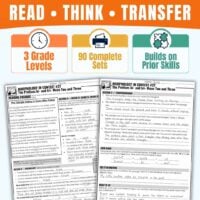
- Provides three grade levels for individual classrooms, intervention groups, homeschool settings, or multi-grade instruction
Standards Alignment
The activities support morphology and vocabulary skills addressed in:
- CCSS L.3.4b–c
- CCSS L.4.4b–c
- CCSS L.5.4b–c
Build Independent Word Solvers
Give students a repeatable strategy for figuring out unfamiliar vocabulary rather than relying on memorization alone.
With 90 passage-based morphology morning work activities for grades 3–5, students progressively learn to analyze prefixes, suffixes, roots, Greek and Latin forms, and other morphemes while using context clues to determine meaning.
The result is purposeful daily word study that strengthens morphology, vocabulary, reading comprehension, and independent word-solving skills as students encounter increasingly complex academic vocabulary.
Reviews
There are no reviews yet.