
Fractions on a Number Line: How to Teach It (Grade 3)
Most students meet fractions as pieces of a pizza or a chocolate bar, so the first time they see a fraction sitting on a number line, it throws them. Suddenly, a fraction is not a piece of something; it is a number with a place, just like 3 or 10. Teaching fractions on a number line is one of the most important moves in the whole fractions unit, because it shows students that fractions are numbers you can locate, compare, and count.
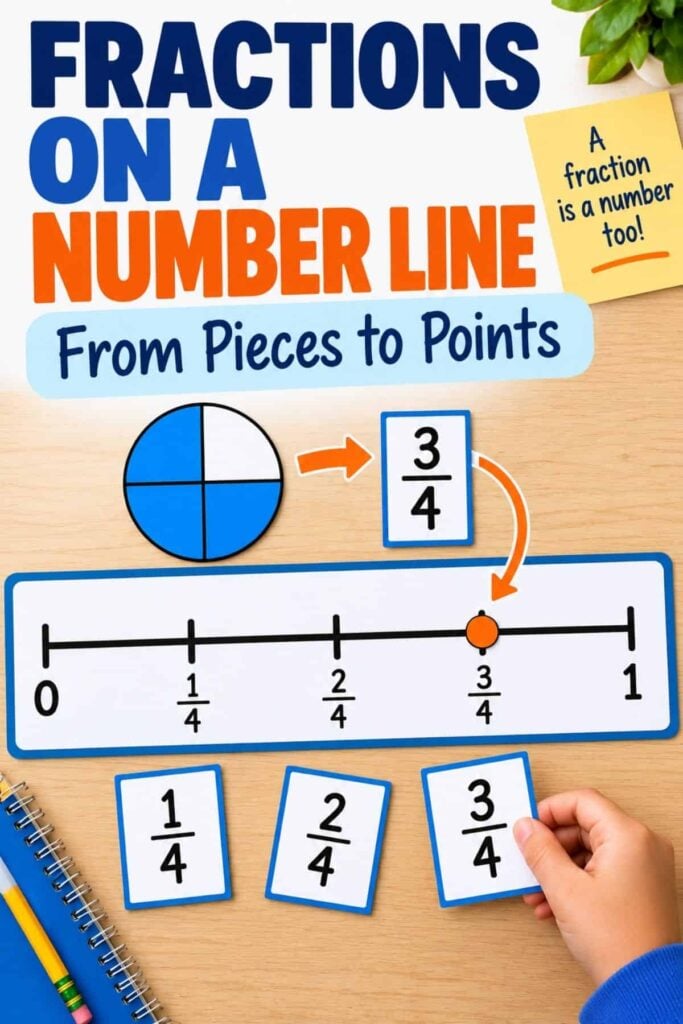
This post explains what fractions on a number line means, how to teach students to partition and plot them, how to show equivalent fractions on a number line, and activities that make it stick in 3rd and 4th grade.
What Does It Mean to Put Fractions on a Number Line?
On a number line, a fraction is a point, not a piece. The stretch from 0 to 1 is one whole. To show fractions, you split that whole into equal parts, and each part is a unit fraction. If you split 0 to 1 into four equal parts, each part is one fourth, and the points fall at 1/4, 2/4, 3/4, and 4/4, which is the same as 1.
This is exactly what students are asked to do in the 3rd grade standards. The Common Core fraction standards (3.NF.2) have students represent fractions on a number line by partitioning the whole into equal parts and marking the point for each fraction. The number line matters because it connects fractions to the whole numbers students already know, so a fraction stops feeling like a separate kind of thing and starts feeling like a number.
How to Teach Fractions on a Number Line
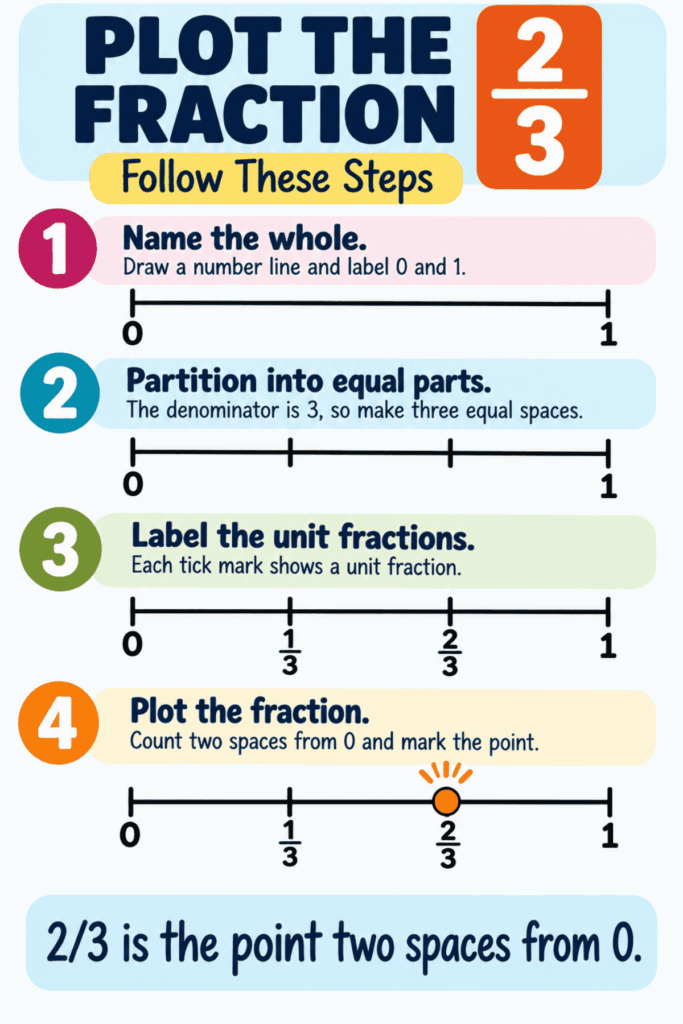
Break it into a few clear steps students can follow every time:
- Start with 0 and 1. Draw a number line and label the ends 0 and 1. That whole space is one whole.
- Partition into equal parts. The bottom number, the denominator, tells you how many equal parts to split the whole into. For fourths, make four equal spaces.
- Label the unit fractions. Each tick mark past 0 is one more unit fraction: 1/4, 2/4, 3/4, 4/4. This shows students that the top number counts the parts.
- Plot the fraction. To show 3/4, start at 0 and count three fourths to the right. The point you land on is 3/4.
If your students are still building comfort with number lines in general, my post on how to teach a number line lays the groundwork, and my vertical number line post gives another way to represent numbers that some students find clearer.
Here is the whole routine on one fraction. To plot 2/3, first name the whole by labeling 0 and 1. The denominator is 3, so make three equal spaces between them, which creates points at 1/3 and 2/3. Then count two spaces from 0 and mark the point. That point is 2/3. Walking through one fraction out loud like this, before students try their own, shows them exactly where each number in the fraction comes from.
Equivalent Fractions on a Number Line
One of the best things a number line does is make equivalent fractions obvious. When two fractions land on the exact same point, they are equal. Draw one number line partitioned into halves and another right below it partitioned into fourths, and students can see that 1/2 sits at the same spot as 2/4. Do it again with sixths, and they see 1/2, 2/4, and 3/6 all stacking up at the same point.

This is a powerful way to teach equivalent fractions on a number line because students see why two different fractions name the same amount. It pairs well with a chart or an area model for students who need another view.
My free equivalent fractions chart gives students a reference they can hold next to the number line.

Fractions Greater Than One on a Number Line
Once students can place fractions between 0 and 1, extend the line past 1. A number line that runs 0 to 2, partitioned into fourths the whole way, shows that 5/4 sits just past 1 and that 8/4 lands on 2. This is how students make sense of fractions greater than one and, later, mixed numbers, without any tricks. The line simply keeps going, and the counting stays the same.
Placing fractions on a number line also sets up comparing and ordering them, since a fraction farther to the right is greater. That makes the number line a natural tool for the comparing work students do in 3rd and 4th grade.
Activities for Fractions on a Number Line
Students understand this topic better by doing than by watching. A few activities that work well:
- Fold paper strips. Give students paper strips to fold into halves, fourths, and eighths, then line them up. The folds become the partitions, and stacking the strips shows equivalence.
- Make a human number line. Hang a clothesline across the room labeled 0 and 1, and have students clip fraction cards where they belong. The whole class can debate a placement.
- Plot and compare. Give students two fractions to plot on the same line and decide which is greater based on position.
- Play a fraction game. Games keep the practice fresh. My fraction Go Fish game and fraction cover-up game build fraction sense that supports number-line work.
Fractions on a number line are one piece of a bigger fractions unit. For the full sequence, my guide on teaching fractions in elementary school shows where the number line fits alongside area models, equivalence, and comparing.
Comparing Fractions on a Number Line
Once students can plot fractions, the number line becomes the clearest tool for comparing them, because a fraction farther to the right is greater. Ask students to plot 2/3 and 3/4 on the same line. To do it, they partition the line into a number of parts that works for both, twelfths in this case, and place each fraction. They can see that 3/4 sits farther right than 2/3, so 3/4 is greater, without needing a rule about cross-multiplying. Comparing fractions on a number line keeps the reasoning visual and grounded, which is exactly what students need before they move to more abstract methods.
Common Mistakes to Watch For
A few predictable errors trip students up, and naming them ahead of time heads them off:
- Counting tick marks instead of spaces. The denominator is the number of equal spaces, not the number of lines. Counting marks lands students one spot off.
- Unequal partitions. The parts have to be the same size. Eyeballing the splits creates a line where the fractions don’t sit where they should.
- Confusing the whole. On a plain 0 to 1 line, the whole is the distance from 0 to 1, not the length of the paper or the whole number line. Students who miss this partition the wrong space.
- Treating the fraction as a piece, not a point. Some students shade a region instead of marking a point. Keep pointing back to the idea that a fraction on a number line is a single location.
Frequently Asked Questions
Bringing It All Together
Fractions on a number line turn a fraction from a slice of pizza into a number that relates to other numbers. Start at 0 and 1, partition into equal spaces, count the unit fractions, and plot the point. From there, students can see equivalence, compare fractions, and stretch past one whole, all on the same line. Give them paper strips and a clothesline before worksheets, and the concept moves from confusing to clear.
Looking for ready-to-use practice? My fraction number puzzles and games give students hands-on practice with fractions and their forms, and pair well with number-line work in 2nd and 3rd grade.
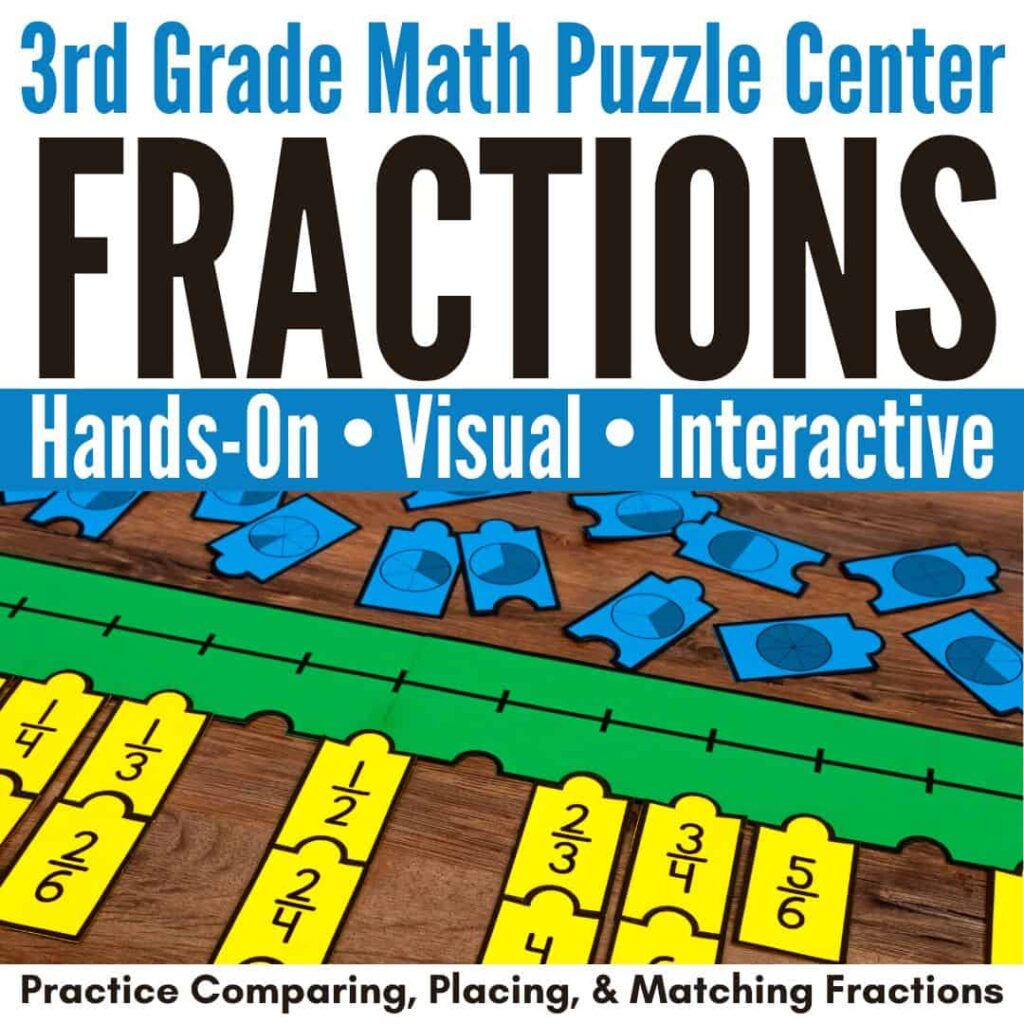
Fraction Number Puzzles 3rd Grade Hands-on Math Activity
Help students understand fraction relationships with both fraction-in-number-form and fraction visual models. This product includes a variety of number puzzles that reinforce equal parts, fractions on a number line, equivalent fractions, and comparing fractions. This covers all the Number & Operations Fractions Standards for third grade.
Jessica BOschen
Jessica is a teacher, homeschool parent, and entrepreneur. She shares her passion for teaching and education on What I Have Learned. Jessica has 16 years of experience teaching elementary school and currently homeschools her two middle and high school boys. She enjoys scaffolding learning for students, focusing on helping our most challenging learners achieve success in all academic areas.