
Fraction Go Fish Game for 2nd and 3rd Grade
Teaching fractions can feel like one of the trickier units of the year. Students need to recognize fractions in multiple ways, as numbers, as parts of a whole, and as parts of a set, before real understanding clicks. Finding practice activities that keep students engaged while building that recognition is the challenge. That’s where this Fraction Go Fish game comes in. It uses a game format students already know and love, so they can spend their energy on the math rather than learning new rules.
Whether you’re introducing fraction names or reinforcing fraction concepts with visuals, this fraction go fish game gives students meaningful practice in an engaging, low-pressure setting.
It’s perfect for small group rotations, math centers, or even those last few minutes before the bell rings. And because it mimics the classic Go Fish format, your students will pick it up quickly, no need for lengthy instructions or complicated prep.
What Is the Fraction Go Fish Game?
Fraction Go Fish is a printable math card game where students practice naming and recognizing fractions by matching cards that show the same fraction in different ways. Instead of just matching numbers, students have to look at both pictorial and numerical representations of fractions and decide if they match.
It’s the same classic Go Fish format, with a meaningful math twist that makes every turn a fraction practice opportunity.
Fraction Go Fish Game | Fraction Recognition & Fraction Vocabulary Practice
Make learning fractions fun with this Fraction Go Fish Game! Students practice identifying, naming, and recognizing common fractions through an engaging card game that includes pictorial representations, fraction word forms, and sentence frames to support mathematical discussions.
What’s Included in the Fractions Go Fish Game?
This resource is more than just a game—it’s a tool for reinforcing understanding of fractions through multiple representations and oral language practice. Here’s what you’ll find in the set:
- 40+ Visual Fraction Cards
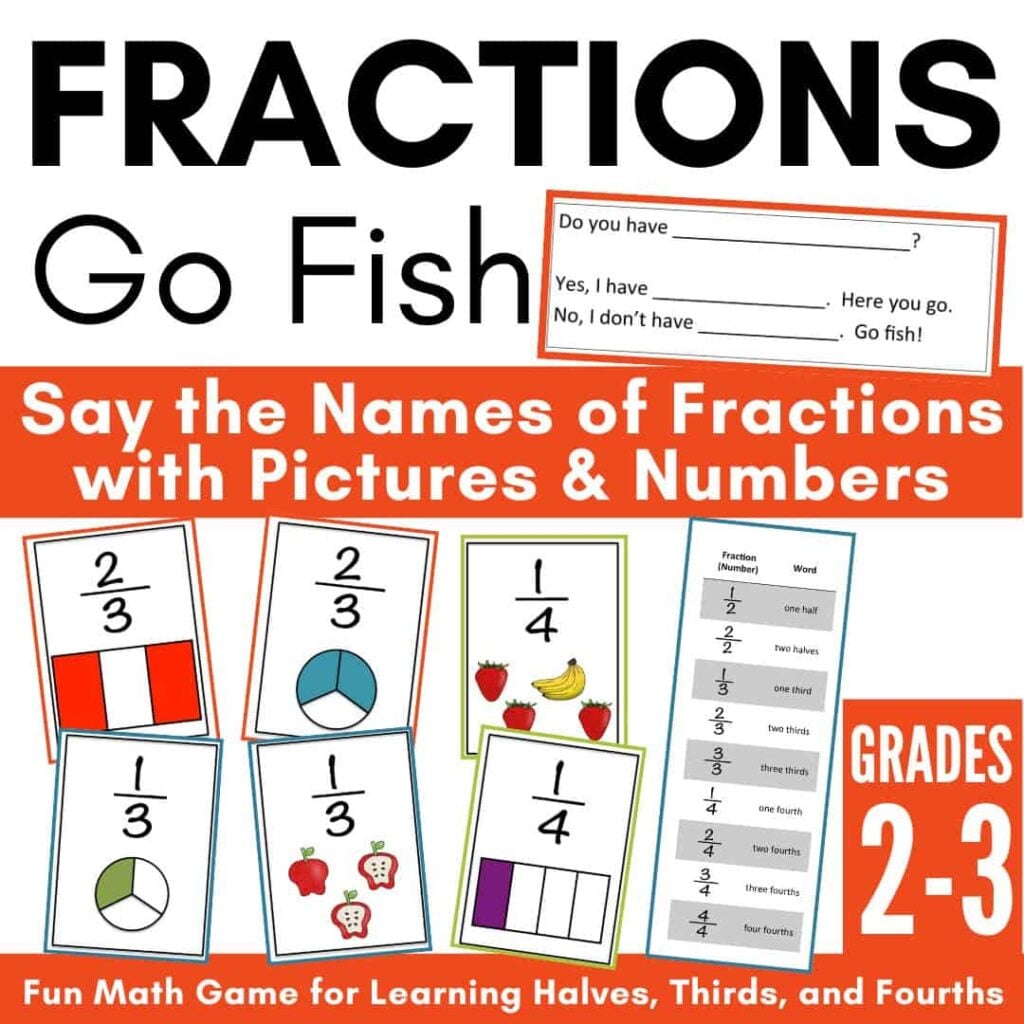
Four cards for each fraction (1/2, 2/2, 1/3, 2/3, 3/3, 1/4, 2/4, 3/4, 4/4, and 1/1), showing both part of a whole and part of a set visual models. - Fraction Name Support
A reference chart showing fractions in both numerical and word form (e.g., 1/2 = one half) to help students verbalize their requests during the game. - Sentence Frames for Math Talk
Scaffolded language support so students can confidently say:
“Do you have one third?”
“Yes, I have one third. Here you go!”
“No, I don’t have one third. Go Fish!” - Easy-to-Follow Instructions
Includes step-by-step directions for setting up and playing with 2–4 players, making it simple to implement with minimal teacher guidance. - Tips for Durability
Suggestions to print on cardstock and laminate the cards so they can be reused throughout the year and across multiple grade levels.

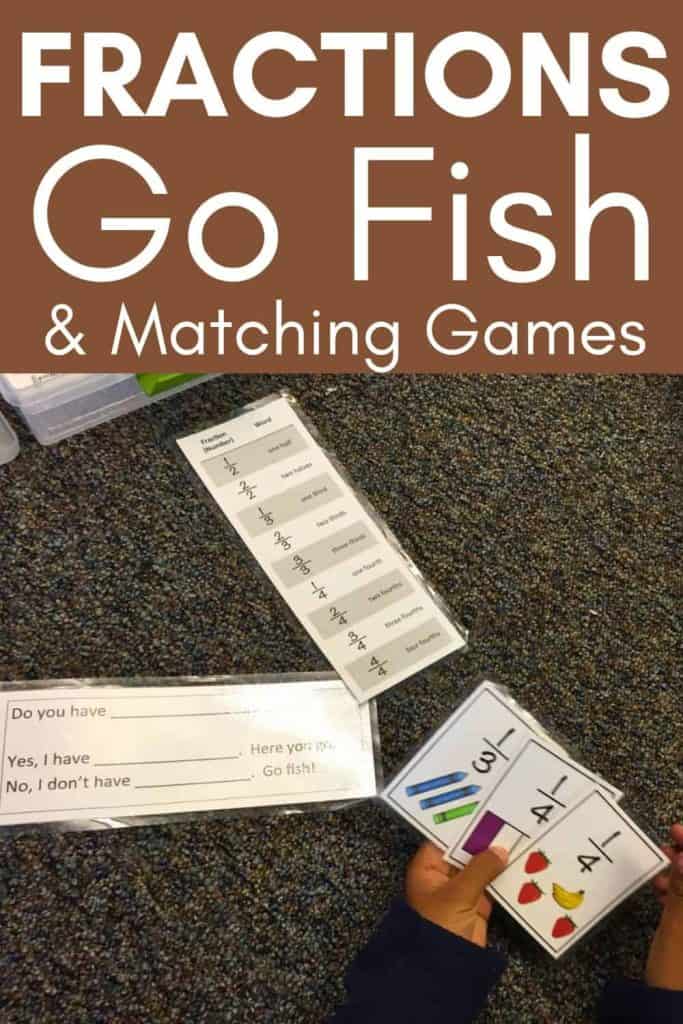
Here’s a picture of a small group of my students playing Fraction Go Fish. They totally use the sentence frames and the cheat sheet when playing. It’s so cool to hear them use fractions in complete sentences!

Why Both Part of a Whole and Part of a Set?
One of the most common misconceptions students have about fractions is that fractions only apply to shapes. When they only see fraction circles and fraction bars, they miss the bigger picture.
Including part of a set of cards — where students see, for example, 1 out of 4 pieces of candy highlighted — helps students generalize their understanding of fractions beyond area models. This is an important stepping stone for deeper fraction concepts in later grades.
Having both types of representations on cards for the same fraction means students are constantly making connections between different ways of showing the same value.
Using the Sentence Frames for Math Talk
The included sentence frames are one of the most practical parts of this resource. Since students are asking for specific fractions rather than just numbers, having the language scaffolded for them makes a real difference — especially for students who are still building vocabulary around fractions.
Students practice saying and hearing things like:
- “Do you have one fourth?”
- “Yes, I have one fourth. Here you go.”
- “No, I don’t have one fourth. Go fish!”
After a few rounds, most students won’t need the sentence frames anymore — but having them available builds confidence and keeps the math talk consistent and accurate.
The fraction reference list works alongside the sentence frames. Students who aren’t sure how to say a fraction can check the list and find the word form right away, removing that barrier so they can focus on playing the game.
How to Play Fraction Go Fish
The game follows traditional Go Fish rules, which means most students can jump right in.
- Deal 4 cards to each player
- Place the remaining cards face down in the center
- Match any pairs in your hand before play begins
- On your turn, ask another player for a specific fraction by name
- If they don’t have it, draw from the pile and play passes to the next student
- The player with the most matched pairs at the end wins
The game works well for 2 to 4 players and moves quickly, which is great for keeping students on task during a math center or small group time.
Printing and Preparing the Cards
For the best results, print the cards on cardstock and laminate them before cutting. Laminated cards hold up well through many rounds of play and will last for years of math centers.
If you want to prevent students from seeing through the cards, glue a slightly smaller piece of colored paper to the back of each sheet before laminating. It’s a small step that makes a big difference in gameplay.
When to Use Fraction Go Fish in Your Classroom
This game fits naturally into many parts of your math block:
- Math centers or stations — students can manage it independently once you’ve modeled it
- Partner work — great for early finishers or a quick 10-minute partner activity
- Small group instruction — easy to observe and informally assess while students play
- Intervention time — low-stakes repetition in a format students enjoy
- Sub plans — familiar format means minimal transition time
Because the game structure stays the same, you can use it at different points in your fractions unit — first as an introduction to fraction names, and later as review and reinforcement.
Why Teachers Love It
This fraction game isn’t just fun—it’s standards-aligned practice that sneaks in vocabulary, conceptual understanding, and listening skills. Your students will strengthen their ability to:
- Identify fractions in visual form
- Match visual representations to symbolic and word forms
- Use math language to communicate clearly with peers
Plus, it’s ready to go. Just print, cut, and play—no complicated prep or materials needed.
Fraction Go Fish Game | Fraction Recognition & Fraction Vocabulary Practice
Make learning fractions fun with this Fraction Go Fish Game! Students practice identifying, naming, and recognizing common fractions through an engaging card game that includes pictorial representations, fraction word forms, and sentence frames to support mathematical discussions.
Where to Get the Fraction Go Fish Game
The Fraction Go Fish Game is available in my Teachers Pay Teachers store and on my website. It’s designed for 2nd and 3rd grade students who are learning to name, recognize, and represent basic fractions.
If you’ve been looking for a hands-on way to make fractions click, this Fractions Go Fish Game might just be your new favorite center activity. It’s flexible, fun, and packed with the kind of repetition and reinforcement your students need—without the moans and groans.
Grab your set today and watch your students fish their way to fraction fluency!
More Go Fish Math Games
If your students enjoy the Go Fish format, there are more games available for other math skills:
Using the same game structure across different concepts is a simple way to reduce transition time and keep math centers running smoothly.
Jessica BOschen
Jessica is a teacher, homeschool parent, and entrepreneur. She shares her passion for teaching and education on What I Have Learned. Jessica has 16 years of experience teaching elementary school and currently homeschools her two middle and high school boys. She enjoys scaffolding learning for students, focusing on helping our most challenging learners achieve success in all academic areas.