
Free Equivalent Fractions Chart (Printable for Elementary Students)
This free equivalent fractions chart is a printable classroom tool that helps students see how different fractions represent the same value. You can use it as a reference chart, cut it apart for a matching activity, or pair it with a hands-on game — all three options are described below.
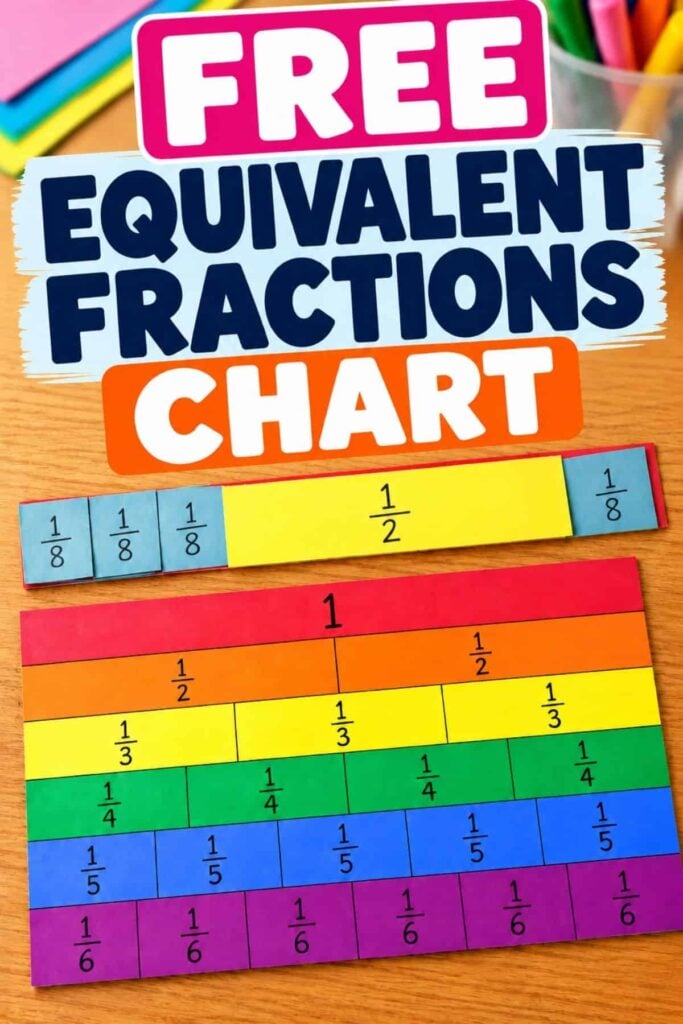
The chart came out of a real classroom moment. A second grader in my class had zoomed through earlier content in our math program and landed on fraction number lines before we had covered fractions as a class. He needed a quick visual to understand that 1/6 + 1/6 + 1/6 = 1/2. I sketched one for him on the spot, then made a cleaner version the next morning. I’ve been using it ever since.
Download the free printable equivalent fractions chart using the link below, then keep reading for two ways to use it with students.
What Is an Equivalent Fractions Chart?
An equivalent fractions chart shows sets of fractions that look different but represent the same amount. For example, 1/2, 2/4, and 4/8 all name the same portion of a whole. Placing these side by side on a chart helps students see the relationship visually rather than just memorizing rules.
This is especially useful in second and third grade, when students are first encountering fractions and the idea that a number can be written more than one way. If you’re looking for a broader overview of how to sequence fraction instruction, this guide on how to teach fractions in elementary school walks through the full progression. An equivalent fraction chart gives students a reference to check their thinking and build confidence before moving into fraction operations.
Benefits of Using an Equivalent Fractions Chart
- Visual Learning Aid: The chart compares fractions, making it easier for students to comprehend their relationships.
- Simplifies Complex Concepts: Fractions can be challenging, but a visual representation breaks down the complexity, facilitating better understanding.
- Supports Fraction Operations: A solid grasp of equivalent fractions is essential for performing operations like addition and subtraction with different denominators.
Common Equivalent Fractions Students Should Know
The chart covers the fractions students encounter most often in elementary math. Here are the key equivalencies it includes:
- 1/2 = 2/4 = 3/6 = 4/8
- 1/3 = 2/6 = 3/9
- 1/4 = 2/8 = 3/12
- 1/6 = 2/12
- 1/8 = 2/16
These are also the fraction sets used in the Cover Up game below, so students who practice with the chart are already prepared to play.
Free Equivalent Fractions Chart Download
To assist educators and students, we offer a free, printable equivalent fractions chart. This resource can be used in classrooms or for at-home learning to reinforce the concept of equivalent fractions. Download your free copy here:

It can be used as is, or can be cut apart and used as a puzzle of sorts. Students can match up the pieces and see how many of the parts equal parts of other fractions. i.e.: 1/3 = 1/6 + 1/6 + 1/6 or 3/6.
Fraction Cover Up Game: A Hands-On Activity to Use with the Chart
Once students have seen the equivalent fractions chart, Cover Up is a natural next step. My students have asked to play this one repeatedly, and it reinforces fraction relationships in a way that feels like a game, not a worksheet.

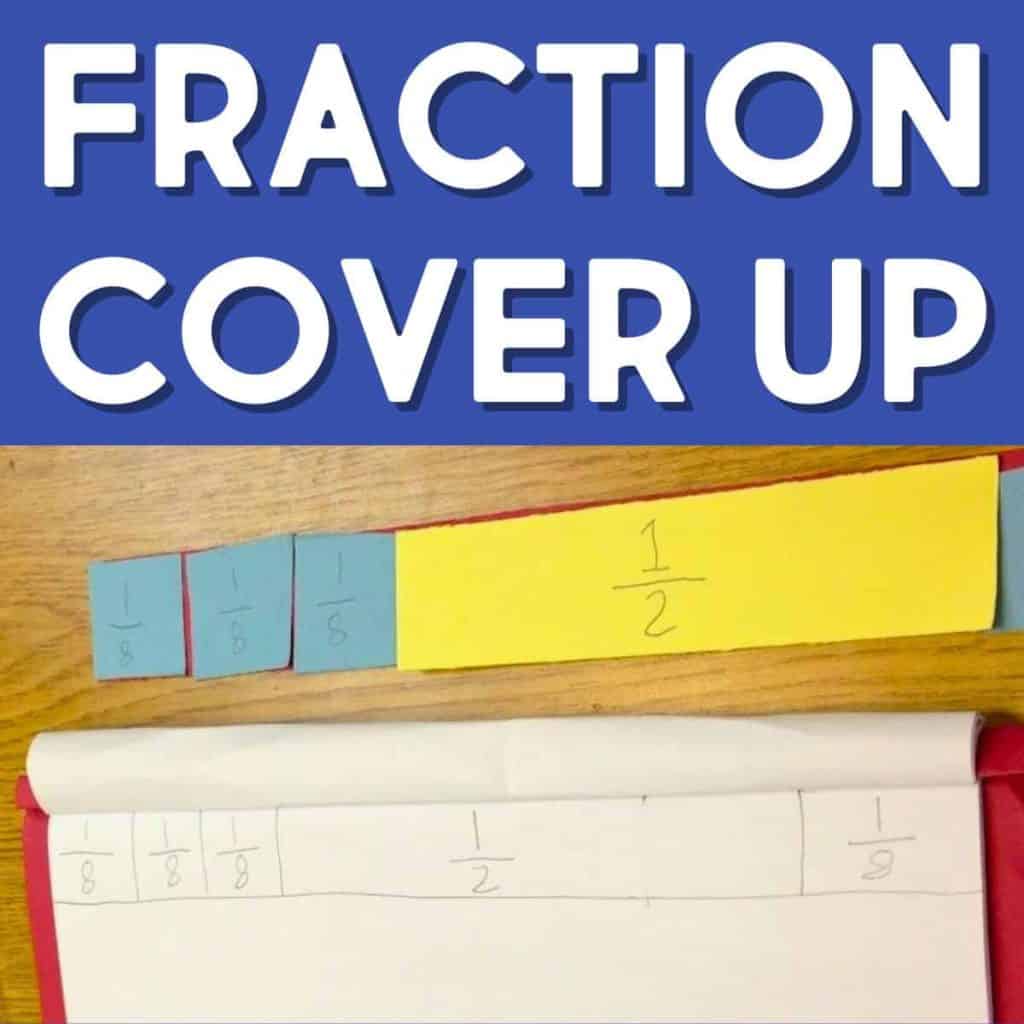
This post shows you how to guid students through cutting the pieces and playing the game.
What You Need
Cut paper strips in five colors. Each color represents one fraction set: red (1 whole), yellow (1/2), green (1/4), blue (1/8), and purple (1/16). Students fold and cut their own strips to create the pieces, which is itself a useful fraction activity. You’ll also need a die labeled with the fraction amounts, not the whole — since the die has six sides, each fraction is represented twice.
How to Play
Each student starts with their one whole strip in front of them. On each turn, students roll the die and place the matching fraction piece on top of the whole. The goal is to cover the entire strip. Toward the end, students need an exact roll to fill the remaining space — this is where the strategic thinking kicks in. The first student to cover the whole completely wins.
What to Do After the Game
Have students draw the fractions they rolled in their math journals. For students who are ready, they can write the addition equation that equals the whole — for example, 1/8 + 1/8 + 1/8 + 1/2 + 1/8 = 1. Higher-level students can practice grouping like denominators: 4/8 + 1/2 = 1. Pairing this with fraction sentence frames gives students the language to explain their equations out loud, which deepens understanding alongside the written practice.
The equivalent fractions chart and the Cover Up game work well together as a two-part introduction to fractions. The chart builds visual understanding; the game builds fluency through repetition. Together, they give students a concrete foundation before moving into comparing and adding fractions with unlike denominators.
If you use these in your classroom, I’d love to hear how it went. Drop a note in the comments below.

I cannot get the fraction equavalalient to laod it say no longer available??