
A fourth grader hits the word photosynthesis in a science text and stops cold. It looks like a wall of letters. But break it into photo (light) and synthesis (putting together), and the meaning starts to open up.
Greek and Latin roots are everywhere in science, and teaching students the word parts behind big terms turns intimidating vocabulary into something they can actually reason through. One root like hydro or therm unlocks a whole family of science words at once.
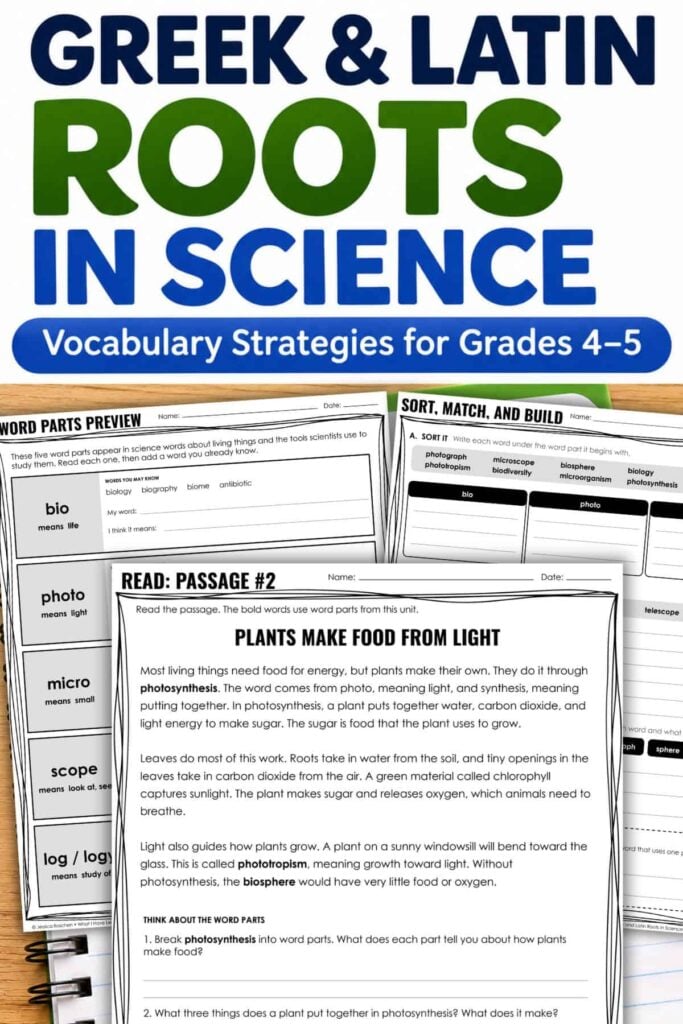
This post explains why science vocabulary is so full of these roots, which high-value ones to teach in grades 4 and 5, and a simple routine for teaching them alongside real science reading.
Why Science Vocabulary Is Full of Greek and Latin Roots
Academic vocabulary, especially science vocabulary, is built almost entirely from Greek and Latin word parts. The everyday words students pick up through conversation are mostly short and familiar, but the words in a science text are long, technical, and built from ancient parts: biology, microorganism, geothermal, hydrosphere. That is a barrier for many readers, and it is exactly where roots help.
When students learn that geo means earth, they learn more than one word. They get a key to geology, geologist, geography, and geothermal. That is the power of teaching Greek and Latin roots in science: the return on one word part is enormous, and it compounds as students move into harder content-area texts.
For the bigger picture on why word parts build reading, my post on what morphology is explains it.
The Greek and Latin Roots That Show Up Most in Science
Not every root is worth classroom time, but a specific set shows up again and again in science. These are the word parts that unlock the most science vocabulary in grades 4 and 5:
| Root | Meaning | Science Words |
|---|---|---|
| bio | life | biology, biome, microbiology |
| photo | light | photosynthesis, photograph |
| micro | small | microorganism, microscope |
| scope | look at | microscope, telescope |
| log / logy | study of | biology, geology, zoology |
| geo | earth | geology, geologist, geothermal |
| astr / aster | star | astronaut, asteroid, astronomy |
| terra / terr | land | terrain, terrarium, terrestrial |
| chron | time | chronological, chronicle |
| morph | shape, form | metamorphosis, morphology |
| hydro | water | hydrosphere, hydroelectric |
| aqua | water | aquatic, aquarium |
| mar | sea | marine, submarine |
| therm | heat | thermal, geothermal, thermometer |
| meter / metr | measure | thermometer, barometer, diameter |
Teach just a handful of these and students start spotting them in their reading on their own.

For the full, grade-by-grade list beyond the science-heavy ones here, see my post on common Latin and Greek roots.
How to Teach Greek and Latin Roots in Science
The routine that makes roots stick is the same whether the content is life science or earth science. Teach a few word parts, then put them to work in real science reading. Here is a five-step rhythm that works well across a week:
- Preview the word parts. Introduce a small set of roots, five is plenty, with their meanings and one familiar example each.
- Break down the terms. Have students split science words into their parts and reason out a meaning before you give it to them.
- Sort, match, and build. Students match roots to meanings, sort words by shared parts, and build new words. This is where the parts move into memory.
- Read science passages that use the words. Put the terms back into real informational text so students meet the roots in context, not on a flashcard.
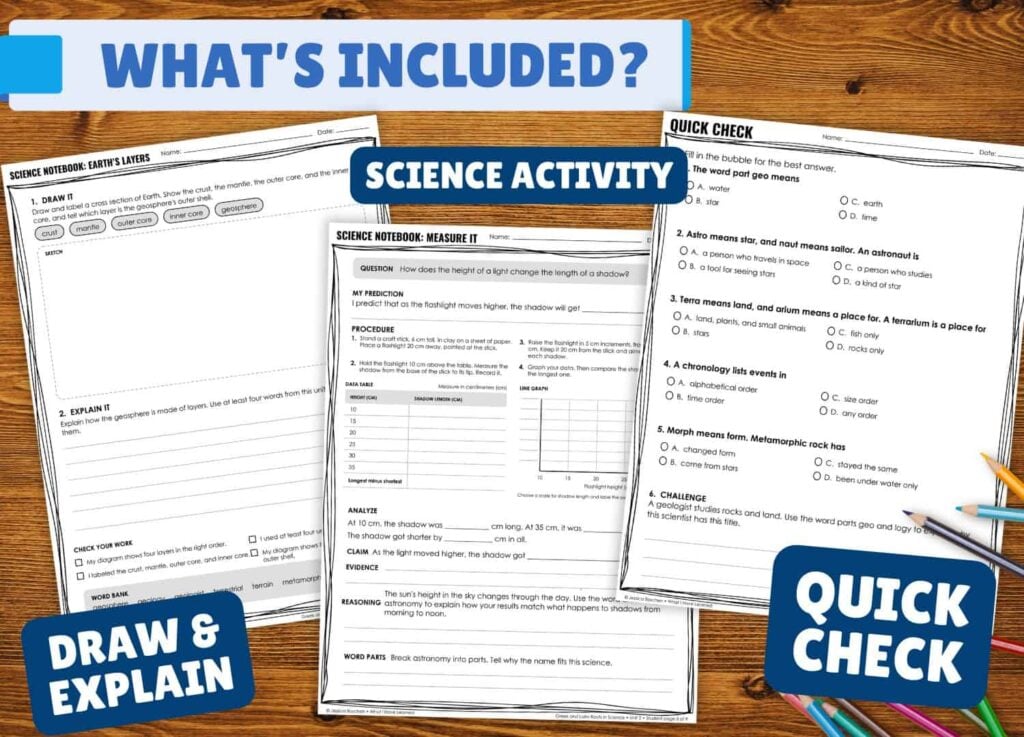
- Apply and check. Use the vocabulary in a science notebook task or investigation, then a quick check to see who has it.

For more hands-on practice with the parts themselves, my morphology worksheets have students build and sort words from a single root.
Pairing Roots With Content-Area Reading
Roots are most powerful when students use them to read, not just to pass a vocabulary quiz. When a student meets microorganism in a passage about things too small to see and can break it into micro, bio, and logy to figure it out, the word part has done real work. That is also where this strategy connects to standards, since it hits both the Greek and Latin roots standards (L.4.4b and L.5.4b) and the informational reading standards at the same time.
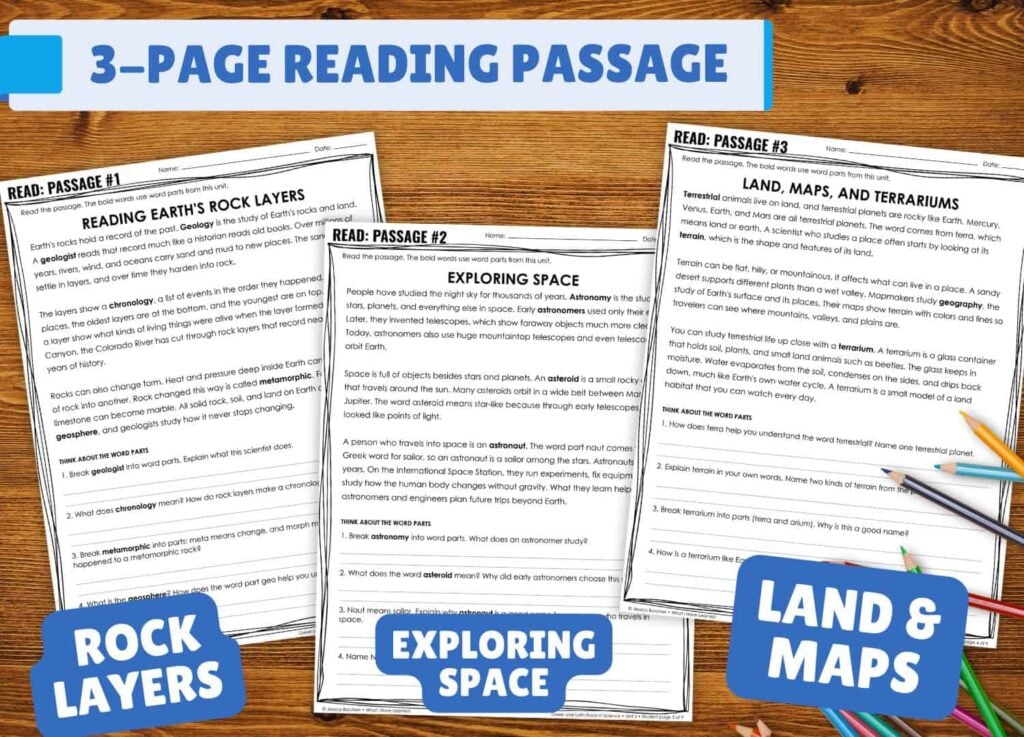
Pairing word parts with short science passages is one of the most efficient moves in an upper elementary literacy block. If your students need a more playful entry point, my Greek and Latin root words games post builds the same word parts through quick, repeatable games. For the research behind why word-part instruction strengthens reading, Reading Rockets has a helpful overview.
Recommended products
Frequently Asked Questions
Bringing It All Together
Greek and Latin roots in science give students a strategy they will use every time they open a science text: break the big word into parts, reason out a meaning, and keep reading. Teach a few high-value roots, put them to work in real science passages, and watch students start decoding vocabulary that used to stop them cold.
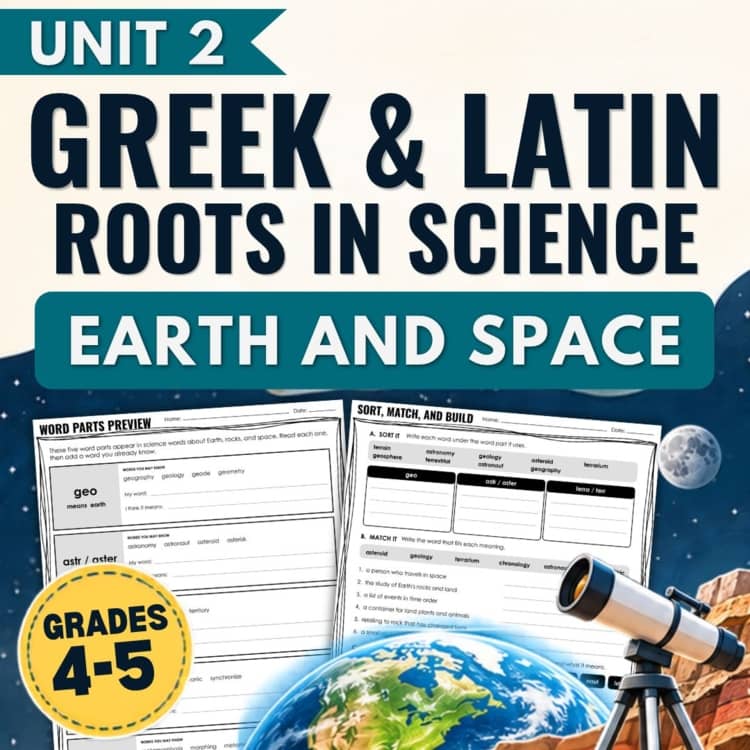
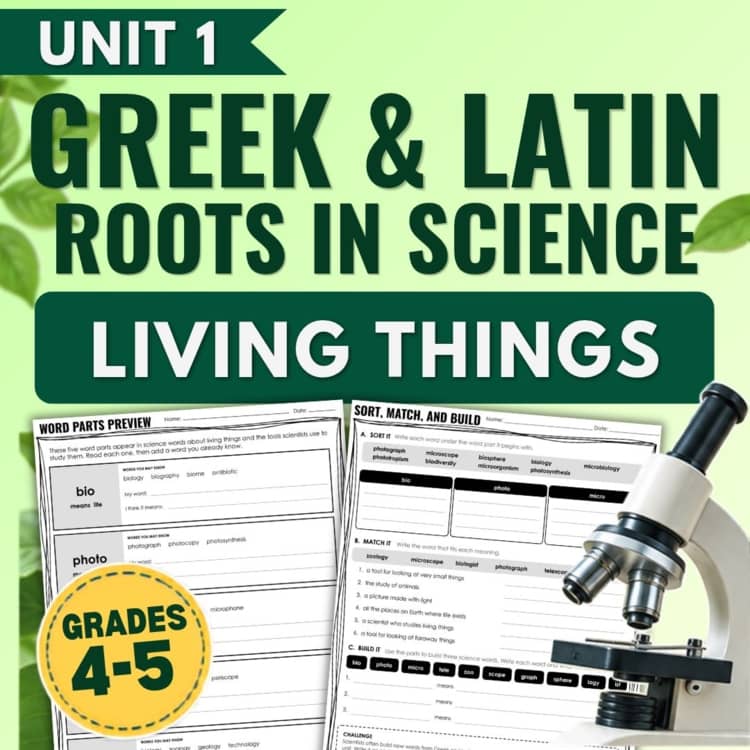
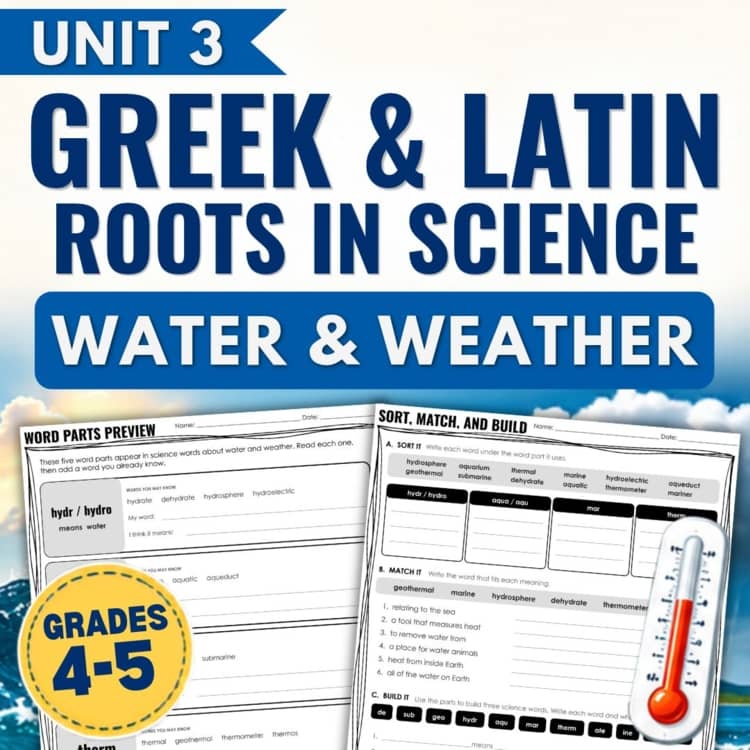
Want it ready to teach? My Greek and Latin Roots in Science units build this routine for you. Each unit covers five science word parts, twelve science terms, three short informational passages, a science notebook investigation, and a quick check, all aligned to the roots and reading standards for grades 4 and 5. Three units are ready now, with more on the way: Living Things (bio, photo, micro, scope, log), Earth and Space (geo, astr, terra, chron, morph), and Water and Weather (hydro, aqua, mar, therm, meter).
Jessica BOschen
Jessica is a teacher, homeschool parent, and entrepreneur. She shares her passion for teaching and education on What I Have Learned. Jessica has 16 years of experience teaching elementary school and currently homeschools her two middle and high school boys. She enjoys scaffolding learning for students, focusing on helping our most challenging learners achieve success in all academic areas.