
Stop Sounds vs. Continuous Sounds: What Every Reading Teacher Should Know
Understanding the difference between stop sounds vs. continuous sounds is one of the most practical things you can know as a reading teacher. How you model each sound directly affects whether students can blend those sounds into words, and most teachers were never explicitly taught this distinction.
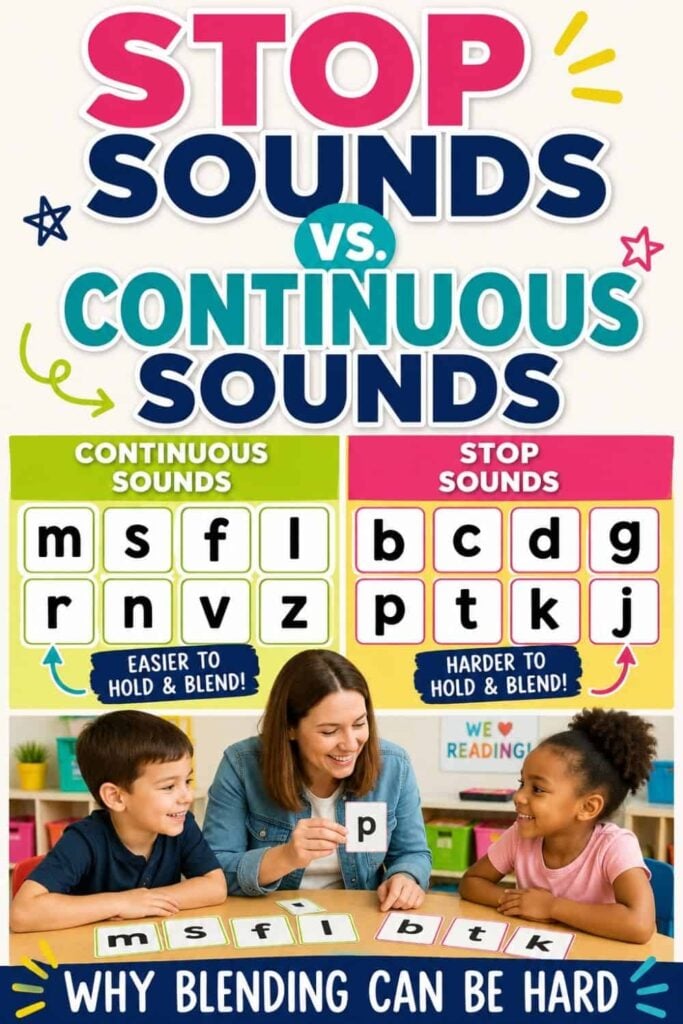
Some sounds can be stretched and held (continuous sounds). Others cut off with a puff of air (stop sounds). And a handful are just plain tricky. When students mispronounce these sounds, blending breaks down, which can significantly stall reading progress.
In this post, you’ll find a breakdown of continuous sounds, stop sounds, and tricky sounds, along with a reference chart and tips for teaching each type correctly.
I’ve seen this play out at home, too. My oldest son struggled for years with /th/, /w/, and /l/ — and the speech patterns affected his reading. Watching him work through continuous sounds first, then gradually tackle stop sounds, made it clear how much the order and pronunciation of these sounds matter to students learning to blend.
Why Stop Sounds vs. Continuous Sounds Matter for Blending
When kids learn to read, they need to know how to blend sounds. As I mentioned earlier in a blog post on blending and segmenting, one of the key skills that my struggling readers (and my own son) are missing is the ability to blend sounds. Some students can segment the sounds in a word and figure out what the word is without blending it. My son can do that with some short A CVC words. However, he struggles with other, less familiar words. Even if he knows the sounds in the word, he cannot figure out the word based on segmenting the sounds.
Teaching students to blend the sounds in words gives them a tool to successfully read most English words. However, for students to successfully blend sounds, they, of course, need to know them.
The Schwa
I still cringe when I hear someone add a schwa sound to the end of a stop sound (or continuous sound, for that matter). What is a schwa sound? It’s that little “uh” sound that people add to the end of /p/, /d/, /c/, /g/, and other stop sounds. It’s really hard to say the stop sound without a little schwa, but eliminate it as much as possible.
I even hear some people add a schwa to the end of some continuous sounds like /f/. I’ve heard people say /fuh/ for the /f/ sound, turning it into a stop sound because of the schwa. That works for the word “fun,” but what about “fan”? Try blending /fuh/ – /a/ – /n/. It doesn’t sound like a fan!
If you are intentional about how you say each sound with your students, specifically teach the correct sounds, and listen and correct students when they mispronounce individual sounds during phonemic awareness activities, students can become successful readers because they will have the tools they need to blend sounds into meaningful words.
What are the Continuous Sounds?
Continuous sounds are the easiest to teach and are usually the first that students learn when reading. They’re the sounds that you practice first during phonemic awareness activities, and usually the first taught during reading instruction.
The letters that make continuous sounds are:
m, s, f, l, r, n, v, z
The pronunciation of these sounds is pretty straightforward. Be sure that the sounds are continuous and that you’re not pronouncing them with a schwa at the end.
What are the Stop Sounds?
The letters that make stop sounds are:
b, c, d, g, p, t, k, j
One trick that I’ve taught my own kids (and students) is to put their hand in front of their mouth. When you say a stop sound, there is often a little puff of air. Their sound should stop when they feel the air. Try it with the /p/ sound. It’s the easiest to feel. Do you feel the little puff of air? That little puff of air occurs with the other stop sounds, too, but it’s a bit harder to feel.
What are those Tricky Sounds?
Some sounds are just plain tricky. They may be a combination of stop and continuous sounds, or they may be pronounced differently across reading programs or even in different areas of the country.
The tricky sounds are:
h, w, y, x, q
About seven years ago, when I started teaching Kindergarten (after having taught third through fifth grades for several years), I learned that I was pronouncing the /w/ and /y/ sounds incorrectly. They’re in the tricky sound, like, because they’re pronounced differently than most of us were taught and most of us would think.
Remember: the goal is for students to learn the sounds of letters so they can blend them into words. Think about the pronunciation with regard to blending the sound in common Kindergarten CVC words.
Continuous Sounds vs. Stop Sounds: Quick Reference Chart
| Type | Letters | Key Feature |
|---|---|---|
| Continuous Sounds | m, s, f, l, r, n, v, z | Can be held and stretched; easier to blend |
| Stop Sounds | b, c, d, g, p, t, k, j | Short burst of air; avoid adding a schwa |
| Tricky Sounds | h, w, y, x, q | Pronounced differently than most expect |
Teaching Stop Sounds and Continuous Sounds: Final Thoughts
Before reading this post, you may not have thought much about the difference between stop sounds vs. continuous sounds. But once you know it, you start hearing it everywhere, in your own modeling, in how your students blend, and in why some words are harder to decode than others.
Knowing the 44 phonemes of English is one piece of the puzzle, but knowing how to produce them accurately is what makes the difference for students who are just learning to blend sounds into words. Start with continuous sounds, watch for the schwa, and give students the explicit instruction they need to blend with confidence.
If you are looking for more resources to work with your early readers on blending and segmenting sounds in print, check out these blending resources. Blending Cards are available for most phonics patterns, and worksheets complement them.
-

-
-
-
-
VCE Words Blending Cards$6.75
-



Closing Thoughts about Teaching Phonics Sounds
Before reading this article, did you know that there was a difference between continuous and stop sounds?
As I mentioned earlier, reading is complicated. Until I started teaching reading to young children, I didn’t realize all the nuances and components needed to help students become successful readers. Knowing the 21 consonant sounds is only one piece of the puzzle, but it’s an important piece!
If you would like to practice some blending and segmenting with your students, sign up to receive my Short A Blending Cards for free.


Love this post! As a former Kindergarten teacher I couldn’t agree more!!! I cringe anytime I hear teachers saying BUH for B! We called them squeezers and explorers and special sounds! Our phonics program had pictures for all the mouth sounds!
I understand the importance of not adding the schwa, but wondering if I’m pronouncing the w and y correctly. I cannot access your video. Is there another way to see it? Thanks!
Thanks for letting me know! Here is a direct link to the video: https://www.facebook.com/whatihavelearnedteaching/videos/vl.1072605782783340/1031263826952332
Hi! I am here seeking clarification and to fact check my understanding before leading my peers in a professional development coaching meeting on phonemic awareness.
I came upon this blog and I was so thankful I did….until I got to the video model! I found that a few of the letter sounds were either incorrectly pronounced or mid categorized as stop/continuous sounds. I hope to gain a better understanding to best support students in their journey toward total reading and to support teachers in learning a crucial element in the science of reading. Thanks for any insight anyone here can offer!
First, I appreciate the explanation Robin Martinet offered in the comments below where she explains how to form your mouth like a donut and control your voice while making the sound /r/ (“Rrrrrrr”) in order to avoid the /er/.
Next, I attest that we should be teaching the sound the letter Q makes in combination with the letter U. In which case, the two sounds together are /kw/ and the W is a continuous sound, therefore the Qu should be categorized and taught as a continuous sound for blending purposes.
Lastly, considering the letter H, the /h/ is a continuous push of breath that flows into the next vowel sound in a word, though it can only last as long as your own breath allows- which for some could be short lived- it isn’t a sound we clip purposely. Thus the letter H should be considered a continuous letter sound. Would you agree?
Thanks for the discussion! I look forward to learning more and collaborating to best support students and teachers alike!
Love it! Thanks for sharing. This will certainly be an asset to my first grade clasroom.
One of my professors in college really emphasized the importance of not adding that -uh sound, and I’m so glad she did, it really helps my kids. We do a lot of work of making those letter sounds correct from the beginning. I teach a lot ELLs so we spend a LOT of time learning to hear those sounds in words and on how to say them correctly!
But I definitely will be using the “new” w and y sound! I’ve never realized that, but it does explain some difficulties my kids have with those letters when reading! Thanks for the tip!!
I agree with all that you say, except for the letter “r”. You are saying /er/, which is not correct. We would never say /er/obot for robot. The consonant r and the R-Control (Bossy R) pattern are pronounced differently. /Rah/ is used for the letter r and /er/ is used for “er”, “ir”, and “ur”. This is my pet peeve and see many, many teachers make this mistake. Thanks for the video. I’d love to see this /r/ corrected so that this could be sent to parents. With second language students, this would be very helpful for parents.
Yes, the R sound at the beginning of syllables in words does not have a vowel sound in front. It is simply, rrr, but is hard to make on it’s own! There are actually many pronunciations for the letter R. There is rrr at the beginning of syllables in words, as well as all the r-controlled vowels, where the R sound takes on some of the characteristics of the preceding vowel. Examples include “er/ur/ir” as in “her”, “fur”, and “stir”; “or” as in “ for”; “air”; and “ar” as in “car.”
How do you blend /rah/ into a word that doesn’t have a short A following the R? Such as Rib… /rah/ i / b /
That doesn’t seem to work when i try?! Can you help?
I found a video that has a good example of the /r/ sound at 2:27. This is from a program that I do not use, but I like her explanations of the sounds. https://www.youtube.com/watch?v=xG4q5_TLHRw
The biggest issue is the schwa preceding the ‘l” sound, not after. Think about how many ‘sounds’ there are in the word ‘little’ and ‘pupil’. There are technically 5 speech sounds (phonemes) in each. There are 4 graphemes in little (l/i/tt/le) and 5 in pupil p/u/p/i/l) So although the schwa is used to say both, when we change from linguistics to phonics it changes. The schwa is swallowed up in ‘little’ with the last sound, and with ‘pupil’ has a letter to map to (the i)
So much fun ! Within the Speech Sound Pics (SSP) Approach the children explore the schwa during the Purple Code Level.
Yes, I agree that adding ‘uh’ to a phoneme is common (try saying ‘p’ across a busy classroom to understand why so many teachers do this, unintentionally) but very important we clearly articulate each, so that the children do not end up spelling ‘pasta’ as ‘past’ etc 🙂
Thank you so much! This is so important! I came across your video as I was doing some research for a Literacy presentation on Word Work for our local ISD. Luckily, my mentor teacher made sure this is how I was teaching sounds when I entered my first grade classroom 7 years ago. So many kiddos come to me adding that schwa to the end of the stop sounds. Thank you for making this video, it will make it easier to show teachers what I mean when I talk to them about continuous and stop sounds. Do you mind if I link this video in my presentation? Thank you!
Here is an alternate term idea –
I use the terms “motor sound” and “breath sound” with my students. I tell them that if they can feel a “motor” on their throat when they make a letter sound, the we know that the letter has a “moter sound”. If they can feel air coming out of their mouth when they make a sound and there is no motor then we know that the letter has a “breath sound”.
Yes, I often use that terminology with the voiced and unvoiced sounds in th.
Do you mind pointing me to the research on stop/continuous sounds? I’m working as a literacy coach with a district that has heard they shouldn’t be differentiating between the two sounds. Any articles you can point me to would be fabulous.
Thanks!
This blog post was written for teachers to know the difference between stop and continuous sounds and to use that knowledge during instruction, especially with students who have reading difficulties. I don’t specifically teach students the terms “stop and continuous sounds”. What I do instead is teach them to continuously blend stop sounds with the vowel next to it. So d-a-d would be blending da-d with the initial /d/ being a quick sound moving swiftly to the vowel sound next to it. I teach students that some sounds can be stretched out and some are quick sounds. The quick sounds need the vowel to help stretch them out. I find that students who have reading difficulties often don’t blend a stop sound continuously with the vowel next to it and instead say each sound in isolation. Some students can put it together in their heads, but some need more practice with phonemic awareness and oral blending. This post was written as a tool for teachers to give them more background knowledge when working with students who have difficulty blending sounds.
Fantastic read!! I’m so glad I came upon your post because after much research I found myself teaching exactly as you do. However, it became increasingly fristrating to have my colleagues adding the ‘uh’ sound and just segmenting out the words instead of stretching them out on one breath. Great read. Thanks
You have a great site with a lot of helpful information for teaching students to blend sounds into words. For a number of year now, I have been teaching students to blend sounds into words without stopping between them, but this is always a challenge because it goes against what most teachers and parents do. I teach sounds much like you do and I call them “stretch” and “quick” sounds.
I would like to point out what I have found to be helpful for the very tricky “r” sound: Instead of pronouncing /er/, I would suggest approaching it much like you explain for “w”. When you give the examples “water” and “wet”, you are careful not to distort the “w”. If you do the same with the “r”, such as “rat” or “rain”, you won’t get /er/. (I say to kids that we don’t pronounce “rat” like “/er/at” or “/ru/at”.)
Years ago I heard a teacher teach the “r” sound by saying, “Round your lips like a doughnut” and I have used that ever since. Rounding your lips before beginning the sound takes care of the /er/ problem. When you demonstrate the sound in isolation, you have to be sure to stop your voice before relaxing the position of your mouth or you will get the dreadful schwa at the end. That doesn’t happen when you blend sounds without pauses in between because you link the /r/ with the vowel sound that follows.
This /r/ is different from what someone suggested to you in a post last April. If we say /rah/ (as was suggested), it might work for words with “r” followed by /ah/, but not for words with other vowel sounds.
One other suggestion I have, although not so frequent a sound, is “q”. I just teach it as “qu” and it is pronounced just like /kw/. The “w”, just as you explained so well, should not have the schwa at the end. The same goes for “qu”.
Thanks for sharing such important information.
Hi! I am here seeking clarification and to fact check my understanding before leading my peers in a professional development coaching meeting on phonemic awareness.
I came upon this blog and I was so thankful I did….until I got to the video model! I found that a few of the letter sounds were either incorrectly pronounced or mid categorized as stop/continuous sounds. I hope to gain a better understanding to best support students in their journey toward total reading and to support teachers in learning a crucial element in the science of reading. Thanks for any insight anyone here can offer!
First, Robin, I appreciate your explanation for the sound the letter R makes and how to form your mouth in order to avoid the /er/, and instead aim for the sound /r/ (“Rrrrrrr”)
Next, I agree that we should be teaching the sound the letter Q makes in combination with the letter U. In which case the two sounds together are /kw/ and the W is a continuous sound, therefore the Qu should be categorized and taught as a continuous sound for blending purposes. Right?
Lastly, considering the letter H, the /h/ is a continuous push of breath that flows into the next vowel sound in a word, though it can only last as long as your own breath allows- which for some could be short lived- it isn’t a sound we clip purposely. Thus the letter H should be considered a continuous letter sound. Would you agree?
Again, thank you so much for helping me!
Sincerely, Katlin
About the /h/ sound: I teach students that although we can make the /h/ sound for as long as our breath holds out, when we are decoding words, we treat it like a “quick” (stop) sound and link it immediately to the next sound. I have found this to work well for students. Otherwise it will either be distorted (with an added vowel sound) or there will be a break before the vowel.
As a speech-language pathologist, I found this Facebook Live very important. I often have students pronounce the schwa sound in their speech. I would love to share this link on my website. Would you grant me permission to do this?
Yes! You’re welcome to share it as long as you link back to this article. Thanks for asking!
Thank you for this valuable information. I was given a grade one assignment after only doing years of junior grades and had no idea about this. It is my first time teaching children to decode words and to be honest I was always scared of teaching grade one because I thought I couldn’t wrap my mind around how to teach children to read. Anyway, I am here now and wish I had known about this schwa earlier as some of them seem to have this habit down. I would have curbed it early on. I am admittedly learning with them so I will go forward correcting this with them as we go. Thanks again.
Regarding early oral phonemic awareness, kindergarten.
I am interested to know which sound children in a word children find easier t9 hear in isolation? For example we tend to focus on teaching the initial , “what sound can you hear in p i g ? Expecting “p” but actually children tend to retain the last thing thing they hear so isolating the “g” would be easier ?
So orally segmenting pig, wig, jug, would enable children t9 hear and say the ‘g’?
Thank you.
This is a great post on phonemic awareness and may address your question: https://whatihavelearnedteaching.com/phonemic-awareness/?swcfpc=1
Students should be able to orally isolate both initial and final sounds as well as segment the sounds in a word.