
Water Erosion Activity: Soil Deposition Lab for 4th Grade
Teaching students about water erosion and soil deposition is so much more powerful when they can see it happening right in front of them. This hands-on soil deposition lab activity gives fourth graders a chance to build soil mountains, pour “rain” from makeshift clouds, and watch erosion unfold in real time, making abstract concepts suddenly very concrete.
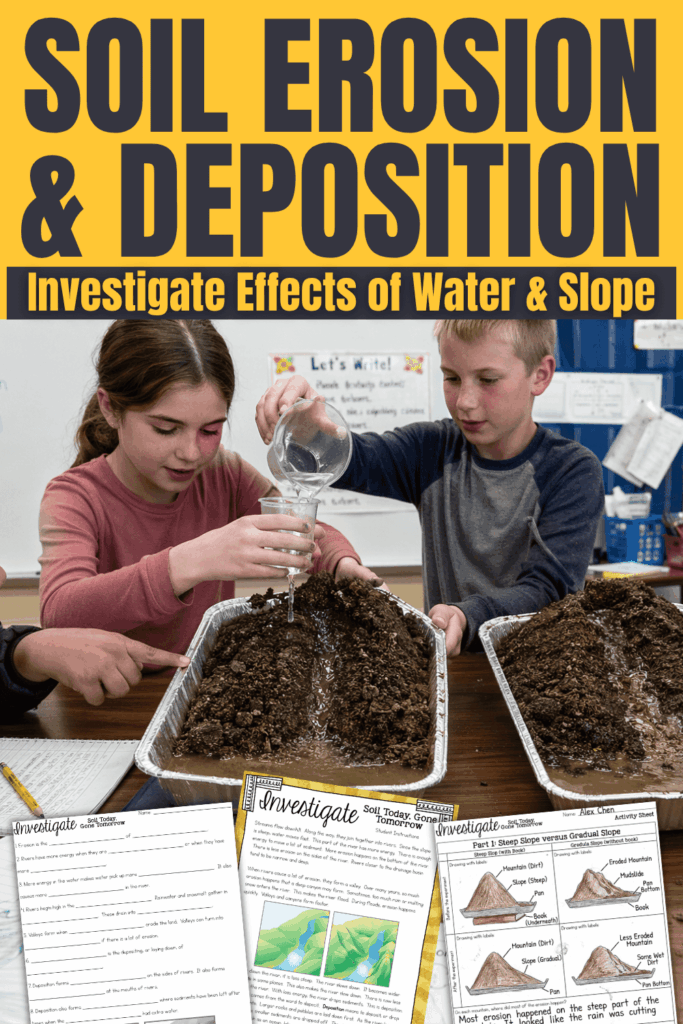
The Soil Today, Gone Tomorrow Investigate Station is one of eight stations in the Weathering and Erosion Science Stations unit for 4th grade, aligned to 4-ESS2.A and 4-ESS2.E.
See how this fits into the bigger picture: Earth Science for Elementary Students: 2nd–5th Grade Guide.
What Students Learn about Soil Erosion
Students begin by reading a short informational passage that introduces key concepts about river erosion and deposition. The reading builds the background knowledge they need to make sense of what they observe during the experiments. Here’s what the passage covers:
- What sediments are and how moving water carries them away (erosion)
- How water energy affects the amount of erosion in a river
- How drainage basins collect rainwater and snowmelt, which drains into streams and rivers
- How rivers flowing on steep slopes cause more erosion, creating valleys and canyons
- What happens when a river slows down and drops its sediments (deposition)
- How deposition forms beaches, deltas, and levees
- What the mouth of a river is and why deltas form there
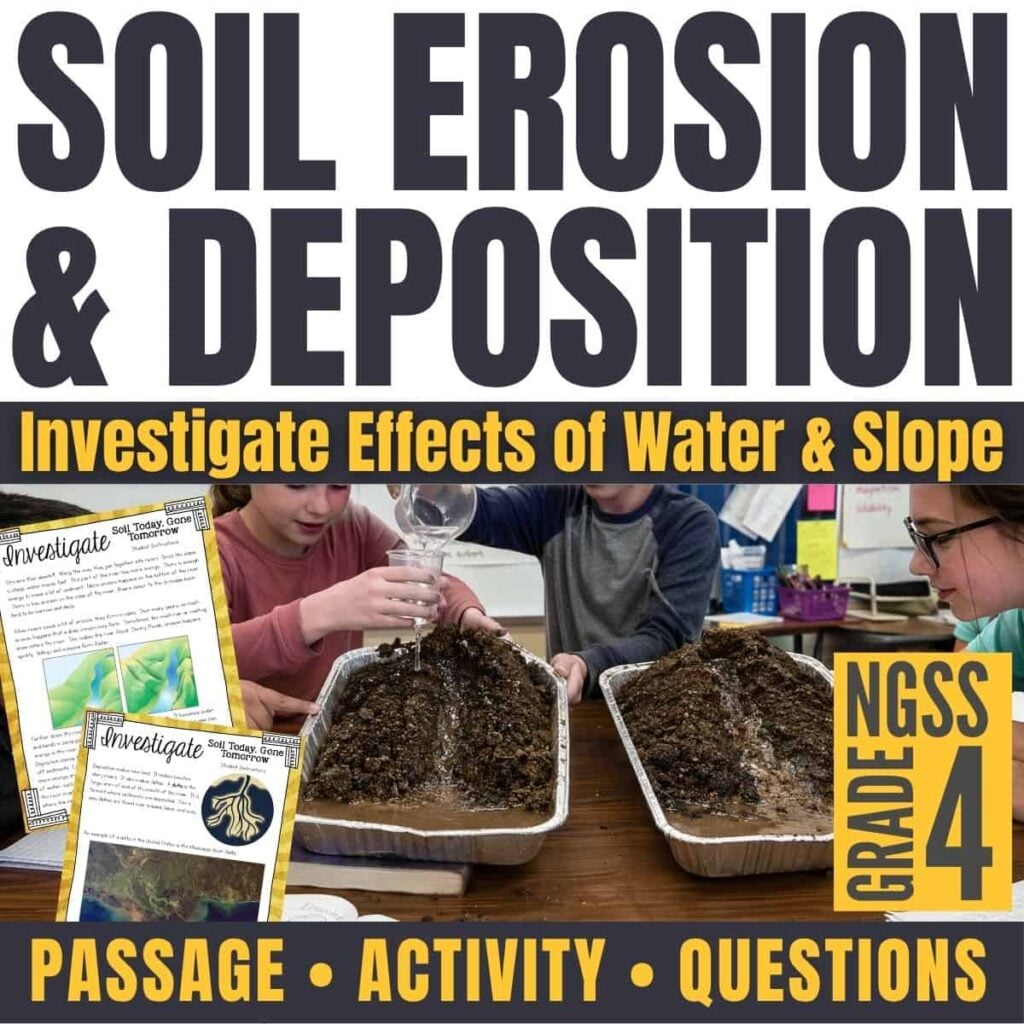
Designed for 4th-grade classrooms, this engaging station encourages students to observe, test, and analyze how water and slope affect soil movement.
Soil Deposition Lab Activity Overview
This is a three-part, hands-on investigation in which students compare variables to see how each affects erosion and deposition rates.
Part 1: Steep Slope vs. Gradual Slope Students build two identical soil mountains in separate pans. A book is placed under one pan to create a steep slope. Students draw their mountains before and after the experiment, then pour water through the “cloud” cups over each mountain and record what happens. The big question: Does the angle of the slope change how much erosion occurs?
Part 2: Straight Riverbed vs. Curved Riverbed Students dig a straight channel down one mountain and a curved channel down another. They run the same amount of water over each and compare where erosion occurs and where sediment is deposited. This part mirrors what happens in real rivers — curves naturally slow the water, which affects where sediment is deposited.
Part 3: One Cloud vs. Two Clouds Students test the effect of water volume by pouring one cup of water over one mountain and two cups over the other. This directly connects to what the reading passage explains about water energy and how more water leads to greater erosion.
Between experiments, groups observe and record on their activity sheets where erosion occurred most, where sediments were deposited, and how the results differed between the two setups.
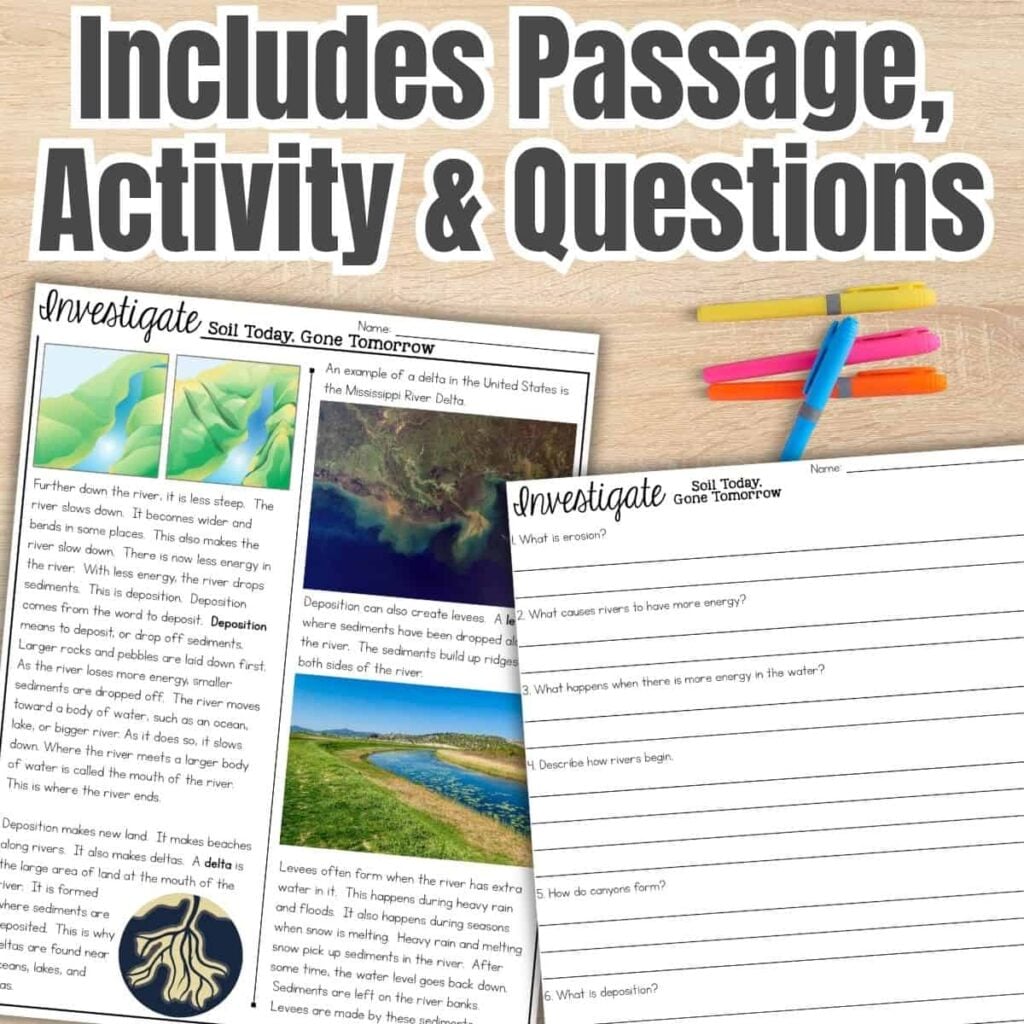
Soil Deposition Lab Student Sheets and Questions
The soil deposition lab includes multiple response options so you can easily match the format to your students’ needs.
Short-answer worksheets ask students to write out responses to seven questions — defining erosion, explaining what causes more energy in rivers, describing how rivers begin, and explaining how canyons and deposition features form. This format works well for students who can construct their own explanations.
Fill-in-the-blank worksheets come in two versions: one without a word bank (more challenging) and one with a full word bank included. The word bank version is a great support for students who struggle with writing or need extra scaffolding to access the vocabulary.
Multiple-choice task cards include 8 questions (numbered to match the short-answer and fill-in-the-blank sets) and are perfect for use with science journals. Students can answer in their journals rather than on a worksheet, which keeps things flexible during rotations.

What This Looks Like in the Classroom
- Station rotations: Set this up as one of your 8 weathering-and-erosion stations. Groups spend about 20 minutes here, which is enough time to complete one part of the investigation and record their observations.
- Assigned experiments: Instead of having every group do all three parts, assign each group a different part and have them share results at the end. This saves time and adds a collaborative element.
- Digital option: A Google Form with the reading passage and questions is included, along with Google Slides for the activity directions and worksheets — making this easy to assign in Google Classroom for hybrid or paperless setups.
Why This Activity Works So Well
Students Observe Science in Action
There is something about watching soil wash away and sediment pile up at the bottom of a pan that sticks with students in a way a textbook illustration just can’t. The three-part structure also helps students think like scientists — changing one variable at a time and comparing results. It’s the kind of activity students talk about afterward.
Vocabulary Becomes Meaningful
The reading passage introduces six key vocabulary terms — sediments, erosion, drainage basin, deposition, delta, and levee — in context, before students do the experiment. By the time they get to the activity, they already have language to describe what they’re seeing. The question sets reinforce those terms again, building retention without feeling repetitive.
Cross-Curricular Connections Are Built In
This station meets NGSS 4-ESS2.A and 4-ESS2.E, but it also connects to ELA standards 4.RI.1, 4.RI.3, 4.RI.4, and 4.RI.7 through the reading passage and comprehension questions. Students practice reading informational text, using context clues for vocabulary, and referring to the text to support their answers — all within a science activity.
It Supports Every Kind of Learner
The three differentiated response formats — short answer, fill-in-the-blank, and multiple choice — mean you’re not locked into one approach. You can assign different formats to different groups, or offer students a choice. The word bank version of the fill-in-the-blank is especially helpful for English language learners and students with reading challenges who still have a strong grasp of the concepts.
Easy Differentiation Ideas for this Water Erosion Activity
For additional support:
- Assign the fill-in-the-blank worksheet with the word bank
- Have students complete only Part 1 of the investigation so they can go deeper, rather than rushing through all three
- Pair students strategically so that stronger readers can help with the passage
For extension:
- Have advanced students visit the BBC Bitesize river processes link included in the station to explore more complex river terminology
- Ask groups to make a prediction before each experiment and write a claim-evidence-reasoning response after
- Assign students to create a short video or oral presentation of their results to share with the class
Bringing It All Together
By the end of this investigation, students can explain why different parts of a river look and behave differently — and they know the science behind it. They understand that steeper slopes create more energy, more energy causes more water erosion, and slowing water deposits sediments that build up over time into beaches, deltas, and levees. That is a lot of conceptual work packed into one well-structured station.
Designed for 4th-grade classrooms, this engaging station encourages students to observe, test, and analyze how water and slope affect soil movement.
Where to Get This Resource
This Soil Today, Gone Tomorrow Investigate Station is available as a standalone product or as part of the full Weathering and Erosion Science Stations bundle.
- Standalone station (TPT): INVESTIGATE Soil Erosion and Deposition – 4th Grade Science Station
- Full Weathering and Erosion Science Stations bundle: Weathering, Erosion, Deposition Science Stations – 4th Grade NGSS — includes all 12 stations covering physical weathering, chemical weathering, animal and plant erosion, glaciers, beavers, protective plants, and more.
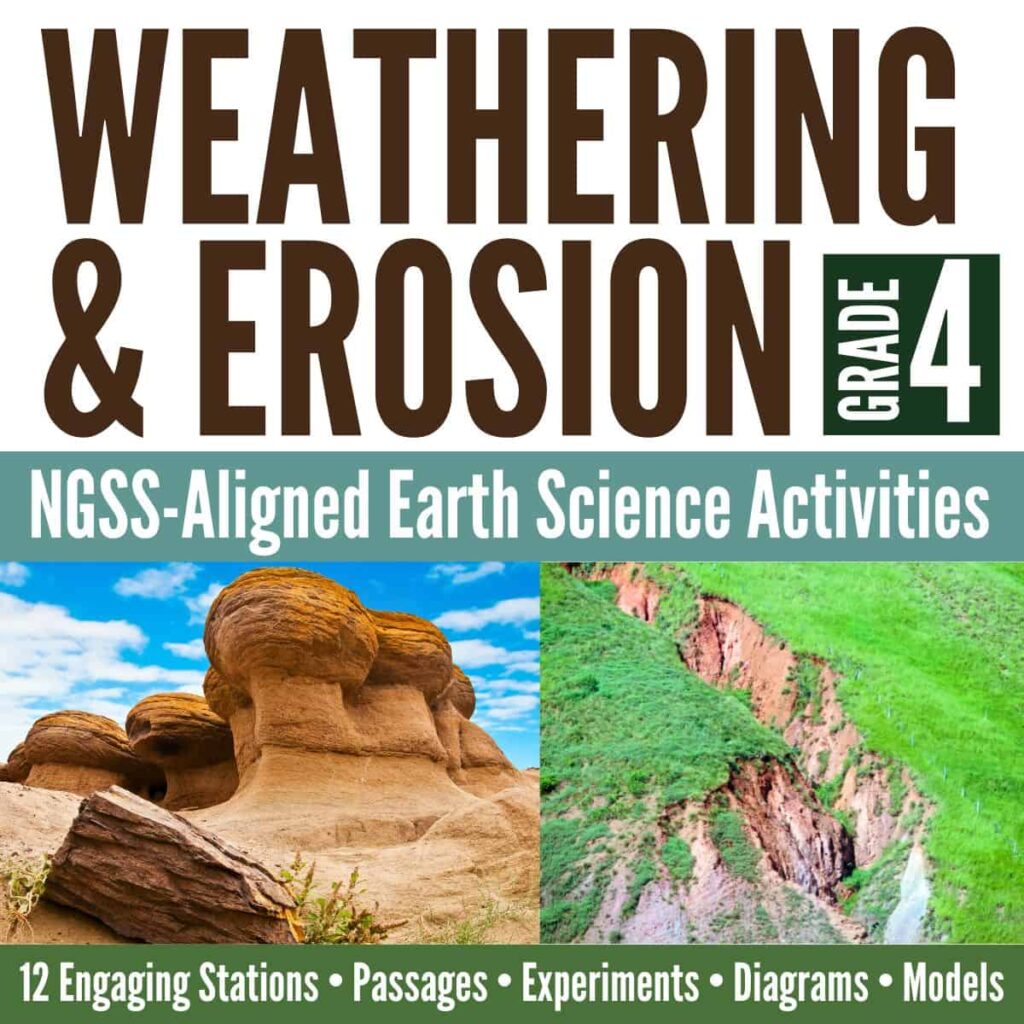
Weathering & Erosion – Earth Materials & Systems, Biogeology BUNDLE
Weathering & Earth Materials & Systems, Biogeology Fourth Grade Next Generation Science Standards include 12 different science stations where students deepen their understanding of how weathering and erosion change the Earth’s surface.
Looking for More Weathering Activities?
Take a look at these weathering and erosion science activities:
Jessica BOschen
Jessica is a teacher, homeschool parent, and entrepreneur. She shares her passion for teaching and education on What I Have Learned. Jessica has 16 years of experience teaching elementary school and currently homeschools her two middle and high school boys. She enjoys scaffolding learning for students, focusing on helping our most challenging learners achieve success in all academic areas.