
Rock-Breaking Plants: A Hands-On Weathering Activity for Kids
Teaching weathering can be tricky because the process happens so slowly in real life. We’re talking years, decades, even centuries. That’s exactly why this rock-breaking plants activity is so effective. Instead of just reading about how plant roots crack open rocks, students actually experience the process themselves using sand, needles, and a little bit of curiosity.
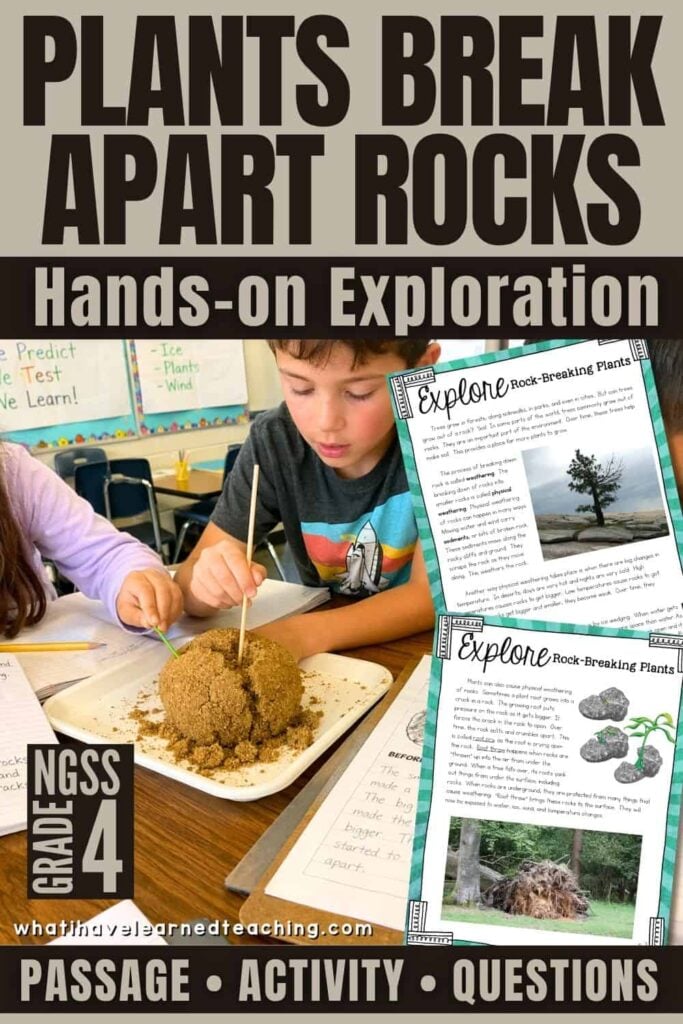
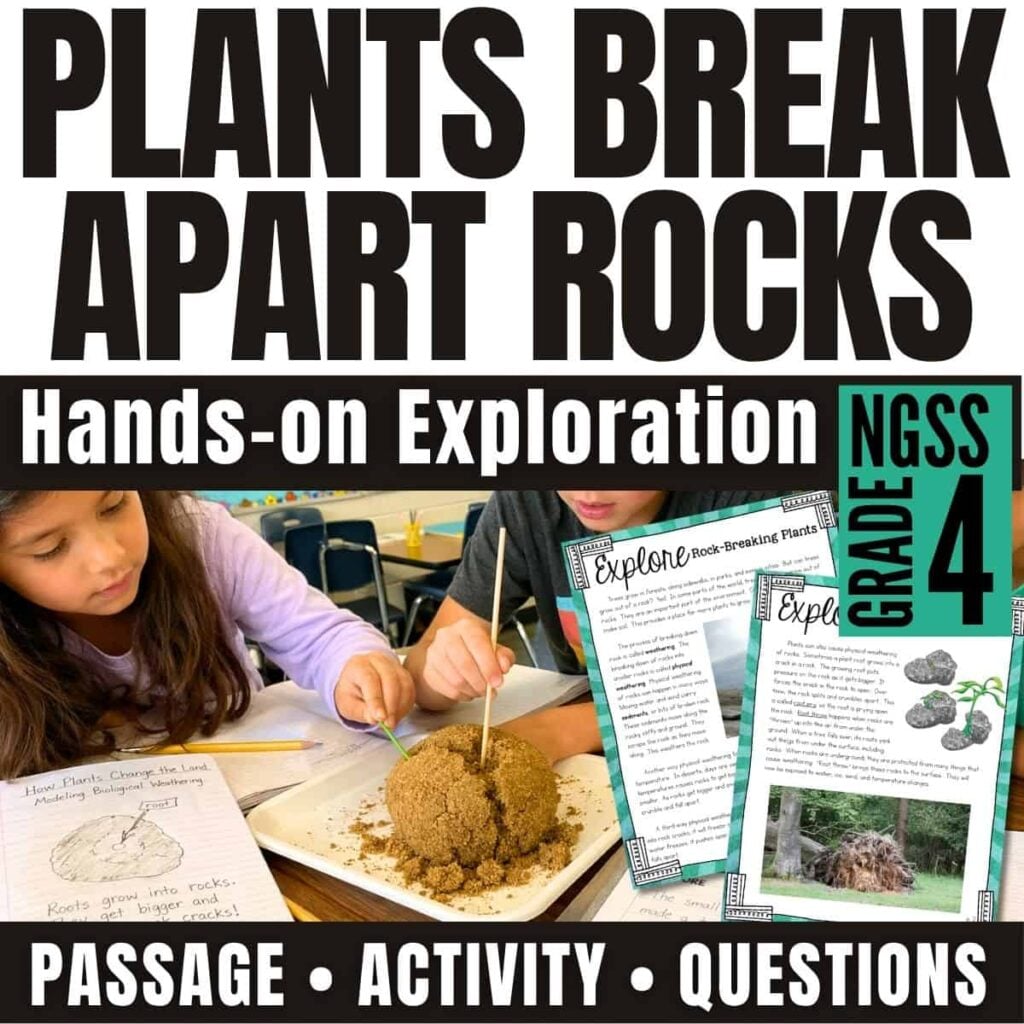
This hands-on exploration activity is part of the Weathering & Erosion Science Stations unit and aligns with 4-ESS2.A and 4-ESS2.E. It combines a reading passage, a guided activity, and comprehension questions that work together to help students truly understand how living things cause weathering.
This activity addresses 4-ESS2-1. For the full picture of how 4th-grade earth science standards connect, including fossils, plate tectonics, and natural resources — see the Earth Science Guide for Elementary Students.
What Students Learn About Rock-Breaking Plants
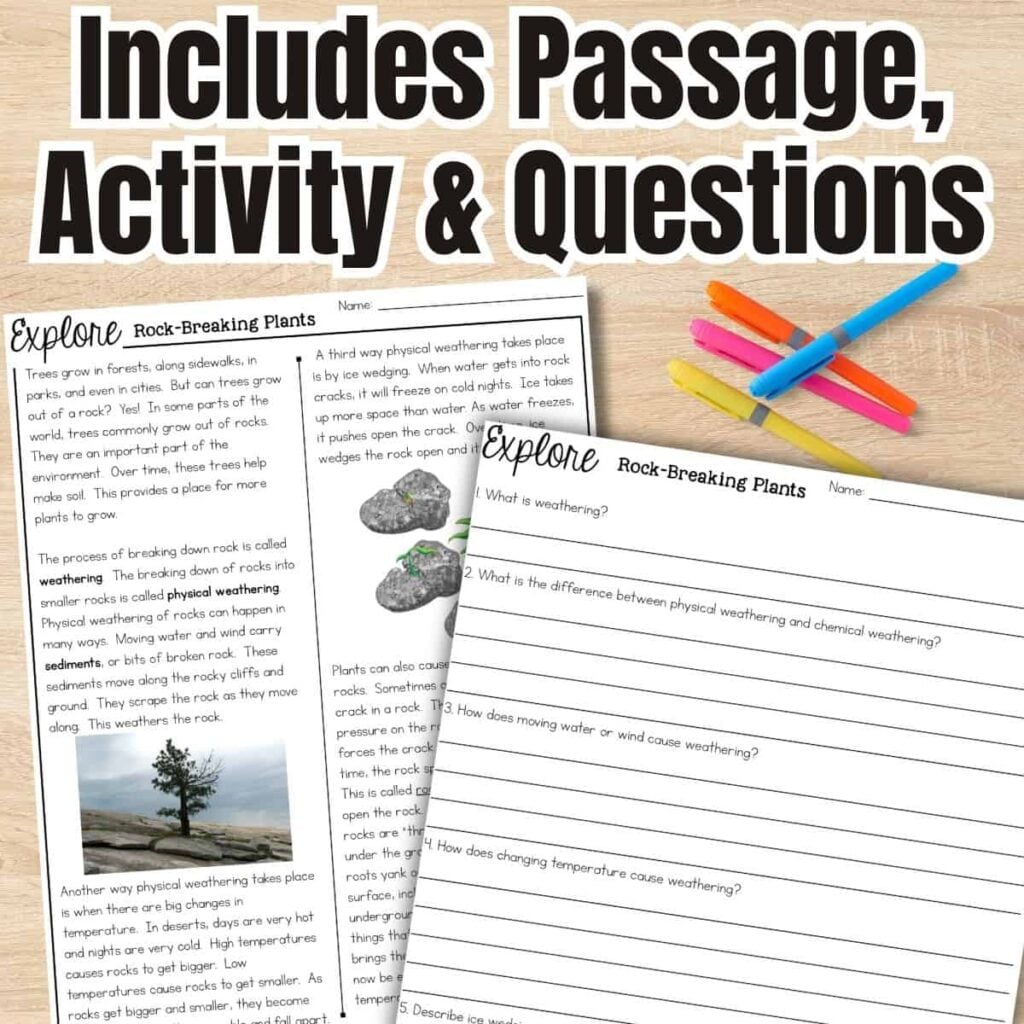
Before getting their hands into the sand, students read a three-page informational passage about how plants weather rocks. The passage covers both physical and chemical weathering, which gives students the full picture.
Key concepts students explore:
- Weathering is the process of breaking down rocks
- Physical weathering breaks rocks into smaller pieces
- Chemical weathering changes the minerals inside rocks
- Plants cause weathering through root pry, root throw, and acid from roots
- Mosses are often the first plants to grow in rocky places and play a key role in soil formation
The reading passage is written at an accessible 4th grade level and includes real photographs of plants growing from rocks and fallen trees with exposed root systems, visuals that help students connect the text to real-world examples they can recognize.
The Explore Activity: Simulating Plant Roots in Rock
This is where students really start to get it.
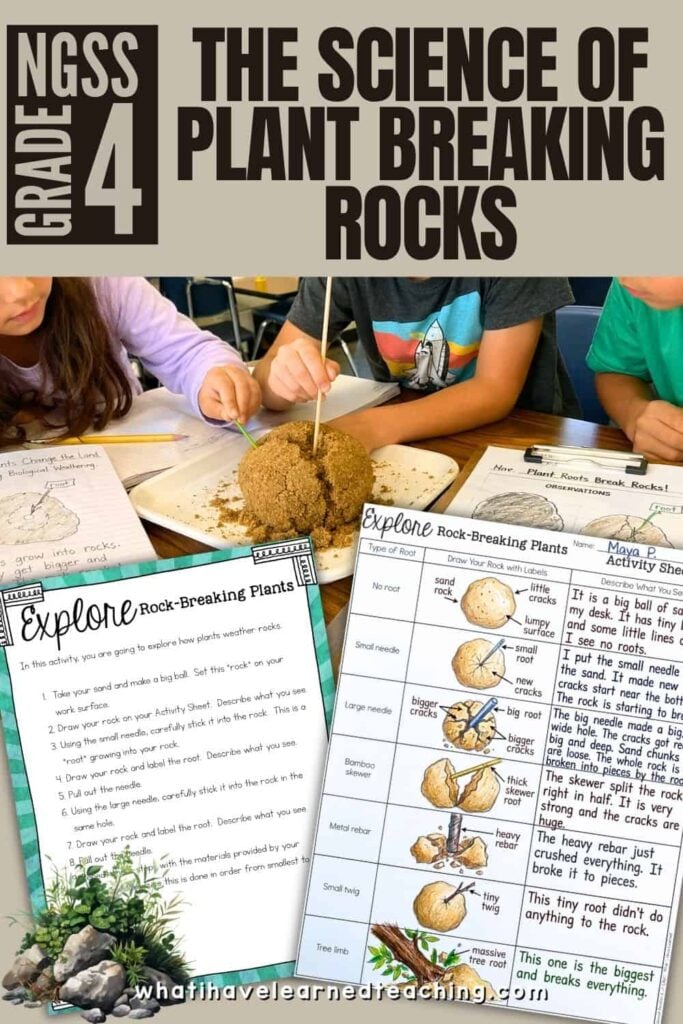
Students form a ball of kinetic sand (or moist sand) to represent a rock. Then, one by one, they push needles and other straight objects of increasing size into the “rock” — simulating how plant roots grow thicker over time and force cracks open.
Materials needed:
- Kinetic sand or moist sand (enough to make a large ball per group)
- Thin sewing needle (smallest from a needle set)
- Large yarn needle
- Assorted straight objects: toothpick, skewer, wooden dowels
- Student activity sheets
Steps students follow:
- Shape the sand into a ball and draw it on Activity Sheet #1
- Push in the smallest needle (a tiny “root”) and draw what they observe
- Remove the needle and push in the large yarn needle into the same hole
- Draw and describe what they observe
- Repeat the process with larger and larger objects in order from smallest to largest
As students work through the activity, they can see and feel the “rock” being pushed apart by each larger “root.” That’s the moment the concept clicks.
Activity Sheets and Questions
The activity includes two recording sheets that walk students through the experience and connect it back to the reading.
Activity Sheet #1 is a three-column chart where students draw their rock at each stage (no root, small needle, large needle) and describe what they observe. This develops scientific observation skills and helps students track changes over time.
Activity Sheet #2 asks students to reflect on the activity:
- What represented the rock? What represented plant roots?
- How big did the roots get before the rock split apart?
- How is this similar to how plants weather rocks in nature?
- How is this different?
These questions push students to make the connection between the classroom simulation and the real-world process — a key part of meaningful science learning.
Reading Comprehension Questions
After the hands-on activity, students answer questions about the reading passage. You have three differentiated options to choose from:
Short-answer questions ask students to explain concepts such as ice wedging, root pry, root throw, and chemical weathering in their own words. These work well for higher-level thinkers or as a written assessment.
Fill-in-the-blank (two versions — with and without a word bank) provides scaffolding for students who need support. The word bank version is especially helpful for English learners or students who need extra vocabulary support.
Multiple-choice task cards (9 questions) work great at a science station where students can respond in their science journals or on a recording sheet.
All three versions cover the same concepts, so you can mix and match based on your classroom needs.
What This Looks Like in the Classroom
This explore weathing activity for kids works well in a few different formats:
- Science station rotation — Students work through the activity in small groups while you pull other groups for instruction
- Whole-class lesson — Walk through the activity together as a class, then have students complete the questions independently
- Partner work — Two students share materials and take turns pushing in the “roots”
The rock-breaking plants station is designed to take about 20 minutes, making it a great fit for a science station rotation block. Since students share the kinetic sand, you won’t need a full set of materials for every student — one set per group of 2–4 works well.
One tip: kinetic sand can get dry over time. If the ball won’t hold its shape, add a tiny amount of water or use moist sand from outside.
Why This Activity Works So Well
1. It Makes an Invisible Process Visible
Weathering happens over hundreds or thousands of years — way outside the scope of what students can observe directly. This activity condenses that process into a few minutes, giving students a concrete mental model they can hold on to.
2. It Builds Vocabulary Naturally
By the time students finish the activity, words like root pry, root throw, sediments, and chemical weathering have real meaning. They’ve seen and felt what those words describe.
3. It Hits Multiple Standards at Once
This activity connects science content (4-ESS2.A, 4-ESS2.E) with ELA reading standards (4.RI.1, 4.RI.3, 4.RI.4, 4.RI.7). Students read informational text, answer text-dependent questions, and interpret vocabulary — all while doing science.
4. Differentiation Is Built In
The three-question format means you’re not creating extra work to meet different needs. You simply hand each student the version that’s right for them.
Easy Differentiation Ideas
For additional support:
- Use the fill-in-the-blank version with the word bank
- Allow students to work with a partner on the activity sheets
- Read the passage aloud before students work independently
For extension:
- Have students try the optional variation: repeat the activity with different sizes of “rocks” or place multiple “roots” in different spots
- Ask: What would happen if a root grew in the middle of a rock versus on the outside edge?
- Connect to the bigger unit: How does plant weathering compare to ice wedging or water erosion?
Would you like a printable version of these sentence-starters for your classroom? This resource includes anchor charts, bookmarks, and a hands-on sorting activity.
Bringing It All Together
By the end of this weathering activity, students don’t just know that plants can break rocks — they understand why it happens and how the process works. They’ve read about it, modeled it, observed it, and explained it in writing.
That’s the kind of learning that sticks.
If you’re teaching weathering and erosion this year, this rock-breaking plants explore station is one that your students will remember. There’s something very satisfying about pushing a dowel into a sand ball and watching it split apart — and knowing exactly why that matters.
This activity is part of the Weathering & Erosion Science Stations for 4th Grade, which includes 12 stations covering physical and chemical weathering, erosion, deposition, and more.
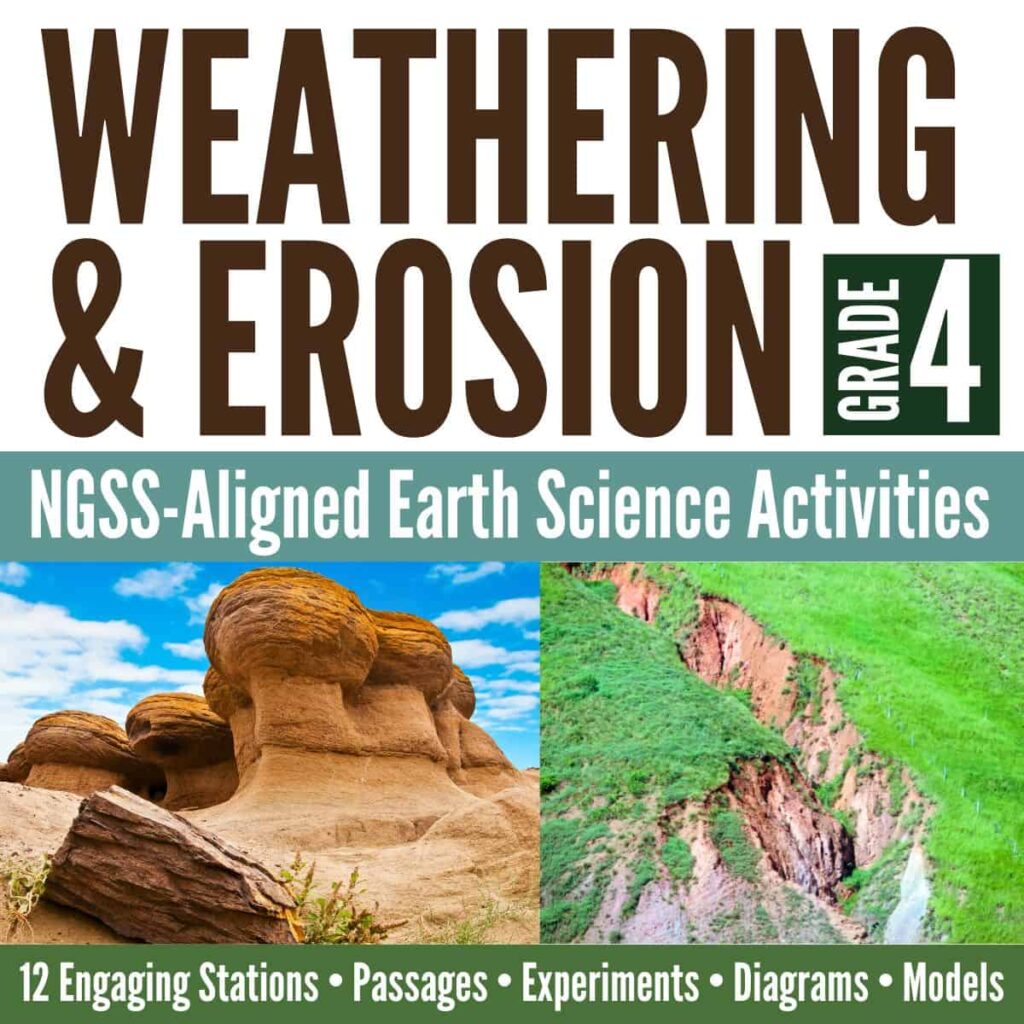
Weathering & Erosion – Earth Materials & Systems, Biogeology BUNDLE
Weathering & Earth Materials & Systems, Biogeology Fourth Grade Next Generation Science Standards include 12 different science stations where students deepen their understanding of how weathering and erosion change the Earth’s surface.
Jessica BOschen
Jessica is a teacher, homeschool parent, and entrepreneur. She shares her passion for teaching and education on What I Have Learned. Jessica has 16 years of experience teaching elementary school and currently homeschools her two middle and high school boys. She enjoys scaffolding learning for students, focusing on helping our most challenging learners achieve success in all academic areas.