
How to Prepare for Back to School as a Teacher: A Guide for New Teachers
Knowing how to prepare for back to school as a teacher is one of those things nobody tells you clearly enough before your first year. You know school starts in September, you know you need a classroom, and beyond that, it can feel like one big blur of things you’re supposed to have figured out already.
After 16 years in the elementary classroom, I can tell you that the teachers who have the smoothest first days are the ones who prepared well in the weeks leading up to it, not the ones who decorated the most Pinterest-worthy bulletin boards. Here’s what actually matters, organized so you can work through it without feeling overwhelmed.
Get to Know Your Students Before They Arrive
As soon as you receive your class list, start learning your students. Practice saying each name out loud — including names that are unfamiliar to you. If you’re not sure how to pronounce a name, ask a colleague, look it up, or write yourself a phonetic note. Getting a student’s name wrong on the first day — especially in front of the class — is a rough start to a relationship that you’ll be working to build all year.
If your school allows access to cumulative folders, student records, or notes from previous teachers, review them before the year starts. You don’t need to read everything, but knowing which students have IEPs, 504 plans, significant allergies, or documented behavioral history helps you prepare rather than react. If possible, introduce yourself to last year’s teachers and ask one question: “Is there anything I should know going into this year?” You’ll get more useful information in five minutes than you will from any file.
Some teachers send a summer postcard to each student before school starts — a short, friendly note letting students know you’re looking forward to meeting them. Kids love getting mail, and it starts the relationship before day one. It takes an afternoon but leaves a real impression.
Set Up Your Classroom With Intention
Your classroom setup directly affects how students move, work, and feel in the space all year. Before you start moving furniture, sketch the layout on paper. Think in zones — a whole-group meeting area, a small-group table where you can see the whole room, an independent work area with good traffic flow, and organized supply and storage spots students can access without asking you.
Don’t let the pressure to have everything perfect before day one push you into spending 60 hours in your classroom in August. A clean, organized room with a functional layout is more valuable than a perfectly decorated one. Students will fill the space with their work and personalities quickly — plan for that rather than trying to finish everything yourself before they arrive.
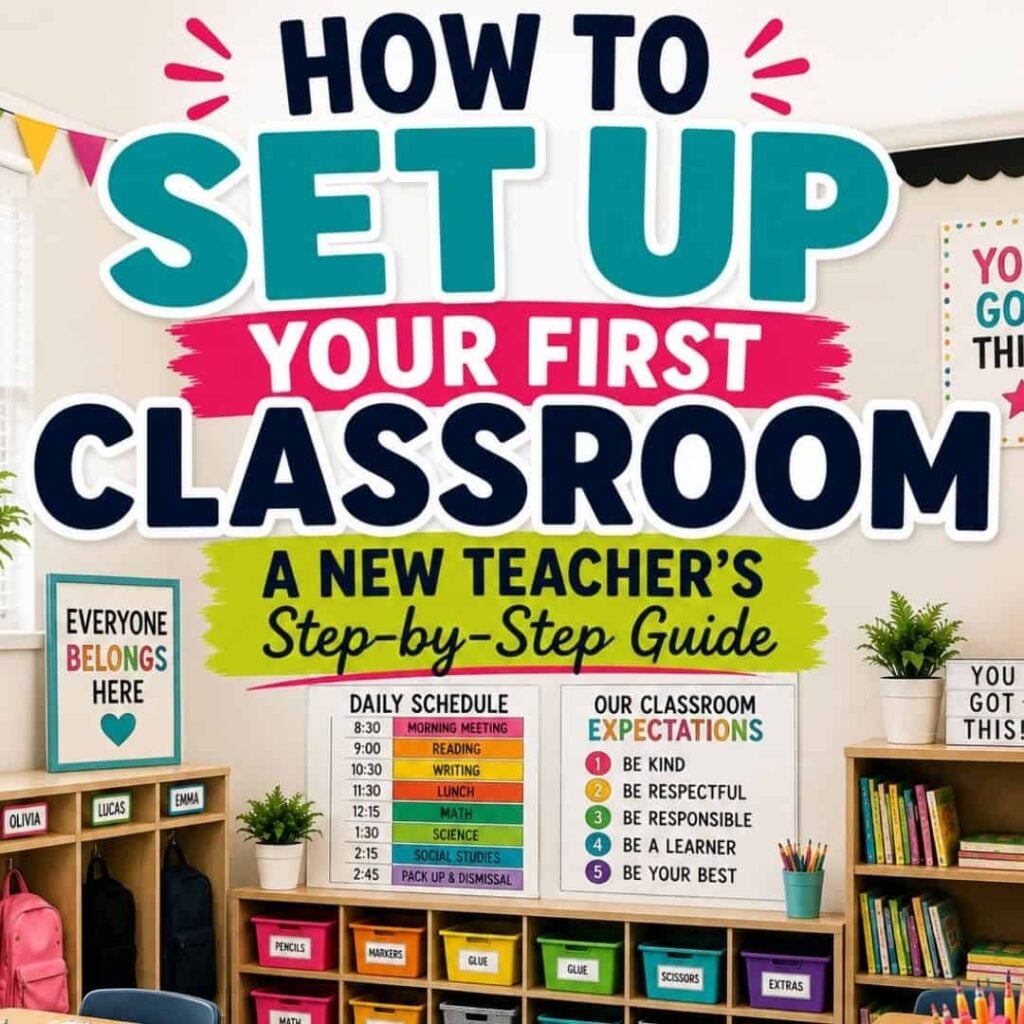
For a full walkthrough of how to approach your classroom layout, zones, storage, and front wall, see How to Set Up a Classroom for the First Time.
Plan Your First Week, Not Just Your First Day
New teachers often put enormous energy into planning the first day and then arrive on day two with almost nothing ready. Plan the whole first week before school starts — and then plan more than you think you’ll need, because timing is unpredictable until you know your class.
Your first week is not primarily about academic content. It’s about establishing routines, building community, and helping students feel safe in the space. Plan time for icebreakers, name games, classroom tours, and explicit instruction in procedures every day. Academic lessons should be woven in, but they shouldn’t be the focus. Students who don’t know the routines yet can’t learn effectively anyway.
Think through your daily schedule and identify any transition points that will need specific procedures: how students move from their desks to the carpet, how they get supplies, how they signal they need help. Every one of those transitions needs to be taught, modeled, and practiced in the first week. Plan for that time explicitly rather than assuming it will happen naturally.
For a complete list of procedures worth teaching in the first week, see 29 Classroom Procedures for Your Elementary Classroom.
Prepare Your Parent Communication
Your first letter home to families sets the tone for your relationship with parents and caregivers for the entire year. Write it before school starts so you’re not scrambling in the first week. It should introduce you warmly, explain a few key things about the year ahead (schedule, supplies, communication preferences), and let families know the best way to reach you.
Keep it readable — a one-page letter in plain language is far more effective than a two-page document full of school jargon. For specific tips on what to include and how to phrase it, see 6 Tips for Writing the Perfect First Letter Home.
Also decide before school starts how you’ll communicate with families throughout the year — email, a class app, a weekly newsletter, or a combination. Whatever you choose, set it up and test it before the first day so it’s ready to go when you need it.
Learn the School’s Systems and People
Before school starts, spend time learning the building and the people who keep it running. Introduce yourself to the office staff, custodians, librarian, and specialists. These are the people who will help you most in your first year — they know where things are, how things work, and who to call when something goes wrong. Building relationships with them before the year starts pays off every time something comes up.
Learn the logistics: Where do you make copies? Where do supplies come from? Who do you call if a student is sick? What’s the dismissal procedure? What’s the fire drill protocol? These questions feel small until you don’t know the answer in the middle of a school day. Find out ahead of time.
If your school assigns a mentor teacher or has a new teacher orientation, take full advantage of it. Ask every question you have. No question is too basic. Experienced teachers generally want to help — they remember what their first year felt like.
Stock Your Classroom and Organize Your Supplies
Find out what your school provides and what you’re expected to supply yourself before you spend money on anything. Many schools provide basic supplies; others provide almost nothing. Ask your department chair, grade-level team, or office manager what’s included — it will save you from buying things you don’t need and from being surprised by items that aren’t there.
Organize your supplies before students arrive. Label storage areas clearly, set up supply stations students will use, and assemble anything that needs it (folders, pencil boxes, organizational systems). The less time you spend managing supply chaos in the first week, the more time you have for actual teaching.
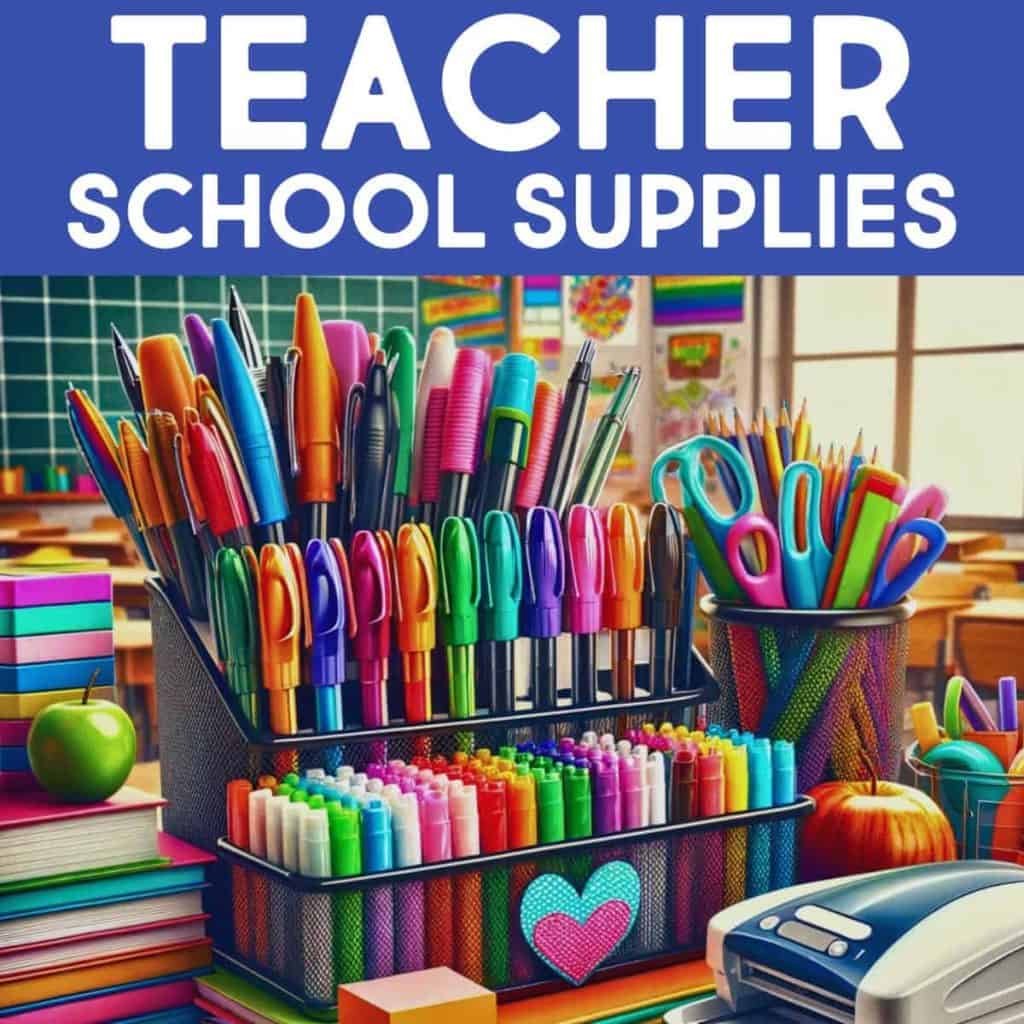
If you’re building your classroom supply list from scratch, 70+ Must-Have Teacher School Supplies is a good place to start.
Prepare Your First-Day Activities in Advance
Have your first-day plan completely ready before the year starts — not outlined, but actually ready. Every activity should have its materials pulled, its instructions written out, and its timing estimated. The first day is disorienting enough without also trying to improvise.
One thing I always have ready before students arrive: something waiting on each desk when they walk in. It gives students a job to do immediately and gives you time to greet families at the door. My go-to is a puzzle piece and a box of crayons — students write their name and color the piece, and later in the day we assemble the class Community Building Puzzle together. It’s a low-prep activity that also becomes the first bulletin board display of the year.

Community Building Puzzle Activity Back to School Team Building
Build classroom community with this collaborative community building puzzle activity! Students decorate individual puzzle pieces, work together to assemble the class puzzle, and create a meaningful back-to-school display that celebrates teamwork and belonging.
Plan more activities than you think you’ll need. First-day timing is unpredictable — assemblies run long, dismissal takes twice as long as expected, or a lesson lands in ten minutes that you thought would take thirty. Having extra in your back pocket means you’re never scrambling.
For 30 first-day activity ideas organized by type, see First Day of School Activities for Elementary Classrooms.
Take Care of Yourself Before the Year Starts
This is the one that most new teachers skip entirely, and it matters more than almost anything else on this list. Teaching is physically and mentally demanding in a way that is hard to understand until you’ve done it. The first month of school is especially intense. You’re making thousands of decisions a day while also building 25 new relationships from scratch.
Before school starts, rest. Do things that aren’t school. Spend time with people who have nothing to do with education. Sleep well. You cannot run on fumes in September and expect to build the kind of classroom community that makes the whole year easier. Taking care of yourself before the year starts is part of preparing for back to school — not an indulgence you’ll get to later.
Back to School Preparation Checklist for New Teachers
Use this checklist in the weeks before school starts to make sure you’ve covered the essentials:
Know Your Students
- Receive and review your class list
- Practice pronouncing every student’s name
- Review IEPs, 504 plans, and relevant records
- Connect with last year’s teachers if possible
- Send a summer postcard or welcome note to students (optional but impactful)
Set Up Your Classroom
- Sketch your room layout before moving anything
- Arrange furniture with zones and traffic flow in mind
- Label supply areas and student storage
- Post daily schedule and classroom expectations
- Prepare a first-day morning activity to place on each desk
Plan Your First Week
- Write out lesson plans for the full first week
- Plan more activities than you think you’ll need
- Identify every procedure that needs to be explicitly taught
- Plan at least one community-building activity per day
- Have all first-day materials pulled and ready
Communicate With Families
- Write your first letter home to families
- Decide how you’ll communicate with parents throughout the year
- Set up your communication platform (email list, class app, etc.)
Learn the School
- Introduce yourself to the office staff, custodians, librarian, and specialists
- Learn where to make copies, get supplies, and find key staff
- Find out the dismissal procedure, fire drill protocol, and emergency plans
- Attend the new teacher orientation and ask every question you have
Supplies and Materials
- Find out what the school provides vs. what you need to purchase
- Organize and label classroom supply areas
- Set up teacher materials (gradebook, planning binder, communication log)
Take Care of Yourself
- Rest before the year starts
- Do something that has nothing to do with school
- Plan at least one thing each week that recharges you
Final Thoughts on how to prepare for Back to School as New Teachers
Preparing for back-to-school as a new teacher is a lot — there’s no way around that. But most of the stress comes from not knowing what to prioritize, not from the work itself. Focus on your students first, your first week second, and the decorative details last. A classroom where students feel known, where routines are clear, and where the teacher is rested and present will always outperform the most beautiful room in the building.
Looking for ready-made resources for your first week? The Community Building Puzzle is designed for day one — students decorate their piece when they walk in, and the class assembles it together. The Getting to Know You Small Group Craftivity is a natural follow-up for the first week.
Jessica BOschen
Jessica is a teacher, homeschool parent, and entrepreneur. She shares her passion for teaching and education on What I Have Learned. Jessica has 16 years of experience teaching elementary school and currently homeschools her two middle and high school boys. She enjoys scaffolding learning for students, focusing on helping our most challenging learners achieve success in all academic areas.