
Classroom Library Ideas for Elementary Teachers: Organization, Labels, and Checkout Systems
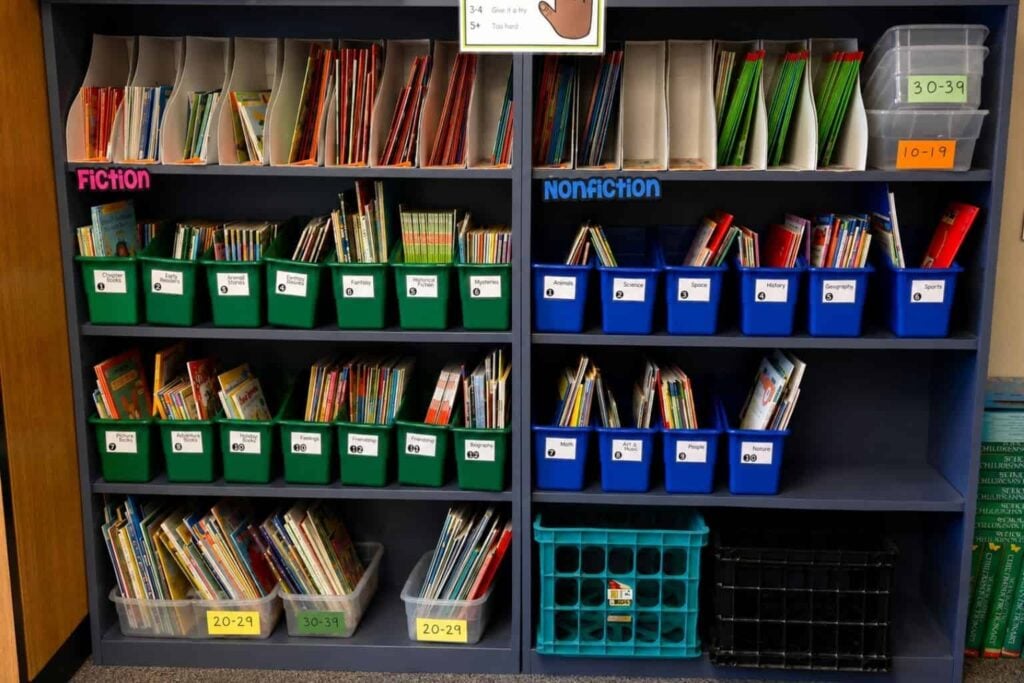
For years, my classroom library was a mess. I had picture books and chapter books mixed together, guided reading books on a separate shelf, and a system that kept falling apart because I didn’t have time to re-sort what students put back in the wrong place. At one point, I gave up and just had students return books to baskets on the floor. At least the floor baskets stayed somewhat manageable. Eventually, I figured out a system that actually held up: two box colors to separate fiction from nonfiction, numbers to identify each category, and matching numbers inside every book cover.
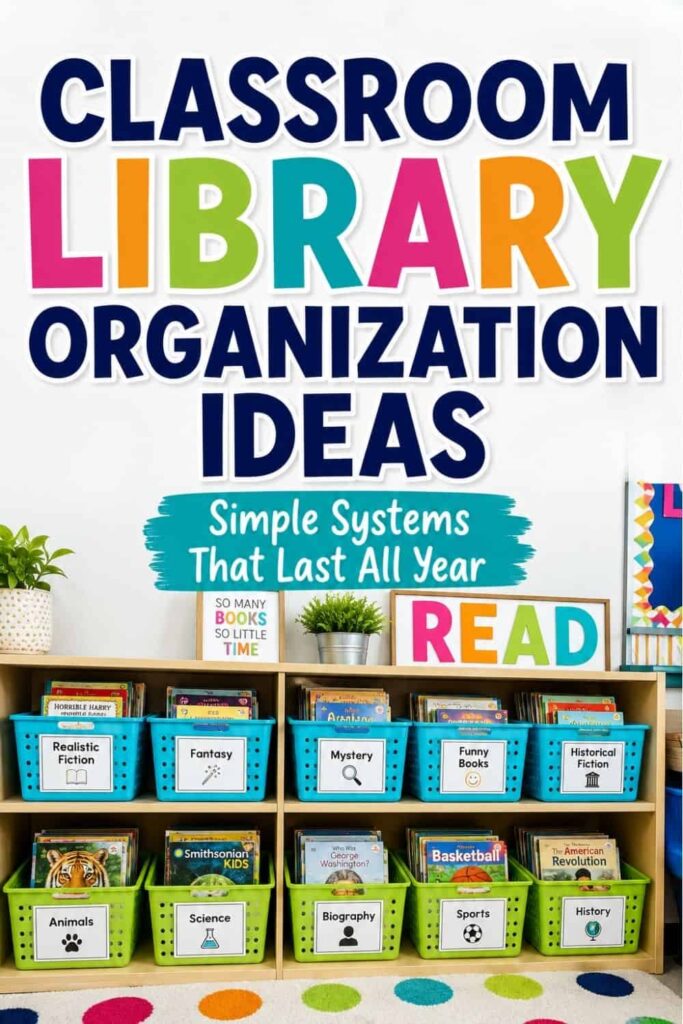
These classroom library ideas come from working through all of that the hard way. This post covers the full picture: how to organize your books, how to label them so students can return them correctly, how to set up a checkout system, and how to teach students to maintain the library themselves.
Where to Put Your Classroom Library
The location of your library matters more than most teachers realize. A library tucked in a back corner feels like a separate area, something students go to when they’re finished with real work. A library positioned where students pass it throughout the day becomes part of the classroom fabric. When students walk past books constantly, they notice titles, remember what they want to read next, and return to the library more naturally.
If your room allows it, position the library near a high-traffic area: the carpet meeting space, the door, or a path students use during transitions. You don’t need a dedicated reading nook with a rug and a lamp (though those are nice if you have the space). What matters most is visibility and access.
How to Organize Classroom Library Books
There is no single right way to organize a classroom library, and anyone who tells you otherwise is selling something. The best system is the one your students can actually navigate independently. Here are the most common approaches and when each makes the most sense.
By Genre and Topic
Organizing by genre and topic is the most common approach in K–5 classrooms, and for good reason. Students browsing for something to read tend to think in terms of what they’re interested in (dinosaurs, mysteries, funny books, friendship stories) rather than author names or reading levels. Grouping books by topic or genre mirrors how students actually browse.
For fiction, common genre bins include realistic fiction, fantasy, mystery, humor, and historical fiction. For nonfiction, topic bins work better than genre: animals, science, biography, history, and sports. The key is using categories your students understand, not technical literary terms. “Funny Books” works better than “Humorous Fiction” for a second grader.
In my second-grade classroom, my nonfiction categories ended up as: mammals, insects and reptiles (including dinosaurs), ocean life, Magic School Bus, biographies, sports, math, animals (mixed), social studies, and science. Social studies and science became broader catch-all categories because I didn’t have enough books in those specific topics to justify separate bins. That’s fine. A “Science (Mixed)” bin is more useful than five half-empty bins. For fiction, I created categories based on what I actually had: series bins for Magic Tree House, Junie B. Jones, and Henry and Mudge, plus genre bins for humor, realistic fiction, and easy readers. I also kept an “I Can Read” bin for early readers that didn’t fit neatly anywhere else.
By Series and Author
Series bins are highly effective in classrooms where students are deep into chapter-book series such as Magic Tree House, Diary of a Wimpy Kid, Dog Man, and I Survived. When all books in a series are kept together, students can find the next book without help and develop a habit of reading in sequence. This works particularly well in grades 2–5, where series reading is common.
Organizing by author works well for picture book sections, especially in K–2 classrooms where students develop strong favorites (Mo Willems, Kevin Henkes, Elephant and Piggie). It also gives students early exposure to the concept of authors, which supports library and bookstore skills later.
Sort First, Then Decide on Categories
Most classroom library advice tells you to decide on your categories first, then sort your books into them. That doesn’t work in real classrooms, where you inherit a random collection of books with no obvious pattern. The better approach: pull all your books off the shelves and sort them into loose piles first. See what you actually have. Then figure out which categories are justified by your actual collection.
You’ll quickly see where you have enough books to create a dedicated bin and where you need to combine topics into a broader category. A bin needs at least 8-10 books to be worth having. Fewer than that, and students can’t really browse it. If you only have four books about weather, they go in a “Science (Mixed)” bin until you have enough to split them out. Categories should reflect your actual library, not an ideal library you don’t have yet.
A Note on Leveled Libraries
Leveled libraries, where books are sorted by reading level, and students are restricted to certain bins, have a significant downside: students know exactly where they stand relative to their peers. The student who can only browse the low-level bins learns something about themselves that goes far beyond reading. An interest-based organization allows every student to browse the whole library, and research consistently shows that interest is one of the strongest predictors of reading comprehension. A student reading about a topic they love will often understand material above their measured level. Dr. Rudine Sims Bishop’s research on mirrors, windows, and sliding glass doors speaks to why the books students can access matter deeply to how they see themselves as readers.
If you use reading levels to select guided reading groups, you don’t need to impose them on independent library browsing. Keep them for instruction. Let the library be open.
Bins and Baskets vs. Spines Out
The great classroom library debate. Both systems work, and the right choice depends on how many books you have, your shelf setup, and your students’ ages.
Book bins and baskets make sense when you have fewer books per category, when students need visual categories to navigate, and when you have shelf space that accommodates bins. They work especially well for picture books and nonfiction, where browsing by cover is natural. The downside: bins require matching labels, books get jumbled quickly, and covers can tear when students repeatedly dig through bins. Bins also limit how many books can fit in each category without making it too crowded to browse.
Spines out on shelves, with color-coded spine labels by genre or author, works well for larger chapter book collections. Students can see every title at a glance, books stay in better condition, and the system looks clean even after heavy use. The learning curve is higher: students need to know how to read spines and understand the color-coding system before they can browse independently. This method typically works better in grades 2–5.
Many teachers use a hybrid: bins or baskets for picture books and nonfiction, spines out for chapter books. Start with what you have and adjust after you’ve watched how your students use the space.
Labeling Books for Your Classroom Library
Labeling is what makes the difference between a library that students can maintain and one that devolves into chaos by November. The goal is simple: when a student picks up a book, they should be able to tell at a glance exactly where to return it. If that’s not obvious from the label, the system will fail.
Colored Dot Sticker System
One of the most durable labeling systems for classroom libraries uses two box colors (one for fiction, one for nonfiction) as the first sorting layer, then a number for each specific category within that color. Every book gets a colored dot sticker on the inside front cover (not the outside; placing it inside keeps the cover clean) that matches the category number. Students returning a book match the color to the right side of the library, then match the number to the right bin. Simple, cheap, and legible even for early readers who can’t yet read bin labels.
One practical note on bin capacity: regular chapter books like Magic Tree House or Junie B. Jones can fit two books across in a standard book bin. Early readers like Henry and Mudge are thicker and only fit one across, so plan for two bins if you have a large collection of those. Knowing this before you label saves you from having to reorganize after the fact.
Genre Labels for Your Classroom Library
Genre labels serve two purposes: they identify where a book belongs on a shelf or in a bin, and, when placed on the spine or cover of each book, they tell students where to return it. Effective genre labels for a classroom library use both a word and a visual symbol or color so students at different reading levels can use them. A “Mystery” label with a magnifying glass icon is readable by a student who can’t yet decode the word.
Laminate your bin labels so they hold up through the year. For spine labels, small Avery sticker labels work well: they adhere cleanly, don’t damage books, and can be color-coded by genre. Label the spine near the bottom so it’s visible even when books are shelved closely together.
What to Do With Unlabeled Books
Most teachers add books to their library faster than they can label them. Keep a “to be labeled” basket near your desk. When you have ten minutes, or when you need a task for a student who finishes early, label a stack. Don’t let unlabeled books circulate freely; they’ll end up in the wrong bin immediately and stay there.
Setting Up a Classroom Library Checkout System
A classroom library checkout system is one of the most skipped pieces of classroom library setup, and one of the most useful. Without a system, books disappear into backpacks and never come back, and you have no way to know what’s missing until it’s too late to ask for it.
The good news is that a checkout system doesn’t have to be complicated to work. Here are three approaches that hold up in real classrooms:
Simple Sign-Out Sheet or Binder
A sheet of paper in a binder near the library with columns for student name, book title, date checked out, and date returned. Students fill it in when they take a book home and cross it off when they return it. This requires no technology, costs nothing, and gives you a clear record of what’s out. The downside is that students forget to sign out, and enforcement falls on you. Works best in grades 2–5 where students can fill it out independently.
Library Pocket Cards
Glue a library pocket inside each book and put a card inside. When a student checks out the book, they write their name on the card and put it in a designated “checked out” holder near the library. When the book comes back, the card goes back inside the book. This is a tangible, concrete system that works well with younger students. There’s a satisfying physical action to the checkout, and the empty pocket on the shelf shows the book is out. Grades K–3.
Digital Checkout With a Spreadsheet or App
A shared Google Sheet with student names and book columns works for upper elementary students who use Chromebooks. Apps like Book Buddy allow you to scan book barcodes and track checkouts digitally. Digital systems make it easy to see at a glance what’s checked out and by whom, which is useful at the end of the year when you’re collecting books. The setup time is longer, and it requires students to have access to a device at checkout. Grades 3–5.
Whichever system you choose, keep it near the library and make checking out part of the library routine you teach explicitly in the first week. A checkout system that students don’t know how to use is no system at all.
Teaching Students to Use and Maintain the Library
This is the piece most classroom library posts skip, and it’s the reason so many libraries look great in September and chaotic by December. The library will only stay organized if students know how to use it, and that knowledge has to be explicitly taught, not assumed.
In the first week of school, walk students through the library the same way you’d teach any other classroom procedure. Show them how books are organized, where each category lives, how to browse without pulling out ten books at once, how to return a book to the right spot, and how the checkout system works. Then practice it. Have students find a specific book, return it correctly, and check it out. Repeat until it’s automatic.
After that initial training, the best way to maintain the library is the Classroom Librarian job. Assign one or two students per week to check the library at the end of each day: straightening bins, pulling misplaced books, and flagging anything that’s damaged. Students take this job seriously when it’s a real classroom responsibility. It’s one of the most effective classroom jobs for elementary students because the task is concrete, visible, and genuinely needed. See how to implement classroom jobs for setting up the full rotation system.
Classroom Library Ideas for Kindergarten
A kindergarten classroom library needs to work for students who are just beginning to understand books as objects, and who will handle them roughly, leave them face-down, and occasionally try to take them home in their pockets. A few ideas that hold up:
- Use picture symbols on all bin labels, not just words. A bin labeled “Animals” with a picture of a dog tells a pre-reader exactly what’s inside. Pair a simple picture with each category label throughout the library.
- Fewer, larger categories. Kindergartners don’t need 15 genre bins. Start with 4-6 large categories (Funny Books, Animal Books, Alphabet Books, Stories, Nonfiction, Big Books) and expand as students show they can navigate the system.
- Keep board books and picture books separate. Board books can handle more handling and work well for browsing bins. Regular picture books stay in better condition with a spine-in bin, so covers don’t curl.
- Library pocket checkout cards are the most kindergarten-friendly checkout system: concrete, simple, and teach the concept of borrowing and returning without requiring reading or writing beyond a student’s name.
- Model and practice library use repeatedly in the first month. Five-year-olds need more repetitions than older students before a routine becomes automatic. Build a library visit into your daily schedule so it becomes a consistent habit.
Building Your Classroom Library on a Budget
Most teachers build their classroom libraries out of pocket, gradually, over many years. A few sources that consistently yield the best results:
- Scholastic Book Clubs: Teacher points from student orders add up quickly and can be redeemed for free books. Dollar books and discounted series make this one of the highest-value sources for building a library fast.
- Library book sales: Public libraries weed their collections regularly and sell discarded books for 25 cents to a dollar. You can often find excellent titles in near-perfect condition.
- Facebook Marketplace and eBay: Parents and retiring teachers regularly sell large lots of children’s books. A $20 lot can add 30-50 titles to your library.
- DonorsChoose: Writing a grant specifically to build your classroom library is one of the most funded project types on the platform. Be specific about what you need and why.
- Amazon Wish List: Share a wish list with families at the beginning of the year. Students who contribute book recommendations to the list feel a sense of ownership over what gets added.
Final Thoughts on Classroom Library Organization
The classroom library ideas that make the biggest difference long-term aren’t the aesthetic ones (the matching bins, the perfect labels, the reading corner rug). They’re the procedural ones: how students learn to use the library, how books get returned to the right place, how checkouts are tracked, and who’s responsible for keeping it organized. Set up those systems in the first week, teach them the way you’d teach any other classroom procedure, and your library will still be functional in June.
Jessica BOschen
Jessica is a teacher, homeschool parent, and entrepreneur. She shares her passion for teaching and education on What I Have Learned. Jessica has 16 years of experience teaching elementary school and currently homeschools her two middle and high school boys. She enjoys scaffolding learning for students, focusing on helping our most challenging learners achieve success in all academic areas.