
Types of Weathering Sort Activity for 4th Grade Science
One of the best ways to know if students truly understand a concept is to ask them to categorize it. That’s exactly what this Types of Weathering Sort Activity does. Instead of just answering questions about weathering, erosion, and deposition, students have to examine real images of landforms and determine what caused them — water, ice, wind, biological forces, or chemical weathering.
It’s a deceptively simple task that requires a surprisingly deep level of thinking.
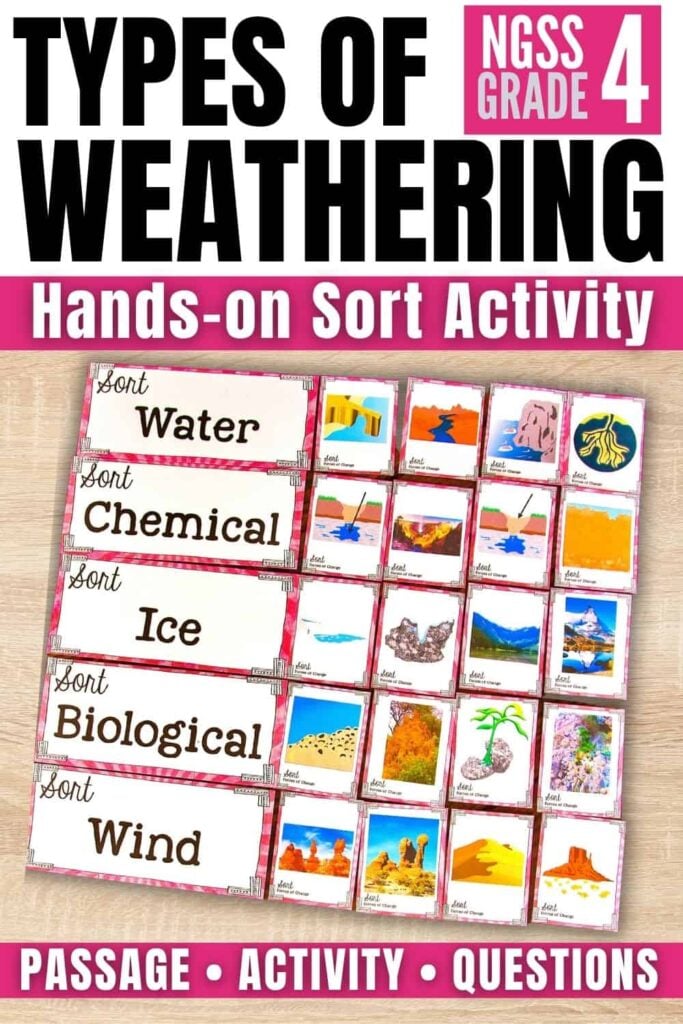
This sort station is part of the Weathering & Erosion Science Stations unit for 4th grade and aligns with 4-ESS1.C, 4-ESS2.A, and 4-ESS2.E. It combines a reading passage with a hands-on picture sort and differentiated comprehension questions — everything you need for a complete science station.
What Are the 5 Types of Weathering?
Before students can sort, they need to understand what weathering is and how each force works differently. Here’s a quick overview of the five types covered in this activity.
Water Weathering Water is one of the most powerful forces of weathering. Rivers carry sediments that scrape against riverbeds, carving V-shaped valleys and canyons. Ocean waves pound against cliffs, slowly breaking off pieces of rock. Water is the main force behind some of Earth’s most dramatic landforms, including the Grand Canyon.
Ice Weathering When water seeps into cracks in rocks and freezes, it expands. This pushes the crack open a little wider. When the ice thaws, more water seeps in, and the cycle repeats. Over time, this process — called ice wedging — breaks off chunks of rock. Glaciers also shape the land, carving out wide U-shaped valleys and bowl-shaped cirques in mountains.
Wind Weathering Wind carries sediments that act like sandpaper, scraping rocks into unusual shapes. Over time, wind erosion forms features like sand dunes and the towering hoodoos found in Bryce Canyon.
Biological Weathering Plants and animals cause biological weathering. Tree roots grow into tiny cracks in rocks and, as the roots expand, they split the rock apart. Burrowing animals move rocks underground to the surface, where they become exposed to other weathering forces.
Chemical Weathering Chemical weathering changes the minerals inside rocks. When oxygen mixes with iron in a rock, the iron rusts and the rock crumbles. When rainwater mixes with carbon dioxide, it forms a weak acid that dissolves rocks like limestone, creating underground caves and sinkholes.
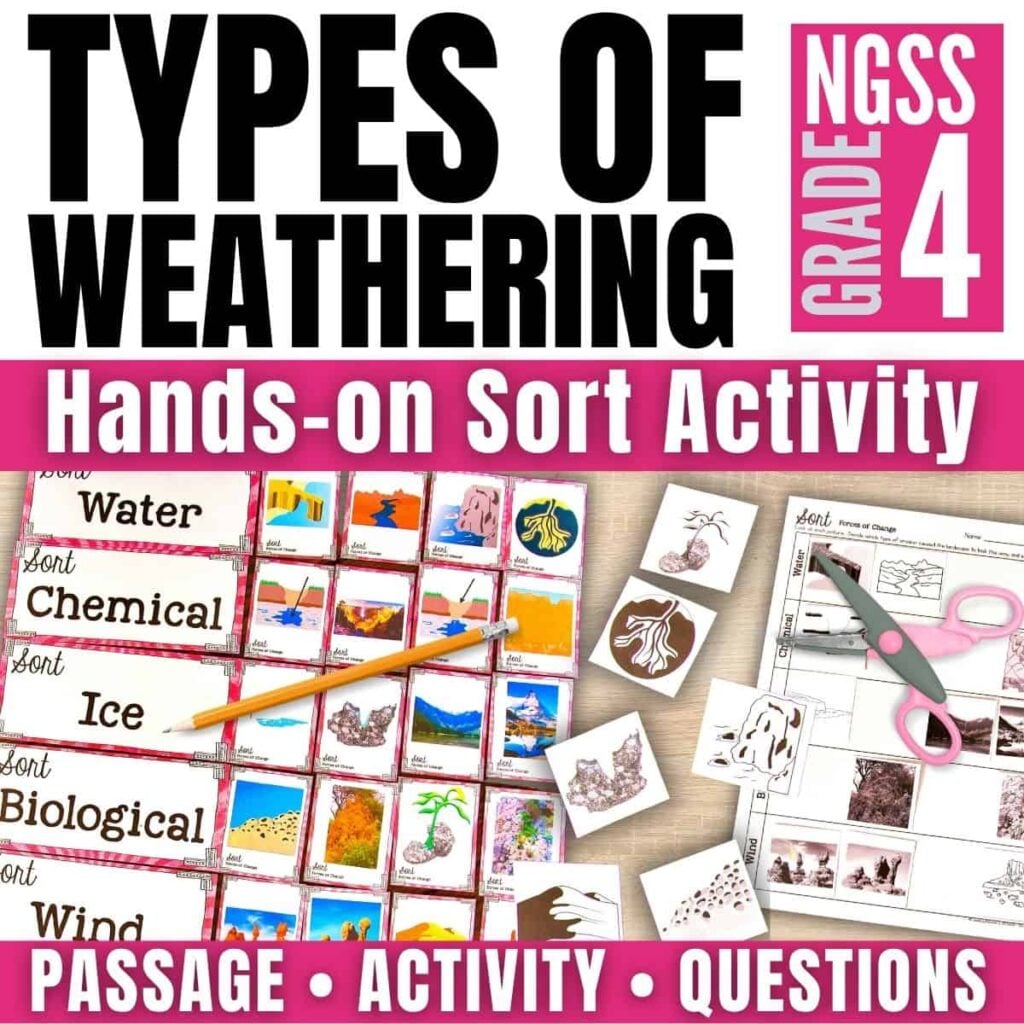
This interactive science station activity helps students explore how water, wind, ice, and living organisms shape Earth’s surface.
What is Included in the Forces of Weathering Sort Station
The sort activity includes everything you need to run it as a science station or a whole-class lesson:
- Google Slides and Google Forms versions for digital use
- A two-page informational reading passage about forces that cause weathering, erosion, and deposition — covering all five types
- Color sort cards for table groups, with images and brief descriptions on each card
- A cut-and-paste sort worksheet (black and white) for individual student work
- Differentiated response options — short answer, fill-in-the-blank (with and without a word bank), and multiple-choice task cards
- An answer key

What Students Learn About the Types of Weathering and Erosion
Before sorting, students read a two-page informational passage that introduces all five forces of change. This gives them the background knowledge they need to make accurate sorting decisions.

The passage covers:
- Weathering — when rocks are broken apart into sediments
- Erosion — when sediments are carried away by wind, water, or ice
- Deposition — when sediments are laid back down
- Water — how rivers form V-shaped valleys, canyons, and deltas; how ocean waves shape cliffs
- Ice — how glaciers carve U-shaped valleys, cirques, and horns; how ice wedging splits rocks apart
- Wind — how wind-carried sediments scrape rocks and form sand dunes
- Biological — how plant roots and animal burrows physically weather rocks
- Chemical — how oxygen turns iron to rust, and how acid dissolves limestone to form caves and sinkholes
By the time students finish the passage, they have a solid mental map of each force and what it looks like in the landscape.
The Sort: Forces of Change
After reading, students cut apart a set of picture cards showing real and illustrated landforms and sort them into five categories: Water, Ice, Wind, Biological, and Chemical.
The sort includes 20 picture cards featuring a mix of photographs and illustrations — river valleys, glacial cirques, sand dunes, termite mounds, moss-covered rocks, sinkholes, ice wedging diagrams, root pry illustrations, and more. Some images are straightforward; others require students to think carefully and apply what they read.
That’s what makes it such a valuable assessment tool. Students who truly understand the content will be able to sort confidently. Students who only partially understood the reading will get stuck — and that’s useful information for you as a teacher.
A color version of the sort is available in Google Slides for a digital option, which works great for paperless classrooms or distance learning.
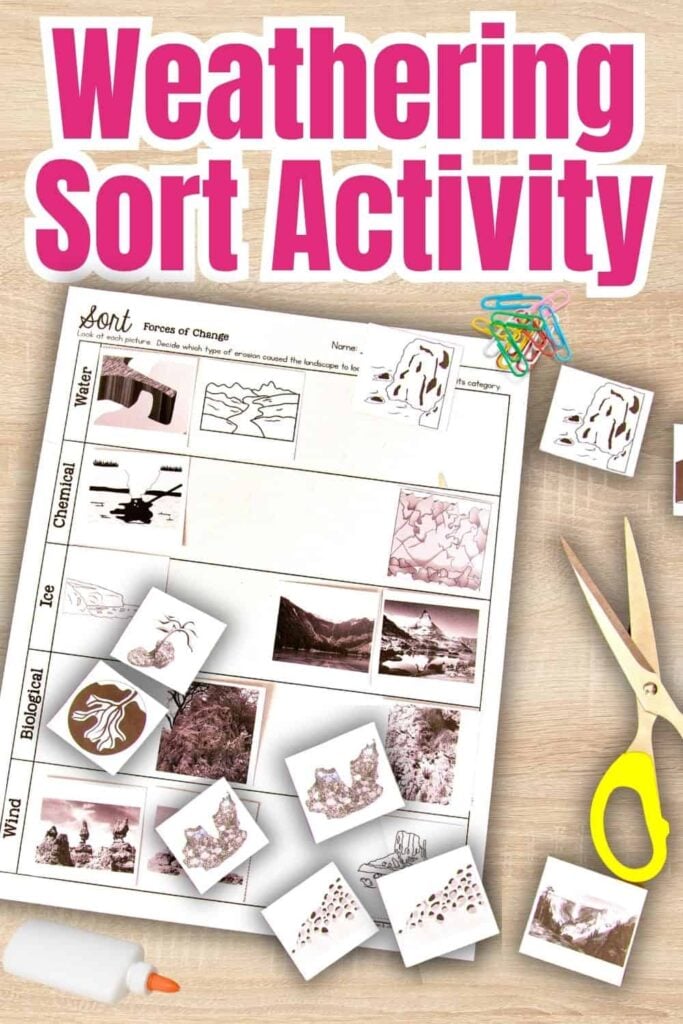
Cut and Paste Sort Option
The second way to do the sort is a cut-and-paste option. Students can do both options: sort color option as a whole group and the cut and paste option individually. Or you can choose to have students do only one option.
The cut-and-paste option is all in black and white and in a worksheet format. After reading the informational passage, students look at the sort cards and then categorize them into the correct weathering types: water, wind, ice, biological, and chemical.
Comprehension Questions
After completing the sort, students answer 8 questions that assess their understanding of all 5 types of weathering and erosion. Three differentiated formats are included to help you meet students where they are.
Short-answer questions ask students to explain each force of change in their own words. These are great for assessing depth of understanding and making strong connections to the reading passage. Questions include descriptions of how ice wedging occurs, how glaciers form different landforms, and how chemical weathering changes rocks.
Fill-in-the-blank (two versions — with and without a word bank) provides scaffolding for students who need support accessing the content. The word bank version is especially helpful for English learners or students who struggle with written expression but understand the science concepts.
Multiple-choice task cards (8 questions) work perfectly at a science station where students respond in their science journals. Each multiple-choice question mirrors the short-answer and fill-in-the-blank questions, so you can mix and match formats within the same class.

What This Looks Like in the Classroom
This sort station is flexible enough to work in several formats:
- Science station rotation — Students work in small groups, cutting and gluing the sort, then answering questions independently
- Whole-class lesson — Use the sort as a formative assessment after teaching the full unit
- Partner work — Two students sort together and discuss their reasoning before recording
- Digital option — Assign the Google Slides version through Google Classroom for a paperless experience
The station is designed to take about 20 minutes. Since the only materials needed are scissors and glue, setup is minimal compared to the hands-on investigate and model stations in the unit.
One tip: before students start sorting, have them do a quick scan of all 20 pictures first. This helps them notice patterns across the categories and makes the sorting process more intentional rather than card-by-card guessing.
Why This Activity Works So Well
1. It Requires Real Thinking
Multiple-choice and fill-in-the-blank questions can sometimes be answered without a deep understanding. Sorting can’t. Students have to connect visual evidence to conceptual knowledge — which is exactly the kind of higher-order thinking that makes learning stick.
2. It Covers All Five Types of Weathering
Many weathering activities focus primarily on physical weathering, treating chemical and biological weathering as afterthoughts. This sort gives equal weight to all five forces, giving students a more complete picture of how the Earth’s surface changes over time.
3. It Works as Both Practice and Assessment
Use it mid-unit as a check for understanding, or at the end of the unit as a review activity. The sort itself quickly tells you which categories students are confident in and which need more instruction.
4. It Hits Multiple Standards at Once
This activity connects earth science content (4-ESS1.C, 4-ESS2.A, 4-ESS2.E) with ELA reading standards (4.RI.1, 4.RI.3, 4.RI.4, 4.RI.7). Students read informational text, interpret visual information, and answer text-dependent questions — all in one station.
Easy Differentiation Ideas
For additional support:
- Use the fill-in-the-blank version with the word bank
- Pre-sort two or three cards as examples before students begin independently
- Allow students to reference the reading passage while sorting
For extension:
- Ask students to explain their reasoning for two or three of the trickiest sort cards in writing
- Have students create their own additional sort card for a category of their choice
- Connect to the bigger unit: Which types of weathering are fastest? Which is the slowest? What evidence from the pictures supports that?
NGSS Alignment
This activity aligns with the 4th Grade NGSS standard 4-ESS2-2: Make observations and/or measurements to provide evidence of the effects of weathering or the rate of erosion by water, ice, wind, or vegetation. It supports the Disciplinary Core Ideas 4-ESS2.A (Earth Materials and Systems) and 4-ESS2.E (Biogeology), as well as the Crosscutting Concept of Cause and Effect.
This interactive science station activity helps students explore how water, wind, ice, and living organisms shape Earth’s surface.
How to Purchase the Forces of Weathering Science Station
This Forces of Weathering Sort Science Station can be purchased on Teachers Pay Teachers. It is sold individually and part of a whole Sorts for Fourth Grade Science Stations. Also available is a Fourth Grade NGSS Science Station BUNDLE.
By the end of this station, students have read about all five types of weathering and erosion, applied that knowledge to real and illustrated landforms, and explained their understanding in writing. That’s a lot of meaningful learning packed into one 20-minute station.
And unlike activities where students can copy answers from the text, the sort requires them to truly internalize the differences between water, ice, wind, biological, and chemical weathering — which is exactly the conceptual understanding they need for 4th-grade earth science.
If you’re teaching the weathering and erosion unit this year, this Forces of Change sort is a great station to include near the end of your rotation when students are ready to pull everything together.
This activity is part of the Weathering & Erosion Science Stations for 4th Grade, which includes 12 stations covering physical and chemical weathering, erosion, deposition, and more.
Weathering & Erosion – Earth Materials & Systems, Biogeology BUNDLE
Weathering & Earth Materials & Systems, Biogeology Fourth Grade Next Generation Science Standards include 12 different science stations where students deepen their understanding of how weathering and erosion change the Earth’s surface.
Jessica BOschen
Jessica is a teacher, homeschool parent, and entrepreneur. She shares her passion for teaching and education on What I Have Learned. Jessica has 16 years of experience teaching elementary school and currently homeschools her two middle and high school boys. She enjoys scaffolding learning for students, focusing on helping our most challenging learners achieve success in all academic areas.