
Translucent, Transparent, and Opaque Objects Sorting Activity for 4th Grade Science
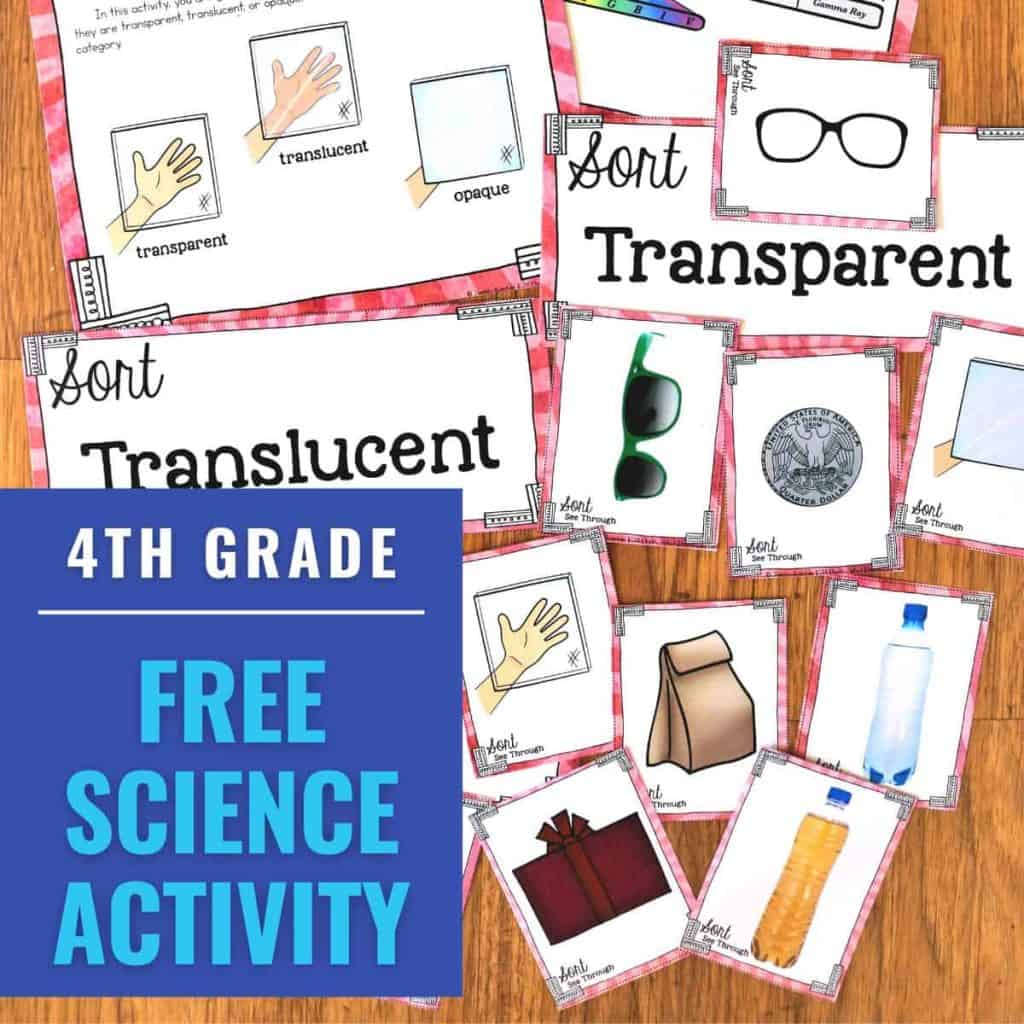
Teach students about translucent, transparent, and opaque with a Properties of Light SORT aligned with the Next Generation Science Stations for Fourth Grade. In this station, students sort objects by how much light is able to pass through them.

Light properties are part of the 4th grade waves and information transfer standards. For more on the full 4th grade physical science scope — and how light connects to the broader waves unit — see my physical science guide for elementary students.
What is Included in the Properties of Light Sort Station
Included in the Sort about the Properties of Light are:
- Larger table-group color sorting cards
- Smaller cut-and-paste sort for individual students
- Differentiated questions in short-answer, fill-in-the-blank, and multiple-choice formats. Worksheets and task cards are included for some options.
- Answer key

This SORT science activity sheds some light on transparent, translucent, and opaque objects! Your students will read an engaging science reading passage and get to sort various pictures of objects into one of three categories.
Properties of Light Sort for Table Groups
There are two ways to do this sort. One way is in table groups where students collaboratively look at the images on the cards and determine how much light passes through.

There are three different categories that students can sort each object into: translucent, transparent, and opaque. For instance, a sunflower is opaque (no light passes through), whereas a water bottle is transparent (light passes through easily).
This sort has colorful image cards that students analyze before deciding whether each object is opaque, transparent, or translucent.
Cut and Paste Sort Option
The second way to do the sort is a cut-and-paste option. Students can do both options: sort color option as a whole group and the cut and paste option individually. Or you can choose to have students do only one option.
The cut-and-paste option is all in black and white and in a worksheet format. After reading the informational passage, students look at the images and then sort them into the correct categories: translucent, transparent, or opaque.
Differentiated Responses
Like all of our science stations, differentiated responses are available for students to demonstrate their understanding. Below is an example of the Short Answer worksheet. Fill-in-the-blanks and multiple-choice task cards are also available.

How to Purchase the Properties of Light Science Station
This Properties of Light Sort Science Station can be purchased on Teachers Pay Teachers. It is sold individually and as part of a whole Sorts for Fourth Grade Science Stations. Also available is a Fourth Grade NGSS Science Station BUNDLE.
This SORT science activity sheds some light on transparent, translucent, and opaque objects! Your students will read an engaging science reading passage and get to sort various pictures of objects into one of three categories.
Jessica BOschen
Jessica is a teacher, homeschool parent, and entrepreneur. She shares her passion for teaching and education on What I Have Learned. Jessica has 16 years of experience teaching elementary school and currently homeschools her two middle and high school boys. She enjoys scaffolding learning for students, focusing on helping our most challenging learners achieve success in all academic areas.