
R-Controlled Vowels Word Lists: AR, OR, ER, IR, and UR Words for Phonics
R-controlled vowels are a key phonics pattern students must master to read accurately. When a vowel is followed by r, the vowel sound changes, and students can no longer rely on typical long- or short-vowel rules. R-controlled vowels, sometimes called bossy r or r-influenced vowels, contain a vowel followed by r, which changes how the vowel sounds.
Clear, organized word lists help students recognize these patterns, practice decoding, and apply the correct vowel sound consistently in reading and spelling.
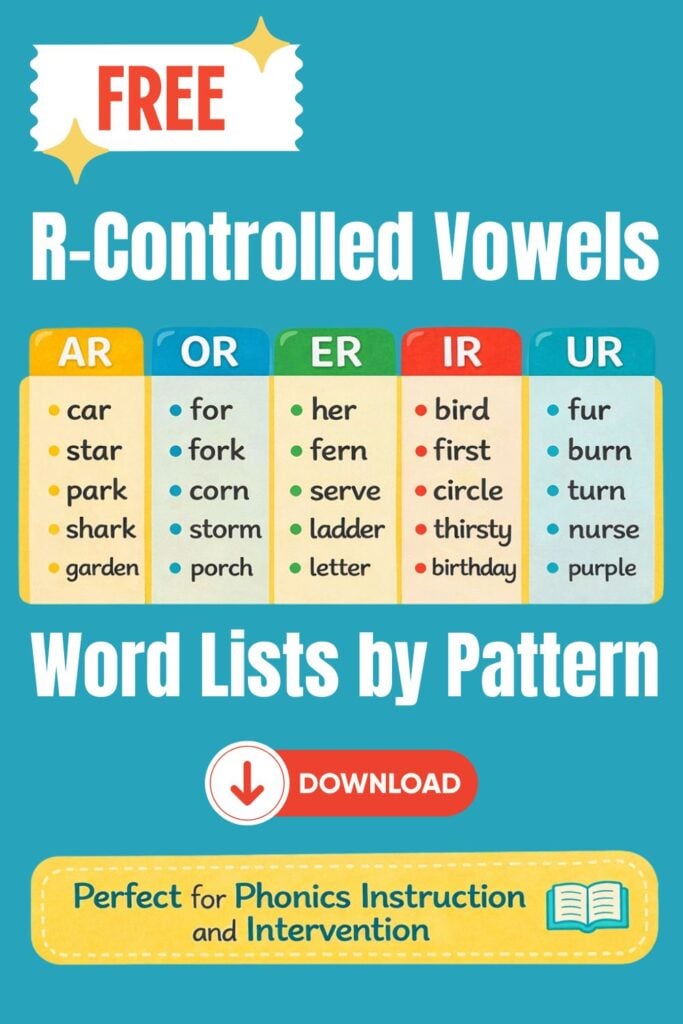
This post focuses on r-controlled vowel word lists and word selection, not on introducing the r-controlled vowel concept itself. Below is a list of r-controlled words organized by pattern to support phonics instruction, decoding practice, and intervention.
What Are R-Controlled Words?
R-controlled words contain a vowel followed by r, which changes the vowel sound. If you’re looking for a full explanation of how r-controlled vowels work and why students struggle with them, start there.
R-Controlled Word Lists by Pattern
Grouping words by pattern helps students notice similarities, hear consistent vowel sounds, and reduce confusion when reading and spelling.
AR Word List
The AR pattern is typically introduced in the first half of first grade and is often the first r-controlled vowel students master because the sound is distinct and consistent.
- One-syllable: car, star, far, jar, bar, barn, farm, yard, card, hard, dark, park, bark, arm, arc
- Two-syllable: garden, market, carpet, artist, harvest, garlic, marble, carton, barking, cartoon
- Multisyllabic: departure, apartment, regardless, remarkable, particular
OR Word List
OR is commonly taught shortly after AR. The sound is generally consistent across common words, though words like “word” and “work” are exceptions worth noting separately.
- One-syllable: for, or, corn, fork, born, worn, port, sort, cord, storm, porch, horn, form, north, sport
- Two-syllable: corner, morning, forget, orbit, report, border, forest, forty, portal, absorb
- Multisyllabic: important, enormous, performance, opportunity, territorial
ER Word List
ER, IR, and UR patterns share the same /er/ sound and are best taught together so students understand the sound is consistent even when the spelling varies. Most scope-and-sequence programs introduce them in late first grade or early second grade.
- One-syllable: her, fern, term, verb, herd, stern, serve, nerve, germ, merge
- Two-syllable: teacher, winter, farmer, letter, enter, sister, river, cover, under, offer
- Multisyllabic: whenever, remember, together, however, messenger
IR Word List
The ir pattern shares the same vowel sound as er and ur in most words.
- One-syllable: bird, shirt, first, girl, third, firm, sir, stir, birth, dirk
- Two-syllable: circle, birthday, circus, dirty, thirty, birches, confirm, thirsty, stirring, girdle
- Multisyllabic: director, confirm, birthday (note for teachers: IR multisyllabic words are less common — connect to the ER/IR/UR teaching point)
UR Word List
The ur pattern completes the ER–IR–UR group and should be taught alongside the other two.
- One-syllable: fur, turn, hurt, burn, curl, church, purse, nurse, surf, lurk
- Two-syllable: turtle, purple, surface, return, curtain, burden, turkey, suburb, murmur, disturb
- Multisyllabic: furthermore, furniture, Saturday, curriculum, supernatural
Using R-Controlled Word Lists in the Classroom
R-controlled word lists can be used in a variety of instructional settings, including:
- Blending and segmenting practice
- Word sorting by vowel pattern
- Dictation and spelling practice
- Fluency drills using phrases or sentences
- Small-group or intervention instruction
Students benefit from repeated exposure to the same patterns across multiple days and activities.
How to Select R-Controlled Words for Instruction
Not all r-controlled words are equally complex. Selecting words intentionally helps students build skill without becoming overwhelmed.
When choosing r-controlled vowel words for instruction, consider the following factors:
1. Start with One-Syllable Words
Begin with simple, one-syllable words that contain only the r-controlled pattern:
- car
- bird
- corn
- fur
These allow students to isolate and master the vowel sound before adding additional phonics complexity.
2. Avoid Stacked Patterns Too Early
Some r-controlled words contain multiple phonics patterns. For example:
- shark (r-controlled + consonant digraph)
- storm (r-controlled + consonant blend)
- surface (r-controlled + syllable division + VCE)
Introducing too many patterns at once can cause students to focus on everything except the r-controlled vowel.
When first teaching the pattern, choose words that contain:
- One vowel
- Minimal blends or digraphs
- Simple consonant-vowel-consonant structures (when possible)
Our R-Controlled Blending Cards are set up to help students specifically focus on the r-controlled vowel pattern.
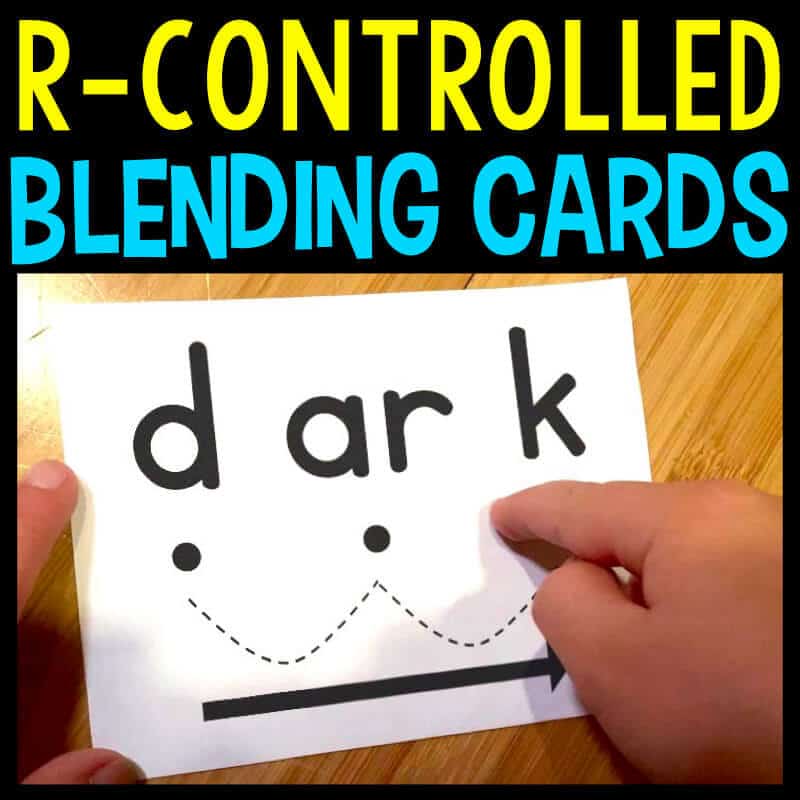
R-Controlled Vowels Blending Cards
Blending Cards for R-Controlled Vowels include words common for Kindergarten and first-grade reading.
3. Gradually Increase Phonics Complexity
Once students can decode single-syllable r-controlled words automatically, increase complexity by introducing:
- Initial blends (storm, smart)
- Digraphs (shark, chart)
- Two-syllable words (market, teacher, corner)
- Multisyllabic words with affixes (farmer, return, birthday)
At this stage, students must:
- Recognize the r-controlled vowel
- Identify syllable boundaries
- Blend syllables accurately
This shifts instruction from simple pattern recognition to multisyllabic decoding.
Our R-Controlled Phonics Worksheets increase the complexity. Students practice single-syllable r-controlled vowels with a variety of phonics patterns.

R-Controlled Vowels Phonics Worksheets & Activities No-Prep Phonics Worksheets
These R-Controlled Vowel Phonics Worksheets are perfect for your first-grade or second-grade phonics word work centers. They focus on words with r-controlled vowel sounds such as AR, IR, OR, UR, and ER and include 99 NO PREP printables to practice words and sentences with r-controlled vowels.
4. Be Strategic with ER, IR, and UR
Because ER, IR, and UR often make the same sound, spelling becomes more challenging than decoding.
To support spelling:
- Teach these patterns together
- Compare words visually
- Use word sorts to highlight differences
- Provide repeated dictation practice
This reduces reliance on guessing and builds orthographic mapping over time.
5. Include High-Frequency Multisyllabic Words
R-controlled vowels frequently appear in grade-level vocabulary. Words like:
- teacher
- corner
- birthday
- surface
- farmer
should be practiced within connected text, not just in isolation.
As students move into upper elementary grades, r-controlled vowels become part of more complex words. Word selection should reflect that shift.
R-Controlled Words in Multisyllabic Decoding
Many multisyllabic words contain r-controlled vowels within one of their syllables. Students must recognize the r-controlled vowel pattern before blending the word.
Examples include:
- market
- teacher
- corner
- birthday
- surface
For instructional routines that support decoding longer words, see this post on multisyllabic decoding strategies.
Our Open and Closed Syllables resource has many r-controlled vowels in simple, two-syllable words.

Open and Closed Syllables Two-Syllable Words
This unit focuses on syllabic patterns for VCCV, VCV, VCCCV. Included are some consonant digraphs and blends, as well as some VCE patterns in one of the syllables. This unit is perfect for students who know how to read cvc and vce words, but struggle with two-syllable decoding.
R-Controlled Vowels Activities and Practice Resources
Structured practice helps students apply r-controlled vowel patterns during reading. Hands-on activities such as word sorts, blending activities, and targeted phonics practice give students repeated opportunities to decode r-controlled words accurately and confidently.
Recommended Products

Download a List of R-Controlled Vowels
Below is a list of simple r-controlled vowels appropriate for first and second-grade classrooms. This list is a great starting point for teaching this concept.
Why Organized Word Lists Matter
R-controlled vowels appear frequently in grade-level text and are not easily decoded without explicit instruction. Organized word lists reduce cognitive load and allow students to focus on pattern recognition rather than guessing.
With consistent practice, students learn to approach r-controlled words strategically, supporting accuracy, fluency, and spelling over time.
Jessica BOschen
Jessica is a teacher, homeschool parent, and entrepreneur. She shares her passion for teaching and education on What I Have Learned. Jessica has 16 years of experience teaching elementary school and currently homeschools her two middle and high school boys. She enjoys scaffolding learning for students, focusing on helping our most challenging learners achieve success in all academic areas.